
AnimaliaNot EvaluatedacceptedspeciesAccepted
Chrysopetalum maculata
Aguado, Capa & San Martin, 2003
GBIF:154498666
0year
ABOUT
Descriptions(5)
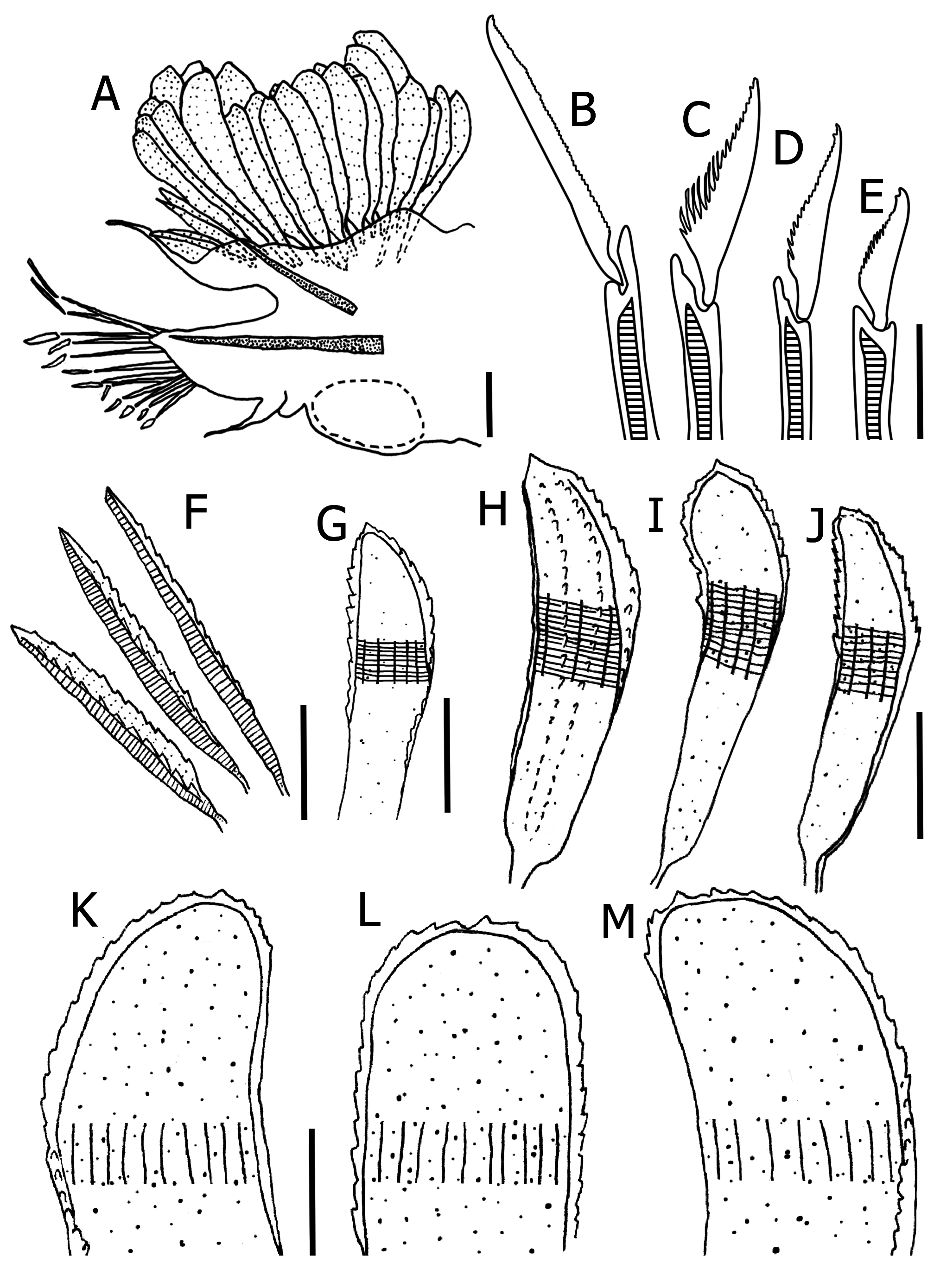
(Figures 6 A – M, 8, 14 G, 15 D)
Cruz-Gómez, Christopher, Bastida-Zavala, J. Rolando (2018): Chrysopetalids (Phyllodocida: Chrysopetalidae) from the southern Mexican Pacific, including a new species. Zootaxa 4521 (1): 61-88, DOI: 10.11646/zootaxa.4521.1.3
Description. Based on two complete specimens, largest 2.3 mm long, 0.8 mm wide, 36 segments. Body broad and fragile. Body pale yellow dorsally, whitish ventrally. Paleae fans yellow to golden, slightly interlocking over dorsum. Prostomium rounded and completely visible among the first three segments. Two lateral subulate antennae; a small median antenna inserted in front of two pairs of eyes; another specimen lacks median antenna. Two pairs of reddish eyes, first pair larger than second. Nuchal fold smaller than prostomium. Two large palps, visible under lateral antennae. Mouth fold small and semicircular, located between third and fourth segment. Eversible proboscis with two slim stylets. Parapodium from the 16 th segment. Notochaetae separated in three main groups and one subgroup (Fig. 6 A). Lateral group inserted just over notoaciculum; comprising 2 – 3 slender and spine-like paleae with two ribs and one raised rib (Fig. 6 F). As subunit 1, one symmetrical palea with 7 – 8 ribs (Fig. 6 G). Main group, comprising 16 – 20 slightly wide, symmetrical and asymmetrical paleae (the most central paleae are symmetrical, while the most lateral and near-median paleae are asymmetrical) with 9 – 12 ribs (Figs 6 K – M). Paleae in this group show two different lengths; the six most lateral paleae being the largest and the 10 - 14 proximal-median paleae, the shortest. Median group, comprising 2 – 4 asymmetrical and curved paleae with 4 – 7 ribs and 0 – 2 raised rib (Figs 6 H – J). Neuropodium large and conical. Heterogomph neurochaetae composed of four groups (Figs 6 B – E). Neurochaetiger with 1 – 2 superior spinigers with a serrated straight blade. In the first three segments neurochaetiger composed of superior spinigers only. Mid-superior group with four falcigers with medium length blades (3 / 4 of spiniger blade length) and serration basally. Mid-inferior group with 5 – 6 falcigers with medium length blades (3 / 4 of spiniger blade length) and serration basally. Inferior group of 3 – 4 falcigers, with short blade (1 / 4 of spiniger blade length) and weak serration basally. Pygidium rounded with two anal cirri. Habitat. Intertidal to subtidal (0 – 10 m). The specimens examined were not found in the same substrata reported in Panama; coarse sand (Aguado et al. 2003), but in dead coral.
Cruz-Gómez, Christopher, Bastida-Zavala, J. Rolando (2018): Chrysopetalids (Phyllodocida: Chrysopetalidae) from the southern Mexican Pacific, including a new species. Zootaxa 4521 (1): 61-88, DOI: 10.11646/zootaxa.4521.1.3
Remarks. The examined material agrees with the description of Aguado et al. (2003).
Cruz-Gómez, Christopher, Bastida-Zavala, J. Rolando (2018): Chrysopetalids (Phyllodocida: Chrysopetalidae) from the southern Mexican Pacific, including a new species. Zootaxa 4521 (1): 61-88, DOI: 10.11646/zootaxa.4521.1.3
Distribution. Tropical Eastern Pacific, from La Ropa Beach, Zihuatanejo, Guerrero, to Bajo Mali Rock, coast of Panama (Aguado et al. 2003) (Fig. 8).
Cruz-Gómez, Christopher, Bastida-Zavala, J. Rolando (2018): Chrysopetalids (Phyllodocida: Chrysopetalidae) from the southern Mexican Pacific, including a new species. Zootaxa 4521 (1): 61-88, DOI: 10.11646/zootaxa.4521.1.3
Material examined. Guerrero: UMAR-Poly 887, one spec. (La Roqueta Island, Acapulco, 16 ° 49 ’ 21 ’’ N 99 ° 54 ’ 29 ’’ W, 0 – 4 m, September 21, 2007, coll. M. S. García-Madrigal); UMAR-Poly 888, one spec. (La Ropa Beach, 17 ° 37 ’ 37 ’’ N, 101 ° 32 ’ 46 ’’ W, on rocks, 0.5 m, September 19, 2007, coll. M. S. García-Madrigal).
Cruz-Gómez, Christopher, Bastida-Zavala, J. Rolando (2018): Chrysopetalids (Phyllodocida: Chrysopetalidae) from the southern Mexican Pacific, including a new species. Zootaxa 4521 (1): 61-88, DOI: 10.11646/zootaxa.4521.1.3
Export occurrence data
Darwin Core Archive (ZIP)
CLASSIFICATION
Taxonomic Classification Tree

MULTIMEDIA
Media Files(2)
FIGURE 6. Chrysopetalum maculata. A, parapodium middle segment; B–E, neurochaetal types; F, lateral paleae; G, subunit 1 palea; H–J, median paleae group; K–M, different shape of main palea. Scale bars: 30 µm (BCDE), 50 µm (FGHIJKLM), 200 µm (A).
Imageimage/png© Cruz-Gómez, Christopher;Bastida-Zavala, J. RolandoCruz-Gómez, Christopher;Bastida-Zavala, J. Rolando
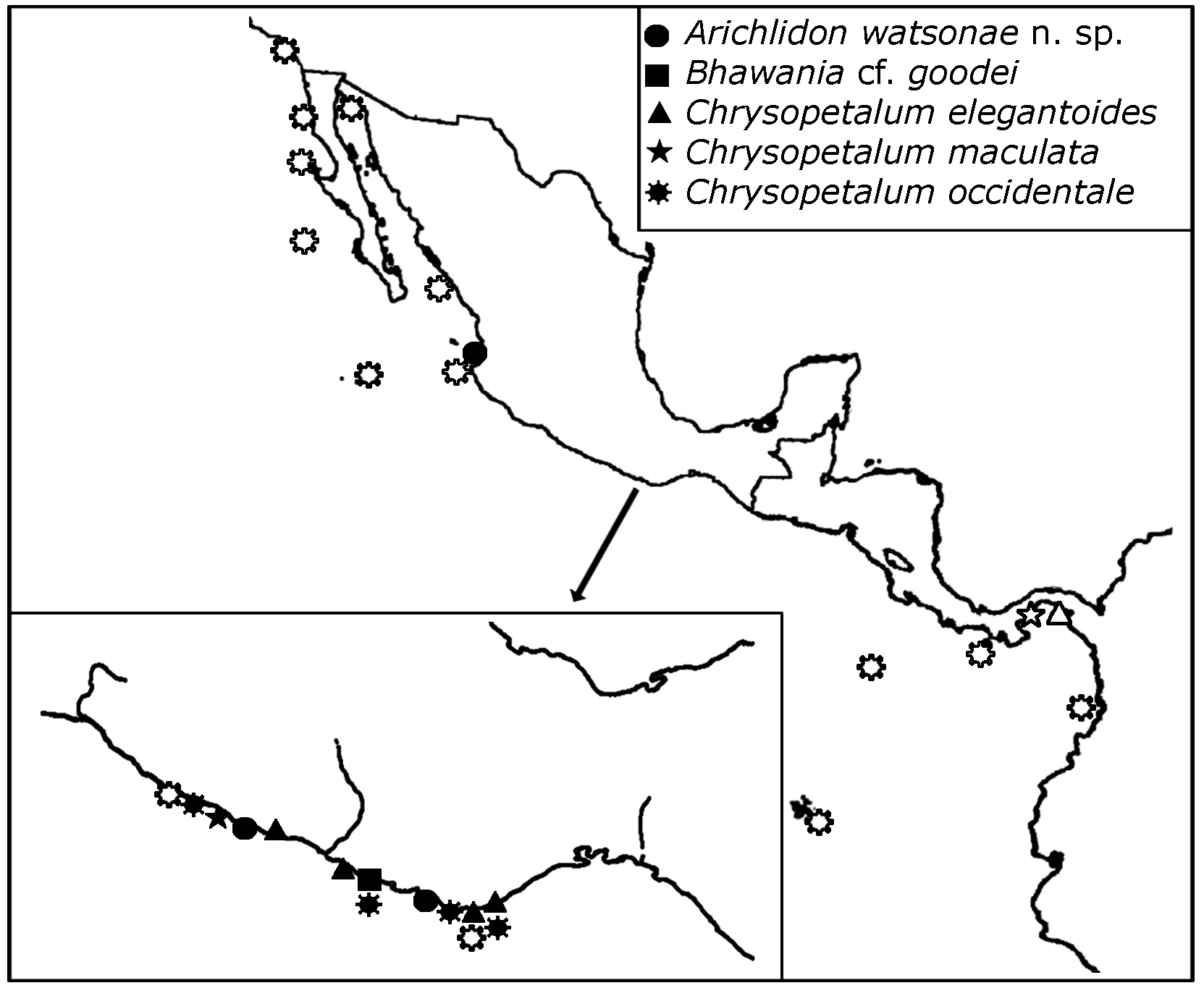
FIGURE 8. Historical and new records of Arichlidon watsonae n. sp., Bhawania cf. goodei, Chrysopetalum elegantoides, C. maculata and C. occidentale in the Tropical Eastern Pacific. Empty symbols indicate previous records.
Imageimage/png© Cruz-Gómez, Christopher;Bastida-Zavala, J. RolandoCruz-Gómez, Christopher;Bastida-Zavala, J. Rolando
IMAGES