AnimaliaNot EvaluatedacceptedspeciesAccepted
Chrysopetalum elegantoides

Chrysopetalum elegantoides

Aguado, Capa & San Martin, 2003

GBIF:154498667

0year

ABOUT

Descriptions(5)

(Figures 4 A – J, 5, 8, 14 F, 15 C)
Cruz-Gómez, Christopher, Bastida-Zavala, J. Rolando (2018): Chrysopetalids (Phyllodocida: Chrysopetalidae) from the southern Mexican Pacific, including a new species. Zootaxa 4521 (1): 61-88, DOI: 10.11646/zootaxa.4521.1.3

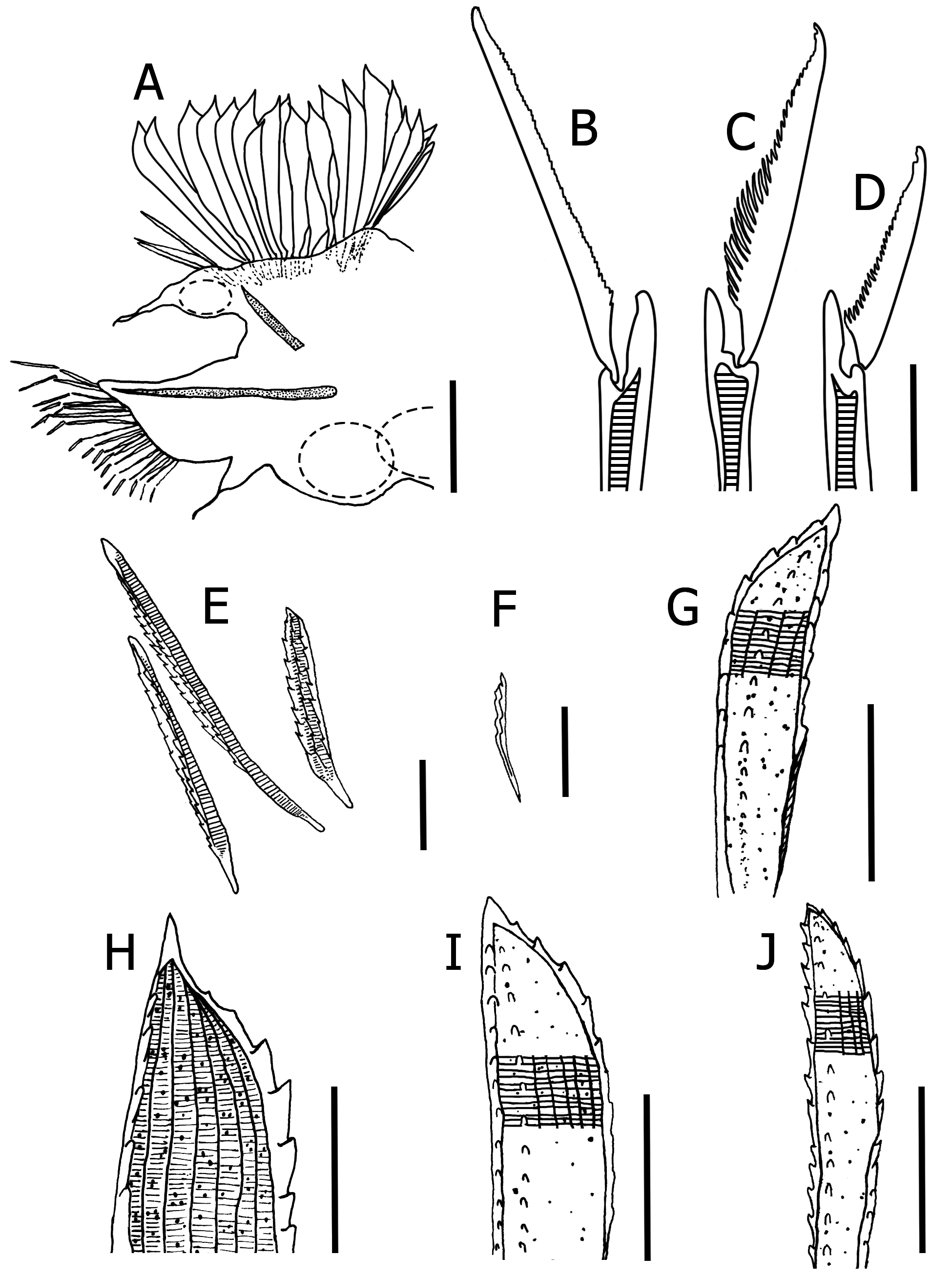
Description. Based mainly on the largest complete specimen, 8.7 mm long, 1.3 mm wide, 68 segments. Body rectangular and wide in the most anterior segments. Body yellow to orange. Paleae fans yellow and iridescent, slightly imbricated over dorsum. Prostomium rounded and completely visible among the first four segments. Two lateral subulate antennae; a small median antenna inserted between two pairs of eyes. Two pairs of reddish eyes, first pair slightly larger than second pair. Nuchal fold smaller than prostomium. Two pear-shaped palps, visible under the lateral antennae. Small and subtriangular mouth fold between third and fourth segment. Eversible proboscis with two slim stylet. Parapodium from the tenth segment. Notochaetae separate in three main groups and two subgroups (Fig. 4 A). Lateral group inserted over the dorsal notoaciculum, comprising 3 – 6 slender and symmetrical paleae with 2 – 5 ribs and one raised rib (Fig. 4 E); over dorsal cirrus 3 – 5 small and slender spines (Fig. 4 F). As sub-unit 1, 1 – 2 asymmetrical and serrated paleae with 6 – 7 ribs and one raised rib (Fig. 4 G). Main group, comprising 12 – 15 asymmetrical and strongly serrated paleae with 5 – 7 raised ribs (Fig. 4 H). As sub-unit 2, three larger paleae (1 / 4 larger than main paleae) with 6 – 7 ribs and one raised rib (Fig. 4 I). Median group, comprising 3 – 4 symmetrical and spine-like paleae, slightly smaller than main paleae with 4 – 5 ribs and 1 raised rib (Fig. 4 J). The serration on all paleae groups is present in both lateral margins of each palea, in main and median group the serration is more marked only in one side margin. Neuropodium large and leaf-shape. Heterogomph neurochaetae composed of three groups (Figs 4 B – D). Neurochaetiger with 1 – 3 superior spinigers with a serrated straight blade. First three segments neurochaetaewith superior spinigers only. Mid-superior group and mid-inferior group indistinguishable, composed of 13 – 16 falcigers with medium and toothed blades (1 / 2 of spiniger blade length). Inferior group of 3 – 4 falcigers with short and serrated blades (1 / 4 of spiniger blade length). Pygidium rounded, with two anal cirri. Habitat. Intertidal to subtidal (0.5 – 11.7 m). Collected from sponges, pier pilings, as epibionts of mollusks, in dead coral and rocks.
Cruz-Gómez, Christopher, Bastida-Zavala, J. Rolando (2018): Chrysopetalids (Phyllodocida: Chrysopetalidae) from the southern Mexican Pacific, including a new species. Zootaxa 4521 (1): 61-88, DOI: 10.11646/zootaxa.4521.1.3
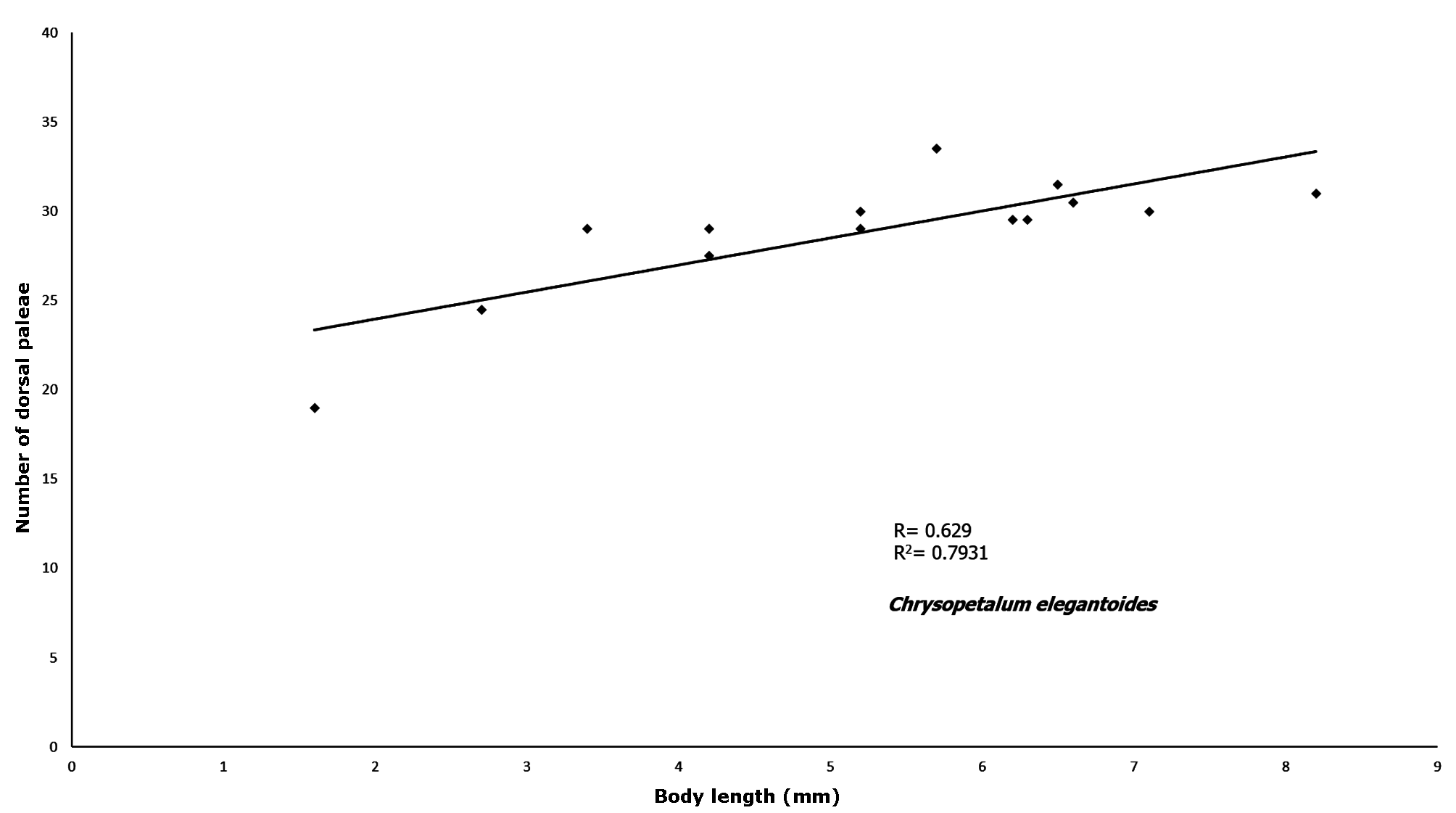
Remarks. Chrysopetalum elegantoides was described from the Pacific coast of Panama. The specimens from Oaxaca accord with the description by Aguado et al. (2003). Nevertheless, we noticed possible intraspecific differences in the number of dorsal paleae. For comparison purposes, 14 complete specimens of Chrysopetalum elegantoides Aguado, Capa & San Martín, 2003, were measured: total length and total number of dorsal paleae from the 15 th segment. An average was obtained from the number of paleae from the left and the right bundles, assuming that descriptions of chrysopetalids paleae are based on the number of paleae of these bundles. Through statistical analysis we confirmed that variability in the number of paleae is size related, showing a direct association of 79 % (t cal = 4.51, t 0.05 (12) = 1.79; p <0.05) (Fig. 5).
Cruz-Gómez, Christopher, Bastida-Zavala, J. Rolando (2018): Chrysopetalids (Phyllodocida: Chrysopetalidae) from the southern Mexican Pacific, including a new species. Zootaxa 4521 (1): 61-88, DOI: 10.11646/zootaxa.4521.1.3
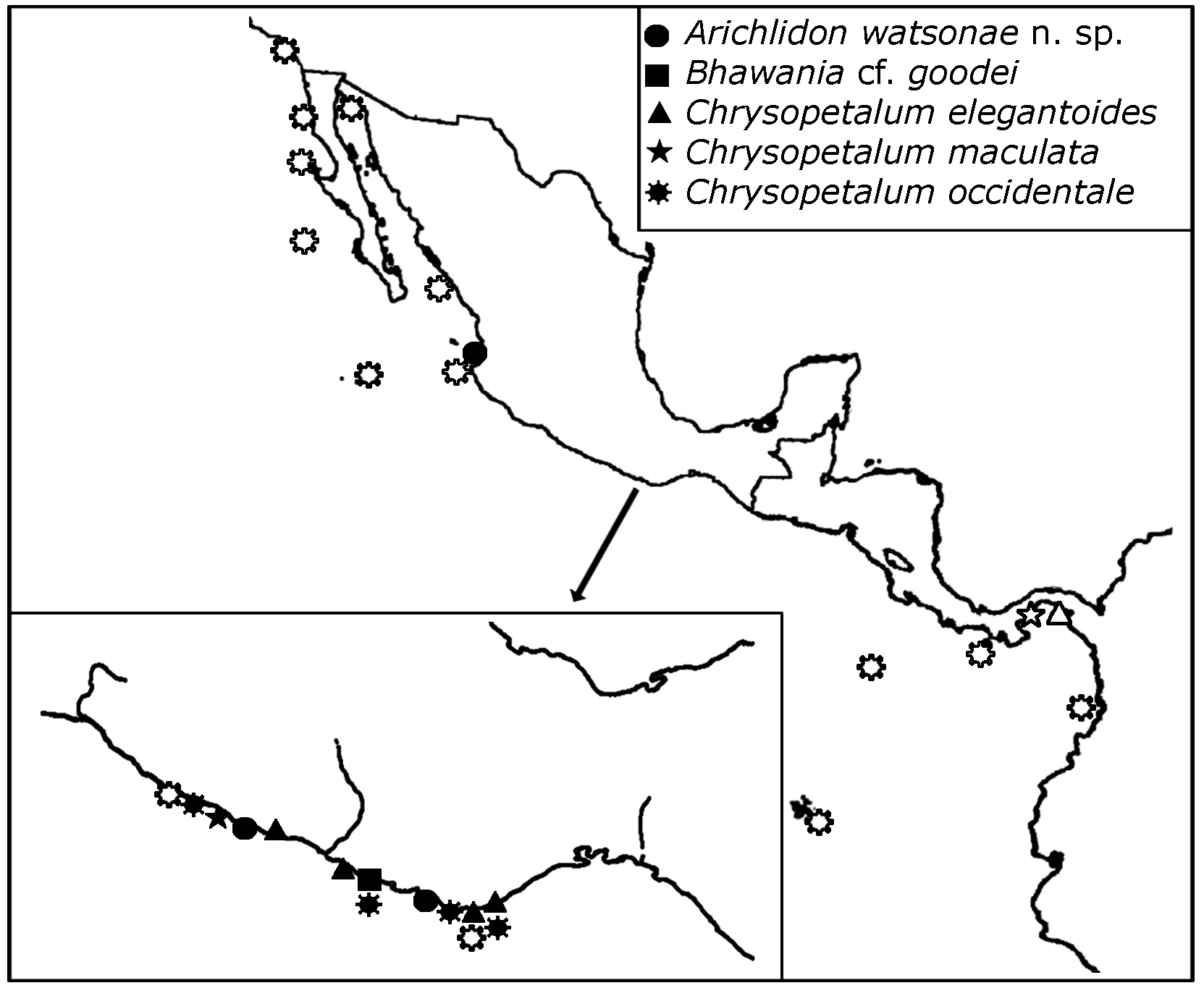
Distribution. Central Pacific of America, from Ixtapa, Guerrero, to Uvas Island, coast of Panama (Aguado et al. 2003) (Fig. 8).
Cruz-Gómez, Christopher, Bastida-Zavala, J. Rolando (2018): Chrysopetalids (Phyllodocida: Chrysopetalidae) from the southern Mexican Pacific, including a new species. Zootaxa 4521 (1): 61-88, DOI: 10.11646/zootaxa.4521.1.3
Material examined. Guerrero: ECOSUR-P 2939, five spec. (La Quebrada, Acapulco, 16 ° 50 ’ 47 ’’ N, 99 ° 54 ’ 55 ’’ W, on Pinctada mazatlanica (Hanley, 1856), 6 m, May 25, 2000, coll. A. Medina); ECOSUR-P 2940, one spec. (Los Cantiles, Acapulco, 16 ° 50 ’ 45 ’’ N, 99 ° 54 ’ 55 ’’ W, on bivalve shells, 8 m, May 26, 2000, coll. A. Medina); UMAR- Poly 856, five spec. (Coral Beach, Ixtapa, 17 ° 40 ’ 36 ’’ N, 101 ° 39 ’ 22 ’’ W, on dead coral, 4 m, September 19, 2007, coll. M. S García-Madrigal); UMAR-Poly 857, one spec. (La Ropa Beach, 17 ° 37 ’ 37 ’’ N, 101 ° 32 ’ 46 ’’ W, rocks, 0.5 m, September 19, 2007, coll. M. S. García-Madrigal); UMAR-Poly 858, four spec. (Manzanillo Beach, 16 ° 50 ’ 31 ’ N, 99 ° 54 ’ 37 ’’ W, on sponge from pier piling, 4 m, September 21, 2007, coll. M. S. García-Madrigal); UMAR-Poly 859, two spec. (La Quebrada, Acapulco, 16 ° 50 ’ 45 ’’ N, 99 ° 54 ’ 55 ’’ W, September 21, 2007, coll. M. S. García-Madrigal); UMAR-Poly 860, four spec. (La Roqueta Island, Acapulco, 16 ° 49 ’ 21 ’’ N, 99 ° 54 ’ 29 ’’ W, 0 – 4 m, September 21, 2007, coll. M. S. García-Madrigal); UMAR-Poly 861, one spec. (Zacatoso, 17 ° 03 ’ 46 ’’ N, 100 ° 19 ’ 46 ’’ W, on stony coral, 9.1 m, December 1, 2010, coll. S. D. Güenduláin); UMAR-Poly 862, one spec. (Caleta de Chón, 17 ° 36 ’ 49 ’’ N, 101 ° 33 ’ 18 ’’ W, on stony coral, 4.3 – 6.1 m, December 2, 2010, coll. S. D. Güenduláin); UMAR-Poly 863, three spec. (Morros de Potosí, 17 ° 38 ’ 49 ’’ N, 101 ° 37 ’ 44 ’’ W, on Pocillopora damicornis (Linnaeus, 1758), 6.1 – 11.7 m, December 3, 2010, coll. S. D. Güenduláin); UMAR-Poly 864, two spec. (Morros de Potosí, 17 ° 38 ’ 49 ’’ N, 101 ° 37 ’ 44 ’’ W, on P. damicornis, 11.7 m, December 7, 2010, coll. S. D. Güenduláin & R. N.); Oaxaca: ECOSUR-P 0339, one spec. (Tangolunda Bay, Huatulco, 15 ° 46 ’ 20 ’’ N, 96 ° 05 ’ 49 ’’ W, on coral, April 1, 1986, coll. G. Sandoval); UMAR-Poly 865, three spec. (El Arrocito Beach, 15 ° 45 ’ 38 ’’ N, 96 ° 06 ’ 00 ’’ W, on dead coral, 3 m, May 25, 2000, coll. J. R. Bastida- Zavala); UMAR-Poly 866, six spec. (Estacahuite Bay, 15 ° 40 ’ 05 ’’ N, 96 ° 28 ’ 56 ’’ W, dead coral, 3 m, April 9, 2005, coll. J. R. Bastida-Zavala et al.); UMAR-Poly 867, three spec. (La Tijera, 15 ° 41 ’ 14 ’’ N, 96 ° 26 ’ 34 ’’ W, on dead coral, 3 m, April 30, 2005, coll. J. R. Bastida-Zavala); UMAR-Poly 868, one spec. (Estacahuite Bay, 15 ° 40 ’ 05 ’’ N, 96 ° 28 ’ 56 ’’ W, on rocks, 3 m, July 30, 2005, coll. G. Ruíz-Cancino); UMAR-Poly 869, five spec. (Estacahuite Bay, 15 ° 40 ’ 05 ’’ N, 96 ° 28 ’ 56 ’’ W, on dead coral, 1 m, September 10, 2005, coll. J. R. Bastida-Zavala et al.); UMAR-Poly 870, four spec. (Estacahuite Bay, 15 ° 40 ’ 05 ’’ N, 96 ° 28 ’ 56 ’’ W, on rocks, 3 m, August 25, 2006, coll. J. R. Bastida-Zavala et al.); UMAR-Poly 871, thirty eight spec. (La Tijera, 15 ° 41 ’ 14 ’’ N, 96 ° 26 ’ 34 ’’ W, on dead coral, 2 – 4 m, September 12, 2006, coll. J. R. Bastida-Zavala); UMAR-Poly 872, sixteen spec. (Estacahuite Bay, 15 ° 40 ’ 05 ’’ N, 96 ° 28 ’ 56 ’’ W, 4 m, December 1, 2006, coll. M. S. García-Madrigal); UMAR-Poly 873, one spec. (mouth of Corralero Lagoon, 16 ° 14 ’ 11 ’’ N, 98 ° 11 ’ 36 ’’ W, on sabellariid tubes, 1 m, December 8, 2006, coll. J. R. Bastida-Zavala et al.); UMAR-Poly 874, one spec. (Panteón Beach, 15 ° 39 ’ 50 ’’ N, 96 ° 29 ’ 43 ’’ W, on dead coral, March 31, 2007, coll. Y. Solís & P. Maza); UMAR-Poly 875, two spec. (main pier, Puerto Ángel, 15 ° 39 ’ 55 ’’ N, 96 ° 29 ’ 28 ’’ W, on dock pilings, 0.5 m, May 20, 2007, coll. F. Cortés-Carrasco); UMAR-Poly 876, one spec. (El Arrocito Beach, 15 ° 45 ’ 38 ’’ N, 96 ° 06 ’ 00 ’’ W, July 4, 2007, coll. B. Martínez et al.); UMAR-Poly 877, one spec. (Chacahua Lagoon, 15 ° 58 ’ 07 ’’ N, 97 ° 41 ’ 01 ’’ W, on rocks, intertidal, November 10, 2007, coll. P. Hernández); UMAR-Poly 878, two spec. (Chacahua Lagoon, 15 ° 58 ’ 07 ’’ N, 97 ° 41 ’ 01 ’’ W, on sabellariid colony, 0.5 m, April 3, 2008, coll. J. Jarquín); UMAR-Poly 879, one spec. (Chacahua Lagoon, 15 ° 58 ’ 07 ’’ N, 97 ° 41 ’ 01 ’’ W, on artificial mount, April 3, 2008, coll. J. Jarquín); UMAR-Poly 880, two spec. (La Tijera, 15 ° 41 ’ 14 ’’ N, 96 ° 26 ’ 34 ’’ W, on dead coral, 3 m, April 17, 2009, coll. F. Cortés-Carrasco); UMAR-Poly 881, six spec. (Montosa Island, 15 ° 45 ’ 52 ’’ N, 96 ° 05 ’ 04 ’’ W, on Pocillopora damicornis, 2.7 – 5.8 m, February 22, 2010, coll. R. Granja-Fernández & S. D. Güenduláin); UMAR-Poly 882, two spec. (San Agustín Bay, 15 ° 41 ’ 23 ’’ N, 96 ° 14 ’ 05 ’’ W, on P. damicornis, 3.3 – 6.4 m, February 23, 2010, coll. R. Granja-Fernández & S. D. Güenduláin); UMAR-Poly 883, six spec. (Estacahuite Bay, 15 ° 40 ’ 05 ’’ N, 96 ° 28 ’ 56 ’’ W, on P. damicornis, 6.4 – 9.7 m, March 26, 2010, coll. A. López- Pérez & R. Zepeta); UMAR-Poly 884, four spec. (Salchi, 15 ° 40 ’ 05 ’’ N, 96 ° 28 ’ 56 ’’ W, stony coral, 6.1 – 7.9 m, March 26, 2010, coll. A. López-Pérez); UMAR-Poly 885, three spec. (Mazunte, 15 ° 39 ’ 42 ’’ N, 96 ° 33 ’ 21 ’’ W, on stony coral, 4.5 m, June 3, 2010); UMAR-Poly 886, six spec. (Mazunte, 15 ° 39 ’ 42 ’’ N, 96 ° 33 ’ 21 ’’ W, on P. damicornis, 7.5 m, August 11, 2010, coll. A. López-Pérez & R. Zepeta).
Cruz-Gómez, Christopher, Bastida-Zavala, J. Rolando (2018): Chrysopetalids (Phyllodocida: Chrysopetalidae) from the southern Mexican Pacific, including a new species. Zootaxa 4521 (1): 61-88, DOI: 10.11646/zootaxa.4521.1.3

Export occurrence data

Darwin Core Archive (ZIP)

CLASSIFICATION

Taxonomic Classification Tree

MULTIMEDIA

Media Files(3)

FIGURE 4. Chrysopetalum elegantoides. A, parapodium middle segment; B–D, neurochaetal types; E, lateral paleae; F, spine G, subunit 1 palea; H, final tip of main palea; I, subunit 2 palea; J, median palea. Scale bars: 20 µm (HIJ), 30 µm (BCD) 50 µm (EFG), 200 µm (A).

Imageimage/png© Cruz-Gómez, Christopher;Bastida-Zavala, J. RolandoCruz-Gómez, Christopher;Bastida-Zavala, J. Rolando

FIGURE 5. Exploratory analysis of the number of dorsal paleae and the body length of Chrysopetalum elegantoides (n= 14, R= 0.629, R 2 = 0.7931).

Imageimage/png© Cruz-Gómez, Christopher;Bastida-Zavala, J. RolandoCruz-Gómez, Christopher;Bastida-Zavala, J. Rolando

FIGURE 8. Historical and new records of Arichlidon watsonae n. sp., Bhawania cf. goodei, Chrysopetalum elegantoides, C. maculata and C. occidentale in the Tropical Eastern Pacific. Empty symbols indicate previous records.

Imageimage/png© Cruz-Gómez, Christopher;Bastida-Zavala, J. RolandoCruz-Gómez, Christopher;Bastida-Zavala, J. Rolando

IMAGES

Gallery(3)

See Gallery

Occurrences with images

Source Information

Chrysopetalids (Phyllodocida: Chrysopetalidae) from the southern Mexican Pacific, including a new species

checklist

This dataset contains the digitized treatments in Plazi based on the original journal article Cruz-Gómez, Christopher, Bastida-Zavala, J. Rolando (2018): Chrysopetalids (Phyllodocida: Chrysopetalidae) from the southern Mexican Pacific, including a new species. Zootaxa 4521 (1): 61-88, DOI: 10.11646/zootaxa.4521.1.3

Abstract

The family Chrysopetalidae has been poorly studied from the Pacific coast of Mexico compared to other families. Specifically from the southern Mexican Pacific, only two species of the family have been recorded in previous studies, Chrysopetalum occidentale and Paleanotus chrysolepis. In this study 311 specimens were revised, and nine species, belonging to six genera were found. Eight of these species are new records from the southern Mexican Pacific coast: Arichlidon watsonae n. sp., Bhawania cf. goodei, Chrysopetalum elegantoides, C. maculata, Hyalopale sp., Paleaequor psamathe, Paleanotus bellis and P. purpurea. A new species is also described, Arichlidon watsonae n. sp., which is characterized by the curved tips blades of the falcigers and their small and ovoid palps. Additionally, the genera Arichlidon and Hyalopale are recorded by first time from the Tropical Eastern Pacific.

Cruz-Gómez C, Bastida-Zavala J R, plazi (2018). Chrysopetalids (Phyllodocida: Chrysopetalidae) from the southern Mexican Pacific, including a new species. Plazi.org taxonomic treatments database. Checklist dataset https://doi.org/10.11646/zootaxa.4521.1.3 accessed via GBIF.org on 2026-06-16.

CC0Published 11/13/2018View dataset
GBIF Usage Key
154498667
Dataset Key
496b64db-ed0b-43a2-bb95-8e75fcf30a7b
Origin
source
Backbone Key
2312813
Taxon ID
039187C9361CFFA06199F9D9D5EB94D5.taxon
Last Crawled
6/10/2026
Last Interpreted
6/10/2026