
AnimaliaNot EvaluatedacceptedspeciesAccepted
Paleanotus purpurea
Rioja, 1947
GBIF:154498670
0year
ABOUT
Descriptions(3)
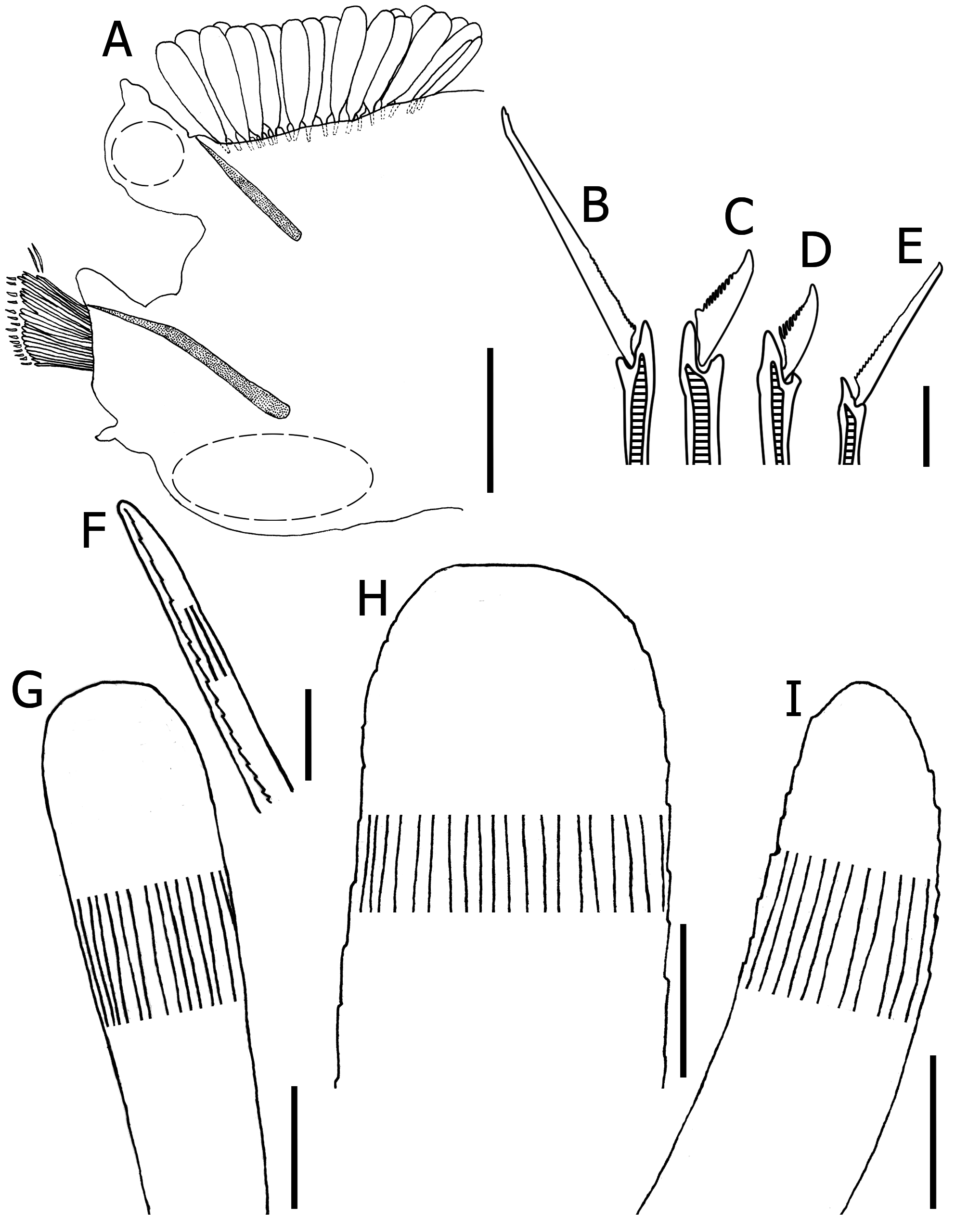
(Figures 12 A – I, 13, 14 L, 15 I)
Cruz-Gómez, Christopher, Bastida-Zavala, J. Rolando (2018): Chrysopetalids (Phyllodocida: Chrysopetalidae) from the southern Mexican Pacific, including a new species. Zootaxa 4521 (1): 61-88, DOI: 10.11646/zootaxa.4521.1.3
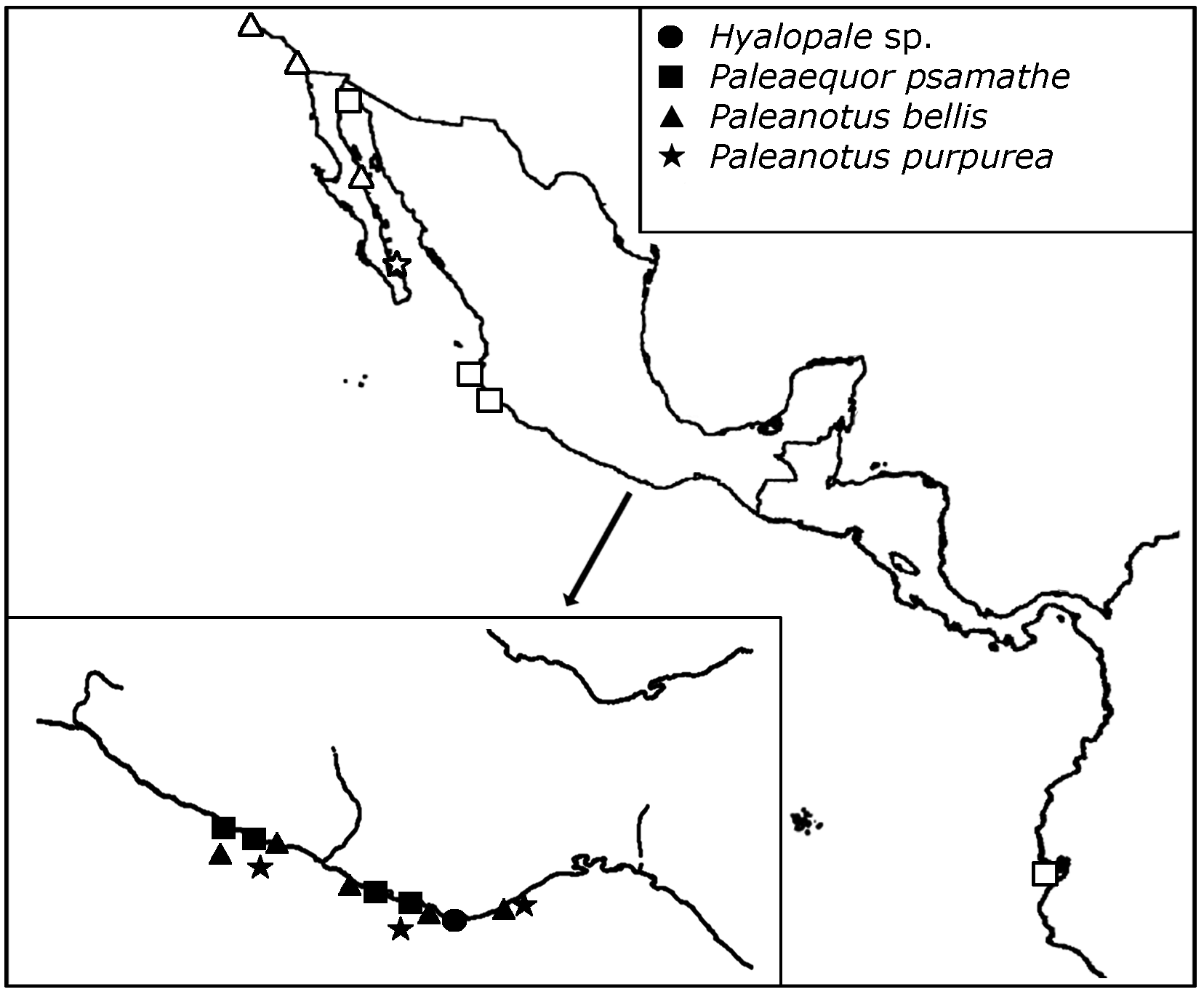
Description. Based mainly on the largest incomplete specimen, 37.2 mm long, 1.8 mm wide, with 215 anterior segments. Body ribbon-shaped, anterior segments slimmer than middle segments, reddish to purple. Paleae fan brown to yellow, in first 40 th segments not imbricated over the dorsum, subsequent segments paleae fan imbricated over middle line of the dorsum. Prostomium rounded and completely retracted among the first six segments. Two pairs of reddish eyes, first pair slightly bigger than second pair. Two lateral antennae; a median antenna similar length to lateral antennae, inserted on anterior margin of prostomium. Nuchal fold semicircular and smaller than prostomium. Two cylindrical palps, visible only in ventral view. Mouth fold wide and semicircular, inserted between second and third segment. Eversible proboscis with two slim stylet. Parapodium from the fifteenth segment. Notochaetae separated into three main groups and one subgroup (Fig. 12 A). Lateral group inserted over the notoaciculum; comprising 1 – 3 slender paleae with three ribs and one raised rib (Fig. 12 F). As sub-unit 1, 1 – 2 symmetrical and slimmer than main paleae group palea with 13 – 18 ribs (Fig. 12 G). Main group, comprising 15 – 20 symmetrical and finely serrated paleae with 19 – 24 ribs (Fig. 12 H). Median group, comprising two asymmetrical and slightly curved paleae, distal palea with 12 – 16 ribs, the proximal and the smallest palea with 12 ribs (Fig. 12 I). Neuropodium large and sheet-shaped bigger than notopodium. Heterogomph neurochaetae composed of four groups (Figs 12 B – E). Neurochaetiger with 1 – 2 superior spinigers with slightly serrated blade. In the first three segments neurochaetae composed of spines and superior spinigers. Mid-superior group conformed by 5 – 7 falcigers with medium length blades (1 / 3 of spiniger blade length). Mid-inferior group with 7 – 9 falcigers with medium length blades (1 / 3 of spiniger blade length) and serration basally. Inferior group of 2 – 4 falcigers, with long blade, longer than mid-inferior’s blades (1 / 2 of spiniger blade length) and serration basally. Pygidium not observed. Habitat. Subtidal (2.7 – 6.1 m). Mostly found as epibionts of bivalves, similar to what Rioja (1947) reported. Distribution. Mexican Pacific, from El Mogote, La Paz, Baja California Sur to La India Beach, Huatulco, Oaxaca (Fig. 13). Taxonomic comment. Paleanotus purpurea is a species with a complicated taxonomic status. Rioja (1947) described the prostomium of the species and indicated that this structure was similar to P. chrysolepis, but he did not explicitly mention if the prostomium and the first segments were retracted. Perkins (1985) remarked this condition in P. purpurea and suggested that Rioja’s species had some characters in common with the genus Bhawania, such as the paleae shape and notopodia. Despite this, Perkins (1985) did not reassign this species to Bhawania. On the other hand, Mora-Vallín (2009) suggested that the original description of P. purpurea agreed better with the genus Arichlidon, based on the curved shape of median paleae. Recently Watson (2015) redefined Paleanotus indicating, as an important diagnostic characteristic of the genus, the shape of the main paleae. These paleae were described as wide, asymmetrical with a small hooked tip, and with either raised or flattenend denticulate ribs (Watson 2015: 710). These features are not present in the main paleae of P. purpurea; in fact, Rioja (1947: 518) even used the absence of hooked tip in the paleae to separate his species from other Paleanotus species. Therefore, the generic status of this species is uncertain.
Cruz-Gómez, Christopher, Bastida-Zavala, J. Rolando (2018): Chrysopetalids (Phyllodocida: Chrysopetalidae) from the southern Mexican Pacific, including a new species. Zootaxa 4521 (1): 61-88, DOI: 10.11646/zootaxa.4521.1.3
Material examined. Guerrero: UMAR-Poly 931, one spec. (Morro del Cerro Colorado, 17 ° 40 ’ 47 ’’ N, 101 ° 30 ’ 31 ’’ W, on stony coral, 2.7 – 4 m, November 30, 2010, coll. S. D. Güenduláin); UMAR-Poly 932, one spec. (Caleta de Chón, 17 ° 36 ’ 49 ’’ N, 101 ° 33 ’ 18 ’’ W, on stony coral, 4.3 – 6.1 m, December 2, 2010, coll. S. D. Güenduláin et al.); Oaxaca: UMAR-Poly 933, one spec. (La India Beach, Huatulco, 15 ° 42 ’ 28 ’’ N, 96 ° 12 ’ 17 ’’ W, on Spondylus limbatus G. B. Sowerby II, 1847, December 3, 2005, coll. J. H. Balandrano); UMAR-Poly 934, one spec. (Carrizalillo Beach, Puerto Escondido, 15 ° 85 ’ 95 ’’ N, 97 ° 07 ’ 87 ’’ W, on bivalve mollusk, August 12, 2006).
Cruz-Gómez, Christopher, Bastida-Zavala, J. Rolando (2018): Chrysopetalids (Phyllodocida: Chrysopetalidae) from the southern Mexican Pacific, including a new species. Zootaxa 4521 (1): 61-88, DOI: 10.11646/zootaxa.4521.1.3
Export occurrence data
Darwin Core Archive (ZIP)
CLASSIFICATION
Taxonomic Classification Tree

MULTIMEDIA
Media Files(2)
FIGURE 12. Paleanotus purpurea. A, parapodium middle segment; B–E, neurochaetal types; F, lateral paleae G, subunit 1 palea; I, final tip of main palea; I–L, median palea. Scale bars: 50 µm (BCDEFGHI), 500 µm (A).
Imageimage/png© Cruz-Gómez, Christopher;Bastida-Zavala, J. RolandoCruz-Gómez, Christopher;Bastida-Zavala, J. Rolando
IMAGES