
AnimaliaNot EvaluatedacceptedspeciesAccepted

Paleanotus bellis
(Johnson, 1897)
GBIF:154498671
0year
ABOUT
Descriptions(5)
(Figures 11 A – L, 13, 14 K, 15 H)
Cruz-Gómez, Christopher, Bastida-Zavala, J. Rolando (2018): Chrysopetalids (Phyllodocida: Chrysopetalidae) from the southern Mexican Pacific, including a new species. Zootaxa 4521 (1): 61-88, DOI: 10.11646/zootaxa.4521.1.3
Description. Based mainly on the largest specimen. Specimen complete 3.4 mm long, 0.7 mm wide, 33 segments. Body wide, tapered in anterior and posterior segments, pale yellow. Paleae fan yellow to golden, imbricated over the dorsum. Prostomium rounded and partially retracted among the first two segments. Two lateral antennae; a bulbous median antenna similar length to lateral antennae, inserted in front of the first pair of eyes. Two pairs of reddish eyes, first pair slightly bigger than second, in some specimens this last pair is almost fused with the first pair. Nuchal fold rectangular and wider than prostomium. Two cylindrical palps, visible in ventral view. Semicircular mouth fold, inserted between second and third segment. Eversible proboscis with two slim stylets. Parapodium from the tenth segment ten separated in three main groups of notochaetae and one subgroup (Fig. 11 A). Lateral group inserted around the notoaciculum; comprising 1 – 3 slender and shovel-like paleae with 4 – 5 ribs (Fig. 11 F). As sub-unit 1, one asymmetrical and smaller than main paleae group palea with 12 – 14 ribs (Fig. 11 G). Between these groups there are 1 – 3 spines inserted over the notoaciculum. Main group, comprising eight asymmetrical and distal-edge finely serrated, paleae with 13 – 15 ribs (Fig. 11 H). Median group, comprising four and almost symmetrical paleae (Figs 11 I – L), distal palea with 11 ribs and three raised ribs, the next proximal palea with 12 ribs and three raised ribs, the next proximal palea smaller with 9 – 10 ribs and two raised ribs, the most proximal and smallest palea with nine ribs and one raised rib. All paleae groups present ornamental granules. Neuropodium large and conical, larger than notopodium. Heterogomph neurochaetae composed of four groups (Figs 11 B – E). Neurochaetiger with 1 – 2 superior spinigers, heterogomph and pale serrated blade. Mid-superior group consists of 5 falcigers with medium length blades (1 / 2 of spiniger blade length) with serration basally. Midinferior group with 5 – 6 falcigers with medium length blades (1 / 2 of spiniger blade length). Inferior group of 2 – 4 falcigers, with short blades (1 / 3 of spiniger blade length) and serration basally. Pygidium conical with two anal cirri. Habitat. Subtidal (2 – 7.9 m). Our specimens were found on dead coral (Pocillopora damicornis), rocks and as epibionts of bivalves. Johnson (1897) found this species associated with sea-weeds, among tunicates and pier pilings.
Cruz-Gómez, Christopher, Bastida-Zavala, J. Rolando (2018): Chrysopetalids (Phyllodocida: Chrysopetalidae) from the southern Mexican Pacific, including a new species. Zootaxa 4521 (1): 61-88, DOI: 10.11646/zootaxa.4521.1.3
Remarks. Paleanotus bellis from the SMP accords with the description by Johnson (1897) from Monterey, California, but some characters considered herein were not mentioned then. In this study, we report the presence of the nuchal fold, and describe all notochaetal and neurochaetal groups.
Cruz-Gómez, Christopher, Bastida-Zavala, J. Rolando (2018): Chrysopetalids (Phyllodocida: Chrysopetalidae) from the southern Mexican Pacific, including a new species. Zootaxa 4521 (1): 61-88, DOI: 10.11646/zootaxa.4521.1.3
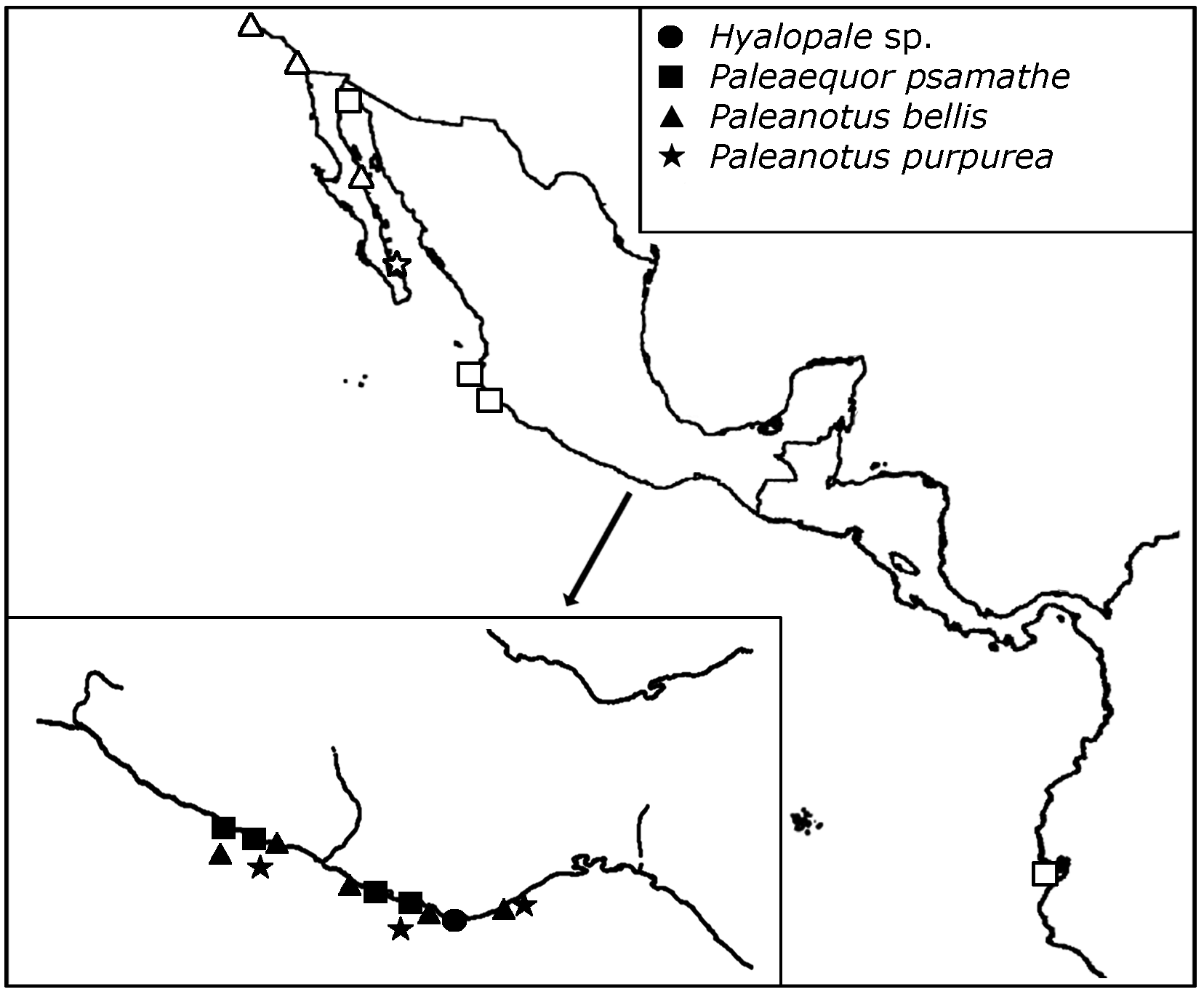
Distribution. California and Tropical Eastern Pacific, from Monterey, California to Montosa Island, Oaxaca, Mexico (Fig. 13).
Cruz-Gómez, Christopher, Bastida-Zavala, J. Rolando (2018): Chrysopetalids (Phyllodocida: Chrysopetalidae) from the southern Mexican Pacific, including a new species. Zootaxa 4521 (1): 61-88, DOI: 10.11646/zootaxa.4521.1.3
Material examined. Guerrero: UMAR-Poly 921, one spec. (La Roqueta Island, Acapulco, 16 ° 49 ’ 21 ’’ N, 99 ° 54 ’ 29 ’’ W, 0 – 4 m, September 21, 2007, coll. M. S. García-Madrigal); UMAR-Poly 922, one spec. (Manzanillo Beach, 16 ° 50 ’ 31 ’’ N, 99 ° 54 ’ 37 ’’ W, September 21, 2007, coll. M. S García-Madrigal); UMAR-Poly 923, two spec. (Peñitas Beach, 16 ° 33 ’ 16 ’’ N, 98 ° 46 ’ 22 ’’ W, September 22, 2007, coll. M. S. García-Madrigal); UMAR-Poly 924, two spec. (Manzanillo Beach, 16 ° 50 ’ 31 ’’ N, 99 ° 54 ’ 37 ’’ W, on Pocillopora damicornis, 3 – 6.1 m, December 4, 2010, coll. S. D. Güenduláin et al.); Oaxaca: UMAR-Poly 925, one spec. (Carrizalillo Beach, Puerto Escondido, 15 ° 85 ’ 95 ’’ N, 97 ° 07 ’ 87 ’’ W, on bivalves, August 12, 2006); UMAR-Poly 926, one spec. (La Tijera, 15 ° 41 ’ 14 ’’ N, 96 ° 26 ’ 34 ’’ W, on dead coral, September 12, 2006); UMAR-Poly 927, one spec. (Chacahua Lagoon, 15 ° 58 ’ 07 ’’ N, 97 ° 41 ’ 01 ’’ W, on rock, April 13, 2007); UMAR-Poly 928, one spec. (Chacahua Lagoon, 15 ° 58 ’ 07 ’’ N, 97 ° 41 ’ 01 ’’ W, November 10, 2007, coll. P. Hernández); UMAR-Poly 929, one spec. (Montosa Island, 15 ° 45 ’ 52 ’’ N, 96 ° 05 ’ 04 ’’ W, on stony coral, 2.7 – 5.8 m, February 22, 2010, coll. R. Granja-Fernández & S. D. Güenduláin); UMAR-Poly 930, one spec. (Salchi, 15 ° 41 ’ 23 ’’ N, 96 ° 21 ’ 00 ’’ W, on stony coral, 6.1 – 7.9 m, March 26, 2010, coll. A. López-Pérez & R. Zepeta).
Cruz-Gómez, Christopher, Bastida-Zavala, J. Rolando (2018): Chrysopetalids (Phyllodocida: Chrysopetalidae) from the southern Mexican Pacific, including a new species. Zootaxa 4521 (1): 61-88, DOI: 10.11646/zootaxa.4521.1.3
Export occurrence data
Darwin Core Archive (ZIP)
CLASSIFICATION
Taxonomic Classification Tree

MULTIMEDIA
Media Files(2)
FIGURE 11. Paleanotus bellis. A, parapodium middle segment; B–E, neurochaetal types; F, lateral paleae G, subunit 1 palea; H, final tip of main palea; I–L, median paleae group. Scale bars: 20 µm (H), 30 µm (BCDE), 50 µm (FGIJKL), 200 µm (A).
Imageimage/png© Cruz-Gómez, Christopher;Bastida-Zavala, J. RolandoCruz-Gómez, Christopher;Bastida-Zavala, J. Rolando
IMAGES