
AnimaliaNot EvaluatedacceptedspeciesAccepted
Sycozoa umbellata
(Michaelsen, 1898)
GBIF:154507572
0year
ABOUT
Descriptions(2)
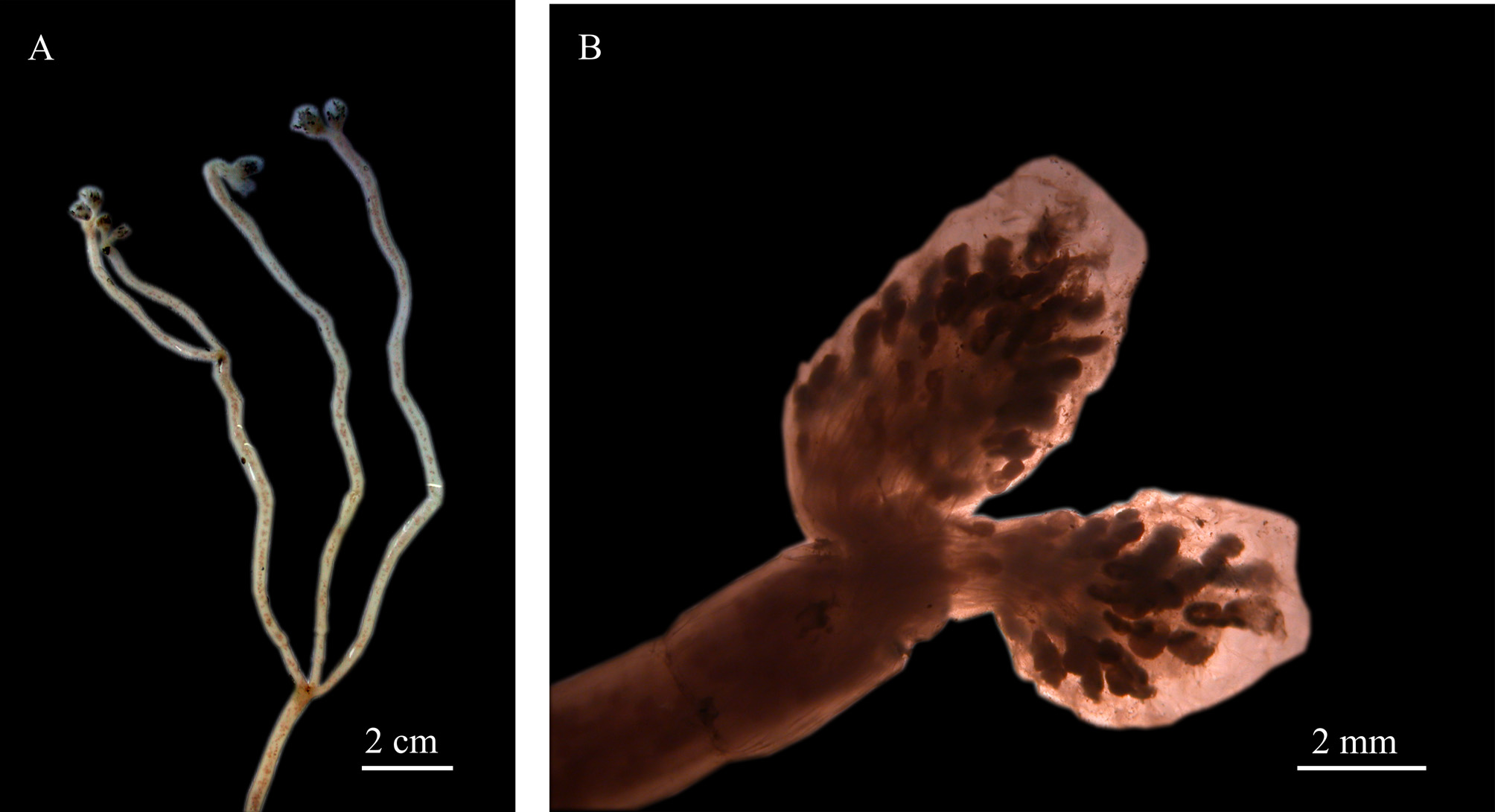
Each head bears longitudinal rows of three to five zooids arranged in oblique or random-like configurations (Fig. 9 B). On average, zooids are 1.9 mm in length. No larvae were found.
Maggioni, Tamara, Taverna, Anabela, Reyna, Paola B., Alurralde, Gastón, Rimondino, Clara, Tatián, Marcos (2018): Deep-sea ascidians (Chordata, Tunicata) from the SW Atlantic: species richness with descriptions of two new species. Zootaxa 4526 (1): 1-28, DOI: 10.11646/zootaxa.4526.1.1
Remarks. The general shape of the colonies (small rounded heads supported by fine peduncles arising from a basal mass of stolons) resembles the closely related species Sycozoa georgiana (Michaelsen, 1907). According to Van Name (1945), each head of S. georgiana is " supported on a separate peduncle that can reach 3 cm in length, but is usually much shorter " (154 p.). The peduncles of the present specimen, on the contrary, reach 14 cm in length, have ramifications and usually have two heads. On the other hand, S. georgiana is cited exclusively for the South Georgia Islands. Sycozoa umbellata, in addition to the South Georgia Islands, has also been recorded in the SW Atlantic, near the area where the colonies of the present work were collected. Van Name (1945) also notes that S. umbellata is closely related to S. sigillinoides Lesson, 1930, of which it is distinguished by " the usual reproduction of numerous heads of the upper part of the peduncle or of broken or injured places along its length, and also fragments of peduncles " (154 p.). In addition, the length of the heads and consequently, the number of zooids per head in S. sigillinoides, is greater. The only reliable characters to distinguish among these three species and Sycozoa gaimardi (Herdman, 1886), all with overlapping distribution ranges, are external: the appearance of the colony and the shape and size of the heads. Table 3 lists such differences in detail. This is the deepest and northernmost record for the species.
Maggioni, Tamara, Taverna, Anabela, Reyna, Paola B., Alurralde, Gastón, Rimondino, Clara, Tatián, Marcos (2018): Deep-sea ascidians (Chordata, Tunicata) from the SW Atlantic: species richness with descriptions of two new species. Zootaxa 4526 (1): 1-28, DOI: 10.11646/zootaxa.4526.1.1
Export occurrence data
Darwin Core Archive (ZIP)
CLASSIFICATION
Taxonomic Classification Tree

MULTIMEDIA
Media Files(1)
IMAGES