
AnimaliaNot EvaluatedacceptedspeciesAccepted
Polysyncraton trivolutum
(Millar, 1960)
GBIF:154507575
0year
0
Synonyms
ABOUT
Descriptions(2)
Remarks. On the revision of the colonies described by Millar (1960) as Didemnum trivolutum from the Argentine Sea (Malvinas / Falkland Islands and Patagonian shelf), Monniot & Monniot (1983) concluded that these specimens corresponded to the genus Polysyncraton based on: (1) the presence of one pointed atrial languet and (2) the morphology of the testes. Polysyncraton trivulutum is an eurybathic species, widely distributed in Antarctic and Sub-Antarctic waters up to the Patagonian shelf (Argentine Sea). The present is the northernmost record of the species. It is also the first record of the species below 935 m (Kott 1969).
Maggioni, Tamara, Taverna, Anabela, Reyna, Paola B., Alurralde, Gastón, Rimondino, Clara, Tatián, Marcos (2018): Deep-sea ascidians (Chordata, Tunicata) from the SW Atlantic: species richness with descriptions of two new species. Zootaxa 4526 (1): 1-28, DOI: 10.11646/zootaxa.4526.1.1
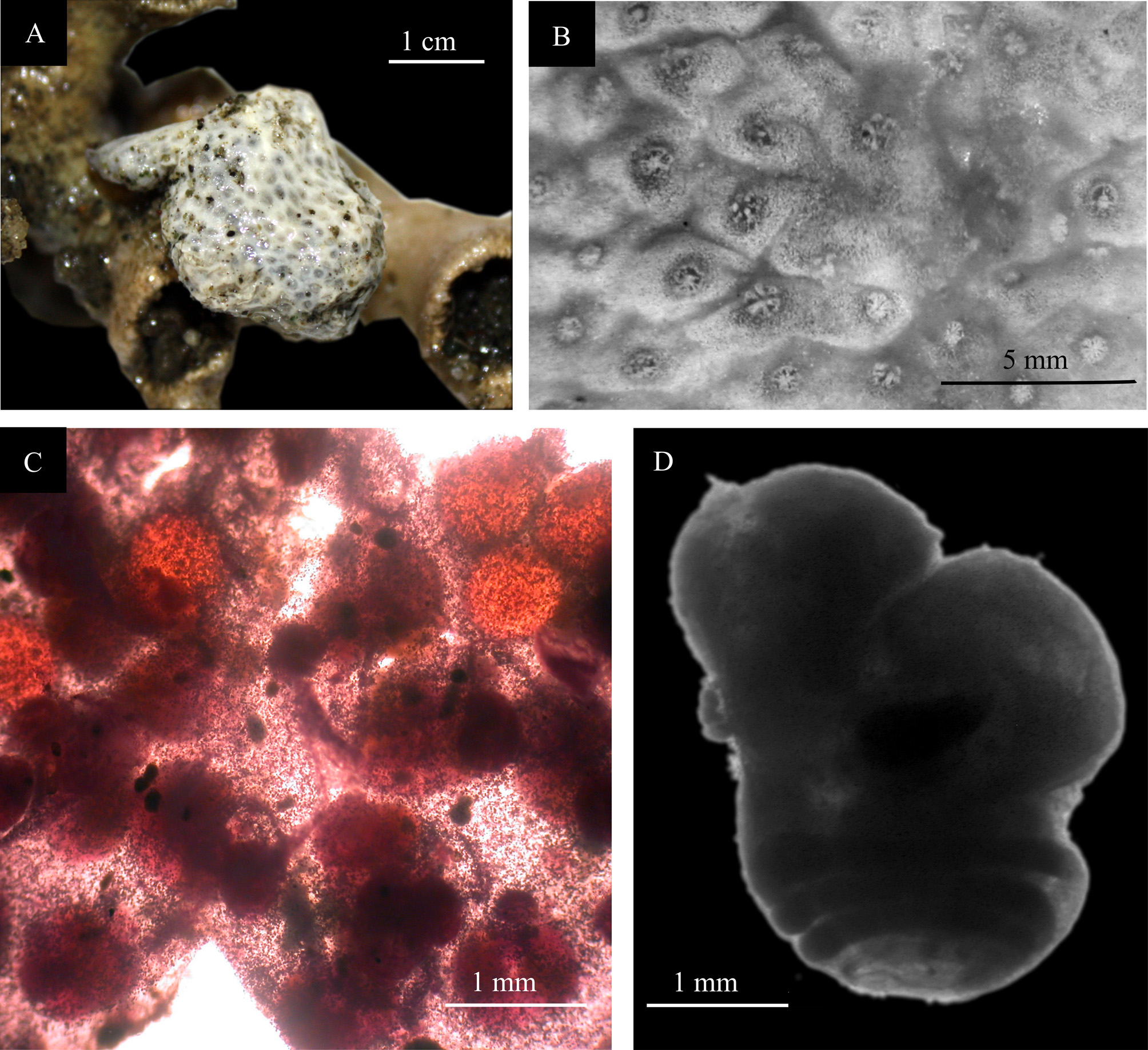
Material examined: several colonies adhered to the tunic of Ascidia meridionalis; trawl; - 37.9876 lat. - 54.6906 long. (station 8); 854 m; 11 August 2012 — three colonies adhered to corals; trawl; - 37.9530 lat. - 55.1843 long. (station 2); 291 m; 10 August 2012 — one colony on one fragment of coral; trawl; - 37.9651 lat. - 54.5320 long. (station 10); 1144 m; 11 August 2012 (Figures 8 A – D). Colonies configure flat and encrusting white patches on the tunics of A. meridionalis, debris and corals (Fig. 8 A). The most superficial layer shows the greatest amount of spicules, which are specially concentrated around the oral apertures (Fig. 8 B). Distributed unevenly and attached to the substrate, numerous yellow and spherical eggs (approximately 0.9 mm in diameter) were found (Fig. 8 C). The zooids show an average length of 1.8 mm. Thorax and abdomen have the same size. The atrial languet is short and triangular. There is no muscular appendage. The thorax is separated from the abdomen by a thin and short neck. The stomach is rounded, almost spherical, and smooth-walled. The gonads, both male and female, are situated inside the intestinal loop. The number of male follicles ranges from three to four. They are densely packed in pear-shaped lobes. The vas deferens makes three to four spiral turns around them (Fig. 8 D). In some zooids only the ovary is developed.
Maggioni, Tamara, Taverna, Anabela, Reyna, Paola B., Alurralde, Gastón, Rimondino, Clara, Tatián, Marcos (2018): Deep-sea ascidians (Chordata, Tunicata) from the SW Atlantic: species richness with descriptions of two new species. Zootaxa 4526 (1): 1-28, DOI: 10.11646/zootaxa.4526.1.1
Export occurrence data
Darwin Core Archive (ZIP)
CLASSIFICATION
Taxonomic Classification Tree

NOMENCLATURE
Synonyms(1)
MULTIMEDIA
Media Files(1)
FIGURE 8. Polysyncraton trivolutum (Millar, 1960). A: colony; B: detail of oral apertures packed with spicules; C: surface of colony showing zooids (pink colored) and oval eggs. (orange colored); D: zooid with detail of coiled vas deferens at its base.
Imageimage/png© Maggioni, Tamara;Taverna, Anabela;Reyna, Paola B.;Alurralde, Gastón;Rimondino, Clara;Tatián, MarcosMaggioni, Tamara;Taverna, Anabela;Reyna, Paola B.;Alurralde, Gastón;Rimondino, Clara;Tatián, Marcos
IMAGES