
AnimaliaNot EvaluatedacceptedspeciesAccepted
Synoicum georgianum
Sluiter, 1932
GBIF:154507580
0year
ABOUT
Descriptions(2)
Remarks. The colony resembles very closely the Antarctic species Synoicum pererratum (Sluiter, 1932) in several characteristics of the zooids. Both share: the external accumulation of sand, short and stout post-abdomens, the number of longitudinal muscles, and the number of rows of stigmata and stigmata per row. However, they differ in the general shape of the colony, the arrangement of the systems of zooids and in the sizes of zooids. Moreover, both species do not coincide in their location: while S. pererratum is confined to the Antarctic region, S. georgianum, apart from its Antarctic records, has also been collected from the Patagonian shelf (Millar 1960). This is the deepest register of the species; the first record below 550 m (Kott 1969).
Maggioni, Tamara, Taverna, Anabela, Reyna, Paola B., Alurralde, Gastón, Rimondino, Clara, Tatián, Marcos (2018): Deep-sea ascidians (Chordata, Tunicata) from the SW Atlantic: species richness with descriptions of two new species. Zootaxa 4526 (1): 1-28, DOI: 10.11646/zootaxa.4526.1.1
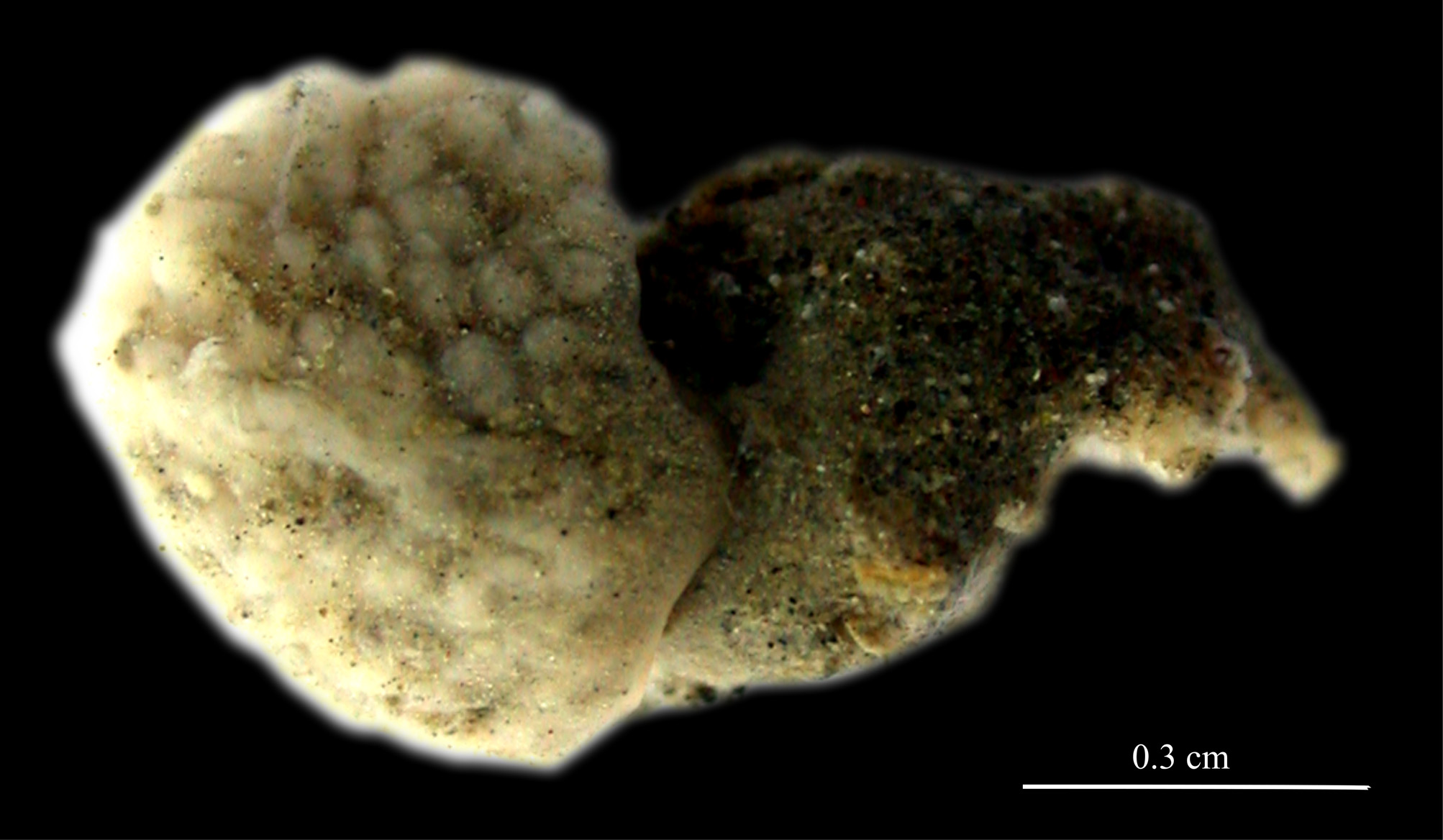
Material examined: one colony; net; - 38.0249 lat. - 54.7361 long. (station 6); 819 m; 16 August 2012 (Figure 5). The only colony found consists of a small rounded head 0.5 cm high by 0.7 cm wide with a conical peduncle 0.8 cm long by 0.5 cm wide (Fig. 5). The zooids are attached by their posterior abdomens to the peduncle. They are all positioned vertically. The entire colony, head and peduncle, is embedded with sand interiorly. The tunic is smooth and grayish. The peduncle is coarse. Zooids are white when alive and after conservation in formalin. The cloacal apertures are inconspicuous. Some zooids presented post-abdomens extremely reduced or even absent, a characteristic related to the state of sexual maturation of each individual. The oral aperture has six slightly marked lobes. The atrial aperture is moderately big and surrounded by a series of three to four circular muscles. The border of the atrial aperture is smooth. The atrial languet is trifid. There are from five to nine longitudinal muscles on each side of the zooids. They run vertically through the thorax, abdomen and post-abdomen. Two-sized oral tentacles are distributed alternately in a single circle. The thorax bears from 14 to 16 rows of small rectangular stigmata. Each half row contains from ten to 14 stigmata. The stomach wall is smooth. The anus is located at the level of the ninth row of stigmata. The posterior margin of the anal border is lobed. No gonads were found. An immature tailless larva was found in the atrial cavity of one zooid.
Maggioni, Tamara, Taverna, Anabela, Reyna, Paola B., Alurralde, Gastón, Rimondino, Clara, Tatián, Marcos (2018): Deep-sea ascidians (Chordata, Tunicata) from the SW Atlantic: species richness with descriptions of two new species. Zootaxa 4526 (1): 1-28, DOI: 10.11646/zootaxa.4526.1.1
Export occurrence data
Darwin Core Archive (ZIP)
CLASSIFICATION
Taxonomic Classification Tree

IMAGES