
AnimaliaNot EvaluatedacceptedspeciesAccepted
Aplidium marplatensis
Maggioni & Tatian
GBIF:154507582
0
Synonyms
ABOUT
Descriptions(3)
Remarks. The genus Aplidium is the most numerous of the Polyclinidae family, with 278 species described to date. This diversity is also found in the deep-sea, with 19 representatives of deep-water Aplidium. However, in the Argentine Basin only 3 deep species of this genus have been recorded. They are: Aplidium effrenatum (Herdman, 1886), Aplidium va r iabile (Herdman, 1886) and Aplidium falklandicum Millar, 1960. Aplidium effrenatum was described in the 19 th century (Herdman 1886) and has not been collected ever since. On the other hand, A. variabile has been collected several times in the Sub-Antarctic area around the tip of South America and Antarctica. Monniot & Monniot (1976; 1985) recorded two additional specimens of Aplidium. However, they could only identify them up to genus level. The three species of Aplidium cited for the deep waters of the South West Atlantic differ from Aplidium marplatensis Maggioni & Tatián (sp. nov. present work) mainly due to the presence of a wide atrial aperture. Although the original and unique description of Aplidium effrenatum (Herdman, 1886) is incomplete, it allows to characterize A. effrenatum as a different species from the current one. Unlike the colony of A. marplatensis Maggioni & Tatián (sp. nov. present work), the colony of A. effrenatum is thin and encrusting. Its color is described as dull reddish-brown or dark gray-brown. In addition, the tunic was found completely embedded with grains of sand. Finally, the absence of an atrial languet definitively separates A. effrenatum from A. marplatensis Maggioni & Tatián (sp. nov. present work).
Maggioni, Tamara, Taverna, Anabela, Reyna, Paola B., Alurralde, Gastón, Rimondino, Clara, Tatián, Marcos (2018): Deep-sea ascidians (Chordata, Tunicata) from the SW Atlantic: species richness with descriptions of two new species. Zootaxa 4526 (1): 1-28, DOI: 10.11646/zootaxa.4526.1.1
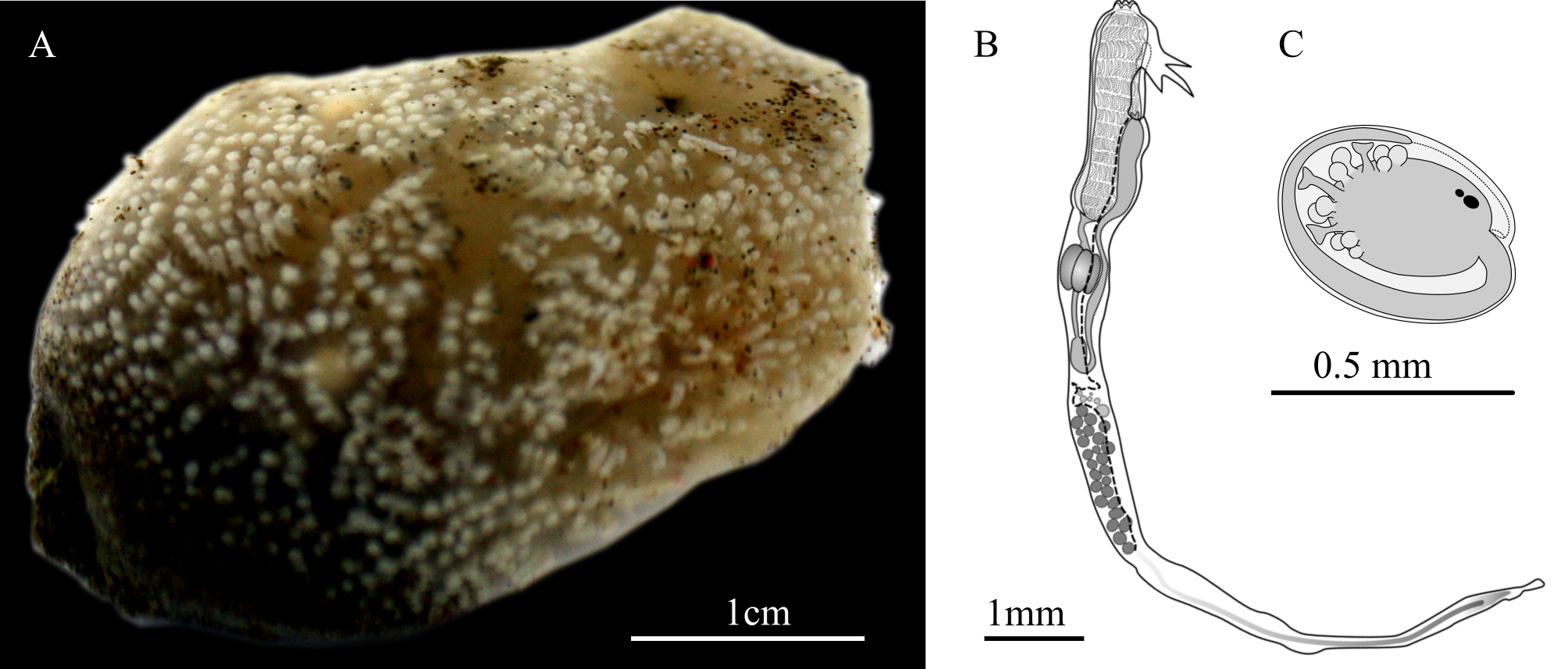
Etymology: in reference to the Mar del Plata submarine canyon, the geographic location where the species was collected. The colony consists of an ovoid mass, attached to the substrate by a small area with rhizoids. It measures 4.6 cm in diameter by five cm in height. The tunic is smooth and free of epibionts or external particles. When alive, the color of the tunic is grayish-brown and the zooids are white (Fig. 3 A). After fixation in formalin, the tunic and zooids turn opaque yellow. Zooids of variable sizes are arranged irregularly around inconspicuous cloacal apertures. The total length varies from 0.3 cm to 1.4 cm. The thorax and the abdomen are the smallest parts of the body, both being about the same size. The post-abdomen is the longest section of the body, reaching a maximum length of 1.1 cm. The oral aperture has six lobes, although some zooids show a smooth edge. The atrial aperture is wide, leaving almost half of the pharynx exposed. It extends from the second to the sixth row of stigmata and is surrounded by a series of five to six thin and circular fine muscles. The atrial languet is wide, medium sized and trifid. Thorax and abdomen show six to eight fine longitudinal muscles on each side. The pre-pharyngeal band is thin and circular. The neural ganglion is small and approximately spherical. There are 14 rows of stigmata that contain ten to 12 stigmata per half row. There is a long and thick esophagus, it widens at its anterior end and narrows when it reaches the stomach. Its course to the stomach may be straight or may present a sharp curve inwards. The stomach is rectangular with rounded edges and presents four to five well marked longitudinal and straight folds. On average, it measures 1.7 mm long by 1.1 mm wide. The intestine also has thick walls. After the stomach, it widens and forms a first pearshaped, sometimes spherical, swelling. Then, it makes a closed turn dorsal and posterior, opening to a second slightly larger swelling. When the ascending branch of the gut loop reaches the level of the stomach, the intestine recovers its initial width and continues its vertical trajectory towards the atrial aperture. The anal border is bilobed and opens at the level of the eighth row of stigmata, just at the lower edge of the atrial aperture. In mature zooids, the gonads are located a short distance from the pole of the gut loop. There are four to six rounded and small oocytes, arranged in a semi-spherical ovary at the beginning of the post-abdomen. Directly under the ovary, testes are arranged in longitudinal rows containing 19 to 30 small and spherical follicles that can fill the first half of the length of the post-abdomen. In more mature zooids, testes are arranged in one or two long longitudinal rows. In less mature zooids, with shorter post-abdomens, testicular follicles are smaller and densely packed. The vas deferens bends several times over the ovary; it then turns dorsal and vertical along the abdomen and part of the thorax and ends at the same level as the anus. The atrial cavity contains one to two developing larvae. The average trunk size of the most mature larvae is one mm long and 0.6 mm wide. The larvae have an otolith and an ocellus. There are three adhesive organs arranged in a single line with two anterior ampullae alternating between them and three lateral ampullae on each side, directly adjacent to the most distal adhesive organs. No epidermal vesicles were observed.
Maggioni, Tamara, Taverna, Anabela, Reyna, Paola B., Alurralde, Gastón, Rimondino, Clara, Tatián, Marcos (2018): Deep-sea ascidians (Chordata, Tunicata) from the SW Atlantic: species richness with descriptions of two new species. Zootaxa 4526 (1): 1-28, DOI: 10.11646/zootaxa.4526.1.1
Material examined: one colony; net; - 37.9942 lat. - 55.2175 long. (station 1); 250 m; 10 August 2012 (Figures 3 A – C). Holotype: MZUCVI 0193.
Maggioni, Tamara, Taverna, Anabela, Reyna, Paola B., Alurralde, Gastón, Rimondino, Clara, Tatián, Marcos (2018): Deep-sea ascidians (Chordata, Tunicata) from the SW Atlantic: species richness with descriptions of two new species. Zootaxa 4526 (1): 1-28, DOI: 10.11646/zootaxa.4526.1.1
Export occurrence data
Darwin Core Archive (ZIP)
CLASSIFICATION
Taxonomic Classification Tree

NOMENCLATURE
Synonyms(2)
MULTIMEDIA
Media Files(1)
FIGURE 3. Aplidium marplatensis Maggioni & Tatián (sp. nov. present work). A: colony; B: zooid; C: larva.
Imageimage/png© Maggioni, Tamara;Taverna, Anabela;Reyna, Paola B.;Alurralde, Gastón;Rimondino, Clara;Tatián, MarcosMaggioni, Tamara;Taverna, Anabela;Reyna, Paola B.;Alurralde, Gastón;Rimondino, Clara;Tatián, Marcos
IMAGES