
AnimaliaNot EvaluatedacceptedspeciesAccepted
Aplidium meridianum

Aplidium meridianum

(Sluiter, 1906)

GBIF:154507584

0year

0

Synonyms

ABOUT

Descriptions(1)

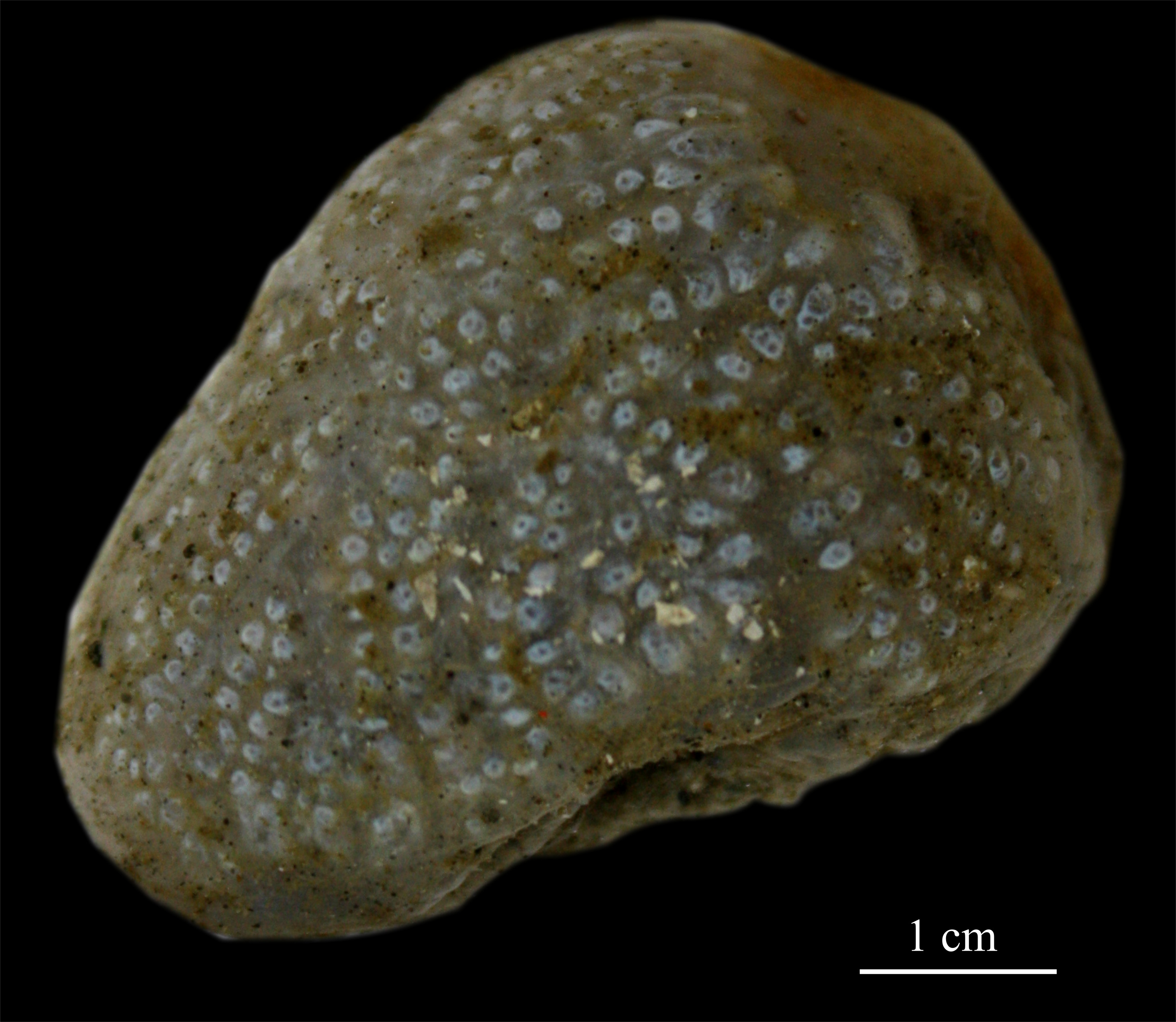
Zooids range from five to 12 mm in length. However, some of the post-abdomens can reach a maximum extension of 14 mm. The small atrial aperture is surrounded entirely by a short ring of tunic. It is situated next to the first and second row of stigmata. The atrial languet is wide and short. There are eight to ten thin and long oral tentacles disposed in a circle. The thorax bears from 12 to 18 rows of 12 to 14 stigmata. Six to ten thin longitudinal muscles run through each side of the zooid. The stomach has six to eight longitudinal well-marked folds of different sizes. Some folds are shorter than others or even incomplete. The gut loop curves dorsal and posterior and widens toward its final part. The bilobed anus ends between the sixth and eighth row of stigmata. The gonads are situated under the gut loop with no space in between. The testes are arranged in a simple longitudinal row or in clusters. The number of male follicles ranged from seven to 14. The sperm duct ends next to the anus. Either one or two larvae were found in the atrial cavities of all zooids in an immature state of development. Remarks. This is the northernmost record of the species, previously known from Antarctic and Sub-Antarctic areas.
Maggioni, Tamara, Taverna, Anabela, Reyna, Paola B., Alurralde, Gastón, Rimondino, Clara, Tatián, Marcos (2018): Deep-sea ascidians (Chordata, Tunicata) from the SW Atlantic: species richness with descriptions of two new species. Zootaxa 4526 (1): 1-28, DOI: 10.11646/zootaxa.4526.1.1

Export occurrence data

Darwin Core Archive (ZIP)

CLASSIFICATION

Taxonomic Classification Tree

MULTIMEDIA

Media Files(1)

FIGURE 2. Aplidium meridianum (Sluiter, 1906). Colony.

Imageimage/png© Maggioni, Tamara;Taverna, Anabela;Reyna, Paola B.;Alurralde, Gastón;Rimondino, Clara;Tatián, MarcosMaggioni, Tamara;Taverna, Anabela;Reyna, Paola B.;Alurralde, Gastón;Rimondino, Clara;Tatián, Marcos

IMAGES

Gallery(1)

See Gallery

Occurrences with images

Source Information

Deep-sea ascidians (Chordata, Tunicata) from the SW Atlantic: species richness with descriptions of two new species

checklist

This dataset contains the digitized treatments in Plazi based on the original journal article Maggioni, Tamara, Taverna, Anabela, Reyna, Paola B., Alurralde, Gastón, Rimondino, Clara, Tatián, Marcos (2018): Deep-sea ascidians (Chordata, Tunicata) from the SW Atlantic: species richness with descriptions of two new species. Zootaxa 4526 (1): 1-28, DOI: 10.11646/zootaxa.4526.1.1

Abstract

The understudied deep-sea benthic communities from the Southwestern Atlantic continental slope (200 m– 3000 m depth) were sampled on August 2012 in an area located around 38°S that included the Mar del Plata submarine canyon. In these samplings we found a total of 16 ascidian species from six different families, of which two corresponded to new species. These were: Aplidium meridianum (Sluiter, 1906); Aplidium variabile (Herdman, 1886); Aplidium marplatensis Maggioni & Tatián (sp. nov. present work); Aplidium solitarium Maggioni & Tatián (sp. nov. present work); Synoicum georgianum Sluiter, 1932; Synoicum molle (Herdman, 1886); Synoicum sp.; Polysyncraton trivolutum (Millar, 1960); Sycozoa umbellata (Michaelsen, 1898); Ascidia meridionalis Herdman, 1880; Cnemidocarpa drygalskii (Hartmeyer, 1911); Styela squamosa Herdman, 1881; Pyura pilosa Monniot C. & Monniot F., 1974; Molgula pyriformis Herdman, 1881; Molgula setigera Ärnbäck-Christie-Linde, 1938 and Asajirus indicus (Oka, 1913). Based on morphological evidence, we propose the new synonymy: Molgula setigera Ärnbäck-Christie-Linde, 1938 = Molgula marioni Millar, 1960 = Molgula robini Monniot C. & Monniot F., 1983. We also propose to maintain Molgula pyriformis and Molgula malvinensis as separate species. We report: the extension of the distribution range of Aplidium meridianum, Synoicum georgianum, Polysyncraton trivolutum, Sycozoa umbellata, Cnemidocarpa drygalskii, Pyura pilosa and Molgula setigera, being the first time they are collected off La Plata River; the deepest registers for Synoicum georgianum, Poylsyncraton trivolutum, Sycozoa umbellata, Ascidia meridionalis, Pyura pilosa, Molgula pyriformis and Molgula setigera; and the shallowest register for Synoicum molle.

Maggioni T, Taverna A, Reyna P B, Alurralde G, Rimondino C, Tatián M, plazi (2018). Deep-sea ascidians (Chordata, Tunicata) from the SW Atlantic: species richness with descriptions of two new species. Plazi.org taxonomic treatments database. Checklist dataset https://doi.org/10.11646/zootaxa.4526.1.1 accessed via GBIF.org on 2026-06-15.

CC0Published 11/28/2018View dataset
GBIF Usage Key
154507584
Dataset Key
4d211ac6-cbb8-4ef7-b710-44d4f34873ef
Origin
source
Backbone Key
2330976
Taxon ID
A0769C75757BFFA10BB6323912CE31CD.taxon
Last Crawled
6/10/2026
Last Interpreted
6/10/2026