
AnimaliaNot EvaluatedacceptedspeciesAccepted
Aplidium solitarium
Maggioni & Tatian
GBIF:154507585
ABOUT
Descriptions(2)
Remarks. The shape and texture of the stomach wall are valid characters for classification among Polyclinidae genera (Millar 1960; Kott 1990). The stomach of the present species shows a diversity of both shape and texture (smooth and with folds). Millar (1960) is the only author who described a species of the genus Aplidium of Sub- Antarctic (Malvinas / Falkland Islands and Patagonian continental margin) and Antarctic (Graham Land, South Orkney Islands and South Georgia Islands) waters, Aplidium falklandicum Millar, 1960, with a stomach presenting a diversity of shapes and textures. The author states that A. falklandicum can show between five to seven slightly marked folds, reduction of folds (which can be discontinued or separated into a few almost imperceptible swellings) and even smooth stomachs. Aplidium falklandicum is similar to Aplidium solitarium Maggioni & Tatián (sp. nov. present work) in several general aspects of the colony and the zooid, especially regarding the variation of the stomach. However, both differ in the following characters: the number of stigmata rows; the position and extension of the atrial aperture; the shape of the atrial languet; the position of the anus in relation to the atrial aperture; and the disposition of the testes in the post-abdomen. The color of the colonies is also different: specimens of A. falklandicum observed and documented alive (Tatián pers. obs.) exhibit a very characteristic greenish-yellow (lemon) color. The presence of a thinning of the body separates some genera of Polyclinidae. However, this feature had only been reported between the abdomen and the post-abdomen, never before between the thorax and the rest of the body (abdomen and post-abdomen). The presence of a thin neck separating the thorax from the rest of the body was found in all zooids of both examined colonies and cannot be interpreted as an artifact of preservation. More samples will allow to confirm the value of this feature in species diagnosis.
Maggioni, Tamara, Taverna, Anabela, Reyna, Paola B., Alurralde, Gastón, Rimondino, Clara, Tatián, Marcos (2018): Deep-sea ascidians (Chordata, Tunicata) from the SW Atlantic: species richness with descriptions of two new species. Zootaxa 4526 (1): 1-28, DOI: 10.11646/zootaxa.4526.1.1
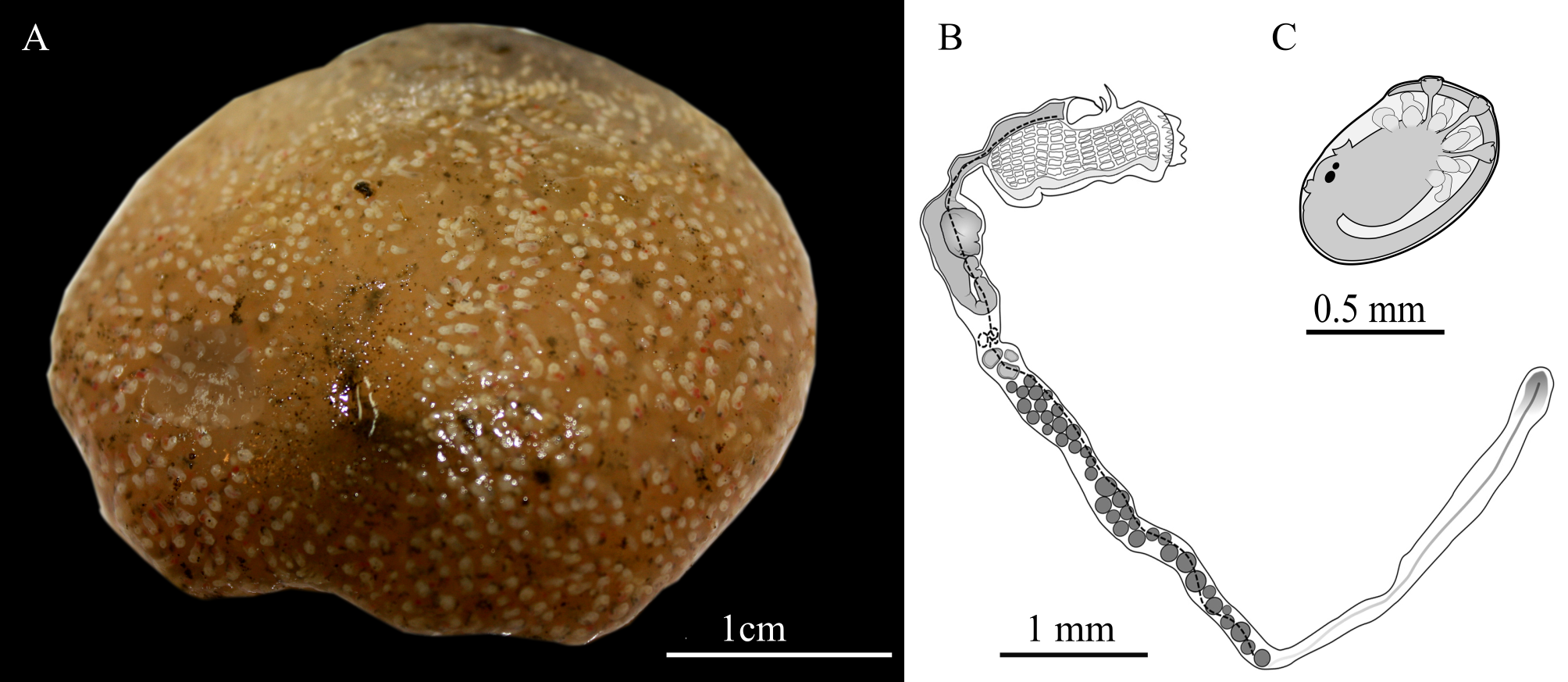
Material examined: two colonies; net; - 37.9783 lat. - 55.1983 long. (station 3); 308 m; 17 August 2012 (Figures 4 A – C). Holotype: MZUCVI 0194. Etimology: From solitarium, the latin neuter adjective for solitary or sole, without companion. The colonies are circular and flattened. They can reach 6.4 cm in diameter and 1.5 in height. They are attached to the substrate by a small area embedded with grains of sand. The tunic is firm and hard but soft. When alive, the tunic is opaque and amber colored with brownish tones. The zooids are white and exhibit red and orange spots in the oral openings in about half the cases (Fig. 4 A). After conservation in formalin the tunic becomes transparent, the zooids turn yellowish and the red and orange spots disappear. Numerous zooids are arranged in irregular elliptical systems around common cloacal apertures. The thorax is separated from the two posterior regions by a very thin and moderately long constriction. This constriction is common in all zooids, but it is more noticeable in the largest zooids of the colony. It is a part of the abdomen. The lengths of the zooids are highly variable, between seven and 23 mm. However, the proportions between regions remain the same. The post-abdomen is the longest and most variable section, depending on the sexual stage of the zooid’s maturation. It can be six times longer than the thorax or abdomen, reaching a maximum length of 18 mm. The oral aperture has six well differentiated lobes. The atrial aperture is moderately large, exposing three rows of stigmata. It is located between the fourth and sixth row of stigmata and it is surrounded by a small ring of thin, circular muscles. The atrial languet is very variable in shape: simple; bifid; trifid; and even show four thin, triangular and pointed lobes. More often it is bifid or trifid. The size of the atrial languet is also variable. The musculature is strong. Approximately 22 longitudinal fibers run through the entire zooid. They are arranged in two well differentiated bands: 12 to 14 muscles are densely grouped over the thickest area of the mantle, while the other eight to ten are evenly distributed over the rest of the zooid, where the mantle becomes thinner. The branchial sac has 13 rows of stigmata. Each half row contains seven thin rectangular stigmata. From ten to 14 oral tentacles are arranged in a circular ring, alternating in sizes. The pre-pharyngeal band is thin, circular and presents soft undulations. Due to the presence of a constriction between the thorax and the abdomen, the esophagus is particularly narrow and long. It connects vertically with a moderately large stomach. The stomach shows four different types of morphologies: cylindrical, cubic, spherical and pyramidal. The wall of the stomach contains five to six folds, although some zooids showed smooth walls. The intestine has thick walls, it is wide and long. It forms a mediumsized swelling shortly after the end of the stomach. The swelling can be elliptical, almost spherical, cylindrical or rectangular. The intestine turns dorsal and anterior and runs parallel to the stomach until reaching the constriction. This portion of the intestine is the widest, sometimes even more than the stomach, and may have smooth transverse folds. In the constriction, the intestine becomes as narrow and thin-walled as the esophagus. It maintains these characteristics until reaching the lower border of the atrial opening. The anal border is bilobed, showing two marked projections. The ovary presents from a single large oocyte up to four small rounded oocytes located a few millimeters from the pole of the gut loop. The testes are composed of small and spherical follicles distributed in four, but more frequently, three longitudinal rows. The broad vas deferens ends at the lower border of the atrial aperture, next to the border of the anus. The atrial cavity of many zooids contains between one to three developing larvae, although the most frequent number is three. The larval dimensions of the trunk reach 1.1 mm in length and 0.7 mm wide. The larvae show three adhesive organs arranged in a straight line. Between these adhesive organs and immediately adjacent to the two most distal ones, there are four rows of three ampoullae each. Externally, there are two additional rows of two ampoullae on each side. No epidermal vesicles were observed. The tail surrounds approximately 5 / 8 of the larval trunk. They present an otolith and an ocellus.
Maggioni, Tamara, Taverna, Anabela, Reyna, Paola B., Alurralde, Gastón, Rimondino, Clara, Tatián, Marcos (2018): Deep-sea ascidians (Chordata, Tunicata) from the SW Atlantic: species richness with descriptions of two new species. Zootaxa 4526 (1): 1-28, DOI: 10.11646/zootaxa.4526.1.1
Export occurrence data
Darwin Core Archive (ZIP)
CLASSIFICATION
Taxonomic Classification Tree

MULTIMEDIA
Media Files(1)
FIGURE 4. Aplidium solitarium Maggioni & Tatián (sp. nov. present work). A: colony; B: zooid; C: larva.
Imageimage/png© Maggioni, Tamara;Taverna, Anabela;Reyna, Paola B.;Alurralde, Gastón;Rimondino, Clara;Tatián, MarcosMaggioni, Tamara;Taverna, Anabela;Reyna, Paola B.;Alurralde, Gastón;Rimondino, Clara;Tatián, Marcos
IMAGES