
AnimaliaNot EvaluatedacceptedspeciesAccepted
Ascidia meridionalis
Herdman, 1880
GBIF:154507588
0year
ABOUT
Descriptions(2)
Remarks. Ascidia meridionalis resembles the closely allied species A. challengeri Herdman, 1882. Both share the same general aspect and are distributed in the Sub-Antarctic and Antarctic regions. Monniot & Monniot (1983) and Monniot et al. (2011) give a list of reliable characters to distinguish between the two species. The examination of the collected specimens proceeding from an area very close to the type locality allowed us to update those characters. We strongly discourage the use of the presence of intermediate branchial papillae and the number of oral tentacles, since both characters showed intermediate values. Instead, we recommend the use of a set of particular differences which are resumed in Table 4. This is the first register of the species below 1097 m (Herdman 1880).
Maggioni, Tamara, Taverna, Anabela, Reyna, Paola B., Alurralde, Gastón, Rimondino, Clara, Tatián, Marcos (2018): Deep-sea ascidians (Chordata, Tunicata) from the SW Atlantic: species richness with descriptions of two new species. Zootaxa 4526 (1): 1-28, DOI: 10.11646/zootaxa.4526.1.1
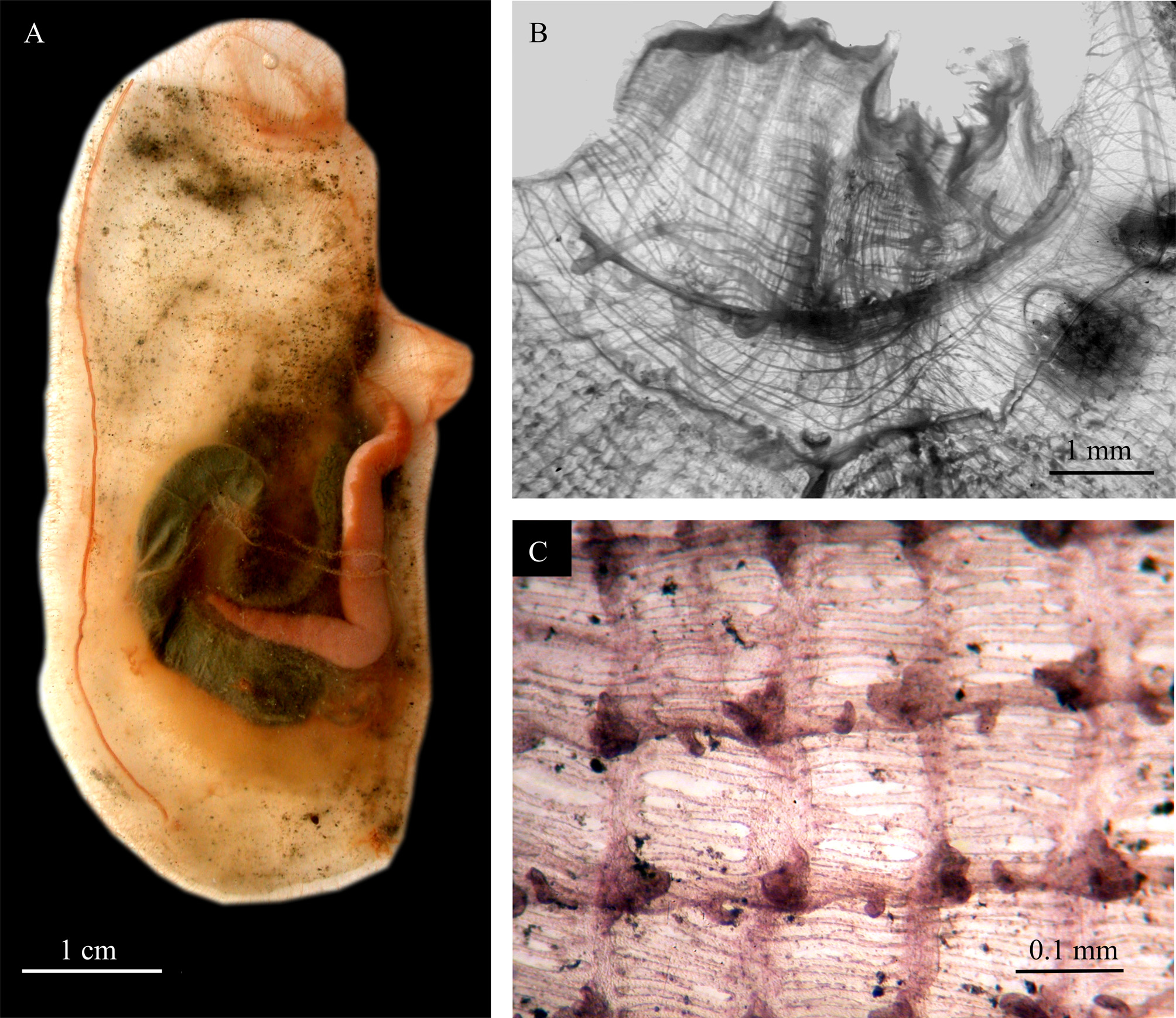
Material examined: One individual; trawl; - 37.9951 lat. - 54.6975 long. (station 7); 852 m; 11 August 2012 — Six individuals; trawl; - 37.9876 lat. - 54.6906 long. (station 8); 854 m; 11 August 2012 — Six individuals; trawl; - 38.0083 lat. - 54.4178 long. (station 11); 1200 m; 12 August 2012 — Two individuals; net; - 37.9548 lat. - 54.3909 long. (station 12); 1308 m; 12 August 2012 (Figures 10 A – C). The specimens are oval in shape and measure 2.5 to 12.2 cm in length (Fig. 10 A). A single row of 28 to 54 filiform and simple oral tentacles are placed in alternated sizes on a wide oral velum (Fig. 10 B). A small dorsal tubercle opens in a wide U or V, with slightly rolled horns. The branchial sac extends down to the body end, covering the entire digestive system. A specimen (nine cm in length) presented 70 longitudinal vessels on its right side and 60 on its left side. The stigmata range from five to ten per mesh. There are crooked branchial papillae at the intersection of every longitudinal and transverse vessel. Intermediate simple papillae are very frequent although not constant (Fig. 10 C). The border of the anus is simple and ends at the level of the top of the primary intestinal loop. The gonads and ramified gonoducts lie on top of the digestive system.
Maggioni, Tamara, Taverna, Anabela, Reyna, Paola B., Alurralde, Gastón, Rimondino, Clara, Tatián, Marcos (2018): Deep-sea ascidians (Chordata, Tunicata) from the SW Atlantic: species richness with descriptions of two new species. Zootaxa 4526 (1): 1-28, DOI: 10.11646/zootaxa.4526.1.1
Export occurrence data
Darwin Core Archive (ZIP)
CLASSIFICATION
Taxonomic Classification Tree

MULTIMEDIA
Media Files(1)
FIGURE 10. Ascidia meridionalis Herdman, 1880. A: individual without tunic; B: oral tentacles, dorsal tubercle and prepharyngeal band; C: detail of branchial sac: stigmata and papillae.
Imageimage/png© Maggioni, Tamara;Taverna, Anabela;Reyna, Paola B.;Alurralde, Gastón;Rimondino, Clara;Tatián, MarcosMaggioni, Tamara;Taverna, Anabela;Reyna, Paola B.;Alurralde, Gastón;Rimondino, Clara;Tatián, Marcos
IMAGES