
AnimaliaNot EvaluatedacceptedspeciesAccepted
Asajirus indicus
(Oka, 1913)
GBIF:154507592
0year
0
Synonyms
ABOUT
Descriptions(2)
Remarks. On the revision of the family Hexacrobylidae, Kott (1989) made Hexacrobylus indicus Oka, 1913 the type species of the new genus Asajirus. Monniot & Monniot (1990) described several species of this group under a new genus Hexadactylus (an objective synonym of Asajirus). Sanamyan & Sanamyan (2006) discussed the features used by Monniot & Monniot (1990) to distinguish among several species and concluded, as Kott 1989 did, that they could not justify specific separation. We agree with Kott (1989) in the recognition of only three species under Asajirus: Asajirus indicus (Oka, 1913), Asajirus dichotomus (Monniot C. & Monniot F., 1984) and Asajirus gulosus (Monniot C. & Monniot F., 1984). Based on morphological evidences Kott (1989) signaled the close relationship between Hexacrobylidae and Molgulidae. Phylogenetic studies based on 18 S rDNA sequences confirmed that the former are in fact highly modified carnivorous Molgulidae (Tatián et al. 2011).
Maggioni, Tamara, Taverna, Anabela, Reyna, Paola B., Alurralde, Gastón, Rimondino, Clara, Tatián, Marcos (2018): Deep-sea ascidians (Chordata, Tunicata) from the SW Atlantic: species richness with descriptions of two new species. Zootaxa 4526 (1): 1-28, DOI: 10.11646/zootaxa.4526.1.1
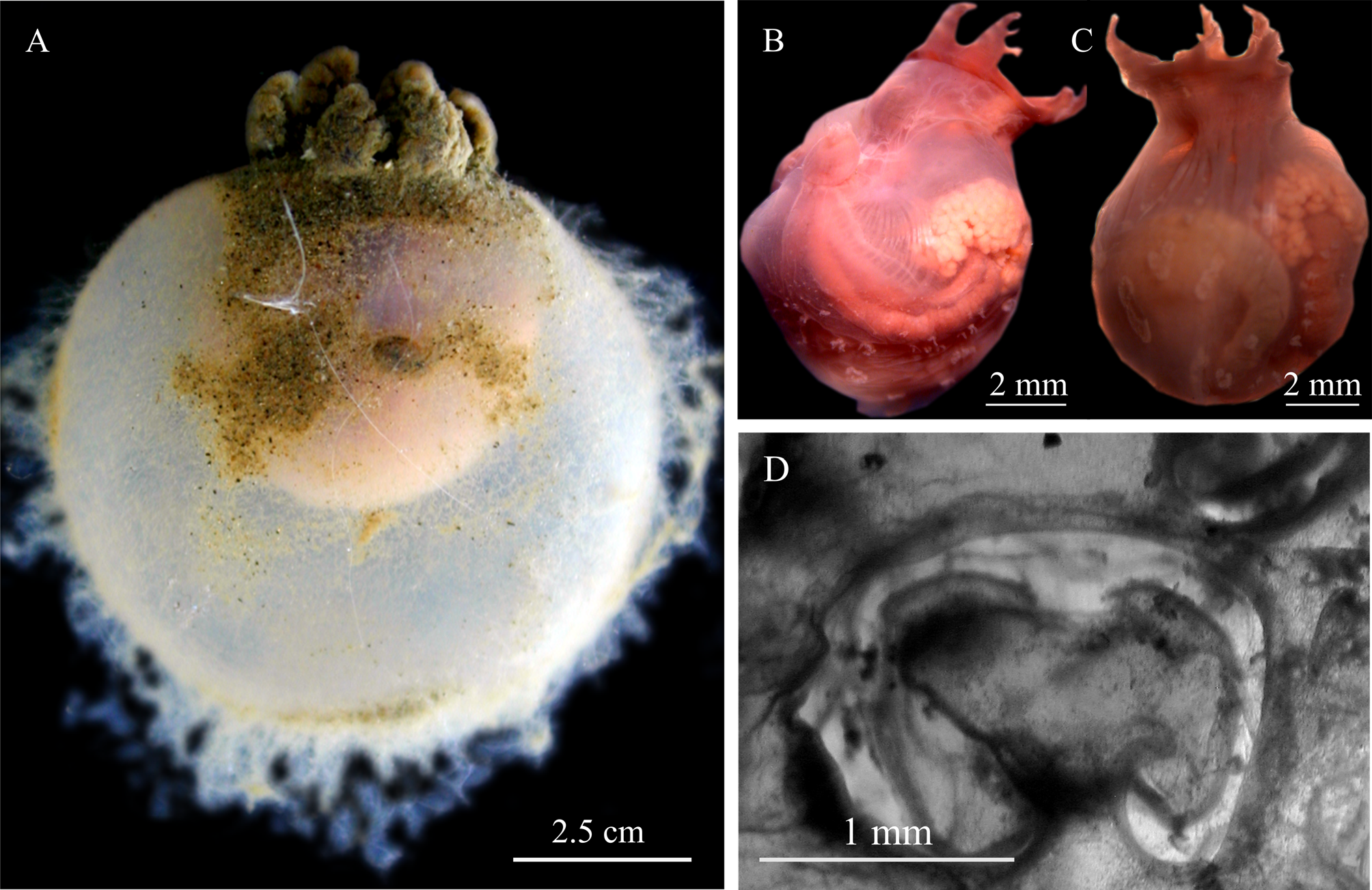
Material examined: 1 individual; trawl; - 37.9651 lat. - 54.5320 long. (station 10); 1144 m; 11 August 2012 — 3 individuals; net; - 37.9448 lat. - 54.1832 long. (station 13); 1508 m; 13 August 2012 — 11 individuals; net; - 37.8717 lat. - 53.9572 long. (station 14); 1738 m; 15 August 2012 (Figures 15 A – D). Specimens are spherical, either ovoid or pyriform-shaped (Fig. 15 A). The biggest specimen measured 2.8 cm long by 2.4 cm wide, while the smallest one was 0.8 cm long by 0.6 cm wide. The oral aperture is surrounded by six big and thick triangular lobes (which Kott 1989 denominated “ branchial arms ”) with pinnate margins. Internally, these lobes acquire branches of the third order. The atrial aperture, located at approximately 1 / 5 from the oral aperture, is inconspicuous. The short pharynx presents two circular perforations that connect with the lateral pharyngeal chambers which, in turn, open to the atrial cavity (Fig. 15 B). The stomach occupies the totality of the ventral side (Fig. 15 C). It is connected with a large and folded hepatic pouch lying above it through a short duct with a circular aperture. The sperm-ducts are also short and open directly into the atrial cavity (Fig. 15 D).
Maggioni, Tamara, Taverna, Anabela, Reyna, Paola B., Alurralde, Gastón, Rimondino, Clara, Tatián, Marcos (2018): Deep-sea ascidians (Chordata, Tunicata) from the SW Atlantic: species richness with descriptions of two new species. Zootaxa 4526 (1): 1-28, DOI: 10.11646/zootaxa.4526.1.1
Export occurrence data
Darwin Core Archive (ZIP)
CLASSIFICATION
Taxonomic Classification Tree

NOMENCLATURE
Synonyms(1)
MULTIMEDIA
Media Files(1)
FIGURE 15. Asajirus indicus (Oka, 1913). A: individual with tunic; B: dorsal side with details of circular musculature, nervous system, atrial aperture and gonads (test removed); C: ventral side with detail of longitudinal muscles, stomach and gonads (test removed); D: ventral side of pharynx showing circular perforations.
Imageimage/png© Maggioni, Tamara;Taverna, Anabela;Reyna, Paola B.;Alurralde, Gastón;Rimondino, Clara;Tatián, MarcosMaggioni, Tamara;Taverna, Anabela;Reyna, Paola B.;Alurralde, Gastón;Rimondino, Clara;Tatián, Marcos
IMAGES