
AnimaliaNot EvaluatedacceptedspeciesAccepted
Molgula setigera
GBIF:154507594
0
Synonyms
ABOUT
Descriptions(2)
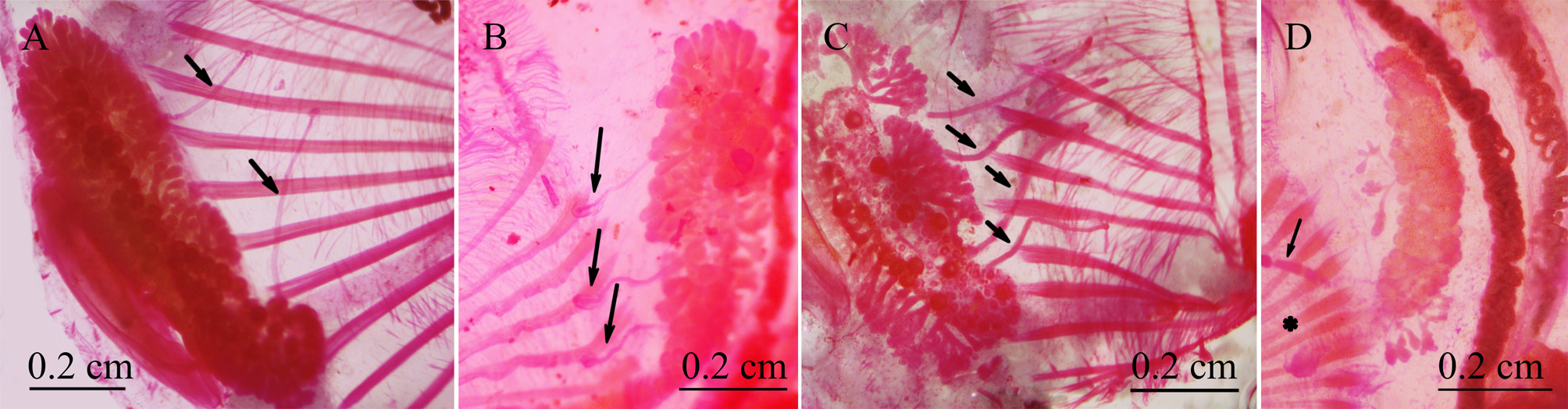
Remarks. Based on the descriptions made by Millar (1960) and the discussion by Kott (1969) about the morphotype, Monniot & Monniot (1983) proposed the existence of three different species based on the characterization of the gonads: (1) Molgula setigera, with only one sperm-duct on each side and the oviduct bent dorsally; (2) Molgula robini Monniot C. & Monniot F., 1983, with many sperm-ducts on both sides and the oviduct bent dorsally; and (3) Molgula marioni Millar, 1960, with only one sperm-duct on each side and the oviduct bent ventrally. The authors also state the correspondence of each species with a particular geographical area. However, our specimens showed a random combination of vas deferens on both sides of the body (Fig. 14 A – D). In sight of this new data, we propose that both M. setigera and M. robini are no longer treated as separate species. Instead, we suggest them to be considered as synonyms. We also found one individual with the oviducts bent ventrally (Fig. 14 D). Monniot & Monniot (1983), on the finding of specimens with the oviducts bent ventrally in the SW Atlantic, proposed a re-colonization of M. marioni from the Sub-Antarctic Region (Crozet, Kerguelen and Marion Islands) to the Magellanic area. However, our data do not support that view. As Kott (1969), we consider that the position of the oviduct does not stand as a valid character to differentiate among the mentioned species, but a result of intra-specific morphological variation. We therefore propose the new synonymy: Molgula robini Monniot C. & Monniot F., 1983 = Molgula marioni Millar, 1960 = Molgula setigera Ärnbäck-Christie-Linde, 1938. The number of sperm-ducts and direction of the oviduct can no longer be considered reliable characters to distinguish among them. The range of distribution of M. setigera is thus expanded, covering from off La Plata River (SW Atlantic) to the area around the South Georgia Islands (Southern Ocean) and the Sub-Antarctic Islands Crozet, Kerguelen and Marion. This is the deepest record of the species, increasing its bathymetric register in 950 m.
Maggioni, Tamara, Taverna, Anabela, Reyna, Paola B., Alurralde, Gastón, Rimondino, Clara, Tatián, Marcos (2018): Deep-sea ascidians (Chordata, Tunicata) from the SW Atlantic: species richness with descriptions of two new species. Zootaxa 4526 (1): 1-28, DOI: 10.11646/zootaxa.4526.1.1
Material examined: Six individuals; net; - 37.9951 lat. - 54.6975 long. (station 7); 852 m; 11 August 2012 — Two individuals; trawl; - 37.9651 lat. - 54.5320 long. (station 10); 1144 m; 11 August 2012 (Figures 14 A – D). All specimens share the characteristic shape and aspect of the species: they are ovoid and flattened dorsoventrally. The tunic, completely covered by a dense layer of sand, presents sparsely distributed long bristle-like projections mainly confined to the area around both apertures. The bigger specimen measured 2.1 cm in diameter, while the smallest one only reached 0.8 cm. There are from 16 to 20 oral tentacles of the third order placed in a single circle. The branchial sac has seven folds on each side, bearing from seven to 11 longitudinal vessels. No longitudinal vessels are found in between the folds. Irregular stigmata form approximately six infundibula along each fold. There is one sausage-like gonad on each side, dorsal to the gut loop and kidney. The ovaries concentrate in the center while the testes are distributed on the margins. Each gonad bears one long and wide oviduct that opens almost at the base of the atrial aperture. It can bend either dorsally or ventrally. The vas deferens is thin and long and also opens near the base of the atrial aperture, running parallel to and some distance away from the oviduct. The number of vas deferens found in our samples was extremely variable (Fig. 14 A – D): there were two specimens with only one vas deferens on each side; two individuals with two vas deferens on each side; one with two vas deferens on the right side but one vas deferens on the left side; one specimen with only one vas deferens on the right side but two on the left side; one with four vas deferens on the right side and only one on the left side; and one individual with four vas deferens on the right side and three on the left side.
Maggioni, Tamara, Taverna, Anabela, Reyna, Paola B., Alurralde, Gastón, Rimondino, Clara, Tatián, Marcos (2018): Deep-sea ascidians (Chordata, Tunicata) from the SW Atlantic: species richness with descriptions of two new species. Zootaxa 4526 (1): 1-28, DOI: 10.11646/zootaxa.4526.1.1
Export occurrence data
Darwin Core Archive (ZIP)
CLASSIFICATION
Taxonomic Classification Tree

MULTIMEDIA
Media Files(1)
FIGURE 14. Molgula setigera Ärnbäck-Christie-Linde, 1938. A: right gonad with two vas deferens (arrows); B: left gonad with tree vas deferens (arrows); C: right gonad with four vas deferens (arrows); D: left gonad with one vas deferens (arrow) and oviduct bent ventrally (*).
Imageimage/png© Maggioni, Tamara;Taverna, Anabela;Reyna, Paola B.;Alurralde, Gastón;Rimondino, Clara;Tatián, MarcosMaggioni, Tamara;Taverna, Anabela;Reyna, Paola B.;Alurralde, Gastón;Rimondino, Clara;Tatián, Marcos
IMAGES