
AnimaliaNot EvaluatedacceptedspeciesAccepted
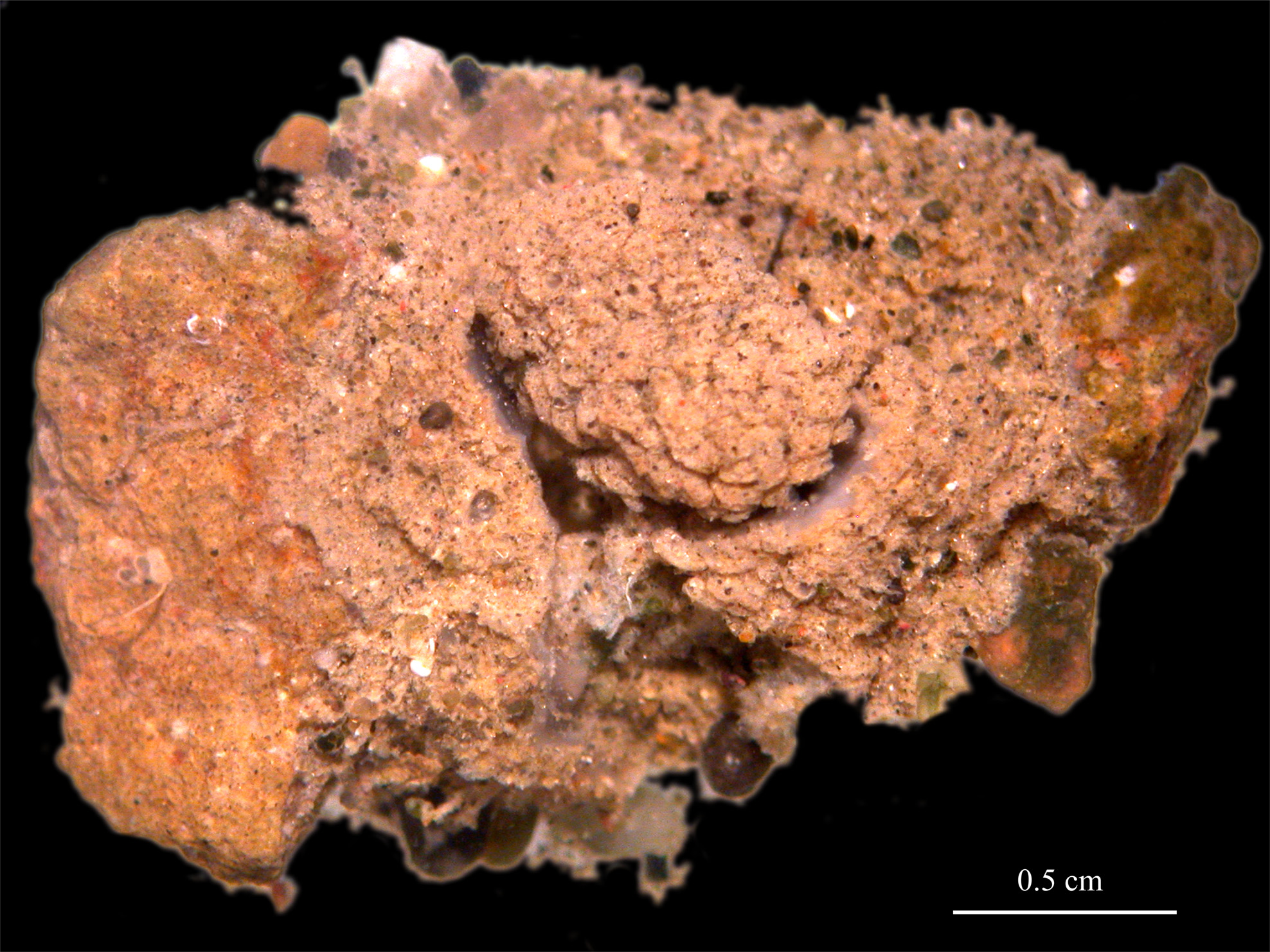
Styela squamosa

Styela squamosa

Herdman, 1881

GBIF:154507601

0year

ABOUT

Descriptions(2)

Remarks. Styela squamosa has been described from most ocean basins in the world, except from the North Atlantic and Indian Oceans, at depths ranging from 165 to 5000 m. This data permits to classify S. squamosa as an eurybathic and cosmopolitan deep-sea species (Monniot C. 1993). There is, though, some degree of character variation that falls into the range of standard intra-specific variability. Our specimen encountered off La Plata River (SW Atlantic), is closest to the description made by Sanamyan (1992) of a few individuals from the Sea of Okhotsk (NW Pacific) in relation to the shape of the border of the anus. While previous descriptions state that the border of the anus is bilobed, Sanamyan´s specimens as well as ours, present a triangular border. The only difference between our specimen and all the rest resides in the number of oral tentacles: 18 in ours and around 30 in the rest.
Maggioni, Tamara, Taverna, Anabela, Reyna, Paola B., Alurralde, Gastón, Rimondino, Clara, Tatián, Marcos (2018): Deep-sea ascidians (Chordata, Tunicata) from the SW Atlantic: species richness with descriptions of two new species. Zootaxa 4526 (1): 1-28, DOI: 10.11646/zootaxa.4526.1.1
Material examined: One individual; trawl; - 37.9651 lat. - 54.5320 long. (station 10); 1144 m; 11 August 2012 (Figure 12). The specimen measures 1.9 cm high and 1.2 cm wide. It was found completely covered by a thick and tough layer of sediment, with rests of sand and pebbles (Fig. 12). There are 18 oral tentacles disposed on the margin of an oral velum. The muscle fibers are densely packed and equally distributed on both sides. The branchial sac has four well developed folds on each side. Thin parastigmatic vessels are present. The stomach presents 24 well-marked folds and bears a small straight pyloric caecum. The border of the anus is triangular and ends near the atrial opening. There is one sinuously curved gonad on each side. The ovary is long and narrow. The small testicular follicles are placed around the distal part of each ovary. Numerous endocarps are distributed on both sides of the body.
Maggioni, Tamara, Taverna, Anabela, Reyna, Paola B., Alurralde, Gastón, Rimondino, Clara, Tatián, Marcos (2018): Deep-sea ascidians (Chordata, Tunicata) from the SW Atlantic: species richness with descriptions of two new species. Zootaxa 4526 (1): 1-28, DOI: 10.11646/zootaxa.4526.1.1

Export occurrence data

Darwin Core Archive (ZIP)

CLASSIFICATION

Taxonomic Classification Tree

MULTIMEDIA

Media Files(1)

FIGURE 12. Styela squamosa Herdman, 1881: dorsal view.

Imageimage/png© Maggioni, Tamara;Taverna, Anabela;Reyna, Paola B.;Alurralde, Gastón;Rimondino, Clara;Tatián, MarcosMaggioni, Tamara;Taverna, Anabela;Reyna, Paola B.;Alurralde, Gastón;Rimondino, Clara;Tatián, Marcos

IMAGES

Gallery(1)

See Gallery

Occurrences with images

Source Information

Deep-sea ascidians (Chordata, Tunicata) from the SW Atlantic: species richness with descriptions of two new species

checklist

This dataset contains the digitized treatments in Plazi based on the original journal article Maggioni, Tamara, Taverna, Anabela, Reyna, Paola B., Alurralde, Gastón, Rimondino, Clara, Tatián, Marcos (2018): Deep-sea ascidians (Chordata, Tunicata) from the SW Atlantic: species richness with descriptions of two new species. Zootaxa 4526 (1): 1-28, DOI: 10.11646/zootaxa.4526.1.1

Abstract

The understudied deep-sea benthic communities from the Southwestern Atlantic continental slope (200 m– 3000 m depth) were sampled on August 2012 in an area located around 38°S that included the Mar del Plata submarine canyon. In these samplings we found a total of 16 ascidian species from six different families, of which two corresponded to new species. These were: Aplidium meridianum (Sluiter, 1906); Aplidium variabile (Herdman, 1886); Aplidium marplatensis Maggioni & Tatián (sp. nov. present work); Aplidium solitarium Maggioni & Tatián (sp. nov. present work); Synoicum georgianum Sluiter, 1932; Synoicum molle (Herdman, 1886); Synoicum sp.; Polysyncraton trivolutum (Millar, 1960); Sycozoa umbellata (Michaelsen, 1898); Ascidia meridionalis Herdman, 1880; Cnemidocarpa drygalskii (Hartmeyer, 1911); Styela squamosa Herdman, 1881; Pyura pilosa Monniot C. & Monniot F., 1974; Molgula pyriformis Herdman, 1881; Molgula setigera Ärnbäck-Christie-Linde, 1938 and Asajirus indicus (Oka, 1913). Based on morphological evidence, we propose the new synonymy: Molgula setigera Ärnbäck-Christie-Linde, 1938 = Molgula marioni Millar, 1960 = Molgula robini Monniot C. & Monniot F., 1983. We also propose to maintain Molgula pyriformis and Molgula malvinensis as separate species. We report: the extension of the distribution range of Aplidium meridianum, Synoicum georgianum, Polysyncraton trivolutum, Sycozoa umbellata, Cnemidocarpa drygalskii, Pyura pilosa and Molgula setigera, being the first time they are collected off La Plata River; the deepest registers for Synoicum georgianum, Poylsyncraton trivolutum, Sycozoa umbellata, Ascidia meridionalis, Pyura pilosa, Molgula pyriformis and Molgula setigera; and the shallowest register for Synoicum molle.

Maggioni T, Taverna A, Reyna P B, Alurralde G, Rimondino C, Tatián M, plazi (2018). Deep-sea ascidians (Chordata, Tunicata) from the SW Atlantic: species richness with descriptions of two new species. Plazi.org taxonomic treatments database. Checklist dataset https://doi.org/10.11646/zootaxa.4526.1.1 accessed via GBIF.org on 2026-06-15.

CC0Published 11/28/2018View dataset
GBIF Usage Key
154507601
Dataset Key
4d211ac6-cbb8-4ef7-b710-44d4f34873ef
Origin
source
Backbone Key
2331976
Taxon ID
A0769C75756AFFB60BB636721799370F.taxon
Last Crawled
6/10/2026
Last Interpreted
6/10/2026