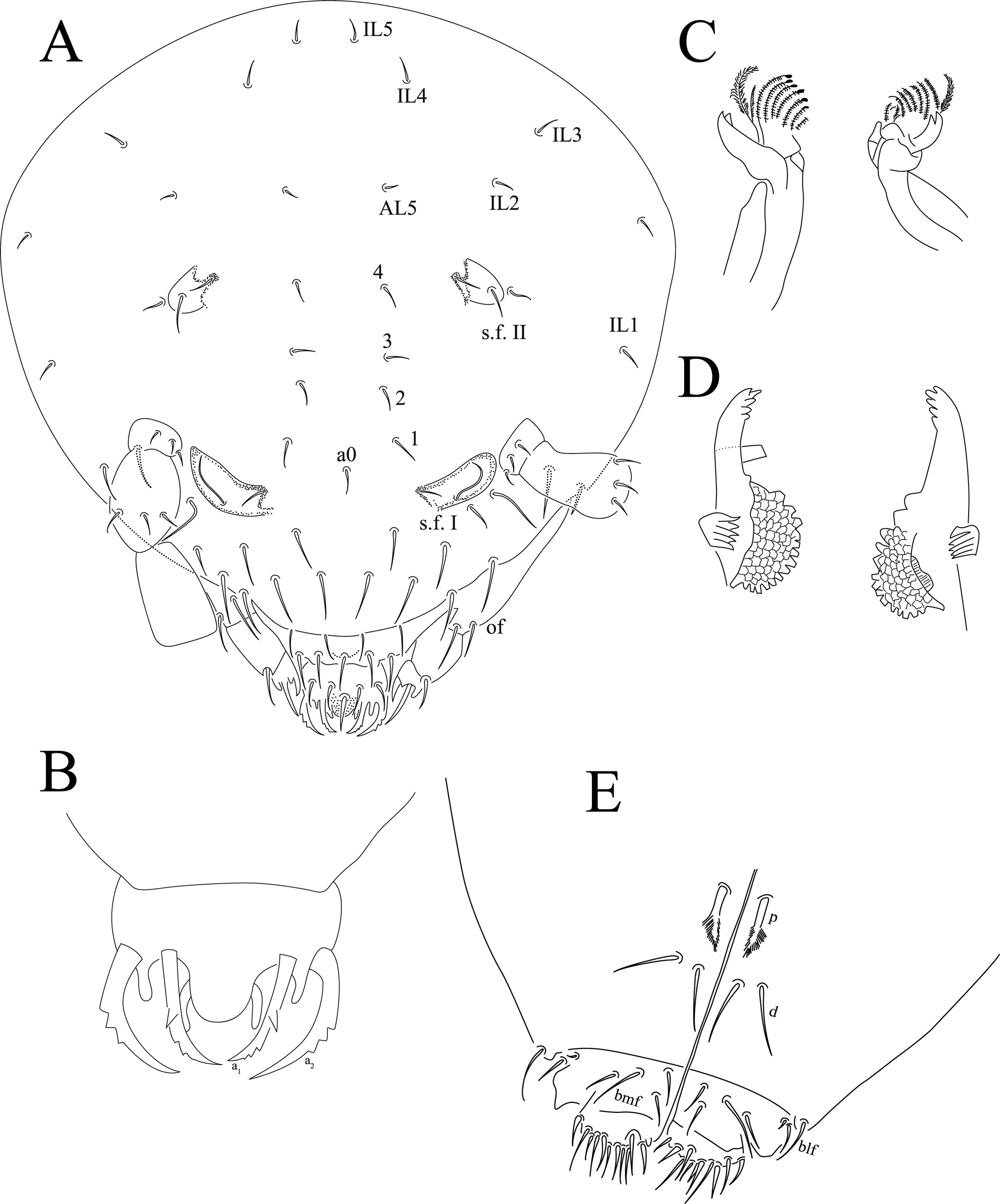
Labrum with 4,5,5,4 setae (Figs 1 A and 5 A). Anterior labral setae a 1 and a 2 thick, curved; a 2 longer than a 1 (16 and 12 µm, respectively). Seta a 1 apically with 3 small serrations and one big basal tooth, a 2 medially with 3 _ 4 strong serrations and some small externally. Medial setae (m-row) subequal (12 µm), smooth, slightly curved, the central one displaced in a small anterior lobe (Figs 1 A, 5 B). Posterior setae (p-row) smooth, subequal and slightly curved (12 µm). Maxillary palp simple, with 1 enlarged terminal seta (11 µm). Basomedian field of labium with 4 + 4 setae (Figs 1 E, 5 D), medial setae longer (16 µm) than others (10 – 11 µm); basolateral field with 1 setae and hyaline microsetae on a big alveolus, as illustrated for N. murinus by Schneider (2017). Ventral side of head with 3 + 3 postlabial setae (18 µm): 2 + 2 distal and 1 + 1 proximal thicker and barbulate (Figs 1 E, 5 C, 5 D). Mandible strong, with 5 apical teeth, and one external appendage, right mandible with an internal triangular tooth between incisive area and molar surface (Fig. 1 D). Maxilla with 6 fringed lamellae (Fig. 1 C). Thorax and abdomen (Fig. 2). Dorsal side of thorax and abdomen covered with ordinary setae, wax rods, swollen S-setae and tertiary rods. Dorso-lateral area of Th. II with: 13 + 13 ordinary setae. Precoxal area of Th. II with 2 + 2 ordinary setae, 1 + 1 τ-setae and 1 + 1 flame-shaped S-setae (s 1). Dorso-lateral area of Th. III-anterior abdomen, with 5 + 5 setae, 2 + 2 round-shaped S setae (s 3, s 3 ’), 7 + 7 wrc (wrc 1 – 7), 8 + 8 τ-setae and several tertiary rods arranged as in Fig. 2 A. Precoxal area of Th. III with 2 + 2 ordinary setae and 1 + 1 τ-setae. Abdomen with about 50 + 50 microsetae (3 – 5 µm), 1 + 1 T-shaped S-setae (s 2), 1 + 1 wrc arranged as in Fig. 2 A. Abd. V, with 4 + 4 setae (17 – 20 µm), VI with 5 + 5 setae (16 – 17 µm), 1 + 1 microsetae (µ. av) and 1 paired posterior mesoseta of anal valve (av, 4 µm) (Fig. 2 E). Male genital plate with 9 + 10 microsetae (6 – 8 µm) arranged in circle (Fig. 2 D). Female genital plate with 4 + 4 setae (9 – 10 µm) and microsetae absent (Fig. 2 E). Abd. IV sternum with 4 + 4 setae (9 – 10 µm), and 1 + 1 distal seta (9 – 10 µm). Ventrally on Abd. III and IV there are one pair of acetabular structures on each side (Fig. 6 C) similar to those of dens. Lateral part of Abd. IV sternum with 1 + 1 short, sharp and curved neosminthuroid setae (8 µm). Appendages. Ant. III and IV distinctly separated (Fig. 4 A). Length of antennae 117 µm, ratio of antenna / head = 0.6. Ratio of Ant. I: II; III; IV as 1: 2,7; 3,7; 4,3. Ant. I with 3 short dorsal setae (5 µm). Ant. II with 4 apical dorsal setae arranged in a whorl. Ant. III with 13 ordinary setae in five whorls (distribution from base to apex: 1, 1, 3, 2 and 6 setae). Antennal organ of Ant. III with 5 apical sensorial elements: Sgd, and Sgv sensilla, two microsensilla; and one ventral m’ spine-shaped (sgd: 15 µm, m: 6 µm, m’: 4 µm). Ant. IV with 10 ordinary setae; 7 sensilla (15 - 19 µm), Sx (10 µm) and Sy (15 µm); 3 long sensilla and 2 rod-like curved setae in apical (a) and subapical position (sa) and subapical organite “ Or ” with two filaments (7 µm). Setation of legs I – III (Figs. 3 A-C): scx I: 1, 1, 3; scx II: 1, 1, 1; coxae: 1, 1, 1; trochantera: 4, 3, 4; femora: 9, 10, 8 and tibiotarsi: 16, 18, 17. Some tibiotarsal setae (table 2) are on a tuberculate alveolus (Fig. 6 B). For details of shape of setae of legs see table 2. Unguis narrow and elongated, both unguis and unguiculus different long in leg I, II and III: unguis 36, 33 and 31 µm, respectively; unguiculus 16, 14 and 16 µm, respectively. Unguis bears one dorsal pseudonychia. Unguiculus untoothed without apical filament, with basal tubercule. Ventral tube with 2 + 2 distal setae and posterior lobe (Fig. 2 B). Retinaculum with 3 + 3 teeth, seta on corpus absent (Fig. 2 C). Furcula well developed (Fig. 4 B), length of manubrium, dens and mucro: 52, 105, and 66 µm, respectively. Manubrium posteriorly with 3 + 3 setae (Fig. 4 B), two distal (17 µm), one proximal (20 µm). Posterior surface of dens I with one long (20 µm) and thick seta, posterio-external part of dens II, with 3 conical spines, one central seta, and one triangular spur on each side, two internal triangular spines in the internal side, anterior surface of dens II with one apical very thin spine (setola). Mucro with both lamellae serrate, tip of mucro rounded. Sensory fields 6 + 6 s. f. placed in depressions each with secretory rod (13 – 15 µm), blunt, straight seta with basal part inserted in the cuticle and placed in upper margin of the field. The fields have following arrangement: (a) anterior and posterior field on head (s. f. I and II; 16 x 9 and 15 x 14 µm respectively) each with secretory rod and 1 internal seta (on anterior field 17 µm, on posterior one 15 µm, and 11 and 9 respectively); (b) large thoracic field (s. f. III; 35 x 20 µm) with secretory rod, 3 internal spines arranged in triangle, 2 marginal setae (13 - 15 µm); and 3 spine-like setae (26 µm); anteriorly with 3 lanceolate spines (axial shorter than lateral); (c) abdominal field VI (s. f. 6; 19 x 14 µm) with secretory rod, 1 curved internal spine, 2 marginal setae (1 internal, 1 external; 8 µm and 13 µm respectively) and T-shaped S-setae (s 2); (d) fields in the precoxal area of Th. II and III (s. f. IV, V; 18 x 14, and 20 x 19 µm, respectively) each with secretory rod, 2 curved spines. Both s. f. with 2 marginal external setae (9 - 16 µm). Both sexes known. Males are smaller than females, the only other difference between sexes is in shape and chaetotaxy of genital area, 18 microsetae in males (Fig. 6 D) vs. 10 in females.
Marín, Elida P., Palacios-Vargas, José G. (2018): Redescription of Neelus fimbriatus Bretfeld & Trinklein, 2000 (Collembola: Neelidae) from Colombia. Zootaxa 4527 (3): 414-424, DOI: 10.11646/zootaxa.4527.3.10