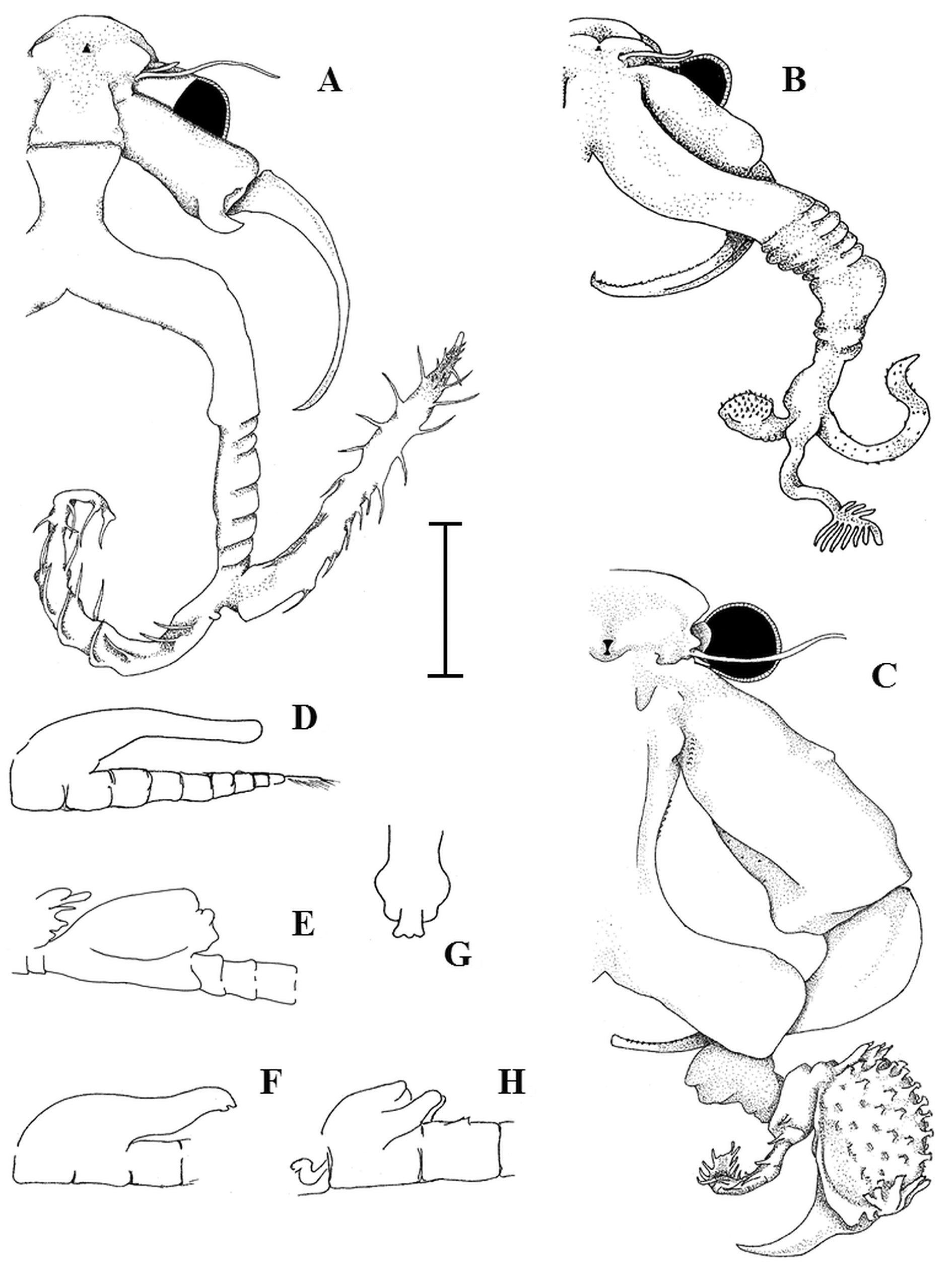
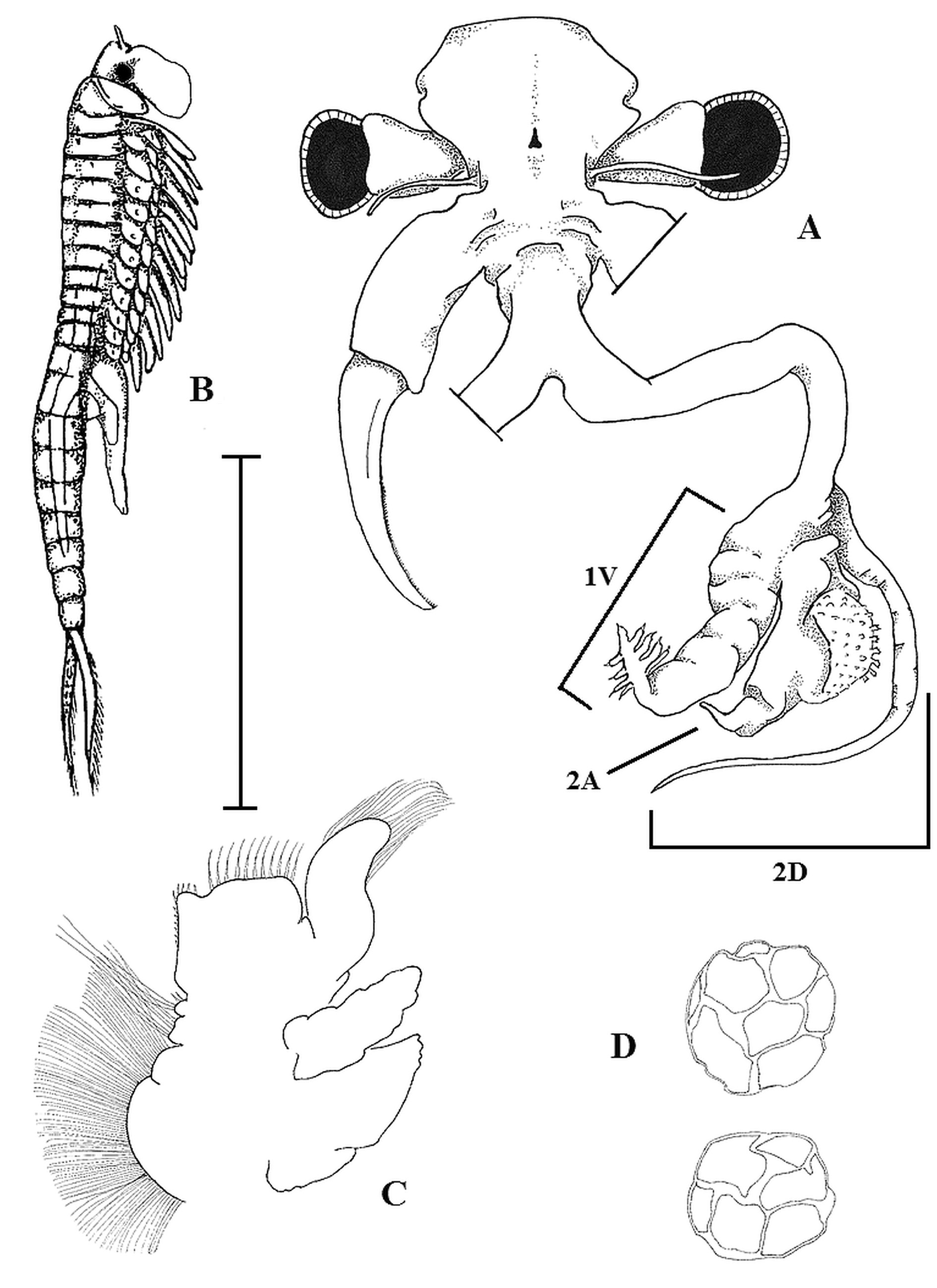
Description Male LENGTH. Average length of preserved material: 4.5 mm (males) and 8.2 mm (females) from apex of head to apex of telson. HEAD (Fig. 2 A). Male anteriolateral corner of head slightly projecting over eyestalk base. Labrum smooth. Antenna-like appendage anteriobasal to eyestalk, filiform, obscure, length approximately 0.1 × eyestalk peduncle. First antenna approximately 85 % the length of eye plus eyestalk. Second antenna capable of extending to thoracomere II or III. Second antennal proximal antennomere subcylindrical, smooth, with length approximately 3.0 × distoapical width. Proximal antennomere distal end with short, medial, lobiform projection. Projection protruding slightly distally, smooth, apically rounded, length approximately 0.1 × antennomere. Second antennal distal antennomere length slightly longer than proximal antennomere, flattened anterioposteriorly, gently arcuate medially, with apex acute and directed medially. Medial edge distal ~ 55 % margined with fine, aciculate denticles, directed subdistally. Cephalic appendage prominent, typical of the subgenus. Proximal trunk subcylindrical, smooth, lacking spines. Primary branches smooth, lacking spines, diverging approximately even with the distal end of the second antenna proximal antennomere. Primary branch triramal. Distal branches diverging at distal end of primary branch. Primary branch length ~ 3.4 × proximal trunk. Branch 2 V thick, flattened, with numerous semiannulations. Length ~ 0.7 × primary branch. Apex tapering in distal third. Distal fourth with four lateral lobes on each margin. Lobes and apex tipped with an acute spine. Spine length ~ 2.5 × basal width. Branch 2 D flagelliform, subequal in length to primary branch, lacking spines or setae. Branch 2 A roughly triangular, with a chitinised tumid area covering approximately one third of the lateral surface, bearing rows of large chitinised, spiniform projections. Spiniform projections smaller distally and medially, length ranging from ~ 0.5 × to 1.0 × basal width. Spiniform projections posteriorly and laterally becoming larger, subcylindrical, length ranging from ~ 1.0 × to 2.0 × basal width, each bearing an apical ring of spinulae. Spinulae number three to five per projection. Branch 2 A distally chitinised, hamulate, with apex subacute. Distal hamulate projection chitinised, length ~ 0.25 total branch 2 A length. Maxillae lobiform and transverse, no setae visible. THORACOPODS (Fig. 2 C). Serially homologous. Thoracopod V with endites margined with long, plumose setae. Endite VI with two distal spines. Endopod subquadrate, with distal margin bearing a submedial emargination. Endopod with distomedial margin bearing a row of acute spines, length ~ 3 × basal width, separated by their basal width. Endopod distal margin mesad of emargination with four spines, slightly curved posteriorly, length ~ 4 × basal width, separated by their basal width. Endopod distal margin lateral of emargination bearing a row of cirriform setae, length ~ 5.0 × to 6.0 × the distal spines. Endopod of all thoracopods, except thoracopod I lack setae on basomedial margin. Thoracopod I and II endopods as in other limbs, although the basomedial margin bears a few obscure filiform setae. Exopod lamellar, sinuate, margined in distal half with long, plumose, recurved setae. Epipodite elliptic and without marginal setae. Margins crenulate. Praepipodite broadly triangular, lamellar, without marginal setae, bearing a light mediolateral cleft. GENITALIA. Genital segments smooth. Retracted gonopod as for genus. Everted gonopods not observed. Abdomen smooth, cercopods ¾ as long as abdomen, margined with plumose setae. Female Generally as typical for the genus (Fig. 2 B). HEAD. Rounded, anterolateral corners slightly projecting over eyestalk base. First antenna length 0.25 × second antenna. Second antenna broadly elliptic, lamellar. Thorax smooth. Thoracopods as in male, except endopods lacking emargination. BROOD POUCH. Fusiform, extending to proximal margin of postgenital abdominal segment IV. Eggs Subspherical, diameter approximately 190 μm, with large, broad pentagonal or quadragonal facies, each face diameter approximately 60 μm (Fig. 2 D).
Rogers, D. Christopher, Dunn, Ann, Price, W. Wayne (2019): A review of Dendrocephalus (Dendrocephalinus) (Crustacea: Anostraca) with the first records of male-male anostracan aggressive competition. European Journal of Taxonomy 509: 1-14, DOI: 10.5852/ejt.2019.509