AnimaliaNot EvaluatedacceptedspeciesAccepted
Carybdea branchi

Carybdea branchi

Gershwin & Gibbons, 2009

GBIF:154529884

0year

ABOUT

Descriptions(5)

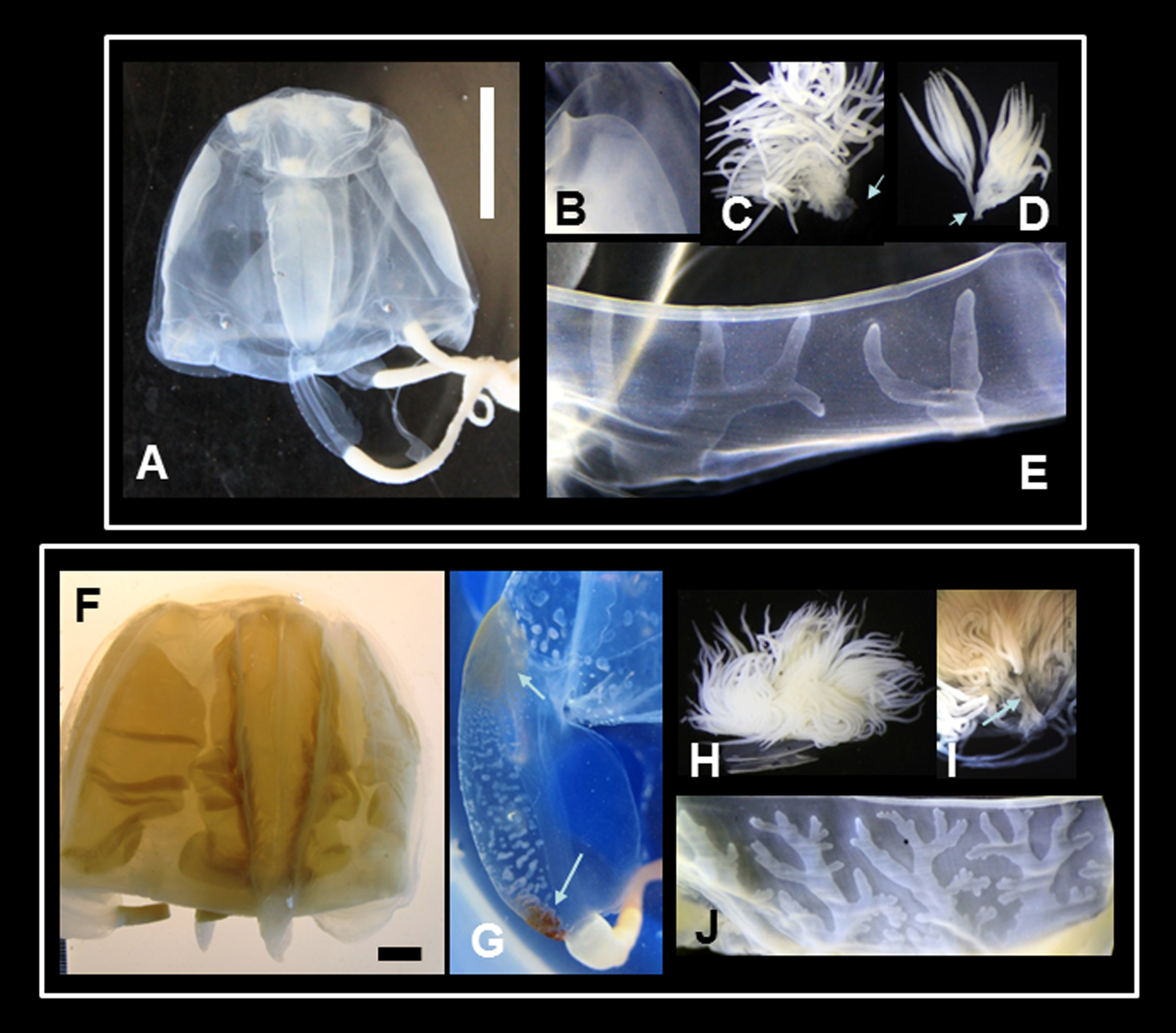
Description: Adult Medusa: Bell (Fig. 2 F), highly transparent, gastric phacellae, yellowish to reddish-brown, pedalia light brown at outer wing base, reddish brown at distal end of outer wing – pigmentation fades very fast after preservation; cube-shaped, densely scattered with white nematocyst warts of different shapes and sizes; mammilation scatters bell from apex to bell margin (bigger nematocyst warts at interradial furrows and bell margin, smaller nematocyst warts on bell sides and apex); apex plane convex, thick mesoglea, no horizontal constriction near the top present. Bell height 50 – 70 mm high, bell width up to 65 – 90 mm (preserved specimens). Pedalia (Fig. 2 G), 4, simple, unbranched, flattened, scalpel-shaped, brownish colour marks on base and distal end of outer wing, measures approx. 1 / 2 bell height in length, situated in each interradial corner, outer keel densely scattered with irregular, white nematocyst warts, carrying single, flesh coloured tentacle; pedalial canal stark depressed at base, square in diameter with lateral keels, going straight through pedalium, showing a volcanoshaped, upwards turned knee bend without appendage. Rhopalia, 4, located inside heart-shaped rhopalial niche ostium. Orifice with triangular upper covering scale with pointed tip, 2 narrow, longish, lower scales, creating a compressed or narrow heart-shaped orifice (resembling almost Y-shaped); very small, round nematocyst warts scattered on scale; approx. 1 / 4 to 1 / 5 of bell height up from margin; rhopalium with 6 eyes (2 median lens eyes + 2 lateral slit eyes + 2 lateral pit eyes). Velarium (Fig. 2 J), free of nematocyst warts, containing 2 velarial canal roots per octant, canals dendritic, some side branches tend to grow in centripetal direction (growth directed away from velarial margin, as defined by Thiel 1970); canals flanking frenulum are as complexly branched as the ones flanking pedalia with 2 to 4 dendritic, lobed main branches and several dendritic, lobed side branches. Manubrium (1 / 2 – 2 / 3 bell height in length) with conspicuously long and broad mouth arms (2 / 3 manubrium length), tips rounded, without nematocyst warts, and connected to flat and shallow stomach; stomach communicates perradially with 4 gastric pockets leading into velarial canals. Gastric phacellae (Fig. 2 H), 4, epaulette-shaped, mounted on 4 stomach corners, consisting of 15 – 20 brush-shaped filaments per quadrant, multiple stalked, stalks of filaments tightly aligned (Fig. 2 I), originated from one root. Gonads, 4 pairs, broad leaf-like to ovoid shape, separated by unperforated interradial septum, extending from stomach rim to bell margin, tapering slightly towards stomach rim and bell margin; sexes separated but unimorph.
Acevedo, Melissa J., Straehler-Pohl, Ilka, Morandini, André C., Stampar, Sergio N., Bentlage, Bastian, Matsumoto, George I., Yanagihara, Angel, Toshino, Sho, Bordehore, César, Fuentes, Verónica L. (2019): Revision of the genus Carybdea (Cnidaria: Cubozoa: Carybdeidae): clarifying the identity of its type species Carybdea marsupialis. Zootaxa 4543 (4): 515-548, DOI: 10.11646/zootaxa.4543.4.3
Figs. 2 F – J
Acevedo, Melissa J., Straehler-Pohl, Ilka, Morandini, André C., Stampar, Sergio N., Bentlage, Bastian, Matsumoto, George I., Yanagihara, Angel, Toshino, Sho, Bordehore, César, Fuentes, Verónica L. (2019): Revision of the genus Carybdea (Cnidaria: Cubozoa: Carybdeidae): clarifying the identity of its type species Carybdea marsupialis. Zootaxa 4543 (4): 515-548, DOI: 10.11646/zootaxa.4543.4.3
Diagnosis: Robust and well sculpted body; gastric phacellae epaulette shaped, single rooted, multiple stemmed; velarial canals 2 per octant; complexely branched; pedalia knee bend upwards turned volcano-shaped. The brownish pigmentation of the phacellae and pedalia is characteristic of this species.
Acevedo, Melissa J., Straehler-Pohl, Ilka, Morandini, André C., Stampar, Sergio N., Bentlage, Bastian, Matsumoto, George I., Yanagihara, Angel, Toshino, Sho, Bordehore, César, Fuentes, Verónica L. (2019): Revision of the genus Carybdea (Cnidaria: Cubozoa: Carybdeidae): clarifying the identity of its type species Carybdea marsupialis. Zootaxa 4543 (4): 515-548, DOI: 10.11646/zootaxa.4543.4.3
Remarks: Gershwin & Gibbons (2009) described C. branchi as a new species from South African waters. Previously, C. branchi had been misidentified in the literature as either Carybdea alata (Alatina alata) or Tamoya haplonema. Reported distribution of C. branchi: South Africa (South Atlantic)
Acevedo, Melissa J., Straehler-Pohl, Ilka, Morandini, André C., Stampar, Sergio N., Bentlage, Bastian, Matsumoto, George I., Yanagihara, Angel, Toshino, Sho, Bordehore, César, Fuentes, Verónica L. (2019): Revision of the genus Carybdea (Cnidaria: Cubozoa: Carybdeidae): clarifying the identity of its type species Carybdea marsupialis. Zootaxa 4543 (4): 515-548, DOI: 10.11646/zootaxa.4543.4.3
Material examined: Seven (7) living adult individuals collected by the authors for gross morphological examinations; 5 preserved adult individuals for detailed morphological observations, Hout Bay (South Africa); collected by A. C. Morandini & S. N. Stampar, May 0 5, 2013; preserved in 5 % formaldehyde solution. One (1) specimen deposited in the Natural History Museum of Barcelona (Museu de Ciències Naturals de Barcelona), Spain (MZB 2015 - 4807). Four (4) specimens deposited in the Natural History Museum of London (NHM 2000.1800 - 1803), labelled as Carybdea robsonae by Gershwin 2000, (mentioned as “ paratypes ” in Gershwin & Gibbons 2009), Simon’s Town Docks, False Bay, South Africa, collected 17 November 1938 by the Discovery Expedition. One (1) specimen deposited in the Royal Belgian Institute for Natural Science in Brussels (RBINS I. G. 11204) labelled as “ Tamoya haplonema ” by Dr. G. Ranson, collected 18 January 1937 by the Cruise of " Mercator ", 4 miles off Luderitz Bay (Namibia, Africa).
Acevedo, Melissa J., Straehler-Pohl, Ilka, Morandini, André C., Stampar, Sergio N., Bentlage, Bastian, Matsumoto, George I., Yanagihara, Angel, Toshino, Sho, Bordehore, César, Fuentes, Verónica L. (2019): Revision of the genus Carybdea (Cnidaria: Cubozoa: Carybdeidae): clarifying the identity of its type species Carybdea marsupialis. Zootaxa 4543 (4): 515-548, DOI: 10.11646/zootaxa.4543.4.3

Export occurrence data

Darwin Core Archive (ZIP)

CLASSIFICATION

Taxonomic Classification Tree

MULTIMEDIA

Media Files(1)

FIGURE 2. Characters for identification of Carybdea species (species in order of appearance in the text; preserved specimens). C. arborifera: A) adult medusa (preserved) B) rounded pedalial canal knee bend C) epaulette-shaped gastric phacellus, note multiple stems of gastric filaments (arrow) D) two short-stemmed (arrow), brush-shaped gastric filaments E) octant of velarium with 2 velarial canal roots, note broad and quite simple branching structure of velarial canals. C. branchi: F) adult medusa (preserved) G) colourful pedalium of living specimen H) epaulette-shaped gastric phacellus I) close up of base of gastric phacellus, note single root as origin of gastric filaments (arrow) J) octant of velarium with 2 velarial canal roots, note complex lobes and branching structure of velarial canals.

Imageimage/png© Acevedo, Melissa J.;Straehler-Pohl, Ilka;Morandini, André C.;Stampar, Sergio N.;Bentlage, Bastian;Matsumoto, George I.;Yanagihara, Angel;Toshino, Sho;Bordehore, César;Fuentes, Verónica L.Acevedo, Melissa J.;Straehler-Pohl, Ilka;Morandini, André C.;Stampar, Sergio N.;Bentlage, Bastian;Matsumoto, George I.;Yanagihara, Angel;Toshino, Sho;Bordehore, César;Fuentes, Verónica L.

IMAGES

Gallery(1)

See Gallery

Occurrences with images

Source Information

Revision of the genus Carybdea (Cnidaria: Cubozoa: Carybdeidae): clarifying the identity of its type species Carybdea marsupialis

checklist

This dataset contains the digitized treatments in Plazi based on the original journal article Acevedo, Melissa J., Straehler-Pohl, Ilka, Morandini, André C., Stampar, Sergio N., Bentlage, Bastian, Matsumoto, George I., Yanagihara, Angel, Toshino, Sho, Bordehore, César, Fuentes, Verónica L. (2019): Revision of the genus Carybdea (Cnidaria: Cubozoa: Carybdeidae): clarifying the identity of its type species Carybdea marsupialis. Zootaxa 4543 (4): 515-548, DOI: 10.11646/zootaxa.4543.4.3

Abstract

While records of Carybdea marsupialis in the literature suggest a worldwide distribution of this species, the validity of some of these records has been questioned recently, as has the validity of some nominal Carybdea species. We inspected material of all known species of Carybdea from multiple locations (i.e. Spain, Algeria, Tunisia, Puerto Rico, California, Hawaii, Australia, South Africa, and Japan) using morphological and genetic tools to differentiate Carybdea species as well as understand their evolutionary relationships. We observed morphological differences between adult medusae of Mediterranean and Caribbean C. marsupialis; the most obvious differences were the structure of the phacellae, the structure of the pedalial canal knee bend, and the number and structure of the velarial canals. The characters of the adult Mediterranean specimens agree with the description provided by Claus (1878) for individuals of C. marsupialis from the Adriatic Sea (Italy); specimens from the Caribbean (Puerto Rico) agreed with the description of C. xaymacana by Conant (1897). Significant differences between both species were also observed in the newly released medusa stage. Further, we resolved a discord about the undefined polyp culture originating from Puerto Rico that was long considered Carybdea marsupialis but should be referred to as C. xaymacana. Although C. marsupialis is currently considered the only species of Cubozoa to occur in the Mediterranean, specimens collected in Algeria and Tunisia suggest that species of Alatinidae may also be present in the Mediterranean. Our investigations indicate that Carybdea spp. are more restricted in their geographical distribution than has been recognized historically. These findings confirm that Carybdea arborifera Maas, 1897 from Hawaii, Carybdea branchi, Gershwin & Gibbons, 2009 from South Africa, Carybdea brevipedalia Kishinouye, 1891 from Japan, Carybdea confusa Straehler-Pohl, Matsumoto & Acevedo, 2017 from California, Carybdea marsupialis Linnaeus, 1758 from the European Mediterranean Sea, Carybdea rastonii Haacke, 1886 from South Australia, and Carybdea xaymacana, Conant, 1897 from the Caribbean Sea are valid names representing distinct species, rather than synonyms. A taxonomic key for all valid species is provided, and a neotype for C. marsupialis is designated.

Acevedo M J, Straehler-Pohl I, Morandini A C, Stampar S N, Bentlage B, Matsumoto G I, Yanagihara A, Toshino S, Bordehore C, Fuentes V L, plazi (2019). Revision of the genus Carybdea (Cnidaria: Cubozoa: Carybdeidae): clarifying the identity of its type species Carybdea marsupialis. Plazi.org taxonomic treatments database. Checklist dataset https://doi.org/10.11646/zootaxa.4543.4.3 accessed via GBIF.org on 2026-06-17.

CC0Published 1/9/2019View dataset
GBIF Usage Key
154529884
Dataset Key
9a6e20a7-1a82-439c-bf30-07a892b110ef
Origin
source
Backbone Key
4340378
Taxon ID
03B45208FFE5F01F14B9FED6DCE29A57.taxon
Last Crawled
6/10/2026
Last Interpreted
6/10/2026
