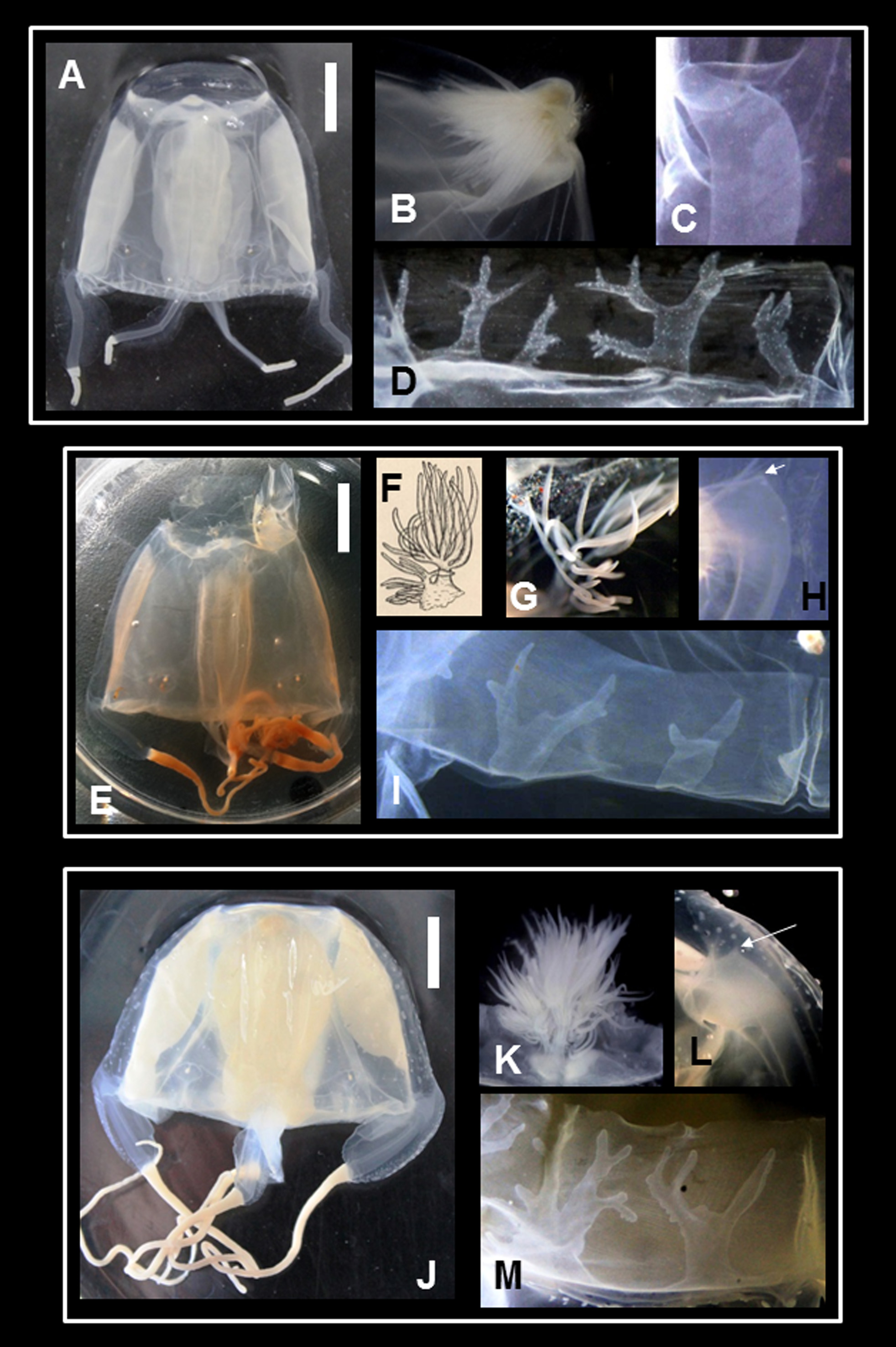
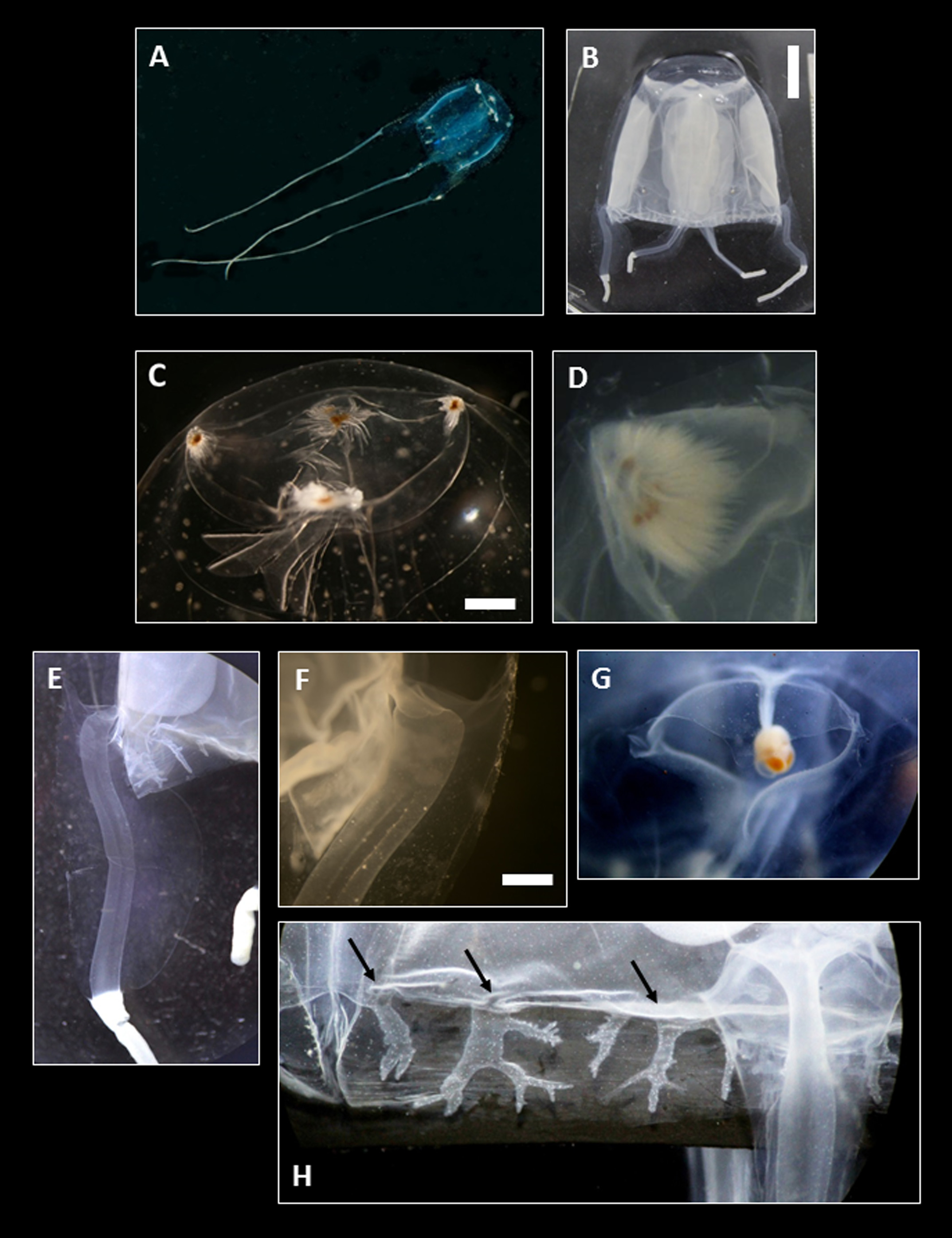
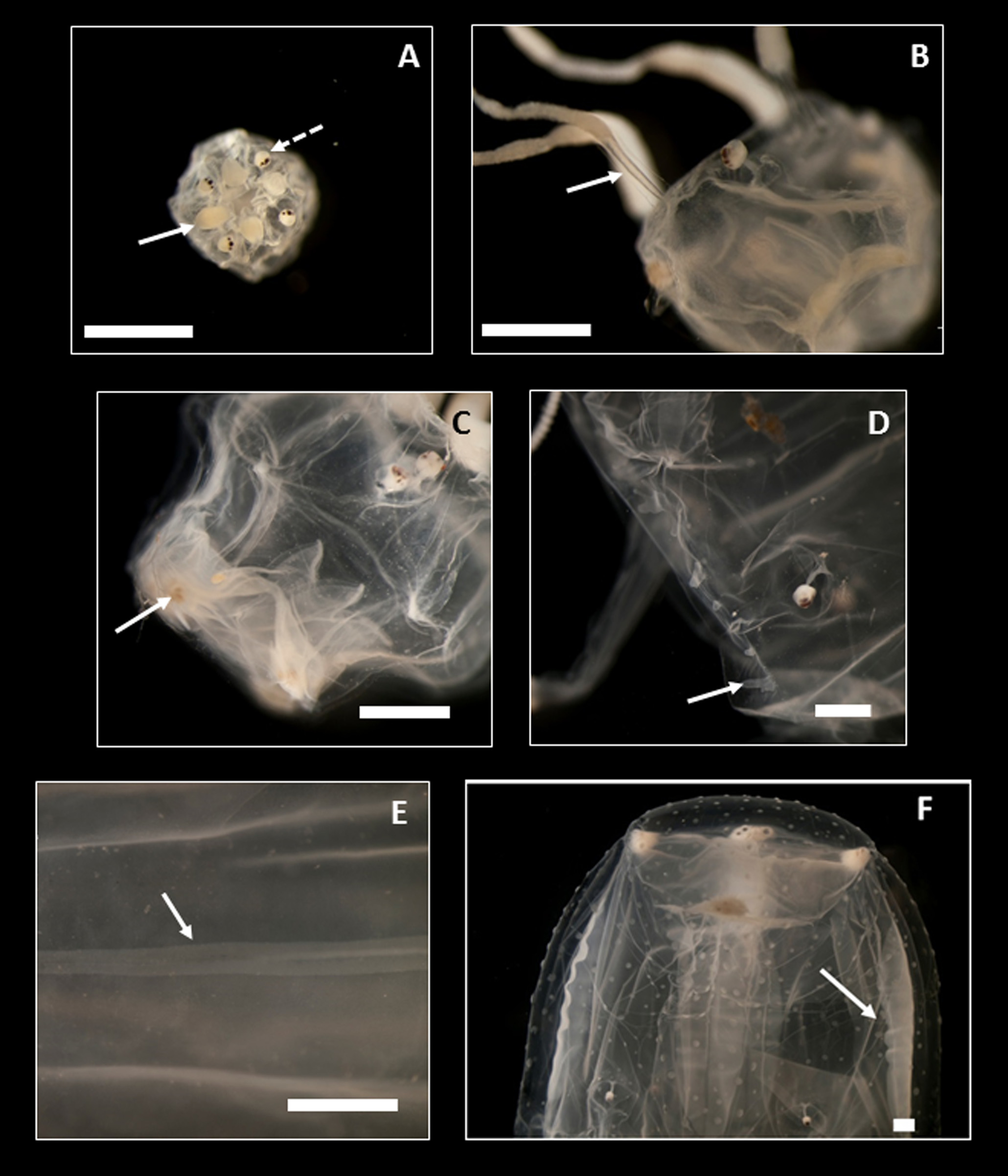
Description: Adult medusa: (Figs. 1 A – D, 5 A – H) Bell sturdy, cuboid, slightly wider than high (BH: DBW ratio less than or equal to 1: 1, Fig. 5 A, B), interradial furrows shallow, highly transparent with few whitish nematocyst warts sparsely scattered on bell from apex (very small warts) to bell margin (big warts along interradial furrows), amount of warts varies between specimens (i. e. some individuals present few or no warts; others have profuse warts); apex, thickened, domed, with slight horizontal constriction at level of gastric phacellae; bell height up to 40.5 mm high, bell width up to 40 mm (DBW). Pedalia (Fig. 5 E), 4, simple, unbranched, flattened, scalpel-shaped, measures approx. 1 / 3 the bell height in length, situated in each interradial corner, with irregularly spaced white nematocyst bands on outer keel of pedalium, smaller warts scatter on outer half of pedalium; in some mature medusae margin of inner keel of pedalium sometimes undulated. Pedalium carrying a single tentacle, tentacles light brownish pink colour when contracted, when extended resemble bead-chains with white nematocyst-battery “ pearls ” on pale pink tentacle “ string ”. Pedalial canal with rectangular knee without any hook or thorn appended on outer knee bend (Fig. 5 F), slightly tapering at the upper end, straight (not bending) throughout the length of the pedalium but slightly curving towards the inner pedalial keel in the middle part, ellipsoid in diameter with sharp outer keels. Rhopalia (Fig. 5 G), 4, suspended within heart-shaped rhopalial niche ostium with triangular upper covering scale, without lower covering scale; some specimens present covering scale with nematocyst mammilation (1 or 2 warts), but not the neotype; approx. 1 / 5 of bell height up from bell margin; rhopalium with 6 eyes (2 median lens eyes + 2 lateral slit eyes + 2 lateral pit eyes). Velarium (Figs. 5 H) with some small nematocyst warts, containing 3 velarial canals per octant (i. e. 6 v. c. / quadrant), slim, sharply pointed tips, deeply forked, slightly lobed with smooth margin, canals flanking frenulum are the simplest, mostly unforked, only few small lobes, middle canals, seldom more than 2 main branches, only single side branches, canals flanking pedalia bases, most complex with 3 to 4 main branches and several side branches. Manubrium (ḵ 1 / 4 BH in length), 4 lobes, cruciform lacking nematocyst warts connected to a small, flat (biconvex lens-shaped) stomach which is connected by narrow, non-conspicuous, perradial mesenteries to the sides of the umbrella; stomach communicates perradially with 4 gastric pockets leading into velarial canals. Gastric phacellae (Fig. 5 C), 4, epaulette-shaped, mounted on 4, conspicuously raised stomach corners; filaments brush-like, tightly bundled, originating from a single stem, deeply branched at some distance from the stalk, with numerous short gastric filaments; phacellae brownish-orange in colour, colour remains after preservation (Figs. 5 C, D). Gonads, 4 pairs, narrow leaf-like, separated by perforated interradial septum, extending from stomach rim to pedalium, tapering at level of rhopalia and towards stomach rim; ripe gonads milky whitish in both sexes. Developmental stages: Development of young medusae to adult stage has been documented herein. We classified the individuals of C. marsupialis captured in Denia (Spain) from June to October 2010 into 6 different developmental stages, using both size and different morphological characters as indicators of the development of the animals. The 6 stages were named from A to F (Figs. 6 A – F). By monitoring the development of small cubomedusae into subsequent stages (Acevedo et al. 2013), we confirmed that they all belong to the same species C. marsupialis. Stage A (MZB 2015 - 4801, n = 10): Although the metamorphosis from polyp to medusa has not been observed and described yet, very small medusae (<2 mm DBW; supposed recently liberated from the polyp) were caught in the field (Denia, Spain) in this study. Initial stage A (Fig. 6 A): whitish-colourless, tetraradial, spheroid to cuboid umbrella with large round warts irregularly dispersed over entire exumbrella; bell height up to 1.4 mm, bell width up to 2.2 mm. Tentacles, 4, without pedalia, resembling pearl-string with white, spherical nematocysts batteries. Velarial canals and rhopaliar niche ostia, not yet developed, rhopalium with 6 eyes (2 median complex lens eyes + 2 lateral slit eyes + 2 lateral pit eyes). No gastric filaments. Stage B (MZB 2015 - 4802, n = 12): Mean bell height (BH) 1.5 (± 1.0) mm, mean bell width (DBW) 2.1 (± 0.7) mm; although an overlap in size with stage A exists, the main difference is the appearance of gastric filaments, 4, one in each stomach corner; velarial canals not yet developed; rhopalial niche with scale, pedalia, 4, begin to develop (Fig. 6 B). Stage C (MZB 2015 - 4803, n = 8): Mean BH 2.1 (± 1.7) mm, mean DBW 3.1 (± 1.6) mm; gastric phacellae, completely developed (Fig. 6 C); velarial canals not yet developed; pedalia, 4, still developing. Stage D (MZB 2015 - 4804, n = 8): Mean BH 4.3 (± 4.2) mm, mean DBW 6.4 (± 3.9) mm; velarial canals, begin to develop (Fig. 6 D); pedalia development completed; gonads, appearance of gonadal tissue along the interradial septum. Stage E (MZB 2015 - 4805, n = 2): Mean BH 15.8 (± 9.1) mm, mean DBW 19.1 (± 10.7) mm; velarial canals and pedalia completely developed; gonads, developing but not yet mature, distinction of sex not yet possible (Fig. 6 E). Stage F (MZB 2015 - 4806, n = 4): Mean BH 23.7 (± 2.1) mm, mean DBW 28.8 (± 2.7) mm; Gonads, mature, sex distinction possible (males: finger-print appearance; females: oocytes) (Fig. 6 F).
Acevedo, Melissa J., Straehler-Pohl, Ilka, Morandini, André C., Stampar, Sergio N., Bentlage, Bastian, Matsumoto, George I., Yanagihara, Angel, Toshino, Sho, Bordehore, César, Fuentes, Verónica L. (2019): Revision of the genus Carybdea (Cnidaria: Cubozoa: Carybdeidae): clarifying the identity of its type species Carybdea marsupialis. Zootaxa 4543 (4): 515-548, DOI: 10.11646/zootaxa.4543.4.3