AnimaliaNot EvaluatedacceptedspeciesAccepted
Hypogastrura satkosiaensis

Hypogastrura satkosiaensis

Mandal & Arbea, 2019

GBIF:157232192

0year

ABOUT

Descriptions(6)

Ecology. In moss, leaf litter of tree trunk of tall trees or moist and blackish soil, in dry mixed deciduous forest, dominated by Bamboo (Family Bambuseae) and shala (Shorea robusta) trees, surrounded by Mahanadi River which in turn influences the habitat landscape of the Satkosia Wildlife Sanctuary.
Mandal, Guru Pada, Arbea, Javier (2019): Critical Checklist of the Indian species of Hypogastrura (Collembola: Hypogastruridae) with a description of a new species from Satkosia Wild Life Sanctuary. Zootaxa 4608 (2): 279-290, DOI: 10.11646/zootaxa.4608.2.5

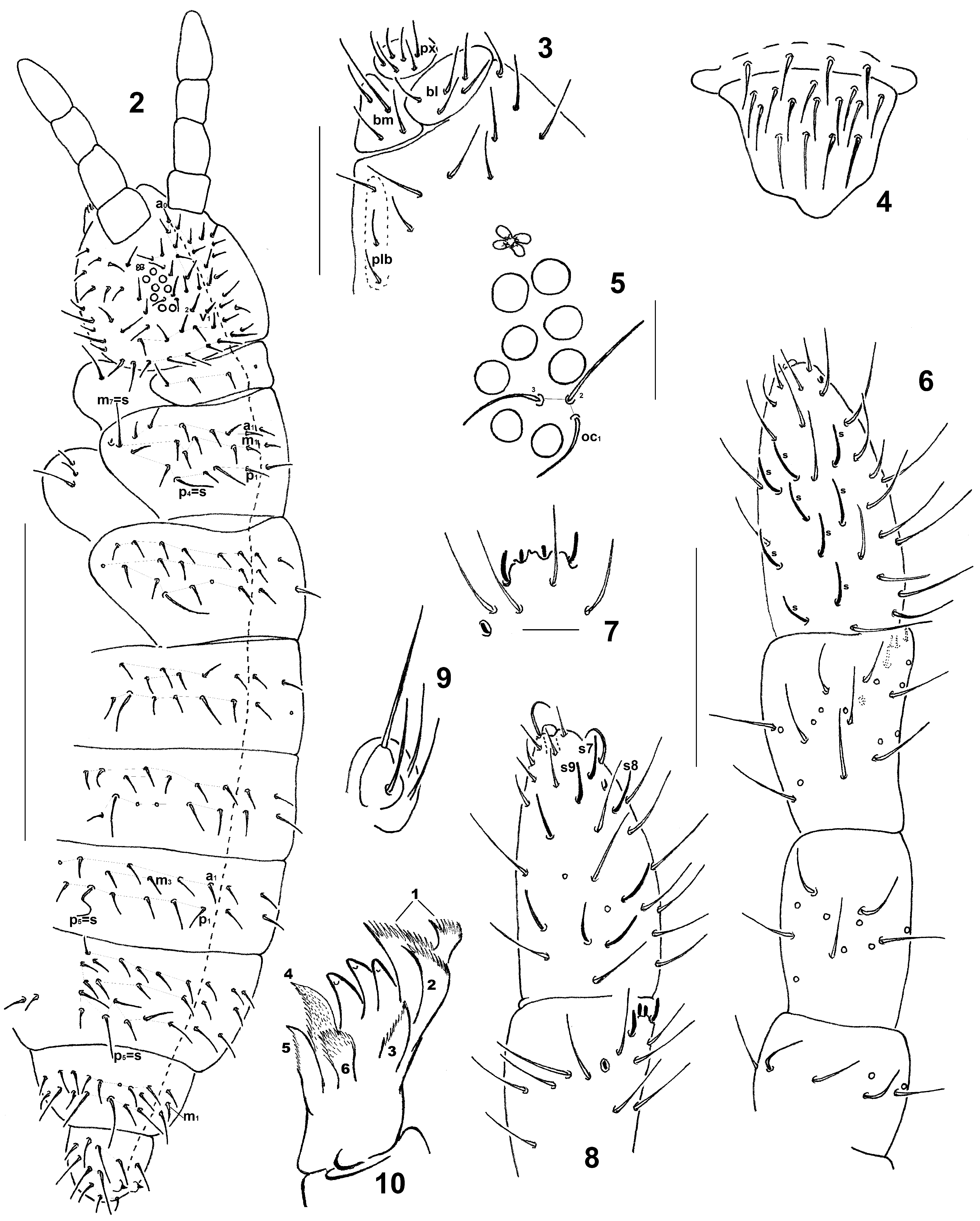
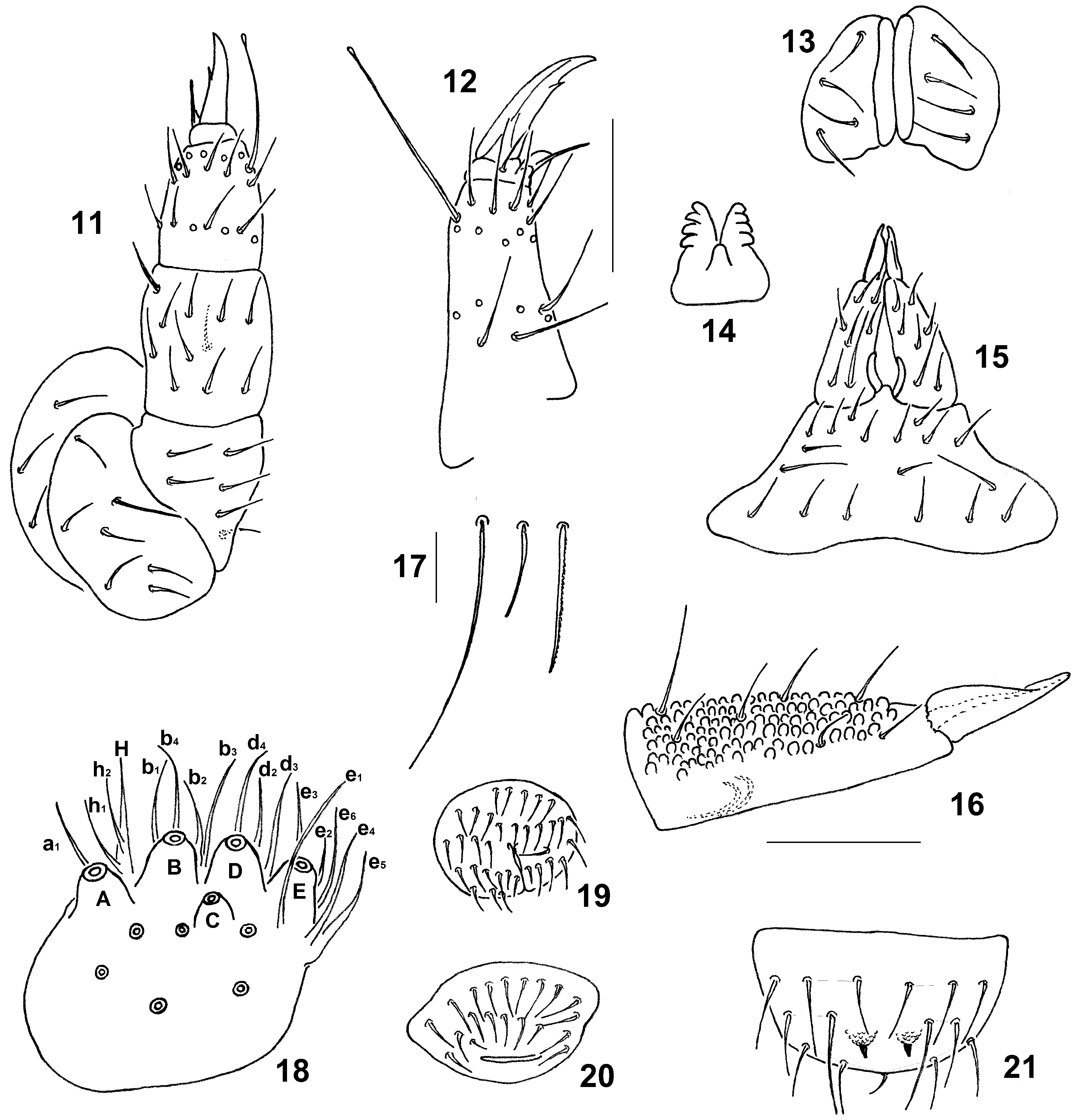
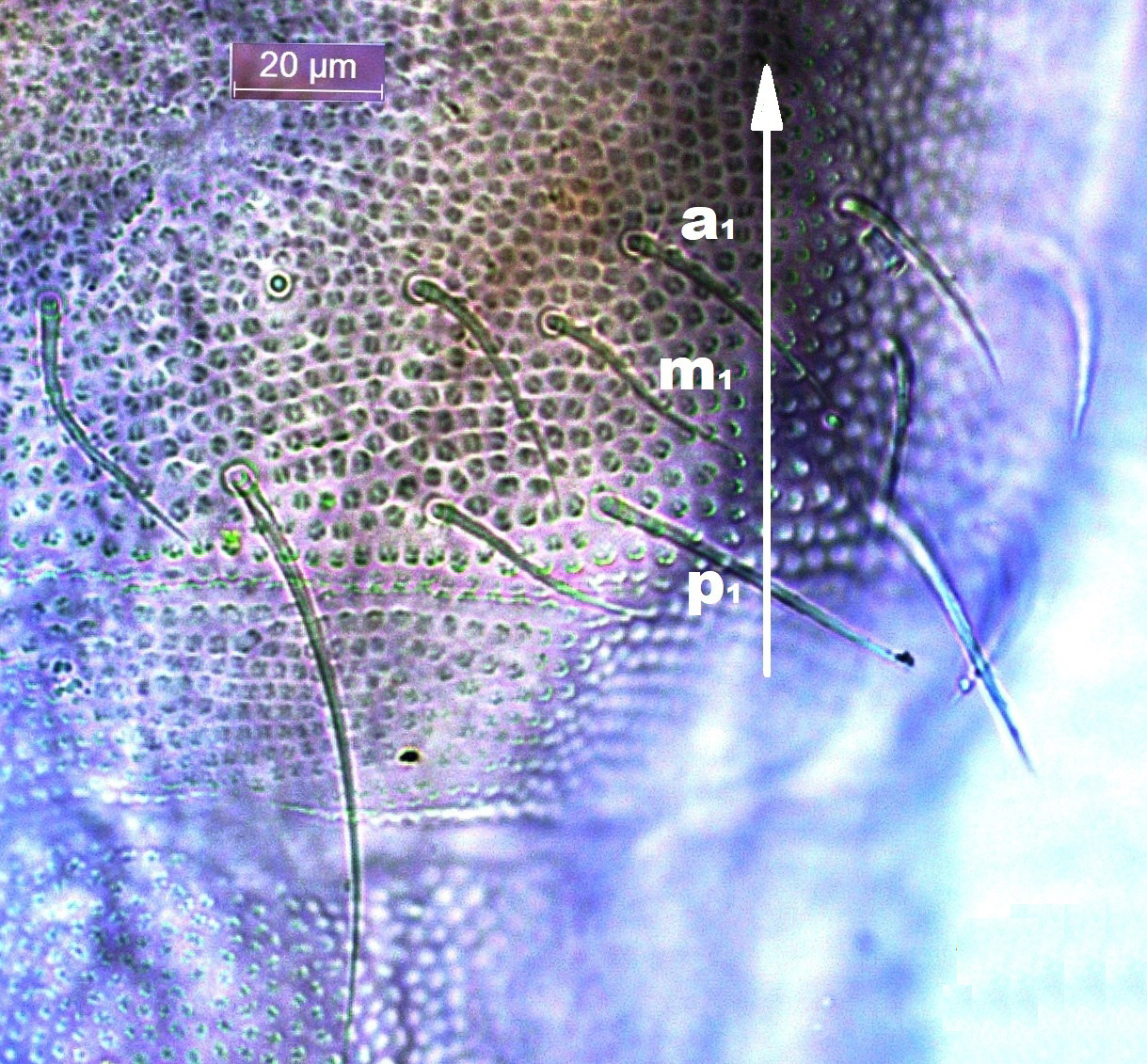
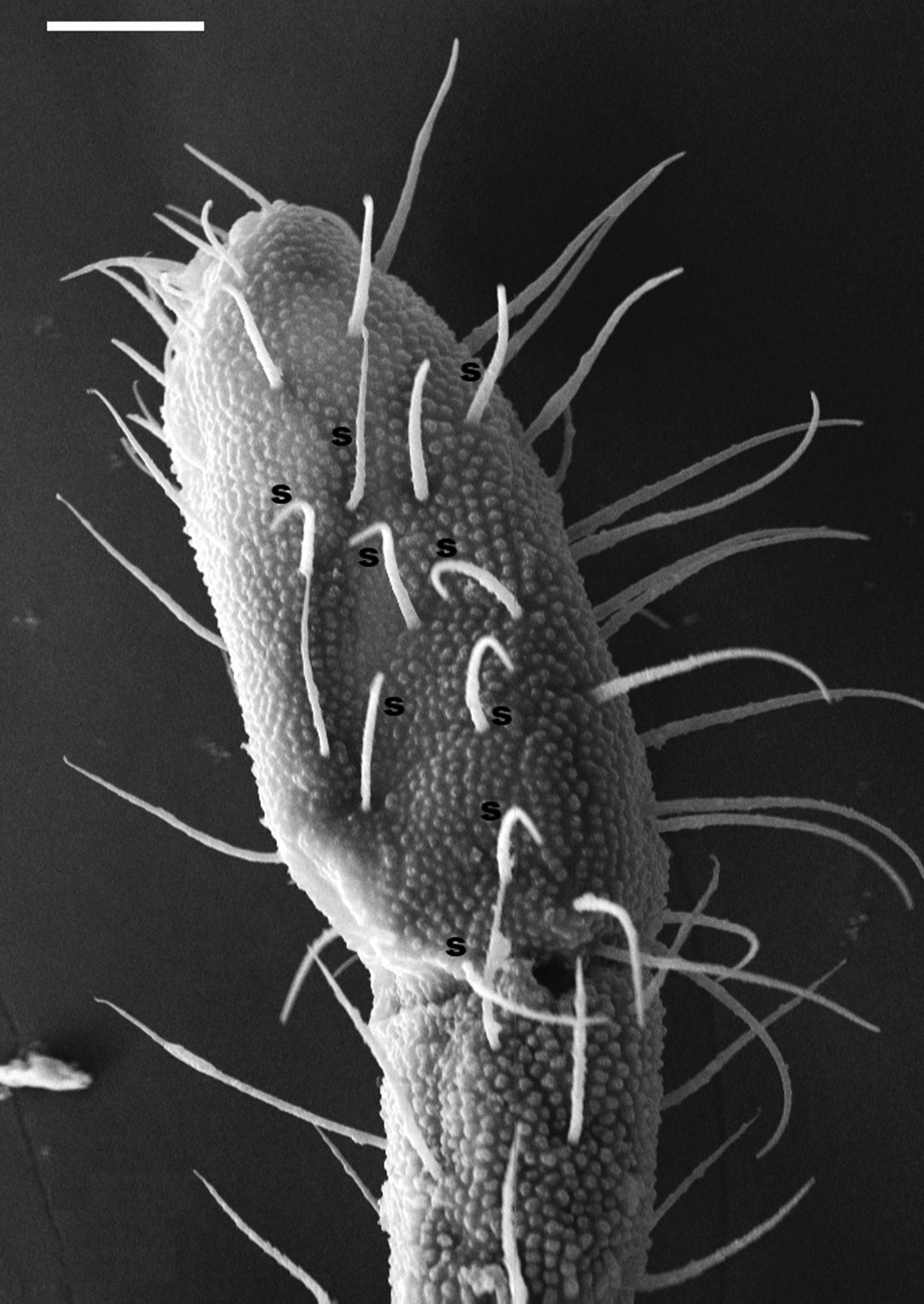
Description. Size. Maximum body length up to 1.7 mm. Color. Dorsum of body violet-black, antennae, legs, furcula slightly paler. Eye patches dark. Dorsal side paler (Figs 1 a & b). Tegument. Tegumentary granulation coarse, 7 – 8 granules between p 1 chaetae (“ a ” number after Yosii 1960) on Abd V (Fig. 22). Weak differentiation between microchaetae and macrochaetae; macrochaetae slightly long, ciliated (Fig. 17). Antennae. Antennae short, 0.90 – 0.95 and 0.20 – 0.25 times as long as cephalic diagonal and body length respectively. Ratio of length of antennal segments I: II: III: IV = 1: 1.5: 1.5: 2.0. Ant IV with simple apical bulb, subapical organite, microsensillum, about 12 curved sensory chaetae which are only slightly thicker than other antennal chaetae: 3 dorso-external s (s 7, s 8 and s 9) and 9 dorso-internal s resulting of plurichaetoses of the dorso-internal side of antennae; ventrally with 5 thicker chaetae (Figs 6, 8 & 23). Ant III organ with two long (outer) guard sensilla, two short (inner) sensilla and a ventral microsensillum (Fig. 7). Antennal eversible sac absent between Ant III and IV. Ant II with 12 – 13 chaetae. Ant I with 7 chaetae, p chaeta absent (Fig. 6). Head. Tubercles and spines absent. Eyes 8 + 8; eye patch with three chaetae, oc 2 longer than oc 1 and oc 3 (Fig. 5). PAO equal or slightly shorter than nearest eye in diameter, composed of 4 lobes, without accessory tubercle (Fig. 5). Labral chaetal formula 4 / 5, 5, 4, labral margin without papillae (Fig. 4). Ventral cephalic chaetotaxy (after Fjell- berg 1999) with 6 chaetae px, 4 bm, 5 bl, and 3 plb (Fig. 3). Labial palp with 5 papillae (A – E), with 1,4,0,3,6 guard chaetae, respectively, lateral process absent (Fig. 18). Maxilla with 6 lamellae, lamella 1 with 2 rows of filaments, lamella 1 and 2 longer than maxillary teeth, lamella 6 larger than lamellae 3 and 5 (Fig. 10). Maxillary outer lobe with 2 sublobal hairs (Fig. 9). Dorsal cephalic chaetotaxy typical of the genus, with 2 + 2 v-chaetae (Fig. 2). Thorax. Dorsal chaetotaxy as in Fig. 2. Th I with 3 + 3 chaetae in p row, usually p 5 longer than p 1 and p 4. Th II with 3 rows of chaetae, 6 + 6 in a row, as a 1 – 6; 6 + 6 chaetae in m row, as m 1 – 5, m 7 as s, m 6 absent; 6 + 6 chaetae in p row, as p 1 – 6, p 4 as s. Th III with 3 rows of chaetae, 6 + 6 chaetae in a row; 4 + 4 chaetae in m row, m 2 - 3 and m 6 absent; 6 + 6 chaetae in p row. Microsensillum on Th II present. Subcoxae I, II, III with 1,3,3 chaetae respectively. No chaetae on thoracic sterna II – III. Legs with unguis well developed, with one inner tooth at 2 / 3 distance of its inner edge from base. Empodial appendage lance-shaped, with small basal lamella and apical filament reaching 1 / 2 distance of inner edge of unguis (Fig. 12). Tibiotarsi I, II, III with 19,19,18 chaetae, respectively, of which 1,1,1 tenent hair (A 1 chaeta) distinctly knobbed (Figs 11 – 12). Hind leg with 3 chaetae on subcoxa, 7 chaetae on coxa, 6 chaetae on trochanter, 11 chaetae on femur, 18 chaetae on tibiotarsus including tenent hair (Fig. 11). Abdomen. Dorsal chaetotaxy as in Fig. 2. Abd I-III with three rows of chaetae, 5 + 5 chaetae in a row, as a 1 – 2, a 3 and a 5 - 6; 2 + 2 chaetae in m row, as m 3 and m 4; 6 + 6 chaetae in p row, as p 1 – 6, p 5 as s; Abd IV with 5 + 5 chaetae in a row, as a 1 – 4 and a 6; 5 + 5 chaetae in m row, as m 1, m 3 and m 5 - 7; 7 + 7 chaetae in p row, as p 1 – 7, p 5 as s; Abd V with three rows of chaetae, 5 + 5 chaetae in a row, as a 1 – 5; m 1 present; 4 + 4 chaetae in p row, as p 1 – 3 and p 5, p 3 as s. Abd VI with three rows of chaetae, 2 + 2 chaetae in a row, 2 + 2 chaetae in m row and 2 + 2 + 1 chaetae in p row (unpaired p 0 and p 1 – 2). Ventral tube with 4 + 4 chaetae (Fig. 13). Retinaculum with 4 + 4 teeth, no chaetae on corpus (Fig. 14). Furca as in Figs 15 and 16. Manubrium usually with 9 posterior chaetae on each side. Dens posteriorly with coarse granules and 7 chaetae, ratio of length of subbasal longer chaeta to basal chaeta as 2.1 – 2.4: 1. Mucro with apex straight, outer lamella long, broad and slightly curved, without inner lamella (Fig. 16). Length ratio of dens to mucro = 2.0 – 2.1: 1. Two short, straight anal spines on Abd VI, slightly bigger than their basal papillae (Fig. 21). Male and female genital plates respectively with 32 – 34 chaetae and about 20 chaetae (Figs 19 & 20).
Mandal, Guru Pada, Arbea, Javier (2019): Critical Checklist of the Indian species of Hypogastrura (Collembola: Hypogastruridae) with a description of a new species from Satkosia Wild Life Sanctuary. Zootaxa 4608 (2): 279-290, DOI: 10.11646/zootaxa.4608.2.5
Fig. 1 – 23, Tab. 1
Mandal, Guru Pada, Arbea, Javier (2019): Critical Checklist of the Indian species of Hypogastrura (Collembola: Hypogastruridae) with a description of a new species from Satkosia Wild Life Sanctuary. Zootaxa 4608 (2): 279-290, DOI: 10.11646/zootaxa.4608.2.5
Discussion. The following features: Ant IV with weakly differentiated sensilla, chaetae m 6 on Th II – III absent, body and posterior side of dens with coarse granulation, retinaculum with 4 + 4 teeth, ventral tube with 4 + 4 chaetae, empodial appendage lance-shaped and tibiotarsi with one tenent hair place the new species in the manubrialis group (see Babenko et al. 1994, Thibaud et al. 2004). From among members of this group Hypogastrura vernalis (Carl, 1901), H. unguiculata (Mitra, 1966), H. druki Babenko, 1994 (in: Babenko et al. 1994), H. turkmenica Babenko, 1994 (in: Babenko et al. 1994) and H. christianseni Yosii, 1960 seems to be most similar to H. satkosiaensis sp. nov. by m 1 chaeta present on Abd V and 4 + 4 teeth on retinaculum, but they differ in the dorsal chaetotaxy (m 2 chaeta on Th II absent in H. unguiculata and H. christianseni vs m 2 present in the other species; only 1 + 1 m chaetae on Abd V in the new species and H. christianseni vs 2 + 2 or 3 + 3 m chaetae in the other species), greater number of sensilla on Ant IV (12 in the new species vs 5 - 8 in the other species) and mucro shape. The main diagnostic features of the new species which identifies it from related members of the H. manubrialis group and other Indian species in this group, are summarized in Table 1.
Mandal, Guru Pada, Arbea, Javier (2019): Critical Checklist of the Indian species of Hypogastrura (Collembola: Hypogastruridae) with a description of a new species from Satkosia Wild Life Sanctuary. Zootaxa 4608 (2): 279-290, DOI: 10.11646/zootaxa.4608.2.5
Etymology. The new species is named after the type locality of Satkosia Wildlife Sanctuary, Odisha, India.
Mandal, Guru Pada, Arbea, Javier (2019): Critical Checklist of the Indian species of Hypogastrura (Collembola: Hypogastruridae) with a description of a new species from Satkosia Wild Life Sanctuary. Zootaxa 4608 (2): 279-290, DOI: 10.11646/zootaxa.4608.2.5
Type material. Holotype: male on slide, INDIA, Odisha, Satkosia Wild Life Sanctuary, Chamundia range, district Nayagarh, Altitude 265 ft, Latitude 20 ° 30 ’ 081 ” North and 84 ° 50 ’ 394 ” East, date 18. xi. 2016, coll. G. P. Mandal (Registration No. 2214 / H 14) deposited in the National Zoological Collection, Zoological Survey of India, Kolkata. Paratypes: 5 specimens (2 males & 3 females) on slide (dissected), same data as Holotype (Registration No. 2499 / H 14 to 2503 / H 14) and 90 specimens in ethyl alcohol, same data as Holotype (Registration No. 2504 / H 14) deposited in the National Zoological Collection, Zoological Survey of India, Kolkata.
Mandal, Guru Pada, Arbea, Javier (2019): Critical Checklist of the Indian species of Hypogastrura (Collembola: Hypogastruridae) with a description of a new species from Satkosia Wild Life Sanctuary. Zootaxa 4608 (2): 279-290, DOI: 10.11646/zootaxa.4608.2.5

Export occurrence data

Darwin Core Archive (ZIP)

CLASSIFICATION

Taxonomic Classification Tree

MULTIMEDIA

Media Files(5)

FIGURE 1. Hypogastrura satkosiaensis sp. nov.: Habitus, a. dorso-lateral view; b. ventral view.

Imageimage/png© Mandal, Guru Pada;Arbea, JavierMandal, Guru Pada;Arbea, Javier

FIGURES 2–10. Hypogastrura satkosiaensis sp. nov.: 2, dorsal chaetotaxy; 3, ventral cephalic chaetae; 4, labrum; 5, postantennal organ and eyes; 6, Ant I–IV, dorsal view (s = dorso-internal sensilla); 7, sensory organ of Ant III; 8, Ant III–IV, ventral view; 9, maxillary outer lobe; 10, maxilla. Scale bar = 500 µm (2), 100 µm (3, 6, 8), 50 µm (5), 20 µm (7).

Imageimage/png© Mandal, Guru Pada;Arbea, JavierMandal, Guru Pada;Arbea, Javier

FIGURES 11–21. Hypogastrura satkosiaensis sp. nov.: 11, chaetotaxy of hind leg; 12, tibiotarsus and foot complex of hind leg; 13, ventral tube; 14, retinaculum; 15, furca; 16, dens and mucro; 17, different types of body chaetae, a. sensillum, b. microchaeta, c. macrochaeta; 18, labial palp; 19, male genital plate; 20, female genital plate; 21, Abd VI with anal spines. Scale bar = 50 µm (12, 16), 20 µm (17).

Imageimage/png© Mandal, Guru Pada;Arbea, JavierMandal, Guru Pada;Arbea, Javier

FIGURE 22. Hypogastrura satkosiaensis sp. nov.: dorsal axial chaetotaxy of Abd V. Scale bar = 20 µm.

Imageimage/png© Mandal, Guru Pada;Arbea, JavierMandal, Guru Pada;Arbea, Javier

FIGURE 23. Hypogastrura satkosiaensis sp. nov.: dorsointernal view of Ant III–IV at SEM microphotograph (s = dorso-internal sensilla). Scale bar = 20 µm.

Imageimage/png© Mandal, Guru Pada;Arbea, JavierMandal, Guru Pada;Arbea, Javier

IMAGES

Gallery(5)

See Gallery

Occurrences with images

Source Information

Critical Checklist of the Indian species of Hypogastrura (Collembola: Hypogastruridae) with a description of a new species from Satkosia Wild Life Sanctuary

checklist

This dataset contains the digitized treatments in Plazi based on the original journal article Mandal, Guru Pada, Arbea, Javier (2019): Critical Checklist of the Indian species of Hypogastrura (Collembola: Hypogastruridae) with a description of a new species from Satkosia Wild Life Sanctuary. Zootaxa 4608 (2): 279-290, DOI: 10.11646/zootaxa.4608.2.5

Abstract

Ten Hypogastrura species have been found from India, two of which are described: H. unguiculata (Mitra, 1966) and H. satkosiaensis nov. sp. Two Indian species have been removed from Hypogastrura and have been included in the genus Ceratophysella based on their original descriptions: C. baltica (Tyagi & Baijal, 1982) comb. nov. and C. katraensis (Tyagi & Baijal, 1982) comb. nov. H. satkosiaensis sp. nov. belongs to H. manubrialis group of species within the genus and is easily separated from the other members of the group by a combination of characters, a greater number of antennal sensilla, dorsal chaetotaxy, specially presence of m1 chaeta on abdominal tergite V, and mucro shape. A key for all of the known Indian species of Hypogastrura is provided.

Mandal G P, Arbea J, plazi (2019). Critical Checklist of the Indian species of Hypogastrura (Collembola: Hypogastruridae) with a description of a new species from Satkosia Wild Life Sanctuary. Plazi.org taxonomic treatments database. Checklist dataset https://doi.org/10.11646/zootaxa.4608.2.5 accessed via GBIF.org on 2026-06-15.

CC0Published 5/20/2019View dataset
GBIF Usage Key
157232192
Dataset Key
05961829-968b-4bc0-87c2-67bd60072ce7
Origin
source
Backbone Key
10277078
Taxon ID
4A35CE6DC41F2321FF4CDFFDFA00BB64.taxon
Last Crawled
6/10/2026
Last Interpreted
6/10/2026