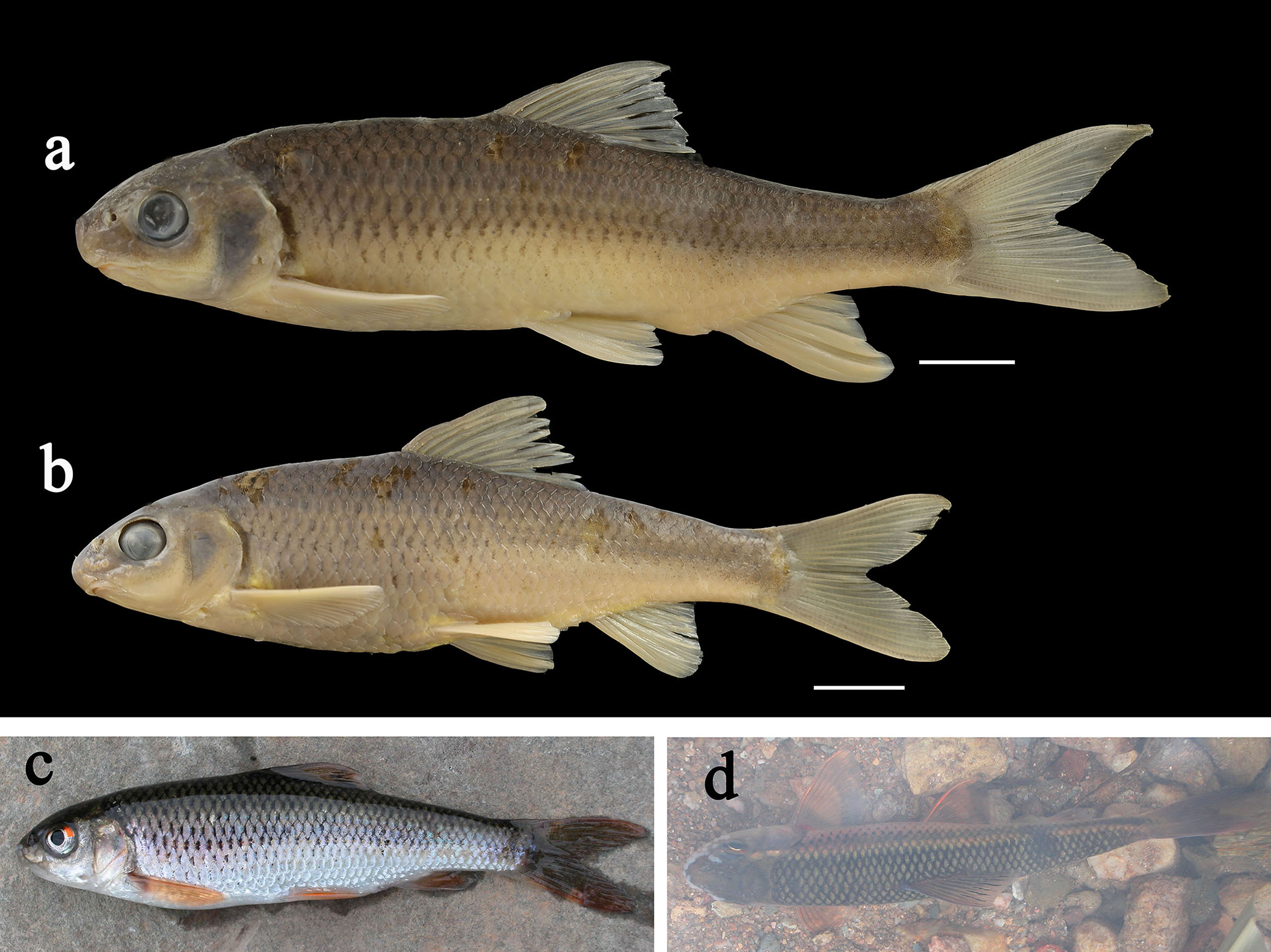
Description. Morphometric and meristic data of type specimens are provided in Table 2, and see Figures 1 a – d for general appearance. Body elongate, laterally compressed and moderately deep, with greatest depth anterior to dorsal-fin origin; caudal peduncle evenly tapering toward caudal-fin base, with least depth slightly anterior to caudal-fin base. Dorsal profile from snout tip to dorsal-fin origin convex; dorsal-fin base and post-dorsal profile sloping downwards until dorsal origin of precurrent caudal-fin rays. Ventral profile from snout tip to posterior end of anal-fin base rounded; from there to caudal-fin base concave. Head moderately large, longer than deep and deeper than wide. Eye relatively small with slightly convex interorbital space, laterodorsally located in anterior half of head. Snout triangular when laterally viewed. Mouth inferior and transverse, with extremities of its opening slightly curved posteriorly. Rostral fold simple and pendulous, covering base of upper lip. Upper lip thin, smooth, entirely enclosing upper jaw, laterally confluent with lower lip around corners of mouth. Lower lip simple, restricted only to side of lower jaw, fully fused with jaw and not free anteriorly; postlabial grooves extending anteromedially beyond vertical through rostral-barbel base. Lower jaw bearing sharp horny sheath on cutting edge. Two pairs of barbels, rostral pair minute, maxillary pair at corners of mouth, little longer than rostral ones. Dorsal fin with 4 simple and 8 * (22) branched rays; origin anterior to pelvic-fin insertion, closer to snout tip than to caudal-fin base; distal edge slightly concave; last simple ray flexible and non-serrated. Pectoral fin with 1 simple and 14 (2), 15 (2), 16 * (16) or 17 (2) branched rays; second branched ray longest, tip of adpressed fin extending halfway to pelvic-fin insertion. Pelvic fin with 1 simple and 8 * (12) or 9 (10) branched rays, inserted posterior to vertical through dorsal-fin origin; first and second branched ray longest, extending beyond halfway to anal-fin origin when depressed. Anal fin with 3 simple and 5 * (22) branched rays, origin equidistant from pelvic-fin insertion and caudal-fin base; distal margin slightly concave. Caudal fin with 9 + 8 branched rays, deeply forked, longest rays approximately 2 times as long as shortest ones; upper and lower lobes equal in length and shape, with pointed tips. Body scales moderately sized; chest and belly scaled, scales along midventral region slightly smaller than those on flank. Lateral line complete, with 43 (1), 44 * (4) or 45 (17) (average 44.7) perforated scales, slightly sloping downwards anterior to middle of pectoral fin, then nearly horizontal. Scale rows between lateral line and origin of dorsal fin 6 * (8) or 6 1 / 2 (14), and 4 * (18) or 4 1 / 2 (4) scales between lateral line and pelvic-fin insertion. Predorsal midline scales 14 (3), 15 * (14) or 16 (5) (average 15.1), slightly smaller than those on flank, not embedded beneath skin. Circumpeduncular scales 16 (9), 18 * (9) or 20 (4) (average 17.5). Gas bladder bipartite, anterior chamber elliptical and posterior chamber slender. Vertebrae: 4 + 36 – 38 (6 specimens under X-ray examination). Sexual dimorphism. In females, last simple and first and second branched rays of anal fin prolonged; average anal-fin length 20.6 % SL for females, 17.1 % for males. Some breeding tubercles (or pearl organs) present on snout and gill cover, and sometimes on anal fin in males during breeding season. Coloration in life. Ground color of top of head and dorsum yellowish green; head below longitudinal line passing through ventral margin of eye and flank below lateral line bright silver. Each scale on flank with dense dark melanophores along exposed portion of posterior edge, and scale pocket covered with dense dark melanophores to constitute reticular framework. Longitudinal luminous yellow stripe running from upper edge of eye along scale row intermediately above lateral line to terminate at caudal-fin base. Dorsal fin orange-brown; interradial membranes with series of black bars parallel to fin rays. Pectoral- and pelvic-fin rays orange, with leading rays brighter and interradial membranes hyaline. Anal and caudal fins orange-brown. Orange blotch on posterordorsal edge of eyeball near pupil (Fig. 1 c). No random grayish-black spots present on scales around lateral line scales in adults and young individuals less than 75 mm SL. Coloration in preservative. Head dark grey on back and lateral part above horizontal line passing through ventral edge of eye, shading to yellowish on ventral surface. Ground color of body dark grey dorsally, becoming yellowish ventrally; no longitudinal black stripe running along lateral line. Each scale on back and upper part of flank above lateral line with dense melanophores on exposed portion of posterior margin, scale pocket covered with dense melanophores. Each scale below lateral line with sparse dark melanophores on exposed portion of posterior margin, scales on abdomen light yellow. Dorsal fin with dark melanophores on distal interradial membranes between branched rays constituting small black stripes. Pectoral and pelvic fin with small dark melanophores on base and fewer melanophores along branched rays. Anal fin hyaline; caudal fin dusky.
Song, Xue-Ling, Cao, Liang, Zhang, E. (2018): Onychostoma brevibarba, a new cyprinine fish (Pisces: Teleostei) from the middle Chang Jiang basin in Hunan Province, South China. Zootaxa 4410 (1): 147-163, DOI: 10.11646/zootaxa.4410.1.8