
AnimaliaNot EvaluatedacceptedspeciesAccepted
Actinopus fernandezi
Duniesky, 2019
GBIF:158491473
0year
ABOUT
Descriptions(7)
(Figs 3, 10) urn: lsid: zoobank. org: act: 05 CDB 14 B- 861 A- 4774 - 8553 - 26 B 4 DA 2 C 4386
Duniesky, Rios-Tamayo (2019): Four new species of Actinopus (Mygalomorphae: Actinopodidae) from Uruguay. Zootaxa 4624 (4): 523-538, DOI: 10.11646/zootaxa.4624.4.5
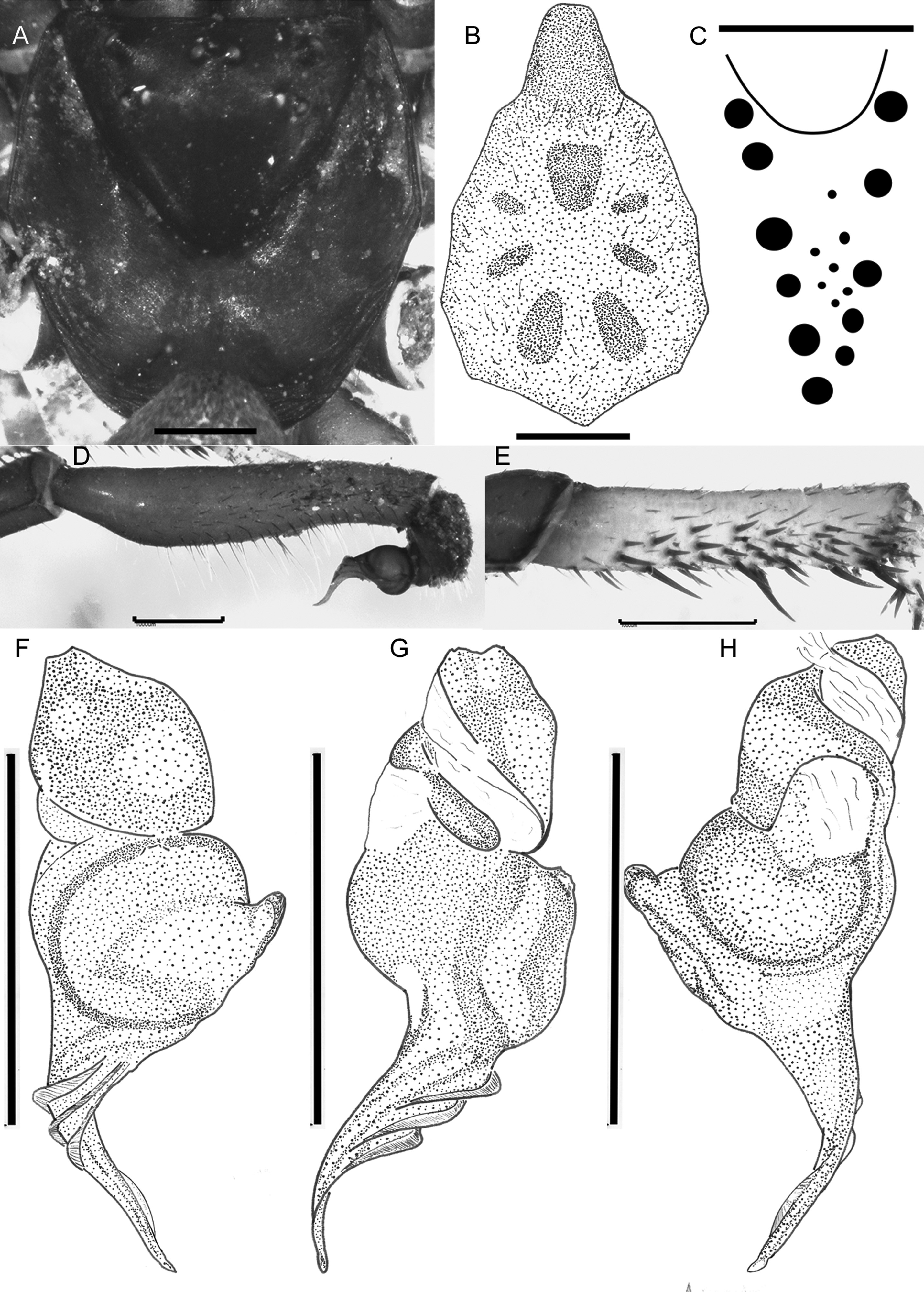
Description. (Figs. 3 A – H). Male holotype (MNHN 1291). Total length: 7.90. Carapace (Fig. 3 A): length 4.00, width 4.20; cephalic region: length 2.30, width 3.10; clypeus small with one bristle, 11 bristles between PME, 2 behind each PME-PLE. Fovea: length 0.60, width 1.60. Eyes, diameters and interdistances: AME 0.16 (small), ALE 0.26, PME 0.11, PLE 0.16, ocular group length 0.89, anterior width 2.44, 2.07 posterior width; AME-ALE 0.95, PME-PLE 0.16, AME-PME 0.42, ALE-PLE 0.53, AME-AME 0.26. Chelicerae: length 2.00, width 1.20; cheliceral apex with 8 recumbent and elongated bristles over fang base. Rastellum with 6 large marginal blunt spines and 3 small dorsal. Cheliceral furrow (Fig. 3 C) with 5 large promarginal and 6 retromarginal teeth and 7 denticles, near promarginal teeth. Labium: length 0.58, width 0.79. Maxillae: anterior length 1.11, posterior length 1.75, width 1.27. Sternum: Center flat (Fig. 3 B): length 3.44, maximum width 2.65, minimum width 0.79. Postlabial sigilla shallow, posterior sigilla well defined. Abdomen: length 4.50, covered by small bristles. PMS: length 0.53; PLS with basal article of length 0.74 (other segments are compressed due to preservation). Spigots: Cannot be observed. Lengths of legs and palp: I: 4.00, 1.80, 2.60, 3.30, 2.00, 13.70. II: 4.20, 1.70, 2.50, 3.30, 2.00, 13.70. III: 3.20, 2.00, 2.00, 3.20, –, ~ 10.40. IV: 4.30, 2.00, 3.30, 3.50, 2.00, 15.10. Palp: 4.90, 2.30, 4.40, –, 1.00, 12.60. Chaetotaxy: Femora: I – IV, 0, III 2 - 3 - 3 - 3 - 3 - 2 - 2 - 3 d (spiniform bristles). Patellae: I 0; II 2 R A; III, 21 P SUP-D ANT + 9 on the margin, 1 - 1 - 1 - 1 D, 5 R A + 11 on the margin; IV, 24 P SUP-D ANT. Tibiae: I, 1 - 1 - 2 - 1 - 1 - 1 - 2 V POST, 1 - 1 - 1 V, 1 - 2 V A ANT, 1 - 2 - 1 - 2 - 2 V POST; II, 30 R, 1 - 1 - 1 - 2 - 1 - 2 - 3 V; III, 1 P, 1 D (1: 2 B), 2 - 1 R (1: 3 A), 1 - 2 - 2 V, with apical crown of 19 thorns; IV, 1 P, 2 - 2 - 3 V. Metatarsi: I, 1 - 1 - 1 - 1 - 1 - 2 - 1 - 1 - 2 - 1 V, 1 - 1 - 2 - 1 - 1 - 1 - 2 V ANT, 1 - 2 - 2 - 2 - 2 - 1 - 3 - 4 - 1 - 4 V POST; II, 2 - 1 - 1 - 2 - 3 - 2 - 2 - 2 V, 1 - 1 - 2 - 2 - 2 V ANT, 1 - 1 - 2 - 3 - 1 - 1 - 4 - 1 - 3 V POST; III, 1 - 2 R (1: 3 A), 1 - 1 - 1 - 1 R SUP (2: 3 B), 1 - 1 - 1 - 2 - 3 V; IV, 1 - 0 - 1 P, 2 - 0 - 1 - 2 V. Tarsi: I, 2 - 1 - 2 - 1 - 2 - 1 - 1 P INF, 1 - 1 - 3 - 4 - 3 - 6 - 4 R INF, 2 - 1 - 2 - 2 - 2 - 3 V; II, 1 - 1 - 1 - 1 - 2 - 1 - 1 P INF, 1 - 3 - 1 - 2 - 2 - 2 - 2 - 3 - 4 - 3 - 3 R INF, 2 - 2 - 0 - 1 - 1 - 1 - 2 V; III, foul; IV, 1 - 2 - 3 - 2 - 4 P INF. Total number of retrolateral spines on tibiae I, II (Fig. 3 E): 0 and 30, respectively. Palp: tibia long, thin (Fig. 3 D). Bulb stylized (Fig. 3 F – H) with ATA little developed and BTA developed, embolus without denticles and with MRk. Scopulae: Tarsi: I – II, sparse 1: 2 apical; IV, dense, uniform. Metatarsi: absent. Trichobothria: Tibiae: I 4 - 4; II 4 - 5; IV 4 - 3. Metatarsi: I 10; II 8; IV 5. Tarsi: I 9; II 7; IV 6. Colour: carapace and chelicerae reddish brown. Abdomen brown; booklungs with dark markings. Sternum reddish brown with darker labium and maxillae. Legs like carapace with lighter tarsitibiae; palp like carapace. Spinnerets yellow.
Duniesky, Rios-Tamayo (2019): Four new species of Actinopus (Mygalomorphae: Actinopodidae) from Uruguay. Zootaxa 4624 (4): 523-538, DOI: 10.11646/zootaxa.4624.4.5
Diagnosis. The male of A. fernandezi sp. nov. can be differentiated from those of all other species by the shape of its copulatory bulb (Fig. 3 F – H) which is, very gracile and slender and the presence of abundant retrolateral spines on tibia II (Fig. 3 E). Legs with tibia-light colored in alcohol. Females unknown.
Duniesky, Rios-Tamayo (2019): Four new species of Actinopus (Mygalomorphae: Actinopodidae) from Uruguay. Zootaxa 4624 (4): 523-538, DOI: 10.11646/zootaxa.4624.4.5
Distribution. Known only from the type locality (Fig. 10).
Duniesky, Rios-Tamayo (2019): Four new species of Actinopus (Mygalomorphae: Actinopodidae) from Uruguay. Zootaxa 4624 (4): 523-538, DOI: 10.11646/zootaxa.4624.4.5
Etymology. The specific name is a patronym in honor of the Cuban malacologist, Alejandro Fernández Velázques, who introduced me to science and shared many field trips.
Duniesky, Rios-Tamayo (2019): Four new species of Actinopus (Mygalomorphae: Actinopodidae) from Uruguay. Zootaxa 4624 (4): 523-538, DOI: 10.11646/zootaxa.4624.4.5
Other material examined. Know only from the holotype.
Duniesky, Rios-Tamayo (2019): Four new species of Actinopus (Mygalomorphae: Actinopodidae) from Uruguay. Zootaxa 4624 (4): 523-538, DOI: 10.11646/zootaxa.4624.4.5
Type material. Uruguay: Salto. Holotype ♂: Río Arapey [30 ° 55 ′ S 57 ° 47 ′ W], 20 April 1974, L. A. de Gambardella (MNHN 1291).
Duniesky, Rios-Tamayo (2019): Four new species of Actinopus (Mygalomorphae: Actinopodidae) from Uruguay. Zootaxa 4624 (4): 523-538, DOI: 10.11646/zootaxa.4624.4.5
Export occurrence data
Darwin Core Archive (ZIP)
CLASSIFICATION
Taxonomic Classification Tree

MULTIMEDIA
Media Files(2)
FIGURE 3. Actinopus fernandezi sp. nov., (male holotype, Río Arapey, MNHN 1291). A cephalothorax, dorsal view; B sternum, ventral view; C cheliceral furrow, denticles distribution; D right palp, retrolateral view; E right tibia II, retrolateral view; F–H, copulatory bulb, three different views. Scale bars: 1mm.
Imageimage/png© Duniesky, Rios-TamayoDuniesky, Rios-Tamayo

IMAGES