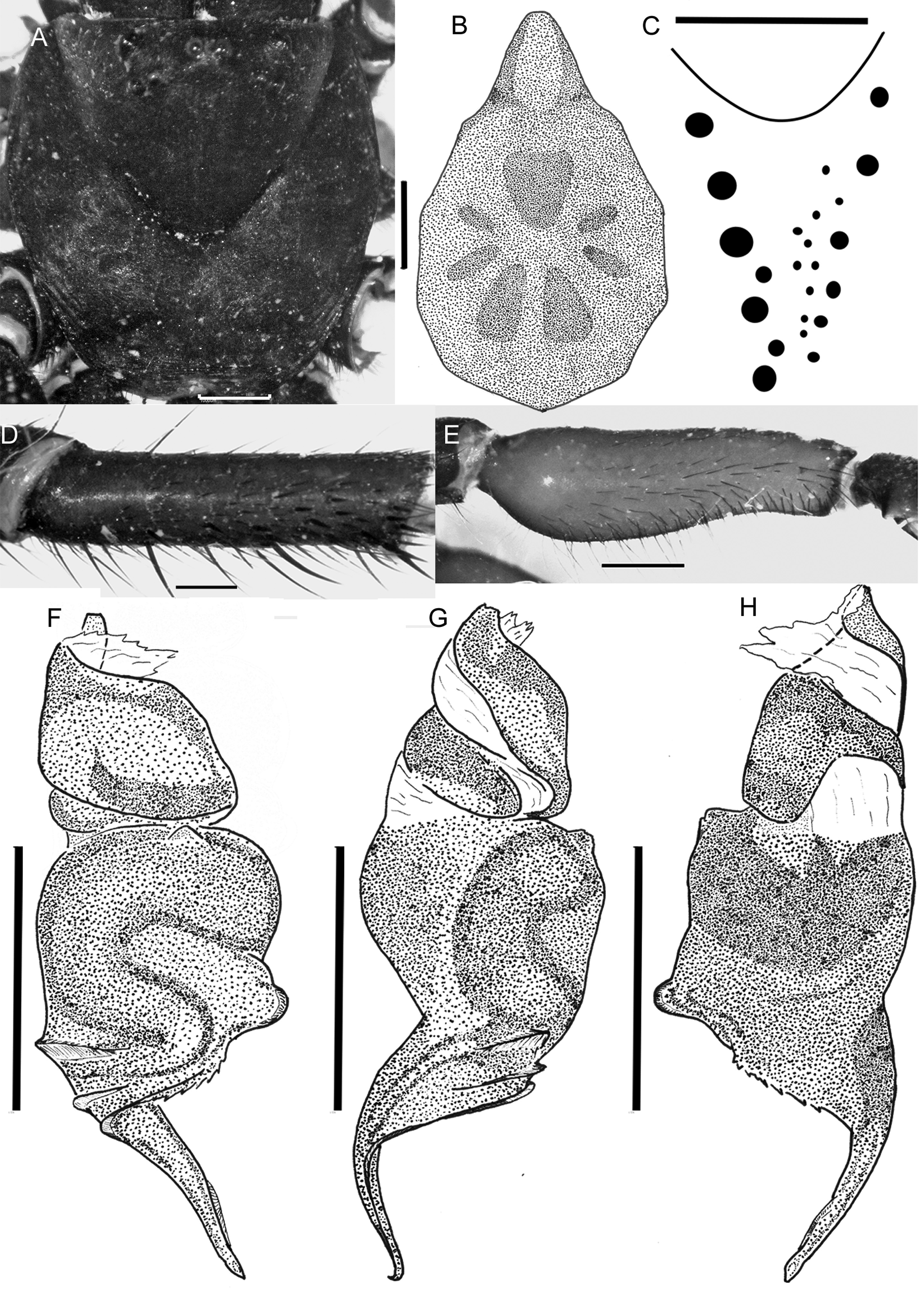
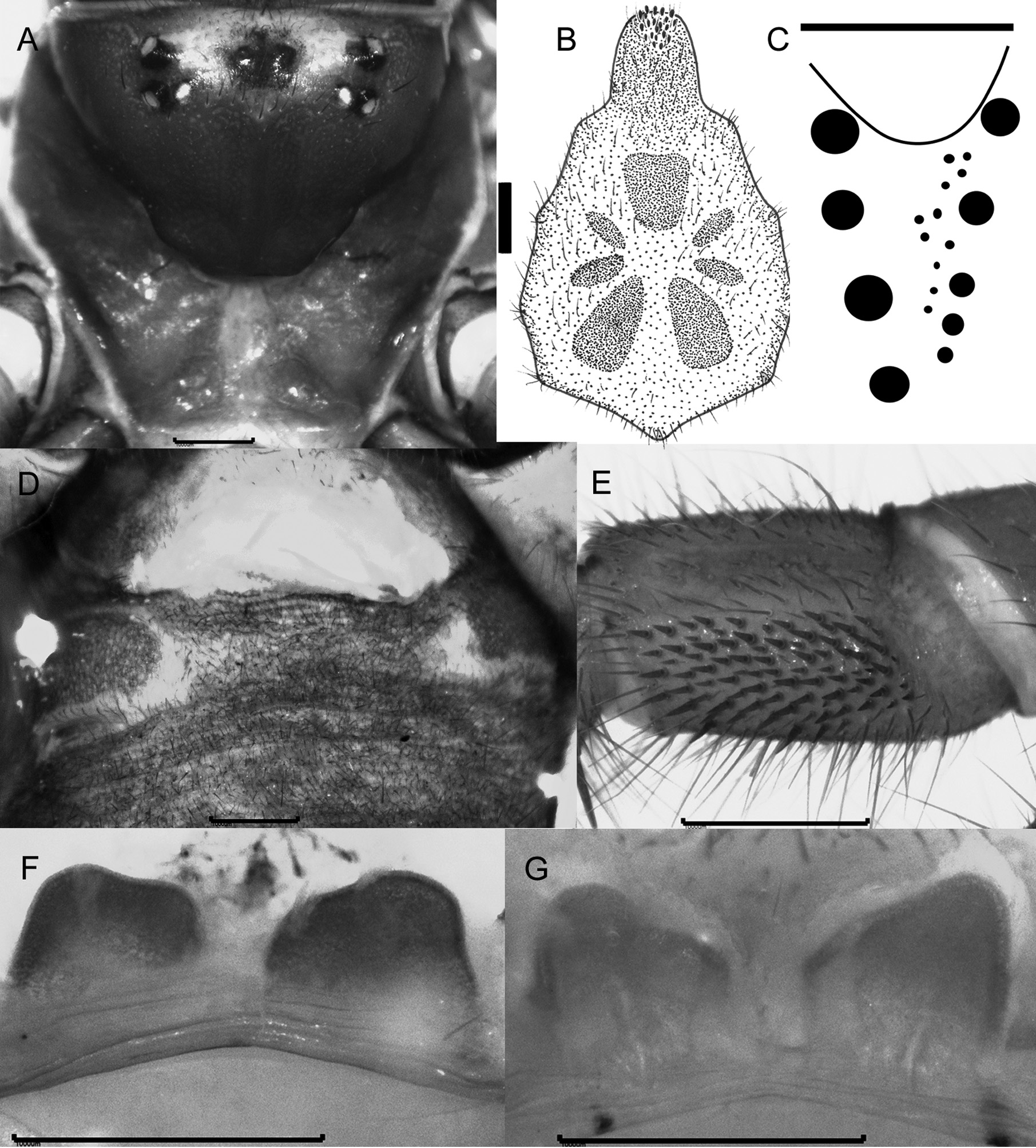
Description. (Fig. 6). Male holotype (MNHN 1310). Total length: 12.20. Carapace (Fig. 6 A): length 5.80, width 5.50; cephalic region: length 3.40, width 4.20; clypeus small, 11 bristles between PME, 4 behind each PME- PLE, 4 bristles and one larger on both sides of ocular group. Fovea: length 1.00, width 2.50. Eyes, diameters and interdistances: AME 0.26 (large), ALE 0.32, PME 0.16, PLE 0.32, ocular group length 0.90, anterior width 2.60, 2.38 posterior width; AME-ALE 0.69, PME-PLE 0.16, AME-PME 0.37, ALE-PLE 0.42, AME-AME 0.21. Chelicerae: length 2.60, width 1.30; cheliceral apex with 12 recumbent and elongated bristles which cover fang base. Cheliceral prolongation without cuspules. Cheliceral furrow (Fig. 6 C) with 6 large promarginal and 5 retromarginal teeth (small one between 3 th – 4 th and 4 th – 5 th) and 10 denticles, near promarginal teeth. Labium: length 0.90, width 1.10. Maxillae: anterior length 1.50, posterior length 2.20, width 1.40. Sternum: Center flat (Fig. 6 B): length 4.00, maximum width 3.20, minimum width 1.10. Postlabial sigilla shallow, posterior sigilla well defined. Abdomen (very compressed due to poor preservation): length ~ 5.40, large, covered by bristles. Spinnerets compressed. Lengths of legs and palp: I: 5.50, 2.20, 3.10, 3.80, 2.20, 16.80. II: 5.50, 2.20, 3.10, 3.80, 2.00, 16.60. III: 4.20, 2.20, 2.50, 4.50, 2.00, 15.40. IV: 5.50, 2.50, 4.50, 4.50, 2.50, 19.50. Palp: 5.50, 2.60, 4.20, –, 1.40, 13.70. Chaetotaxy: Femora: I – IV, 0. Patellae: I – II: 0; III, 35 P SUP-D ANT + 10 on margin, 1 - 1 - 1 - 1 D (2: 3 B), 7 R A + 11 on margin; IV, 54 P SUP- D ANT. Tibia: I, 1 - 1 - 3 V (1: 2 A); II, 1 - 2 - 2 - 3 - 4 - 2 - 3 R, 1 - 2 - 1 - 3 V; III, 1 P, 1 D (1: 2 B), 1 - 1 R (1: 3 A), 1 - 4 V A, with apical crown of 19 thorns; IV, 1 - 1 - 2 P, 1 - 1 - 2 - 3 V. Metatarsi: I, 1 - 0 - 1 - 1 V ANT, 2 - 2 - 1 - 1 - 2 V POST; II, 1 - 1 - 2 V ANT, 2 - 1 - 2 - 1 - 2 - 2 - 1 - 4 V POST; III, 1 - 3 - 1 - 2 - 1 - 1 - 3 P, 1 D A, 2 - 2 - 2 - 1 - 1 - 3 - 3 - 4 D POST-R SUP, 2 - 3 - 3 - 1 - 1 - 1 - 2 - 2 V; IV, 1 - 2 - 2 - 2 - 2 - 1 - 3 P, 2 - 1 - 1 - 1 - 4 V. Tarsi: I, 1 - 1 - 1 - 1 P INF, 16 R INF; II, 2 - 1 - 1 - 1 - 2 - 2 - 1 P INF, 19 R INF; III, 12 P INF, 18 R INF; IV, 20 P INF, 13 R A. Total number of retrolateral spines on tibiae I, II (Fig. 6 D): 0 and 17, respectively. Palp: tibiae short, thickened (Fig. 6 E). Bulb (Fig. 6 F – H) with ATA and BTA developed, embolus with series of denticles at base. Scopulae: Tarsi: I – II, sparse 1: 2 apical; III – IV, dense, uniform. Metatarsi: IV sparse 1: 4 A. Trichobothria: Tibiae: I – II 4 - 3; III 5 - 4; IV 6 - 5. Metatarsi: I – II 10; III 8; IV 7. Tarsi: I 9; II 7; III 9; IV 7. Color: carapace and chelicerae black. Abdomen dark brown; booklungs with dark markings. Sternum, labium and maxillae dark reddish brown. Legs like carapace with lighter tarsi-metatarsi; palp with lighter tibiae. Female paratype (MNHN 1281). Total length: 16.20. Carapace (Fig. 7 A): length 6.40, width 6.30; with 12 bristles on each posterior margin; cephalic region: length 3.70, width 5.30; clypeus small with 18 bristles, 9 on chillum; 12 bristles between PME and 4 behind each PME-PLE, 6 bristles and one larger on both sides of ocular group. Fovea: length 1.20, width 3.00. Eyes, diameters and interdistances: AME 0.21, ALE 0.42, PME 0.21, PLE 0.26, ocular group 1.06, anterior width 3.55, 3.34 posterior width; AME-ALE 1.06, PME-PLE 0.21, AME-PME 0.72, ALE-PLE 0.58, AME-AME 0.32. Chelicerae: Length 2.80, width 2.10, chelicerae apex with 12 recumbent and elongated bristles covering fang base. Rastellum with 11 marginal, blunt spines and 7 small dorsal. Cheliceral furrow (Fig. 7 C) with 5 promarginal and 4 retromarginal teeth, and 10 denticles in furrow, near promargin. Labium: length 1.10, width 1.30, with 10 anterior cuspules. Maxillae: anterior length 2.10, posterior length 2.50, width 1.40, with 60 cuspules 1: 3 V ANT, expanding to anterior face. Sternum: Center flat (Fig, 7 B), length: 5.30, maximum wide 4.20, minimum width 1.30. Postlabial sigilla deep, posterior sigilla shallow, well defined. Abdomen: length 11.00, covered by dark bristles. PMS: length 0.79; PLS with basal: medial: apical articles 0.79: 0.42: 0.26. Spigots: 2 large, 25 small on PMS; PLS, numbers of large (small) spigots on basal: medial: apical article 3 (35): 2 (+ 20): 0 (~ 50). Lengths of legs and palp: I: 3.40, 2.40, 1.60, 2.20, 1.10, 10.70. II: 3.40, 2.50, 1.60, 2.30, 1.10, 10.90. III: 3.00, 2.70, 1.20, 2.50, 1.00, 10.40. IV: 4.00, 2.80, 2.50, 2.70, 0.80, 12.80. Palp: 3.20, 2.20, 2.20, –, 2.50, 10.10. Chaetotaxy: All femora: 0. Patellae: I – II, 0; III, 20 P A + 13 on the margin, 25 R A + 14 on the margin; IV, 71 P SUP-D ANT; palp, 1 - 1 - 1 p. Tibiae: I, 5 - 11 R, 1 / 1 - 1 V POST; II, 85 R; III, 1 D B, with apical crown of 19 thorns and 6 apical (at apex, anterior to crown), 50 R; IV, 0; palp, 1 - 1 - 1 P INF, 1 - 1 - 1 p, 17 R INF. Metatarsi: I, 18 P INF, 1 - 1 - 1 V POST, 24 R INF; II, 7 P INF, 12 R INF, 1 - 1 - 2 V POST; III, 28 D ANT-P SUP, 50 on row D POST-R (more abundant R A); IV, 12 P INF, 1 D A. Tarsi: I, 9 P INF, 13 R INF, 1 V A; II, 12 P INF, 9 R INF, 1 V A; III, 22 R, 87 V-P; IV, 82 V-P; palp, 17 P INF, 28 R INF, 2 V A. Total number of retrolateral spines on tibiae I, II (Fig. 7 D): 16 and 85, respectively. Trichobothria: Tibiae: I 4 - 5; II – III 6 - 4; IV 7 - 6. Metatarsi: I 11; II 10; III 9; IV 5. Tarsi: I 7; II 9; III 11; IV 5. Color: carapace, cephalic region, legs and chelicerae dark reddish brown. Abdomen brown; booklungs with dark markings (Fig. 7 D). Sternum light reddish brown, darker labium and maxillae. Spinnerets dark.
Duniesky, Rios-Tamayo (2019): Four new species of Actinopus (Mygalomorphae: Actinopodidae) from Uruguay. Zootaxa 4624 (4): 523-538, DOI: 10.11646/zootaxa.4624.4.5