AnimaliaNot EvaluatedacceptedspeciesAccepted
Aethiopella ricardoi

Aethiopella ricardoi

Paz, Queiroz & Bellini, 2019

GBIF:158517887

0year

ABOUT

Descriptions(7)

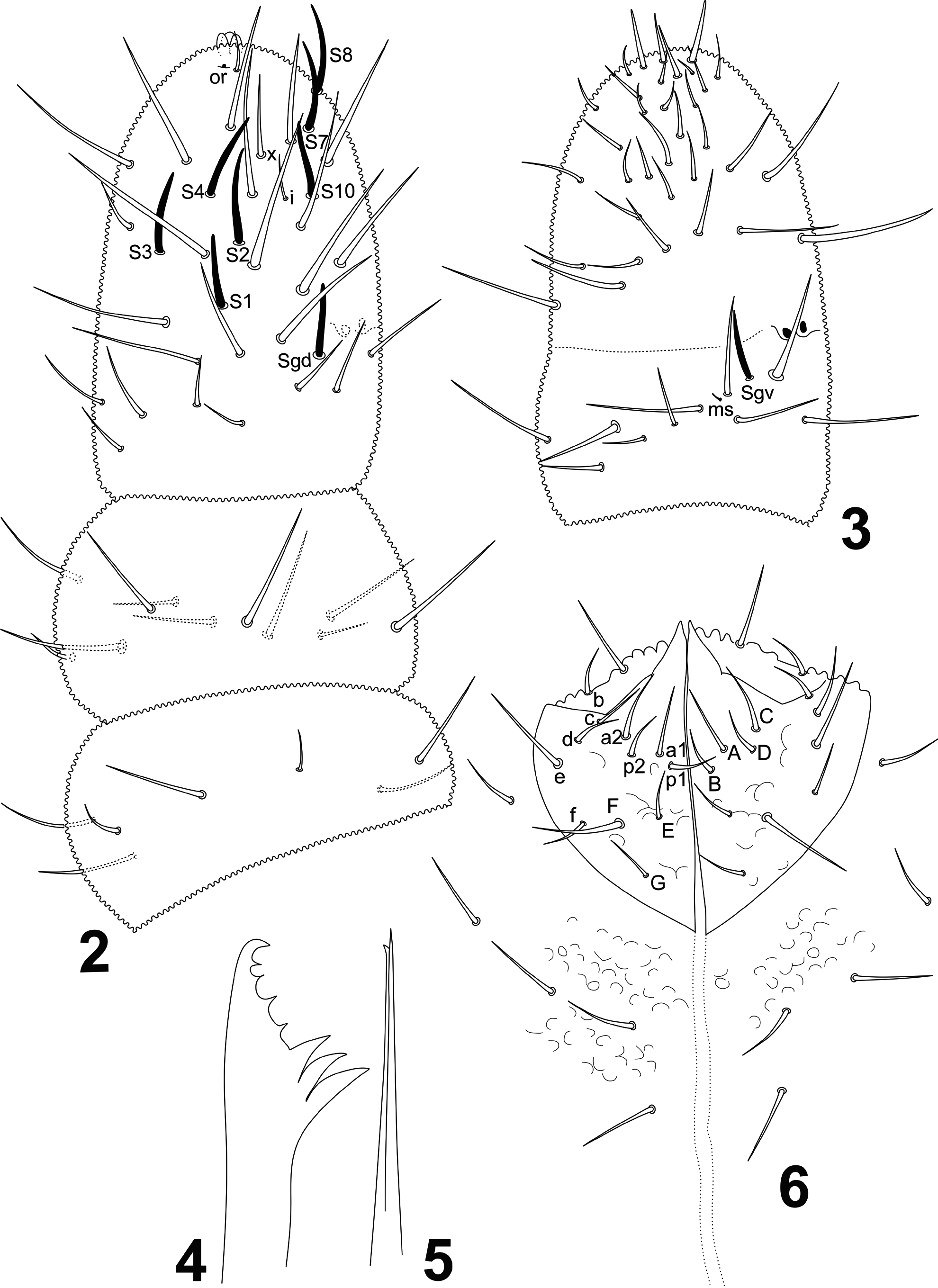
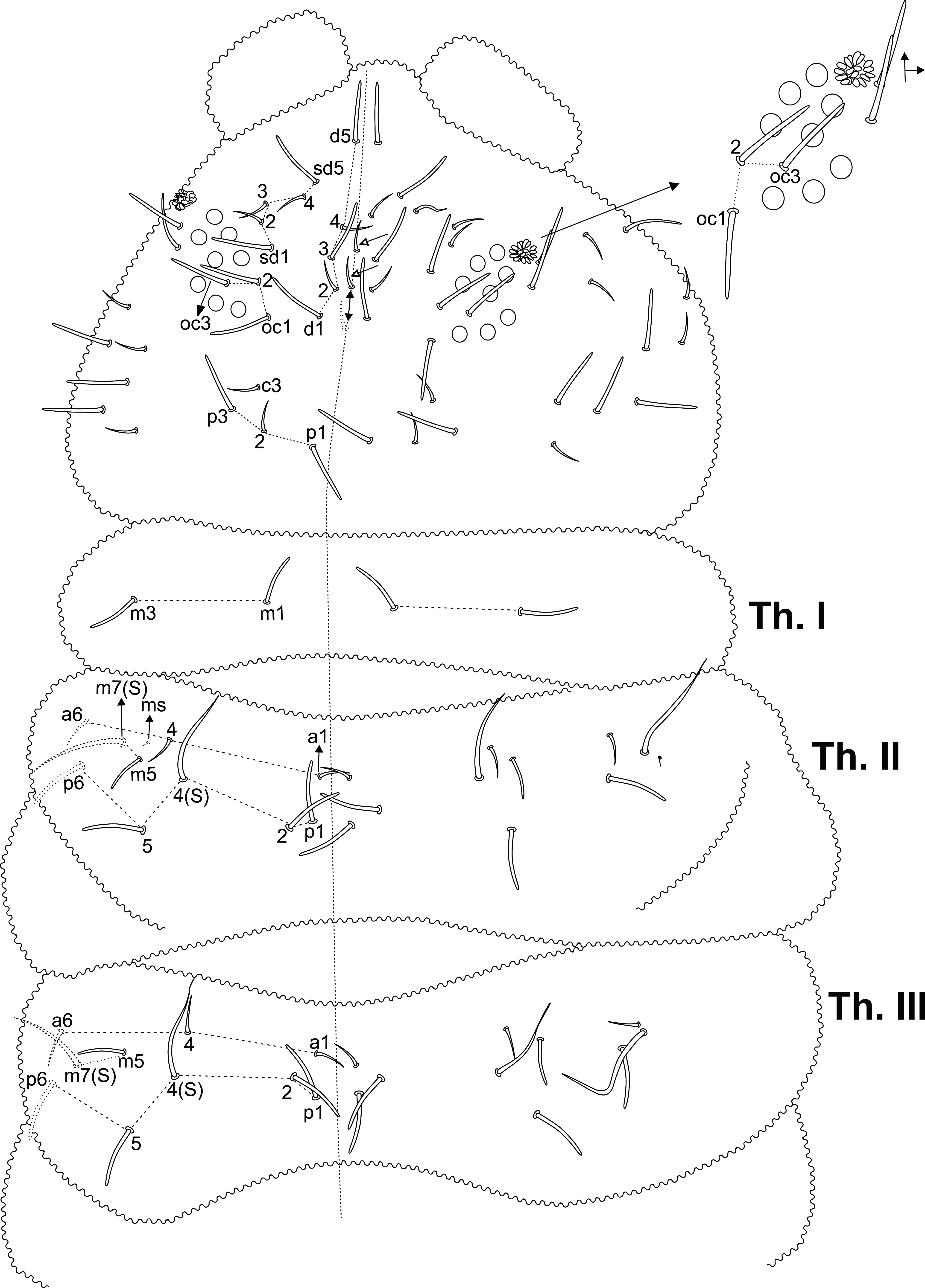
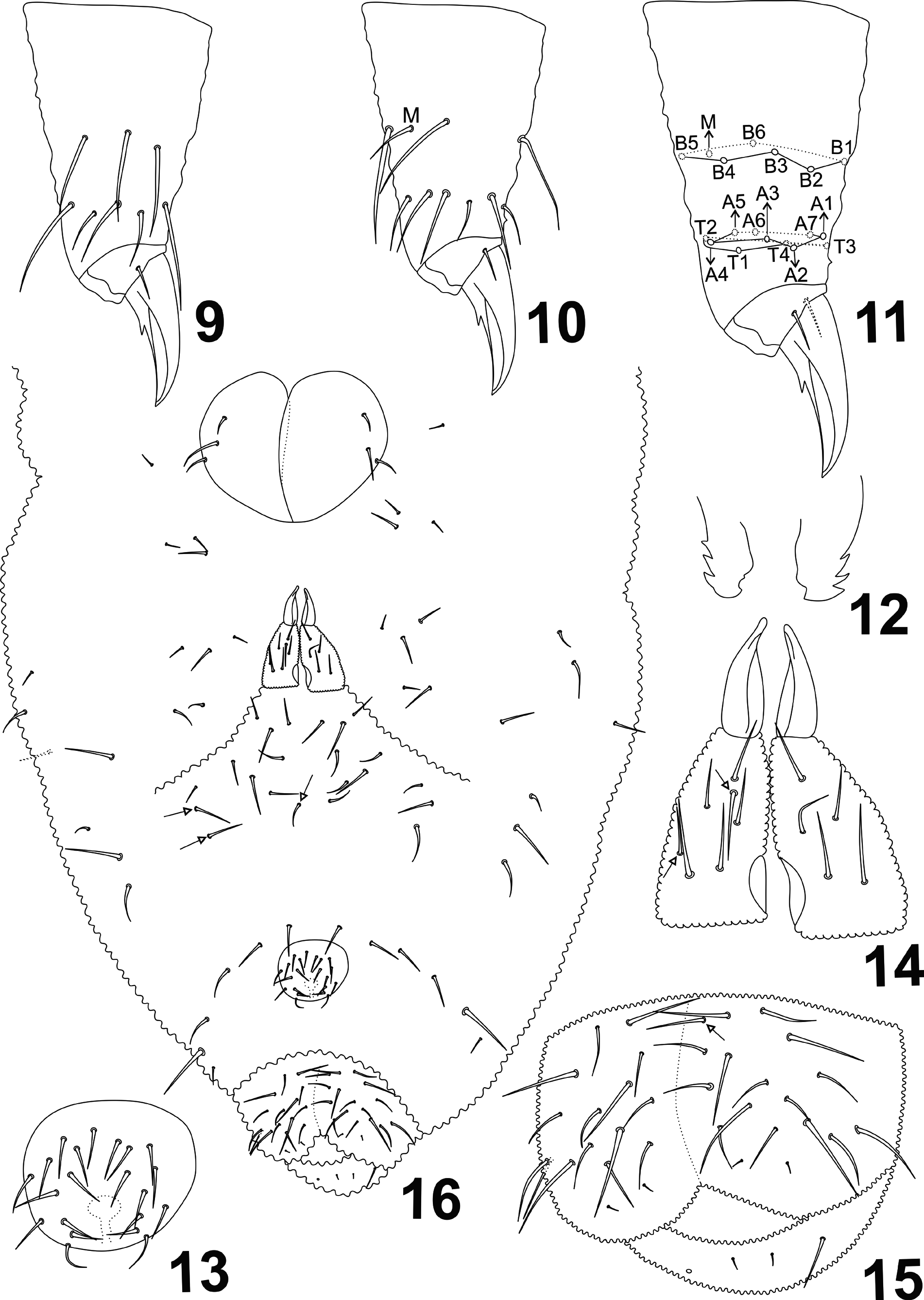
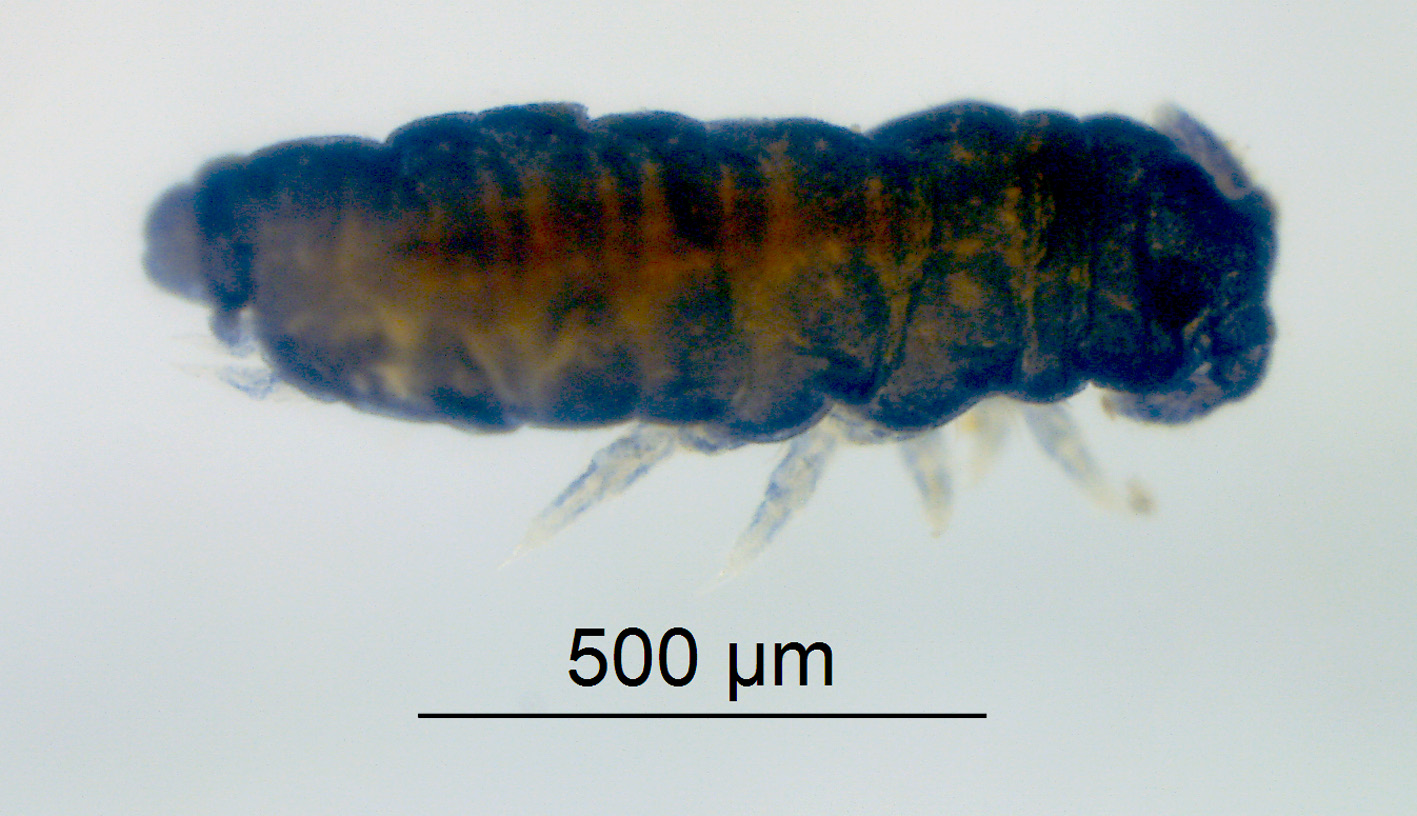
Description. Habitus oval to elongate, specimens dark blue to brownish in ethanol (Fig. 1). Body granules medium sized, uniformly distributed on tegument. Body length of holotype: 1.17 mm, range of type series 0.72 to 2.83 mm, average 1.54 mm. Head (Figs 2 – 7). Ratio cephalic diagonal: antenna in holotype = 1: 0.74. Ant. IV with trilobed apical bulb, dorsally with 7 subcylindrical sensilla (S 1 - S 4, S 7 – S 8 and S 10), ms absent; ventrally with smaller chaetae (Figs 2 – 3). Ant. III and IV fused dorsally, ventral separation marked (Fig. 3). Sensory organ of Ant. III with two small clubshaped sensory rods in an integument depression, protected by two longer subequal guard sensilla (Sgd and Sgv), ventral ms present (Figs 2 – 3). Ant. I and II with 7 and 11 chaetae, respectively (Fig. 2). Mandible with 7 – 8 teeth, 3 basal larger plus 4 – 5 smaller apical teeth (Fig. 4). Maxilla capitulum styliform with two partially fused lamellae, apically the external one discretely curved outside (hooked) (Fig. 5). Oral cone moderately elongate. Basomedian and basolateral labial fields with chaetae F and e longer than others, labium lacking properly formed papillae, chaetae A – D present, C and D apically displaced (Fig. 6). Eyes 8 + 8, subequal lenses, with 3 interocular chaetae (oc 1 – oc 3) (Fig. 7). PAO moruliform, larger than ocellus A, bearing 13 – 19 vesicles (Fig. 7). Dorsal head chaetotaxy with micro (average 12 μm in holotype) and apically blunt mesochaetae (average 28 μm in holotype), a 0 absent; d 5 – d 1, sd 5 – sd 1 and c 3 present; c 1 – 2, c 4 absent; some specimens with 1 or 2 extra abnormal unpaired chaetae near d series, posterior one near d 2 or d 1 (Fig. 7, white arrows). Trunk dorsal chaetotaxy (Figs 7 – 8). Dorsal thorax and abdomen with heterochaetosis: micro (average 10 μm in holotype) and apically blunt mesochaetae (average 25 μm in holotype) plus long sensilla (average 54 μm in holotype) (Figs 7 – 8). Sensillar formula from Th. II to Abd. V as 22 / 11111. Th. I with 2 + 2 mesochaetae. Th. II – III chaetotaxy similar, with 3 + 3 chaetae on a series (a 1, a 4 and a 6), 2 + 2 on m series (m 5 and m 7) and 5 + 5 on p series (p 1 – 2, p 4 – p 6); Th. II – III long sensilla as p 4 and m 7; lateral ms present on Th. II (Fig. 7). Abd. I – III main chaetotaxy similar, with 3 + 3 chaetae on a series (a 1, a 4 and a 6) and 5 + 5 on p series (p 1 – 2, p 4 – p 6); Abd. IV main chaetotaxy with the same chaetae, but with a 4 as mesochaeta, internal or just above p 4; a 2 absent in Abd. I – IV; Abd. I – IV long sensilla as p 5 (Fig. 8). Abd. V with 2 + 2 chaetae on a series (a 1 and a 4) and 3 + 3 on p series (p 1, p 2 and p 4), long sensilla as p 2 (Fig. 8). Abd. VI with unpaired mesochaeta p 0 (Fig. 8). Trunk appendages and ventral abdomen (Figs 9 – 16). Chaetotaxy of legs I – III: Scx. I: 1 / 2 / 2; Scx. II: 0 / 2 / 2; Cx. 2 – 3 / 5 / 7; Tr. 6 / 6 / 6; Fe. 12 / 11 / 10; Tita 19 / 19 / 18 (Figs 9 – 11); Tita chaeta M present, aligned to B series or slightly more proximal (Figs 10 – 11). Ungues with a single median inner tooth; anterior and posterior pretarsal chaetae present (Figs 9 – 11). Ventral tube with 3 + 3 chaetae (Fig. 16). Tenaculum with 3 teeth on each ramus (Fig. 12). Manubrium with 11 + 11 chaetae, 3 chaetae (2 external and 1 internal) present or absent in different specimens (Fig. 16). Furca well developed, dens with 5 – 7 dorsal chaetae, 2 – 3 chaetae slightly longer than others (one proximal-external, one subdistal, if present and one distal) (Fig. 14). Mucro tapering at the apex, average ratio mucro: dens = 1: 2,3 (Fig. 14). Abdominal segments I – V ventrally with 1 / 3 / 8 / 3 / 6 chaetae by half body respectively, excluding genital plates (Fig. 16). Male’s genital plate with about 21 chaetae, eugenital chaetae not differentiated (Fig. 13), female’s genital plate with about 4 smaller eugenital plus 8 regular genital chaetae. Paired ventral anal valves with 15 – 16 ordinary chaetae plus 2 hr microchaetae each; unpaired dorsal anal valve with 13 – 15 ordinary chaetae (including p 0) plus 2 hr microchaetae (Figs 8, 15).
Paz, Raiane Vital Da, Queiroz, Gabriel Costa, Bellini, Bruno Cavalcante (2019): A new species of Aethiopella Handschin, 1942 (Collembola, Poduromorpha, Neanuridae) from Neotropical Region, with comments on the genus. Zootaxa 4629 (1): 39-50, DOI: 10.11646/zootaxa.4629.1.3

Figs 1 – 16, Table 1
Paz, Raiane Vital Da, Queiroz, Gabriel Costa, Bellini, Bruno Cavalcante (2019): A new species of Aethiopella Handschin, 1942 (Collembola, Poduromorpha, Neanuridae) from Neotropical Region, with comments on the genus. Zootaxa 4629 (1): 39-50, DOI: 10.11646/zootaxa.4629.1.3
Diagnosis. Habitus oval to elongate; Ant. IV with trilobed apical bulb, with 7 (S 1 – S 4, S 7 – S 8 and S 10) dorsal subcylindrical sensilla, ms absent; Ant. IV and III ventral separation marked; sensory rods of Ant. III organ small and club-shaped, Sgd relatively distant from the rods, ventral ms present; PAO with 13 – 19 vesicles; mandibles with 7 – 8 teeth, 4 – 5 tiny teeth at the apex plus 3 basal larger; maxillae styliform with two lamellae, apically the external one discretely curved outside (hooked); head lacking a 0; dorsal trunk sensillar formula from Th. II to Abd. V as: 22 / 11111, mesochaetae apically blunt; Th. I with 2 + 2 dorsal chaetae; Tita I – III with 19 / 19 / 18 chaetae, respectively, M chaeta aligned to B series or slightly more proximal; ventral tube with 3 + 3 chaetae; tenaculum with 3 teeth on each ramus; manubrium with 11 – 12 chaetae; dens with 5 – 7 dorsal chaetae; mucro tapering at the apex; male’s eugenital chaetae not differentiated from others; anal valves with 2 hr chaetae.
Paz, Raiane Vital Da, Queiroz, Gabriel Costa, Bellini, Bruno Cavalcante (2019): A new species of Aethiopella Handschin, 1942 (Collembola, Poduromorpha, Neanuridae) from Neotropical Region, with comments on the genus. Zootaxa 4629 (1): 39-50, DOI: 10.11646/zootaxa.4629.1.3
Remarks. Aethiopella ricardoi sp. nov. resembles other Neotropical taxa as Aethiopella caraibensis, A. delamarei, A. littoralis and A. pilarandresae by Ant. IV with trilobed apical bulb and 7 dorsal sensilla (except for A. delamarei, which description lacks the number of dorsal sensilla), Th. I with 2 + 2 chaetae and dens with 5 – 7 chaetae (6 in all other compared species). However, the new species is unique by the combination of PAO with 13 – 19 vesicles (20 – 27 in A. pilarandresae and about 36 A. caraibensis), mandibles with 7 – 8 teeth (6 in A. caraibensis and A. pilarandresae, 4 in A. delamarei, 9 – 10 in A. littoralis), 19 / 19 / 18 chaetae respectively on Tita I – III (18 / 18 / 17 in A. littoralis, unknown in A. caraibensis and A. delamarei) and males lacking modified eugenital chaetae (with such chaetae in A. littoralis, unknown in A. caraibensis and A. delamarei). Despite the already mentioned differences, it must be remarked that A. littoralis and the new species Aethiopella ricardoi sp. nov. present a strikingly similar body chaetotaxic pattern, with a noteworthy heterochaetosis. In this sense both display the pattern of Handschinurida Queiroz, 2015 group of genera sensu Queiroz & Zeppelini, 2017 on head and body, except for Th. I with only 2 + 2 chaetae. In addition, they present a similar number of PAO vesicles (13 – 15 for the first and 13 – 19 for the latter); regarding mandibles, despite a slight difference in number of apical teeth, their general shape is similar, with three strong basal teeth and smaller apical ones. The same is true regarding Ant. III – IV chaetotaxy, for which both also present the pattern of Handschinurida group. The absence of M chaeta on tibiotarsi of A. littoralis is the most striking difference in relation to Aethiopella ricardoi sp. nov. Otherwise, the position of M chaeta aligned to B row of chaetae in the new species is not fully in accordance to the basally displacement seen on other genera of the Handschinurida group. Further comparisons among Aethiopella species are summarized in Table I.
Paz, Raiane Vital Da, Queiroz, Gabriel Costa, Bellini, Bruno Cavalcante (2019): A new species of Aethiopella Handschin, 1942 (Collembola, Poduromorpha, Neanuridae) from Neotropical Region, with comments on the genus. Zootaxa 4629 (1): 39-50, DOI: 10.11646/zootaxa.4629.1.3
Distribution and Habitat. Specimens of Aethiopella ricardoi sp. nov. were collected at the beginning of rainy season in Lagoa Redonda Farm, Nísia Floresta municipality, Rio Grande do Norte State, Brazil, with pitfall traps installed in sandy soil surrounded by dead foliage near vegetation and lentic freshwater. This is a coastland area about 9 km far from the seashore which presents some spots of primary forest. Climate is “ As ” sensu the Köppen-Geiger climate classification, meaning an equatorial main climate with dry summer (Kottek et al. 2006). The new species was only found in the type locality until this moment.
Paz, Raiane Vital Da, Queiroz, Gabriel Costa, Bellini, Bruno Cavalcante (2019): A new species of Aethiopella Handschin, 1942 (Collembola, Poduromorpha, Neanuridae) from Neotropical Region, with comments on the genus. Zootaxa 4629 (1): 39-50, DOI: 10.11646/zootaxa.4629.1.3
Etymology. The new species name honors the memory of our dear friend Dr. Ricardo Andreazze, a cherished professor and entomologist at UFRN who recently passed away.
Paz, Raiane Vital Da, Queiroz, Gabriel Costa, Bellini, Bruno Cavalcante (2019): A new species of Aethiopella Handschin, 1942 (Collembola, Poduromorpha, Neanuridae) from Neotropical Region, with comments on the genus. Zootaxa 4629 (1): 39-50, DOI: 10.11646/zootaxa.4629.1.3
Type material. Holotype: female in slide (CC / UFRN): Brazil, Rio Grande do Norte State, Nísia Floresta municipality, “ Lagoa Redonda ” Farm, 06 ° 02 ’ 45.02 ” S 35 ° 11 ’ 42.63 ” W, 49 m, 15 - 16 - iv- 2017, pitfall-trap, Paz, R. V and Carvalho, M. N. A coll. Paratypes deposited in CC / UFRN: 1 male in slide, same data as holotype; 2 males and 2 females collected in the same locality of the holotype, but during 16 - 18 - vi- 2018. Paratypes deposited in CC / MNRJ: 2 females and 1 male collected in the same locality of the holotype, but during 16 - 18 - vi- 2018; 2 females collected in the same locality of the holotype, but during 13 - 15 - iv- 2018.
Paz, Raiane Vital Da, Queiroz, Gabriel Costa, Bellini, Bruno Cavalcante (2019): A new species of Aethiopella Handschin, 1942 (Collembola, Poduromorpha, Neanuridae) from Neotropical Region, with comments on the genus. Zootaxa 4629 (1): 39-50, DOI: 10.11646/zootaxa.4629.1.3

Export occurrence data

Darwin Core Archive (ZIP)

CLASSIFICATION

Taxonomic Classification Tree

MULTIMEDIA

Media Files(4)

FIGURE 1. Aethiopella ricardoi sp. nov.: habitus of a specimen fixed in ethanol.

Imageimage/png© Paz, Raiane Vital Da;Queiroz, Gabriel Costa;Bellini, Bruno CavalcantePaz, Raiane Vital Da;Queiroz, Gabriel Costa;Bellini, Bruno Cavalcante

FIGURES 2–6. Aethiopella ricardoi sp. nov. head: 2, right Ant. I–IV, dorsal view; 3, right Ant. III–IV, ventral view; 4, left mandible apex; 5, left maxilla capitulum; 6, labium and surrounding chaetotaxy (left D’Haese’s and right Massoud’s labial nomenclatures).

Imageimage/png© Paz, Raiane Vital Da;Queiroz, Gabriel Costa;Bellini, Bruno CavalcantePaz, Raiane Vital Da;Queiroz, Gabriel Costa;Bellini, Bruno Cavalcante

FIGURE 7. Aethiopella ricardoi sp. nov. dorsal chaetotaxy of head (with detail of eyes, interocular chaetae and PAO) and Th. I–III, double arrow indicates chaeta which may be in different positions.

Imageimage/png© Paz, Raiane Vital Da;Queiroz, Gabriel Costa;Bellini, Bruno CavalcantePaz, Raiane Vital Da;Queiroz, Gabriel Costa;Bellini, Bruno Cavalcante

FIGURES 9–16. Aethiopella ricardoi sp. nov.: 9, chaetotaxy of tibiotarsus III (anterior view); 10, chaetotaxy of tibiotarsus III (posterior view); 11, tibiotarsus III entire schematic chaetotaxy; 12, tenaculum rami; 13, male’s genital plate; 14, dens and mucro (dorsal view); 15, anal valves (ventral view); 16, ventral chaetotaxy of male’s abdomen. Arrows indicates chaeta(e) which may be present or absent.

Imageimage/png© Paz, Raiane Vital Da;Queiroz, Gabriel Costa;Bellini, Bruno CavalcantePaz, Raiane Vital Da;Queiroz, Gabriel Costa;Bellini, Bruno Cavalcante

IMAGES

Gallery(4)

See Gallery

Occurrences with images

Source Information

A new species of Aethiopella Handschin, 1942 (Collembola, Poduromorpha, Neanuridae) from Neotropical Region, with comments on the genus

checklist

This dataset contains the digitized treatments in Plazi based on the original journal article Paz, Raiane Vital Da, Queiroz, Gabriel Costa, Bellini, Bruno Cavalcante (2019): A new species of Aethiopella Handschin, 1942 (Collembola, Poduromorpha, Neanuridae) from Neotropical Region, with comments on the genus. Zootaxa 4629 (1): 39-50, DOI: 10.11646/zootaxa.4629.1.3

Abstract

Aethiopella Handschin, 1942 as other Pseudachorutinae (Neanuridae) presents a diagnosis with overlapping characters when compared to other similar genera, especially Halachorutes Arlé, 1966, Ceratrimeria Börner, 1906 and Pseudachorutes Tullberg, 1871. This condition, combined to several gaps on the knowledge of described species and a wide range of morphological differences within the genus, reinforces the need of its revision, since it can be an artificial group. In spite of that, a new species, Aethiopella ricardoi sp. nov., is described and illustrated. It resembles the other five Neotropical taxa of Aethiopella but is unique by the combination of fourth antennal segment with trilobed apical bulb and 7 dorsal sensilla, lack of dorsolateral S - microchaeta (ms); postantennal organ with 13–19 vesicles; mandibles with 7–8 teeth; maxillae apically hooked; and tibiotarsi I–III with 19/19/18 chaetae, respectively, with M chaeta slightly basally displaced. We also present an updated diagnosis of Aethiopella based on current knowledge of Pseudachorutinae, a table comparing all species, a key to Neotropical taxa and remarks on the genus.

Paz R V D, Queiroz G C, Bellini B C, plazi (2019). A new species of Aethiopella Handschin, 1942 (Collembola, Poduromorpha, Neanuridae) from Neotropical Region, with comments on the genus. Plazi.org taxonomic treatments database. Checklist dataset https://doi.org/10.11646/zootaxa.4629.1.3 accessed via GBIF.org on 2026-06-15.

CC0Published 7/4/2019View dataset
GBIF Usage Key
158517887
Dataset Key
09bd5c7f-53cc-40ef-895b-6dc1ae69747a
Origin
source
Backbone Key
10216778
Taxon ID
B1207C75FF9BA27F59BC7FD4FDF9F847.taxon
Last Crawled
6/10/2026
Last Interpreted
6/10/2026