AnimaliaNot EvaluatedacceptedspeciesAccepted
Ptychozoon cicakterbang

Ptychozoon cicakterbang

Grismer, Wood Jr, Grismer, Quah, Thy, Phimmachak, Sivongxay, Seateun, Stuart, Siler, Mulcahy, Anamza & Brown, 2019

GBIF:158690989

0year

ABOUT

Descriptions(7)

2011 b: 139; Grismer et al., 2011: 78 (in part); Grismer et al., 2018 a: 203 (in part). Ptychozoon lionatum (sic.) Grismer, Youmans, Wood, & Grismer 2006: 161; Grismer & Pan, 2008: 278.
Grismer, L. Lee, Wood Jr, Perry L., Grismer, Jesse L., Quah, Evan S. H., Thy, Neang, Phimmachak, Somphouthone, Sivongxay, Niane, Seateun, Sengvilay, Stuart, Bryan L., Siler, Cameron B., Mulcahy, Daniel G., Anamza, Tashitso, Brown, Rafe M. (2019): Geographic structure of genetic variation in the Parachute Gecko Ptychozoon lionotum Annandale, 1905 across Indochina and Sundaland with descriptions of three new species. Zootaxa 4638 (2): 151-198, DOI: 10.11646/zootaxa.4638.2.1

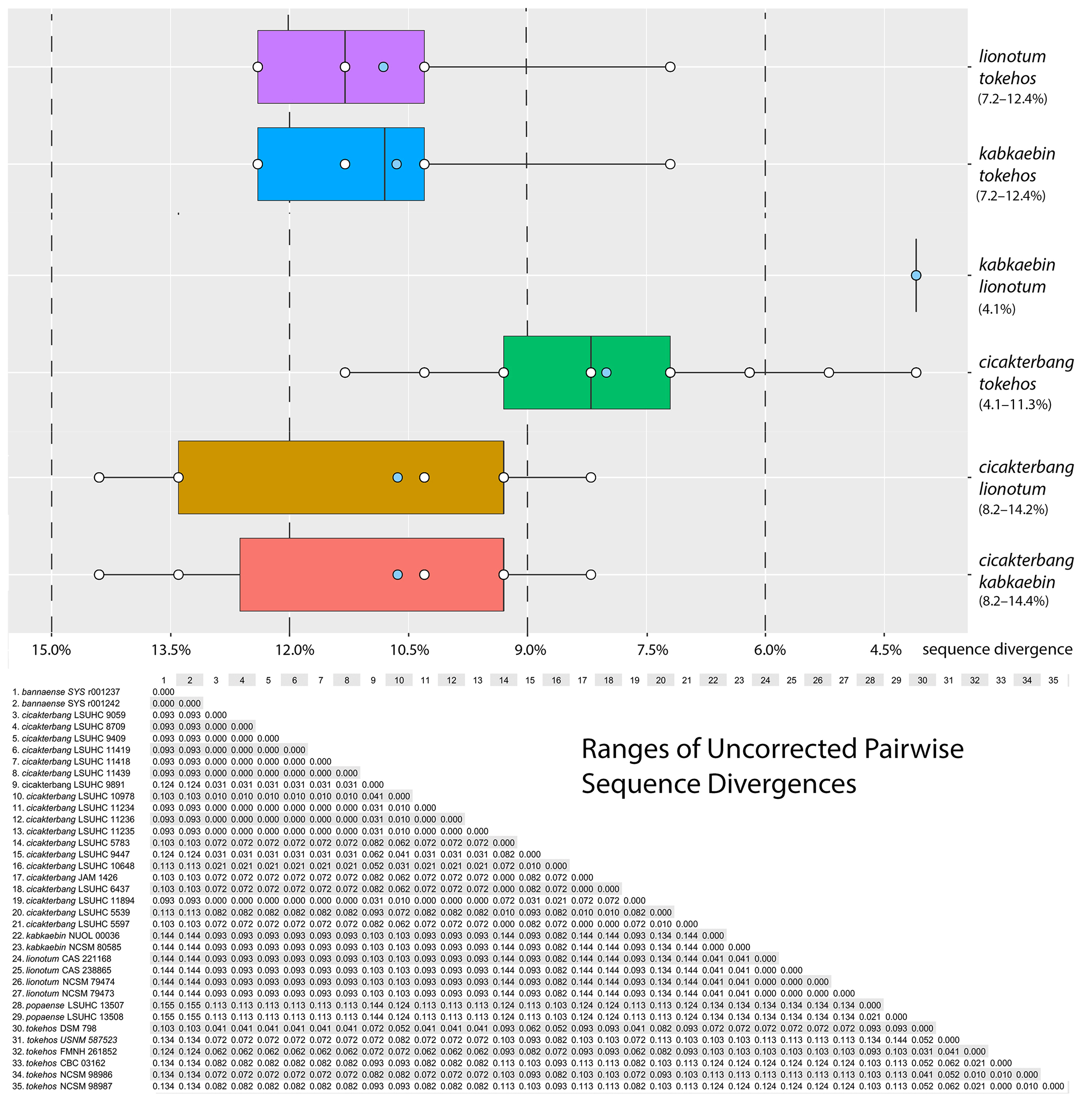
Description of holotype. Adult female SVL 86.0 mm; head moderate (HL / SVL 0.27), wide (HW / HL 0.76), depressed (HD / HL 0.40), distinct from neck; snout rounded at tip in dorsal profile; prefrontal region concave; lores rounded; rostral scale large, rectangular, bearing an inverted Y-shaped, dorsomedial groove, in contact posteriorly with two supranasals, one postnasal, dorsolaterally with nostrils, and laterally with first supralabials; supralabials (10 R, L) to mid-orbital position; infralabials (12 R, 14 L); nostrils elliptical with long axes oriented dorsoventrally, occupying anterior portion of nasal scale, bordered anteriorly by rostral, dorsally by supranasal, posteriorly by four postnasals of varying sizes (upper largest), and ventrally by first and second supralabials; scales on rostrum granular slightly larger than granular scales on top of head and occiput; eyes large (ED / HL 0.22), less than snout length; pupil vertically elliptical, crenelated; supraciliaries elongate, posteriormost weakly pointed; auricular opening rounded, bearing a prominent supra-auricular lobe; tympanum deeply sunk; infra-auricular flap broad, rounded, extending from below corner of mouth to lateral margin of neck midway between posterior margin of ear opening and forelimb insertion, measuring 3.9 mm at its widest point; dorsal scales of infra-auricular flap large, subimbricate proximally, small juxtaposed distally, ventral flap scales minute and granular; mental triangular, slightly wider than deep, bordered laterally by first infralabials and posteriorly by paired, rectangular postmentals contacting medially for 80 % of their length; one row of enlarged sublabials bordering infralabials, anteriormost largest; gular scales small, rounded, grading into larger, imbricating throat and subimbricate pectoral and ventral scales. Body dorsoventrally depressed, relatively stout (AXG / SVL 0.46); patagium 9.4 mm at midpoint of body, bearing enlarged subimbricate, rectangular scales dorsally, minute juxtaposed, subrectangular scales ventrally, ventral surface bearing raised ridges of granular scales extending from body to edge of flap; 86 minute, flat, round, juxtaposed midbody dorsal scales, largest mid-dorsally; four (L) and one (R) large, flat, isolated, dorsal scale (s) immediately anterior to the hind limb insertions; 42 transverse rows of large, smooth, flat, subimbricate ventrals, ventrals much larger than dorsals, decreasing in size laterally into granular scales at base of flap; 23 enlarged, precloacal scales; five rows of enlarged, post-precloacal scales; and scales immediately anterior to vent granular. Limbs short, robust (FL / SVL 0.11; TBL / SVL 0.15); dorsal scales of forelimbs, flat, juxtaposed, larger than dorsal body scales; ventral forelimb scales subimbricate; anterior and posterior margins of forelimbs, and posterior margins of hind limbs bearing wide, cutaneous flaps; that of anterior margin of forearm (i. e. pre-antebrachial flap) emarginated distally and terminating low on base of digit I; scales of forelimb flap large, elongate, subimbricate; those of hind limb flap much smaller, rounded, subimbricate; palmar scales smooth, rounded; digits fully webbed, relatively short, dorsoventrally compressed; undivided transverse subdigital lamellae number 12 (I), 15 (II), 18 (III), 17 (IV), 18 (V), distalmost lamellae V-shaped; claws arise from within the dorsal surface of digital pads; claw of digit I replaced by an enlarged, flat scale; dorsal scales of hind limbs, flat, juxtaposed, larger than dorsal body scales; ventral scales of hind limbs flat, subimbricate, smaller than ventral scales of belly; flat scales of anterior margin of thigh subimbricate; plantar scales smooth, subimbricate; digits fully webbed; transverse subdigital lamellae number 10 (I), 13 (II), 17 (III), 17 (IV), 14 (V), distalmost lamellae V-shaped; claws arise from within the dorsal surface of digital pads; and claw of digit I replaced by an enlarged, flat scale. Tail original, flattened, shorter than SVL (TL / SVL 0.88); two median rows of transversely widened, smooth subcaudals anteriorly becoming less regular and broken up posteriorly; postcloacal scales large, flat, imbricate; dorsal caudals flat, juxtaposed, larger than dorsal body scales; 6 – 10 smaller scales between much larger, transversely aligned scales composing whorls; tail width and caudal lobes decrease posteriorly; 23 caudal lobes on each side slightly angled posteriorly; and tail terminates in a short, narrow, flap (7.3 mm) bearing weakly crenulated edges. Light phase coloration and pattern in life (Fig. 7). Dorsal ground color of head, body, and tail beige; top of head essentially unicolor; labial scales lighter than body, delimited by thin, dark lines at their junctures; infra-auricular flap same lighter color as labial scales; four faint, thin, sinuous dorsal bands between limb insertions transitioning into approximately six darker caudal bands; terminal caudal band on caudal flap nearly black, edged posteriorly by narrow white band; subcaudal region mottled, weakly banded; iris deep-red; gular region, throat, ventral surfaces of forelimbs, pectoral region, and anterior portion of belly dull-white with stippled scales; and posterior margin of belly dull-white, immaculate; stippling on ventral surfaces of hind limbs dense. Variation (Fig. 8). Variation in coloration and pattern is extensive due to this species’ having very different dark and light phases and its ability to substrate-match (see Grismer 2011 a). Color pattern variation in the paratypes described here is based on preserved material. LSUHC 9059, 9447, and 11418 have more boldly marked dorsal bands. Dorsal caudal bands in LSUHC 11418 are much more prominent than those of the holotype. Dark, subcaudal banding in LSUHC 9447 and 11418 is far more distinct than that of the holotype and in LSUHC 9059 and 10991 the banding is more defined than that of the holotype but not nearly as much as the former three specimens. The belly of LSUHC 11418 is much more densely stippled than other specimens of the type series. The parachute scales of the body patagia do not imbricate in LSUHC 5539, 5597, 6437, 8709, and 9059 whereas in the holotype and the other paratypes they are subimbricate. The tails of LSUHC 5783 and 11058 are regenerated and bear no caudal lobes. Males LSUHC 5597, 5783, 8709, and 11418 have 17 – 25 enlarged pore-bearing precloacal scales. Meristic differences amongst the type material and the additional specimens examined are presented in Table 6. Comparisons (Tables 4, 5; Figs. 3, 5, 6). Ptychozoon cicakterbang sp. nov. differs from all other species of Ptychozoon in having a prominent supra-auricular lobe as opposed to a small ridge or no enlargement at all. It differs further from P. intermedium Taylor, 1915, P. kuhli (Stejneger, 1902), and P. trinotaterra in lacking as opposed to having caudal tubercles. From P. intermedium, P. rhacophorus (Boulenger, 1899), P. trinotaterra, and P. kaengkrachanense it differs in having four body bands as opposed to 0 – 3. Ptychozoon cicakterbang sp. nov. differs from P. bannaense Wang, Wang, & Liu, 2016, P. horsfieldii, P. intermedium, P. kuhli, P. nicobarense, P. rhacophorus, P. trinotaterra, and P. kaengkrachanense in having an emargination between the pre-antebrachial flap and digit I as opposed to no emargination. From P. popaense it differs by having a maximum SVL of 93.4 mm versus 86.2 mm, 14 – 17 subdigital lamellae on the fourth toe versus 13 or 14, the absence versus the presence of a thick, dark postorbital stripe; and the absence versus the presence of large, irregularly shaped, white, vertebral markings. Ptychozoon cicakterbang sp. nov. differs futher from P. lionotum, P. kabkaebin sp. nov., and P. tokehos sp. nov. by having a significantly higher mean number of infralabials and a prominent supra-auricular lobe versus a slightly raised ridge. From C. tokehos sp. nov. it differs further by having a significantly higher mean number of subdigital lamellae on the fourth toe, a higher mean number of ventral scales, and a significantly longer axilla-groin length. From P. lionotum it differs even further by having, as opposed to lacking, prominent ridges on the ventral surface of the patagia and weakly crenulated as opposed to smooth caudal flap edges. From C. kabkaebin sp. nov. and P. lionotum it differs further by having a significantly higher mean number of supralabial scales and midbody scales and caudal whorls composed of enlarged scales. From C. kabkaebin sp. nov. it differs further by lacking, as opposed to having, a thick, dark, postorbital stripe. From C. lionotum it differs further by having a significantly narrower head. Ptychozoon cicakterbang sp. nov. is well-separated from other species previously recognized as P. lionotum in the PCA and DAPC and occupies a significantly different position along PC 1 from that of P. kabkaebin sp. nov. and P. tokehos sp. nov. and along PC 2, it occupies a significantly different positon from that of P. lionotum. From these three species, it is further separated by an uncorrected pairwise sequence divergence of 4.1 – 14.4 %. Combinations of other characters differentiating P. cicakterbang sp. nov. from other more distantly related species are presented in Table 5.
Grismer, L. Lee, Wood Jr, Perry L., Grismer, Jesse L., Quah, Evan S. H., Thy, Neang, Phimmachak, Somphouthone, Sivongxay, Niane, Seateun, Sengvilay, Stuart, Bryan L., Siler, Cameron B., Mulcahy, Daniel G., Anamza, Tashitso, Brown, Rafe M. (2019): Geographic structure of genetic variation in the Parachute Gecko Ptychozoon lionotum Annandale, 1905 across Indochina and Sundaland with descriptions of three new species. Zootaxa 4638 (2): 151-198, DOI: 10.11646/zootaxa.4638.2.1
Diagnosis. Ptychozoon cicakterbang sp. nov. differs from all other species of Ptychozoon by having the following unique combination of characters: a maximum SVL of 93.4 mm; supranasals not in contact; 9 – 13 supralabials; 11 – 15 infralabials; infra-auricular cutaneous flap present; prominent supra-auricular lobe; no dorsal or caudal tu-
Grismer, L. Lee, Wood Jr, Perry L., Grismer, Jesse L., Quah, Evan S. H., Thy, Neang, Phimmachak, Somphouthone, Sivongxay, Niane, Seateun, Sengvilay, Stuart, Bryan L., Siler, Cameron B., Mulcahy, Daniel G., Anamza, Tashitso, Brown, Rafe M. (2019): Geographic structure of genetic variation in the Parachute Gecko Ptychozoon lionotum Annandale, 1905 across Indochina and Sundaland with descriptions of three new species. Zootaxa 4638 (2): 151-198, DOI: 10.11646/zootaxa.4638.2.1
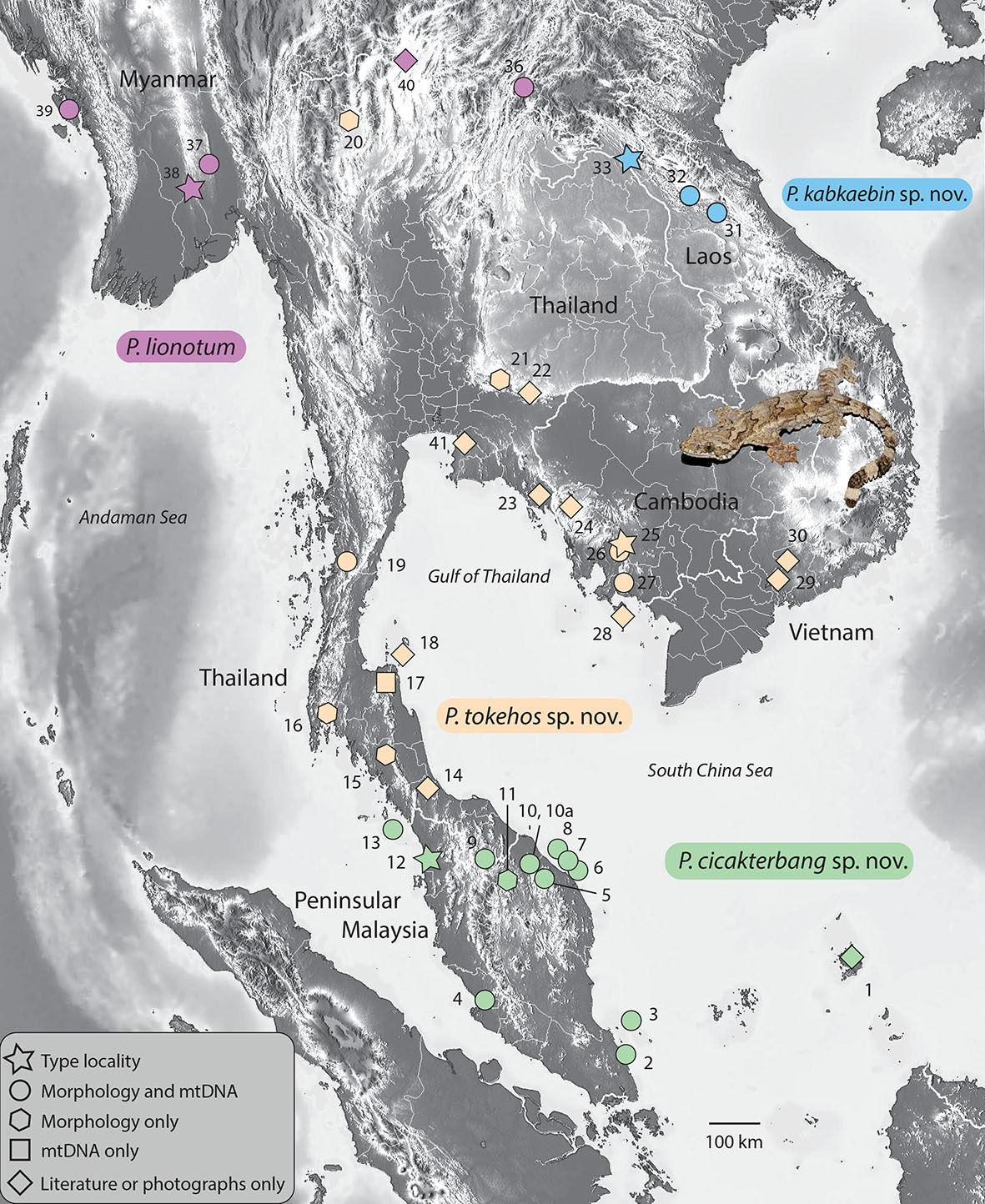
Distribution (Fig. 1). Ptychozoon cicakterbang sp. nov. ranges throughout Peninsular Malaysia and its associated east and west coast islands and most probably extends into extreme southern Thailand. A population has also been reported from Natuna Besar Island, Indonesia that lies between Peninsular Malaysia and Borneo (Leong et al. 2003).
Grismer, L. Lee, Wood Jr, Perry L., Grismer, Jesse L., Quah, Evan S. H., Thy, Neang, Phimmachak, Somphouthone, Sivongxay, Niane, Seateun, Sengvilay, Stuart, Bryan L., Siler, Cameron B., Mulcahy, Daniel G., Anamza, Tashitso, Brown, Rafe M. (2019): Geographic structure of genetic variation in the Parachute Gecko Ptychozoon lionotum Annandale, 1905 across Indochina and Sundaland with descriptions of three new species. Zootaxa 4638 (2): 151-198, DOI: 10.11646/zootaxa.4638.2.1
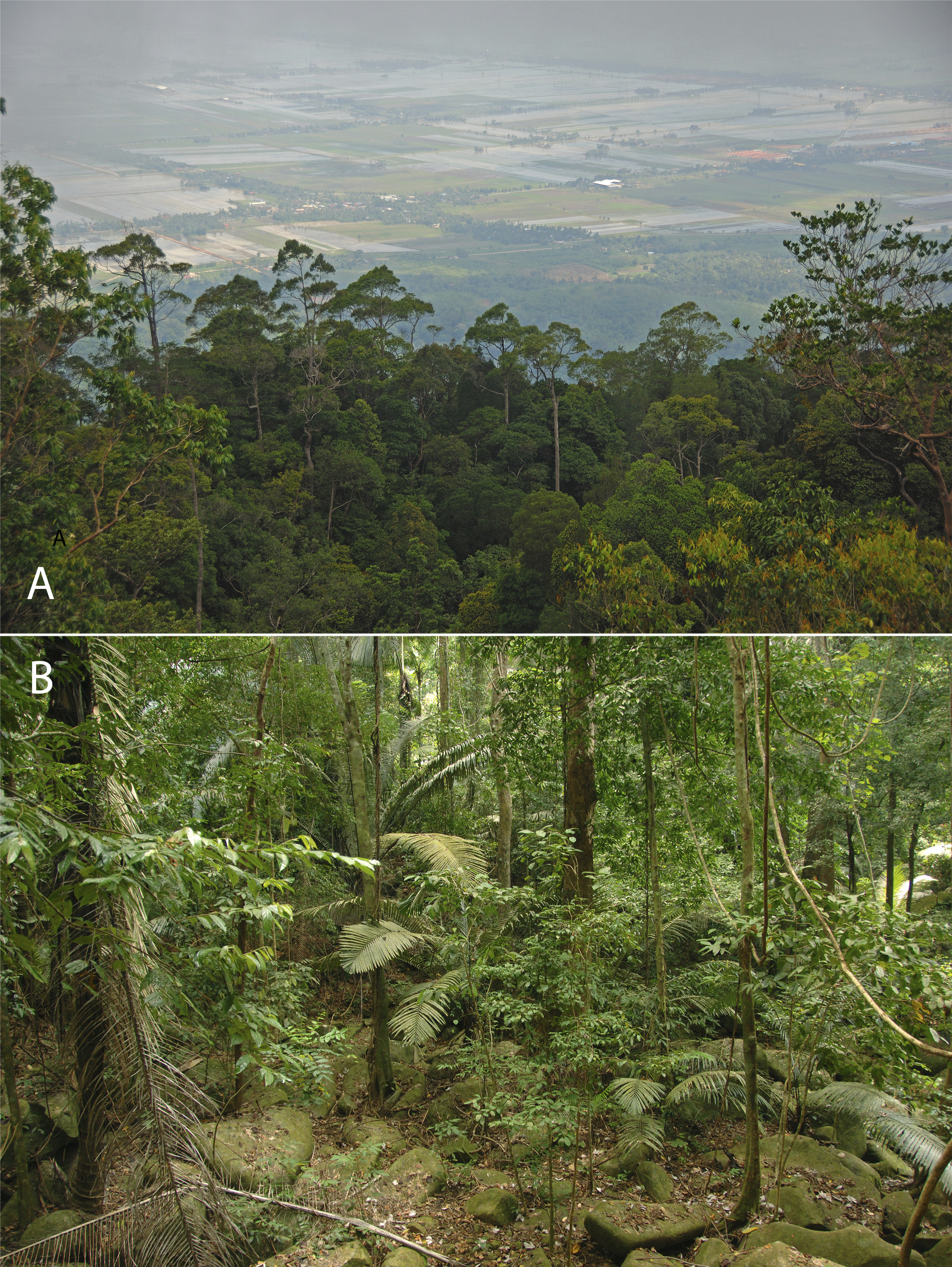
Etymology. The specific epithet cicakterbang is derived from the Malay word for flying lizards. The word “ cicak ” means lizard and “ terbang ” means flight. The term is used for both Ptychozoon and Draco. Natural history. Ptychozoon cicakterbang sp. nov. is found on trees of varying sizes in primary and old secondary, lowland dipterocarp forests (Fig. 9) up to approximately 800 meters in elevation (Dring 1979; Grismer 2011 a, b; Grismer et al. 2011). On Pulau Sibu, it occurs at sea level on small trees within coastal forest adjacent to mangrove swamps (Grismer 2011 a) and can often be found sleeping on the smaller branches of small trees and large shrubs during the day and night less than two meters above the ground (Grismer 2011 a; Grismer et al. 2011). When alarmed, it may jump to the ground to escape. On Pulau Lang Tengah, Terengganu, specimens were observed on the ground eating winged termites on a rainy evening during a storm (Evan S. H. Quah; pers. obs.). Ptychozoon cicakterbang sp. nov. is adept at substrate matching and can vary considerably in coloration and pattern from one area to the next (Fig. 8).
Grismer, L. Lee, Wood Jr, Perry L., Grismer, Jesse L., Quah, Evan S. H., Thy, Neang, Phimmachak, Somphouthone, Sivongxay, Niane, Seateun, Sengvilay, Stuart, Bryan L., Siler, Cameron B., Mulcahy, Daniel G., Anamza, Tashitso, Brown, Rafe M. (2019): Geographic structure of genetic variation in the Parachute Gecko Ptychozoon lionotum Annandale, 1905 across Indochina and Sundaland with descriptions of three new species. Zootaxa 4638 (2): 151-198, DOI: 10.11646/zootaxa.4638.2.1
Holotype. LSUHC 10648 adult female collected by Evan S. H. Quah, L. Lee Grismer, Anuar Shahrul, and Jesse L. Grismer on 26 June 2012 on the road to the top of Gunung Jerai, Kedah, Peninsular Malaysia (5.8099 ° N, 100.4367 ° E, 744 m above sea level). Paratypes. LSUHC 5597 adult male collected by Jesse L. Grismer, L. Lee Grismer, and Perry L. Wood Jr. on 23 July 2003 from Pulau Sibui, Johor, Peninsular Malaysia (2.217539 ° N, 104.069966 ° E, 16 m above sea level). LSUHC 5783 bears the same data as LUSHC 5597 except it was collected on 1 September 2003. LSUHC 8709 adult male collected by L. Lee Grismer, Perry L. Wood Jr., and Jesse L. Grismer from Pulau Perhentian Besar, Terengganu, Peninsular Malaysia (5.901514 ° N, 102.746672 ° E, 123 m above sea level). LSUHC 9059 adult female bearing the same collection data as LSUHC 8709 except being collected on 18 October 2007. LSUHC 9447 adult female collected by Perry L. Wood Jr., Jesse L. Grismer, and L. Lee Grismer from Gunung Machinchang, Pulau Langkawi, Kedah, Peninsular Malaysia (6.386111 ° N, 99.661111 ° E, 634 m above sea level). LSUHC 10978 adult female collected by Evan S. H. Quah and L. Lee Grismer on 7 September 2013 from Hutan Lipur Lata Belatan, Terengganu, Peninsular Malaysia (5.579567 ° N, 102.589028 ° E, 527 m above sea level). LSUHC 11058 adult female collected by L. Lee Grismer and Shahrul Anuar on 26 June 2013 from Kem Baha, Gunung Stone, Kelantan, Peninsular Malaysia (5.340092 ° N, 101.966917 ° E, 511 m above sea level). LSUHC 11418 adult male collected by Evan S. H. Quah and L. Lee Grismer on 26 June 2013 from Pulau Bidong, Terengganu, Peninsular Malaysia (5.620990 ° N, 103.058062 ° E, 25 m above sea level). Additional specimens examined. LSUHC 5539 adult female collected by Jesse L. Grismer, L. Lee Grismer, Perry L. Wood Jr. on 23 July 2003 from Pulau Sibu, Johor, Peninsular Malaysia (2.21754 ° N, 104.06997 ° E, 16 m above sea level); LSUHC 6437 adult female collected by Jesse L. Grismer and Perry L. Wood Jr. on 2 July 2004 from the Tekek-Juara Trail, Pulau Tioman, Pahang, Peninsular Malaysia (2.82070 ° N, 104.168954 ° E, 110 m above sea level); LSUHC 9409 adult female collected by Evan S. H. Quah and L. Lee Grismer at the Reng Reef field station, Pulau Redang, Terengganu, Peninsular Malaysia (5.81212 ° N, 103.000749 ° E, 49 m above sea level); LSUHC 9891 adult female collected by Perry L. Wood Jr., L. Lee Grismer, and Jesse L. Grismer on 6 September 2007 from Lata Tembaka, Terengganu, Peninsular Malaysia (5.554063 ° N, 102.431311 ° E, 690 m above sea level); LSUHC 11439 adult female collected by Evan S. H. Quah and L. Lee Grismer on 26 June 2013 from Pulau Bidong, Terengganu, Peninsular Malaysia (5.620990 ° N, 103.058062 ° E, 25 m above sea level). LSUHC 11234 – 36 collected by Evan S. H. Quah and L. Lee Grismer on 3 July 2013 from Hutan Lipur Lata Belatan, Terengganu, Peninsular Malaysia (5.57957 ° N, 102.58902 ° E, 527 m above sea level).
Grismer, L. Lee, Wood Jr, Perry L., Grismer, Jesse L., Quah, Evan S. H., Thy, Neang, Phimmachak, Somphouthone, Sivongxay, Niane, Seateun, Sengvilay, Stuart, Bryan L., Siler, Cameron B., Mulcahy, Daniel G., Anamza, Tashitso, Brown, Rafe M. (2019): Geographic structure of genetic variation in the Parachute Gecko Ptychozoon lionotum Annandale, 1905 across Indochina and Sundaland with descriptions of three new species. Zootaxa 4638 (2): 151-198, DOI: 10.11646/zootaxa.4638.2.1
Malaysia Parachute Gecko Figs. 7, 8
Grismer, L. Lee, Wood Jr, Perry L., Grismer, Jesse L., Quah, Evan S. H., Thy, Neang, Phimmachak, Somphouthone, Sivongxay, Niane, Seateun, Sengvilay, Stuart, Bryan L., Siler, Cameron B., Mulcahy, Daniel G., Anamza, Tashitso, Brown, Rafe M. (2019): Geographic structure of genetic variation in the Parachute Gecko Ptychozoon lionotum Annandale, 1905 across Indochina and Sundaland with descriptions of three new species. Zootaxa 4638 (2): 151-198, DOI: 10.11646/zootaxa.4638.2.1

Export occurrence data

Darwin Core Archive (ZIP)

CLASSIFICATION

Taxonomic Classification Tree

MULTIMEDIA

Media Files(7)

FIGURE 1. Distribution of Ptychozoon lionotum, P. cicakterbang sp. nov., P. kabkaebin sp. nov., and P. tokehos sp. nov. Diamond designated localities are non-specimen based and considered tentative. Their sources are: (1) Pulau Natuna Besar, Indonesia (Leong et al. 2003); (14) Hat Yai, Songkla, Thailand (LSUDPC 10946); (18) Ko Samui, Surat Thani, Thailand (LSUDPC 10948); (22) Dong Paya Fei Mounatains, Nakhon Ratchasima, Thailand (Smith 1935); (23) Chantabun, Chanthaburi, Thailand (Smith 1935); (24) Phnom Samkos, Pursat, Cambodia (LSUDPC 10949–53); (28) Phu Quoc Island, Kiem Giang Province, Vietnam (Nguyen et al. 2009); (29) Trang Bom, Dong Nai Province, Vietnam (Nguyen et al. 2009) however this specimen may be P. trinotaterra (see Distribution section for P. tokehos sp. nov.); (30) Cat Tien, Dong Nai Province, Vietnam (Nguyen et al. 2009); and (41) Siracha, Chanthaburi, Thailand (Smith 1935). Numbered locations for the specimen-based localities are listed in Tables 1 and 6–9 and on the tree in Figure 2.

Imageimage/png© Grismer, L. Lee;Wood Jr, Perry L.;Grismer, Jesse L.;Quah, Evan S. H.;Thy, Neang;Phimmachak, Somphouthone;Sivongxay, Niane;Seateun, Sengvilay;Stuart, Bryan L.;Siler, Cameron B.;Mulcahy, Daniel G.;Anamza, Tashitso;Brown, Rafe M.Grismer, L. Lee;Wood Jr, Perry L.;Grismer, Jesse L.;Quah, Evan S. H.;Thy, Neang;Phimmachak, Somphouthone;Sivongxay, Niane;Seateun, Sengvilay;Stuart, Bryan L.;Siler, Cameron B.;Mulcahy, Daniel G.;Anamza, Tashitso;Brown, Rafe M.

FIGURE 3. Uncorrected pairwise sequence divergence between species of rhe Ptychzoon lionotum group (boxplots) and between individuals of the P. lionotum group (matrix). Colored squares represent the 50% quartile. Light-blue circles are means.

Imageimage/png© Grismer, L. Lee;Wood Jr, Perry L.;Grismer, Jesse L.;Quah, Evan S. H.;Thy, Neang;Phimmachak, Somphouthone;Sivongxay, Niane;Seateun, Sengvilay;Stuart, Bryan L.;Siler, Cameron B.;Mulcahy, Daniel G.;Anamza, Tashitso;Brown, Rafe M.Grismer, L. Lee;Wood Jr, Perry L.;Grismer, Jesse L.;Quah, Evan S. H.;Thy, Neang;Phimmachak, Somphouthone;Sivongxay, Niane;Seateun, Sengvilay;Stuart, Bryan L.;Siler, Cameron B.;Mulcahy, Daniel G.;Anamza, Tashitso;Brown, Rafe M.

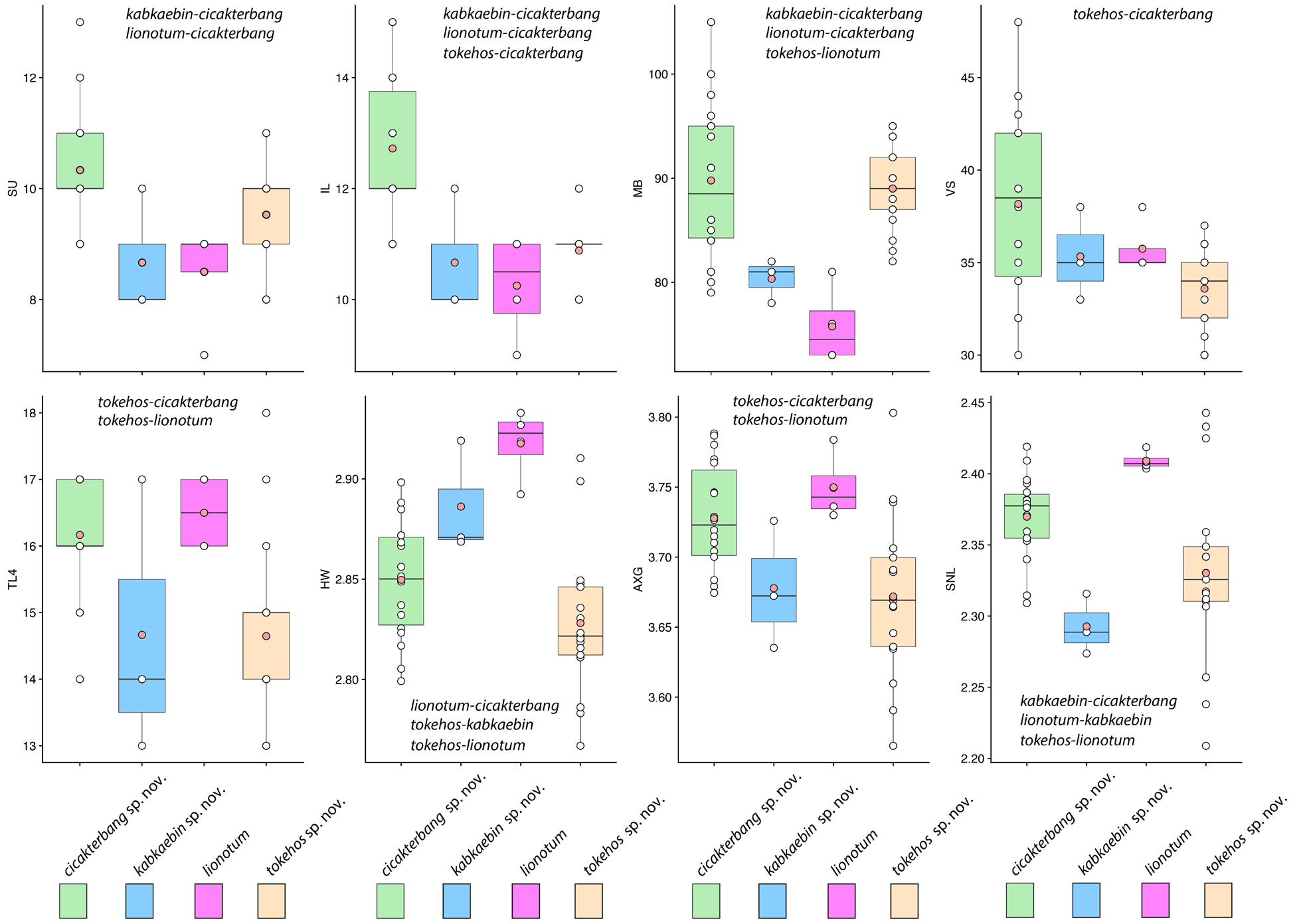
FIGURE 5. Boxplot analyses of the characters bearing statistically significant mean values between various combinations of species pairs. The species pairs are listed on the plot. Colored squares represent the 50% quartile. Orange circles are the means.

Imageimage/png© Grismer, L. Lee;Wood Jr, Perry L.;Grismer, Jesse L.;Quah, Evan S. H.;Thy, Neang;Phimmachak, Somphouthone;Sivongxay, Niane;Seateun, Sengvilay;Stuart, Bryan L.;Siler, Cameron B.;Mulcahy, Daniel G.;Anamza, Tashitso;Brown, Rafe M.Grismer, L. Lee;Wood Jr, Perry L.;Grismer, Jesse L.;Quah, Evan S. H.;Thy, Neang;Phimmachak, Somphouthone;Sivongxay, Niane;Seateun, Sengvilay;Stuart, Bryan L.;Siler, Cameron B.;Mulcahy, Daniel G.;Anamza, Tashitso;Brown, Rafe M.

FIGURE 6. Multivariate analyses of P. lionotum, P. cicakterbang sp. nov., P. kabkaebin sp. nov., and P. tokehos sp. nov. A. PCA ordination along PC 1 and PC2. B. DAPC showing complete separation of the 95% confidence ellipses. C. PCA ordination along PC1, PC2, and PC3.

Imageimage/png© Grismer, L. Lee;Wood Jr, Perry L.;Grismer, Jesse L.;Quah, Evan S. H.;Thy, Neang;Phimmachak, Somphouthone;Sivongxay, Niane;Seateun, Sengvilay;Stuart, Bryan L.;Siler, Cameron B.;Mulcahy, Daniel G.;Anamza, Tashitso;Brown, Rafe M.Grismer, L. Lee;Wood Jr, Perry L.;Grismer, Jesse L.;Quah, Evan S. H.;Thy, Neang;Phimmachak, Somphouthone;Sivongxay, Niane;Seateun, Sengvilay;Stuart, Bryan L.;Siler, Cameron B.;Mulcahy, Daniel G.;Anamza, Tashitso;Brown, Rafe M.

FIGURE 7. Holotype of Ptychozoon cicakterbang sp. nov. LSUHC 10648 from Gunung Jerai, Kedah, Peninsular Malaysia. Photograph by L. L. Grismer.

Imageimage/png© Grismer, L. Lee;Wood Jr, Perry L.;Grismer, Jesse L.;Quah, Evan S. H.;Thy, Neang;Phimmachak, Somphouthone;Sivongxay, Niane;Seateun, Sengvilay;Stuart, Bryan L.;Siler, Cameron B.;Mulcahy, Daniel G.;Anamza, Tashitso;Brown, Rafe M.Grismer, L. Lee;Wood Jr, Perry L.;Grismer, Jesse L.;Quah, Evan S. H.;Thy, Neang;Phimmachak, Somphouthone;Sivongxay, Niane;Seateun, Sengvilay;Stuart, Bryan L.;Siler, Cameron B.;Mulcahy, Daniel G.;Anamza, Tashitso;Brown, Rafe M.

FIGURE 9. Habitat of Ptychozoon cicakterbang sp. nov. A. Forest at the type locality of Gunung Jerai, Kedah, Peninsular Malaysia. B. Microhabitat along the Tekek-Juara Trail, Pulau Tioman, Peninsular Malaysia.

Imageimage/png© Grismer, L. Lee;Wood Jr, Perry L.;Grismer, Jesse L.;Quah, Evan S. H.;Thy, Neang;Phimmachak, Somphouthone;Sivongxay, Niane;Seateun, Sengvilay;Stuart, Bryan L.;Siler, Cameron B.;Mulcahy, Daniel G.;Anamza, Tashitso;Brown, Rafe M.Grismer, L. Lee;Wood Jr, Perry L.;Grismer, Jesse L.;Quah, Evan S. H.;Thy, Neang;Phimmachak, Somphouthone;Sivongxay, Niane;Seateun, Sengvilay;Stuart, Bryan L.;Siler, Cameron B.;Mulcahy, Daniel G.;Anamza, Tashitso;Brown, Rafe M.

IMAGES

Gallery(7)

See Gallery

Occurrences with images

Source Information

Geographic structure of genetic variation in the Parachute Gecko Ptychozoon lionotum Annandale, 1905 across Indochina and Sundaland with descriptions of three new species

checklist

This dataset contains the digitized treatments in Plazi based on the original journal article Grismer, L. Lee, Wood Jr, Perry L., Grismer, Jesse L., Quah, Evan S. H., Thy, Neang, Phimmachak, Somphouthone, Sivongxay, Niane, Seateun, Sengvilay, Stuart, Bryan L., Siler, Cameron B., Mulcahy, Daniel G., Anamza, Tashitso, Brown, Rafe M. (2019): Geographic structure of genetic variation in the Parachute Gecko Ptychozoon lionotum Annandale, 1905 across Indochina and Sundaland with descriptions of three new species. Zootaxa 4638 (2): 151-198, DOI: 10.11646/zootaxa.4638.2.1

Abstract

An integrative taxonomic analysis of the Ptychozoon lionotum group across its range in Indochina and Sundaland recovers P. lionotum sensu lato Annandale, 1905 as paraphyletic with respect to P. popaense Grismer, Wood, Thura, Grismer, Brown, & Stuart, 2018a and composed of four allopatric, genetically divergent, ND2 mitochondrial lineages. Multivariate and univariate analyses of continuous and discrete morphological and color pattern characters statistically and discretely diagnose each lineage from one another and together, with maximum likelihood and Bayesian inference analyses, provide the foundation for the recognition of each lineage as a new species—hypotheses corroborated with a Generalized Mixed Yule Coalescent species delimitation analysis. Ptychozoon cicakterbang sp. nov. ranges throughout Peninsular Malaysia to Pulau Natuna Besar, Indonesia; P. kabkaebin sp. nov. is endemic to northern and central Laos; and P. tokehos sp. nov. ranges from southern Thailand south of the Isthmus of Kra northward to Chiang Mai, fringing the Chao Phraya Basin and ranging southward through Cambodia to southern Vietnam. Ptychozoon lionotum sensu stricto ranges from northwestern Laos through southern Myanmar to eastern India. The phylogeographic structure within each species varies considerably with P. lionotum s.s. showing no genetic divergence across its 1,100 km range compared to P. cicakterbang sp. nov. showing upwards of 8.2% sequence divergence between syntopic individuals. Significant phylogeographic structure exists within P. tokehos sp. nov. and increased sampling throughout Thailand may require additional taxonomic changes within this species.

Grismer L L, Wood Jr P L, Grismer J L, Quah E S H, Thy N, Phimmachak S, Sivongxay N, Seateun S, Stuart B L, Siler C B, Mulcahy D G, Anamza T, Brown R M, plazi (2019). Geographic structure of genetic variation in the Parachute Gecko Ptychozoon lionotum Annandale, 1905 across Indochina and Sundaland with descriptions of three new species. Plazi.org taxonomic treatments database. Checklist dataset https://doi.org/10.11646/zootaxa.4638.2.1 accessed via GBIF.org on 2026-06-15.

CC0Published 7/16/2019View dataset
GBIF Usage Key
158690989
Dataset Key
008c2ce6-d9ae-424c-9e2b-0d16d9da40e7
Origin
source
Backbone Key
10075198
Taxon ID
0384597AFFBFFFA7FF5EBAAE25CFF880.taxon
Last Crawled
6/10/2026
Last Interpreted
6/10/2026