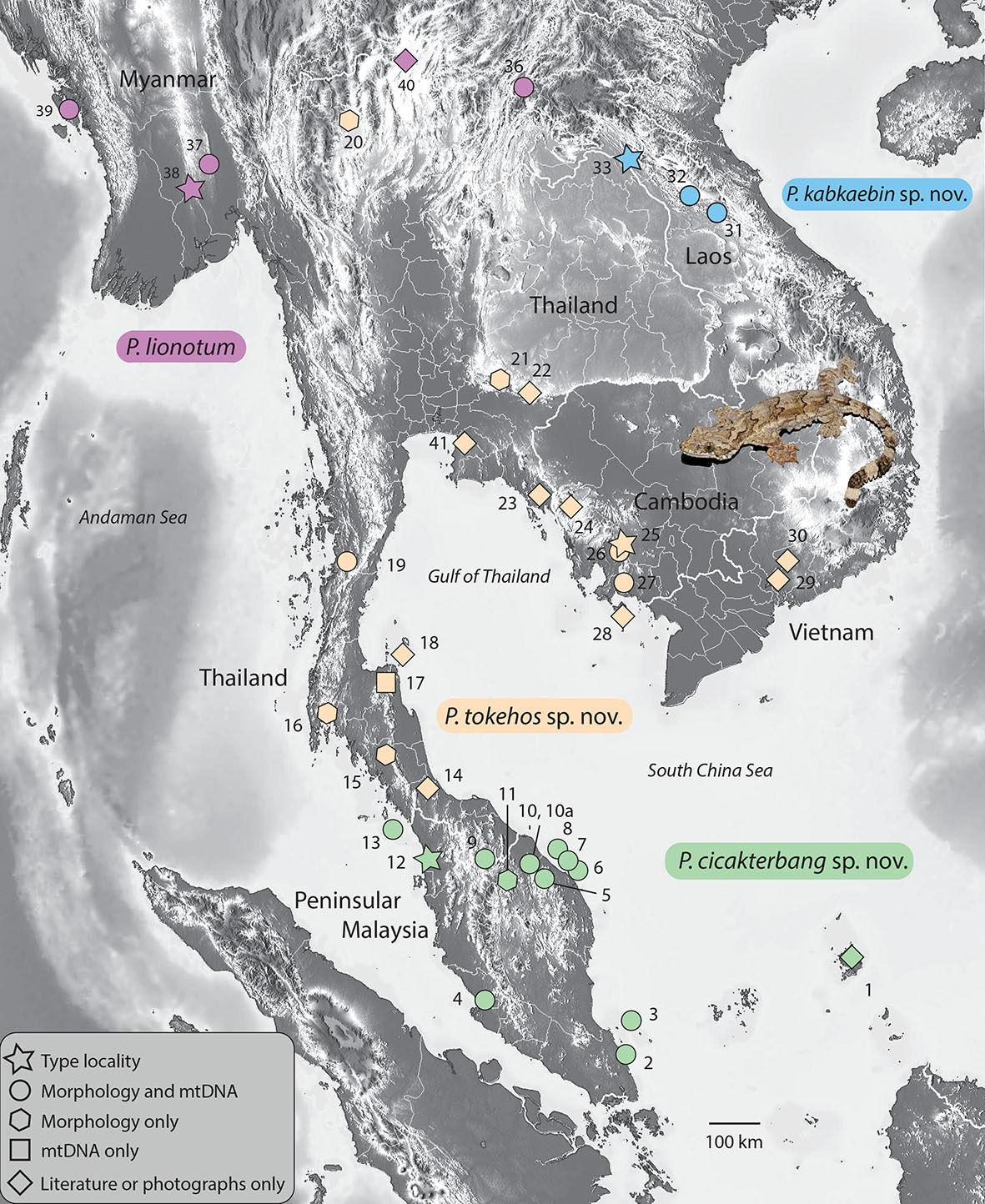
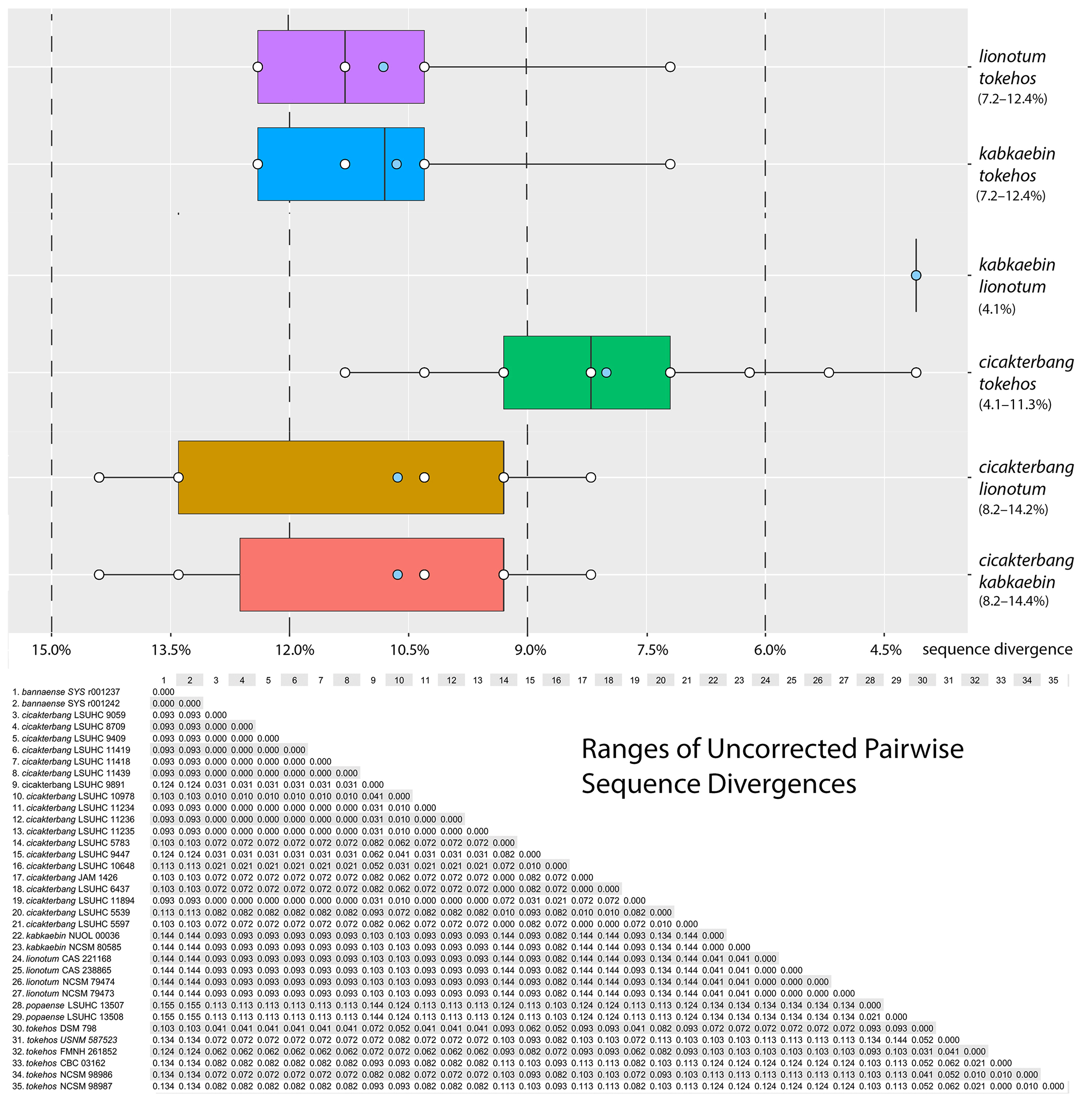
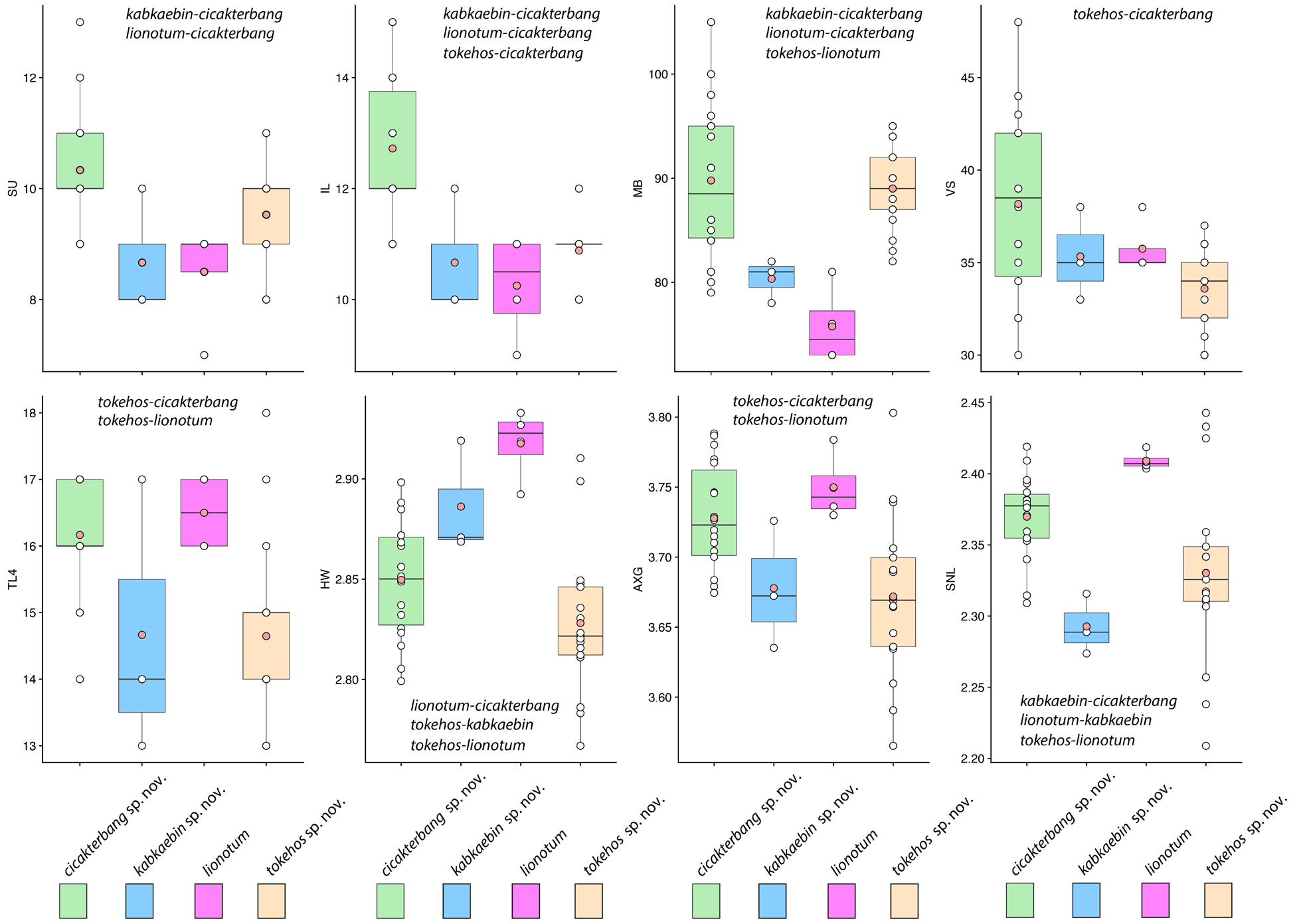
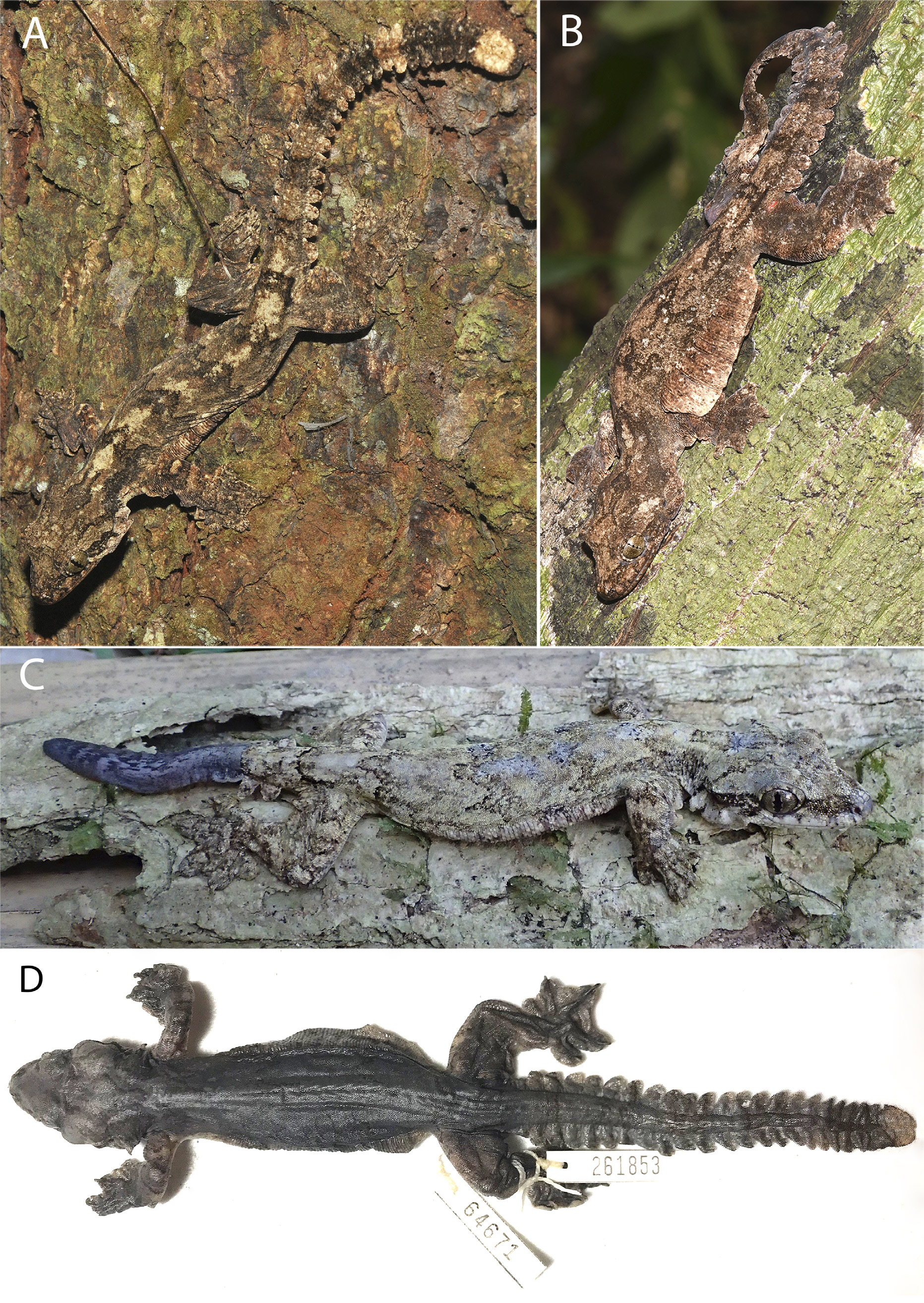
Description of holotype. Adult female SVL 97.5 mm; head moderate (HL / SVL 0.25), wide (HW / HL 0.79), depressed (HD / HL 0.44), distinct from neck; snout rounded at tip in dorsal profile; prefrontal region weakly concave; lores rounded; rostral scale large, rectangular, in contact posteriorly with two supranasals and one postnasal, dorsolaterally with nostrils, and laterally with first supralabials; supralabials (10 R, 9 L) to mid-orbital position; infralabials (12 R, 11 L); nostrils elliptical with long axes oriented obliquely, occupying anterior portion of nasal scale, bordered anteriorly by rostral, dorsally by supranasal, posteriorly by four postnasals of varying sizes (upper largest), and ventrally by first supralabial; scales on rostrum granular larger than granular scales on top of head and occiput; eyes large (ED / HL 0.23), less than snout length; pupil vertically elliptical, crenelated; supraciliaries elongate, posteriormost pointed; auricular opening rounded, bearing a weak supra-auricular ridge; tympanum deeply sunk; infra-auricular flap broad, rounded, extending from below corner of mouth to lateral margin of neck midway between posterior margin of ear opening and forelimb insertion, measuring 5.0 mm at its widest point; dorsal scales of infra-auricular flap large, subimbricate proximally, small juxtaposed distally, ventral scales of flap minute and granular; mental triangular, as wide as deep, bordered laterally by first infralabials and posteriorly by paired, rectangular postmentals, posterior section of left postmental divided into three smaller scales; one row of enlarged sublabials bordering infralabials, anteriormost largest; gular scales granular, grading into larger imbricating throat and subimbricate pectoral and ventral scales. Body dorsoventrally depressed, relatively stout (AXG / SVL 0.53); patagia 8.9 mm at midpoint of body bearing enlarged, subimbricate, rectangular scales dorsally, minute, juxtaposed, subrectangular scales ventrally, ventral surface bearing raised scaly ridges extending from body to edge of flap; 88 minute, flat, round, juxtaposed midbody dorsal scales, largest mid-dorsally; no large, flat, dorsal scales immediately anterior to the hind limb insertions; 36 transverse rows of large, smooth, flat, subimbricate ventral scales much larger than dorsal scales, decreasing in size laterally into granular scales at the base of the flap; 21 enlarged, precloacal scales; five rows of enlarged, post-precloacal scales; and scales immediately anterior to vent granular. Limbs short, robust (FL / SVL 0.10; TBL / SVL 0.17); dorsal scales of forelimbs, flat, juxtaposed, larger than dorsal body scales; ventral forelimb scales small, subimbricate; anterior and posterior margins of forelimbs, and posterior margins of hind limbs bearing wide, cutaneous flaps; that of anterior margin of forearm (i. e. pre-antebrachial flap) emarginated distally and terminates low on the base of digit I, that of the foreleg does not reach the base of digit I; scales of forelimb flaps large, elongate, subimbricate; those of hind limb flaps smaller, more rounded, subimbricate; palmar scales smooth, rounded; digits fully webbed, relatively short, dorsoventrally compressed; undivided transverse subdigital lamellae number 11 (I), 13 (II), 12 (III), 13 (IV), 12 (V), distalmost lamellae V-shaped; claws arise from within the dorsal surface of digital pads; claw of digit I replaced by an enlarged, flat scale; dorsal scales of hind limbs, flat, juxtaposed, same size as dorsal body scales; ventral scales of hind limbs flat, subimbricate, smaller than ventral scales of belly; scales of anterior margin of thigh large, subimbricate; plantar scales smooth, subimbricate; digits fully webbed; transverse subdigital lamellae number 11 (I), 12 (II), 14 (III), 15 (IV), 13 (V), distalmost lamellae V-shaped; claws arise from within the dorsal surface of digital pads, and claw of digit I replaced by an enlarged, flat scale. Tail original, flattened, shorter than SVL (TL / SVL 0.88); two median rows of transversely widened, smooth subcaudals anteriorly becoming less regular and broken up posteriorly; postcloacal scales large, flat, imbricate; dorsal caudals flat, juxtaposed, larger than dorsal body scales, bearing whorls of larger scales; tail width and caudal lobes decrease posteriorly; 22 caudal lobes on each side slightly angled posteriorly; and tail terminates in a short, narrow flap (10.0 mm) bearing smooth edges. Dark phase coloration in life (Fig. 12). Dorsal ground color of head, body, and tail brown; top of head darkly speckled; darker, inverted Y-shaped marking overlying nape and occiput; labial scales lighter than body, delimited by thin, dark lines at their junctures; infra-auricular flap same color as labials; irregularly shaped, white, vertebral markings between and just posterior to the forelimb insertions and in the sacral region; four faint, thin, deeply sinuous dorsal bands between limb insertion transitioning into approximately five wide, faint, caudal bands; terminal caudal band on caudal flap dull-white; subcaudal region mottled, weakly banded; iris bronze; gular region, throat, ventral surfaces of limbs, pectoral region, and belly dull-white with stippled scales. In preservation, the coloration is uniformly dull-grey on all dorsal surfaces with only faint patterning visible. Variation (Fig. 12). Variation in coloration and pattern is highly variable due to this species’ having dark and light color phases and its ability to substrate match. Color pattern variation in the paratypes described here is based on preserved and living material. The paratypes closely approximate the holotype in all aspects coloration and pattern. Caudal banding is present in all specimens in varying degrees of distinctness. FMNH 261852 – 53 have a series of large, irregularly shaped, white, vertebral markings extending from the nape to the postsacral region whereas no other specimens (N = 17) have these markings. FMNH 261852 and 261854 have partially regenerated tails bearing a single flap with no lobes. FMNH 177359, 181844, and 261851 are males bearing 23, 22, and 21 pore-bearing precloacal scales. Variation in meristic characters is presented in Table 8. Comparisons (Tables 4, 5; Figs. 3, 5, 6). Differences between Ptychozoon tokehos sp. nov., P. kabkaebin sp. nov., and P. cicakterbang sp. nov. are listed above in the comparisons sections of those species. Ptychozoon tokehos sp. nov. differs from P. intermedium, P. kuhli, and P. trinotaterra in lacking, as opposed to having, caudal tubercles. From P. intermedium, P. nicobarense, P. rhacophorus, P. trinotaterra, and P. kaengkrachanense it differs in having four body bands as opposed to 0 – 3. Ptychozoon tokehos sp. nov. differs from P. bannaense, P. horsfieldii, P. intermedium, P. kuhli, P. nicobarense, P. rhacophorus, P. trinotaterra, and P. kaengkrachanense in having an emargination between the pre-antebrachial flap and digit I as opposed to no emargination. From P. popaense it differs by having a maximum SVL of 97.5 mm versus 86.2 mm. Ptychozoon tokehos sp. nov. is well-separated from P. cicakterbang sp. nov. and P. lionotum in the PCA and from all species in the DAPC where their 95 % confidence ellipses do not overlap. Ptychozoon tokehos sp. nov. occupies a significantly different position along PC 1 from that of P. cicakterbang sp. nov. and along PC 2, it occupies a significantly different positon from those of P. kabkaebin sp. nov. and P. lionotum. From all other species of the P. lionotum group it is further separated by an uncorrected pairwise sequence divergence of 4.1 – 15.5 %. Combinations of other characters differentiating P. kabkaebin sp. nov. from other more distantly related species are presented in Table 5.
Grismer, L. Lee, Wood Jr, Perry L., Grismer, Jesse L., Quah, Evan S. H., Thy, Neang, Phimmachak, Somphouthone, Sivongxay, Niane, Seateun, Sengvilay, Stuart, Bryan L., Siler, Cameron B., Mulcahy, Daniel G., Anamza, Tashitso, Brown, Rafe M. (2019): Geographic structure of genetic variation in the Parachute Gecko Ptychozoon lionotum Annandale, 1905 across Indochina and Sundaland with descriptions of three new species. Zootaxa 4638 (2): 151-198, DOI: 10.11646/zootaxa.4638.2.1