AnimaliaNot EvaluatedacceptedspeciesAccepted
Ptychozoon kabkaebin

Ptychozoon kabkaebin

Grismer, Wood Jr, Grismer, Quah, Thy, Phimmachak, Sivongxay, Seateun, Stuart, Siler, Mulcahy, Anamza & Brown, 2019

GBIF:158690991

0year

0

Synonyms

ABOUT

Descriptions(6)

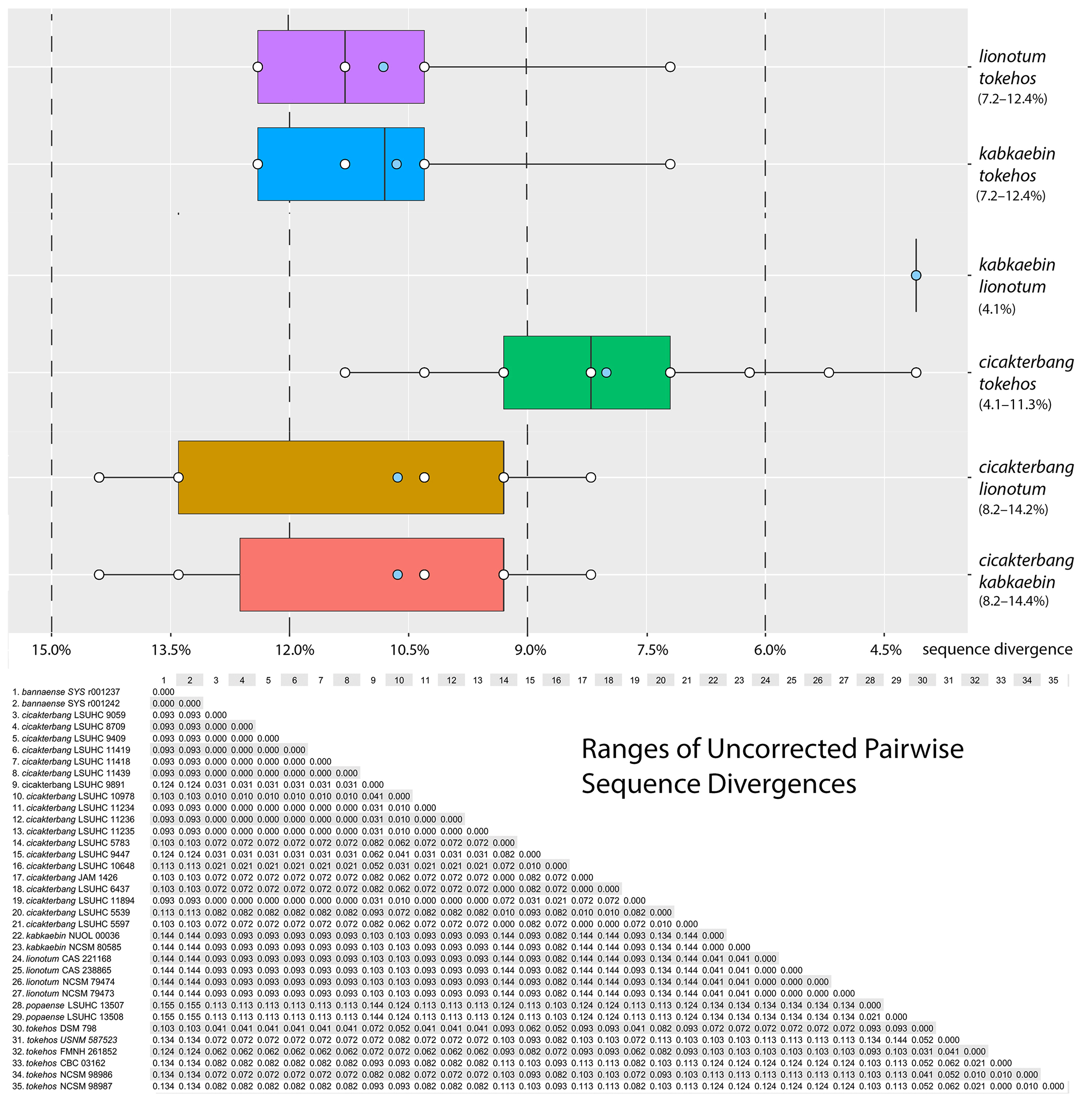
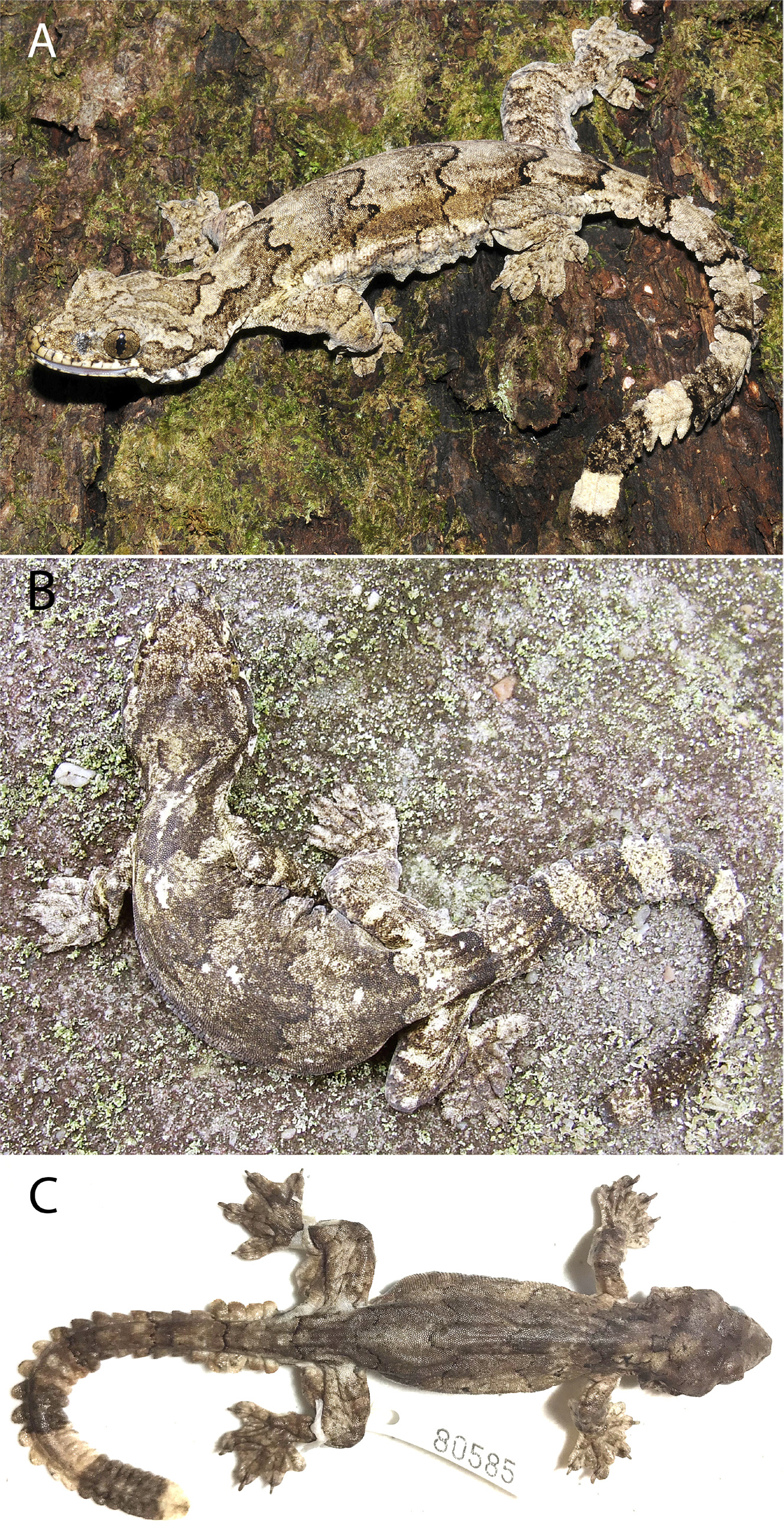
Description of holotype. Adult female SVL 85.1 mm; head moderate (HL / SVL 0.27), wide (HW / HL 0.79), depressed (HD / HL 0.41), distinct from neck; snout rounded at tip in dorsal profile; prefrontal region weakly concave; lores rounded; rostral scale large, rectangular, in contact posteriorly with two supranasals and two small postnasals, dorsolaterally with nostrils, and laterally with first supralabials; supralabials (10 R, L) to mid-orbital position; infralabials (12 R, L); nostrils elliptical with long axes oriented obliquely, occupying anterior portion of nasal scale, bordered anteriorly by rostral, dorsally by supranasal, posteriorly by six postnasals of varying sizes (upper largest), and ventrally by first supralabial; scales on rostrum granular slightly larger than granular scales on top of head and occiput; eyes large (ED / HL 0.21), less than snout length; pupil vertically elliptical, crenelated; supraciliaries elongate, posteriormost weakly pointed; auricular opening rounded, bearing a weak, supra-auricular ridge; tympanum deeply sunk; infra-auricular flap broad, rounded, extending from below corner of mouth to lateral margin of neck midway between posterior margin of ear opening and forelimb insertion, measuring 5.6 mm at its widest point; dorsal scales of infra-auricular flap large, subimbricate proximally, small juxtaposed distally, ventral flap scales minute and granular; mental triangular, as wide as deep, bordered laterally by first infralabials and posteriorly by paired, rectangular postmentals contacting medially for 100 % of their length; one row of enlarged sublabials bordering infralabials, anteriormost largest; gular scales small, rounded, grading into larger imbricating throat and subimbricate pectoral and ventral scales. Body dorsoventrally depressed, relatively stout (AXG / SVL 0.47); patagia 7.4 mm at midpoint of body bearing enlarged, subimbricate, rectangular scales dorsally, minute, juxtaposed, subrectangular scales ventrally; ventral surface not bearing raised ridges of granular scales; 81 minute, flat, round, juxtaposed midbody dorsal scales, largest mid-dorsally; no large flat dorsal scales immediately anterior to the hind limb insertions; 35 transverse rows of large, smooth, flat, subimbricate ventral scales much larger than dorsal scales, decreasing in size laterally into granular scales at the base of the flap; 22 enlarged, precloacal scales; seven rows of enlarged, post-precloacal scales; and scales immediately anterior to vent granular. Limbs short, robust (FL / SVL 0.12; TBL / SVL 0.16); dorsal scales of forelimbs, flat, juxtaposed, larger than dorsal body scales; ventral forelimb scales subimbricate; anterior and posterior margins of forelimbs, and posterior margins of hind limbs bearing wide, cutaneous flaps; that of anterior margin of forearm (i. e. pre-antebrachial flap) emarginated distally and terminates low on the base of digit I, that of the foreleg does not reach the base of digit I; scales of forelimb flaps large, elongate, subimbricate; those of hind limb flaps much smaller, rounded, subimbricate; palmar scales smooth, rounded; digits fully webbed, relatively short, dorsoventrally compressed; undivided transverse subdigital lamellae number 15 (I), 14 (II), 13 (III), 15 (IV), 14 (V), distalmost lamellae V-shaped; claws arise from within the dorsal surface of digital pads; claw of digit I replaced by an enlarged, flat scale; dorsal scales of hind limbs, flat, juxtaposed, larger than dorsal body scales; ventral scales of hind limbs flat, subimbricate, smaller than ventral scales of belly; flat; scales of anterior margin of thigh subimbricate; plantar scales smooth, subimbricate; digits fully webbed; transverse subdigital lamellae number 10 (I), 13 (II), 13 (III), 14 (IV), 11 (V), distalmost lamellae V-shaped; claws arise from within the dorsal surface of digital pads, and claw of digit I replaced by an enlarged, flat scale. Tail original, flattened, same length as SVL (TaL / SVL 1.00); two median rows of transversely widened, smooth subcaudals anteriorly becoming less regular and broken up posteriorly; postcloacal scales large, flat, imbricate; dorsal caudals flat, juxtaposed, larger than dorsal body scales and not bearing transversely aligned whorls of enlarged scales; tail width and caudal lobes decrease posteriorly; 23 caudal lobes on each side slightly angled posteriorly; and tail terminates in a short flap (11.9 mm) bearing weakly crenulated edges. Light phase coloration and pattern in preservative (Fig. 10). Dorsal ground color of head, body, and tail light-brown; top of head essentially unicolor; labial scales much lighter than body, demarkated by thin, dark lines at their junctures; infra-auricular flap same lighter color as labial scales and gular region; four, thin, sinuous dorsal bands between limb insertion eventually transitioning into approximately two dark-brown caudal bands towards the end of the tail; terminus of caudal flap white; subcaudal region mottled anteriorly and banded; pectoral region, belly, and ventral surfaces of limbs dull-white with no stippling. Variation. Variation in coloration and pattern varies due to this species’ having dark and light phases and its ability to substrate match. Color pattern variation in the paratypes described here is based on preserved material. The paratypes closely approximate the holotype in coloration and pattern. Caudal banding is distinct in all specimens. The wide white band on the caudal flap extends all the way to the tip in the holotype whereas in the paratypes a black band encompasses the tip. Paratype FMNH 271140 has irregularly shaped, white vertebral markings that are absent in the paratype NUOL 00036 and the holotype. Variation in meristic characters is presented in Table 7. Comparisons (Tables 4, 5; Figs. 3, 5, 6). Differences between Ptychozoon kabkaebin sp. nov. and P. cicakterbang sp. nov. are listed above in the comparisons section of P. cicakterbang sp. nov. Ptychozoon kabkaebin sp. nov. differs from P. intermedium, P. kuhli, and P. trinotaterra in lacking, as opposed to having, caudal tubercles. From P. intermedium, P. nicobarense, P. rhacophorus, P. trinotaterra, and P. kaengkrachanense it differs in having four body bands as opposed to 0 – 3. Ptychozoon kabkaebin sp. nov. differs from P. bannaense, P. horsfieldii, P. intermedium, P. kuhli, P. nicobarense, P. rhacophorus, P. trinotaterra, and P. kaengkrachanense in having an emarginated preantebrachial flap as opposed to lacking an emargination. From P. popaense it differs by having a maximum SVL of 95.4 mm versus 86.2 mm. Ptychozoon kabkaebin sp. nov. differs from P. lionotum, and P. tokehos sp. nov. by having a significantly higher mean number of infralabials. Ptychozoon kabkaebin sp. nov. differs from P. tokehos sp. nov. in having a significantly wider head. Even though Ptychozoon kabkaebin sp. nov. and P. tokehos sp. nov. have nearly discrete differences in their numbers of midbody scales (78 – 82 and 80 – 95, respectively), their mean differences (80.3 versus 89.0) were not significantly different in the ANOVA (p = 0.09) although they were significantly different in a two-sample Student t- test (t = 5.585; p = 0.002). Ptychozoon kabkaebin sp. nov. is the sister species of P. lionotum but differs further from it by having a significantly shorter snout. Ptychozoon kabkaebin sp. nov. is well-separated from P. cicakterbang sp. nov. and P. lionotum in the PCA and from all species in the DAPC where their 95 % confidence ellipses do not overlap. Ptychozoon kabkaebin sp. nov. occupies a significantly different position along PC 1 from that of P. cicakterbang sp. nov. and along PC 2, it occupies a significantly different positon from that of P. tokehos sp. nov. From all species of the lionotum group it differs by having an uncorrected pairwise sequence divergence of 4.1 – 14.4 %. Combinations of other characters differentiating P. kabkaebin sp. nov. from the other more distantly related species are presented in Table 5.
Grismer, L. Lee, Wood Jr, Perry L., Grismer, Jesse L., Quah, Evan S. H., Thy, Neang, Phimmachak, Somphouthone, Sivongxay, Niane, Seateun, Sengvilay, Stuart, Bryan L., Siler, Cameron B., Mulcahy, Daniel G., Anamza, Tashitso, Brown, Rafe M. (2019): Geographic structure of genetic variation in the Parachute Gecko Ptychozoon lionotum Annandale, 1905 across Indochina and Sundaland with descriptions of three new species. Zootaxa 4638 (2): 151-198, DOI: 10.11646/zootaxa.4638.2.1

Fig. 10
Grismer, L. Lee, Wood Jr, Perry L., Grismer, Jesse L., Quah, Evan S. H., Thy, Neang, Phimmachak, Somphouthone, Sivongxay, Niane, Seateun, Sengvilay, Stuart, Bryan L., Siler, Cameron B., Mulcahy, Daniel G., Anamza, Tashitso, Brown, Rafe M. (2019): Geographic structure of genetic variation in the Parachute Gecko Ptychozoon lionotum Annandale, 1905 across Indochina and Sundaland with descriptions of three new species. Zootaxa 4638 (2): 151-198, DOI: 10.11646/zootaxa.4638.2.1
Diagnosis. Ptychozoon kabkaebin sp. nov. differs from all other species of Ptychozoon by having the following unique combination of characters: a maximum SVL of 95.4 mm; supranasals not in contact; 8 – 10 supralabials; 10 – 12 infralabials; infra-auricular cutaneous flap; weak, supra-auricular ridge present; no dorsal or caudal tubercles; imbricate parachute support scales on dorsal surface of patagia; no prominently raised ridges on ventral surface of patagia; 78 – 82 midbody dorsal scales; 33 – 38 ventral scales; an emargination between the pre-antebrachial flap and digit I; no enlarged femoral scales; 22 or 23 enlarged precloacal scales; 5 – 7 rows of enlarged post-precloacal scales; 13 – 17 transverse subdigital lamellae on fourth toe; no enlarged dorsal caudal scales forming whorls; approximately 27 – 30 scales across widest portion of caudal flap; distal lobes fusing to form a short, narrow caudal flap; edges of caudal flap weakly crenulated; caudal lobes angled posteriorly; caudal lobes decrease posteriorly in size; thick, dark, postorbital stripe; four dark body bands between limb insertions; irregularly shaped, white, vertebral markings variably present; and subcaudal region banded in adults (Tables 4, 5).
Grismer, L. Lee, Wood Jr, Perry L., Grismer, Jesse L., Quah, Evan S. H., Thy, Neang, Phimmachak, Somphouthone, Sivongxay, Niane, Seateun, Sengvilay, Stuart, Bryan L., Siler, Cameron B., Mulcahy, Daniel G., Anamza, Tashitso, Brown, Rafe M. (2019): Geographic structure of genetic variation in the Parachute Gecko Ptychozoon lionotum Annandale, 1905 across Indochina and Sundaland with descriptions of three new species. Zootaxa 4638 (2): 151-198, DOI: 10.11646/zootaxa.4638.2.1
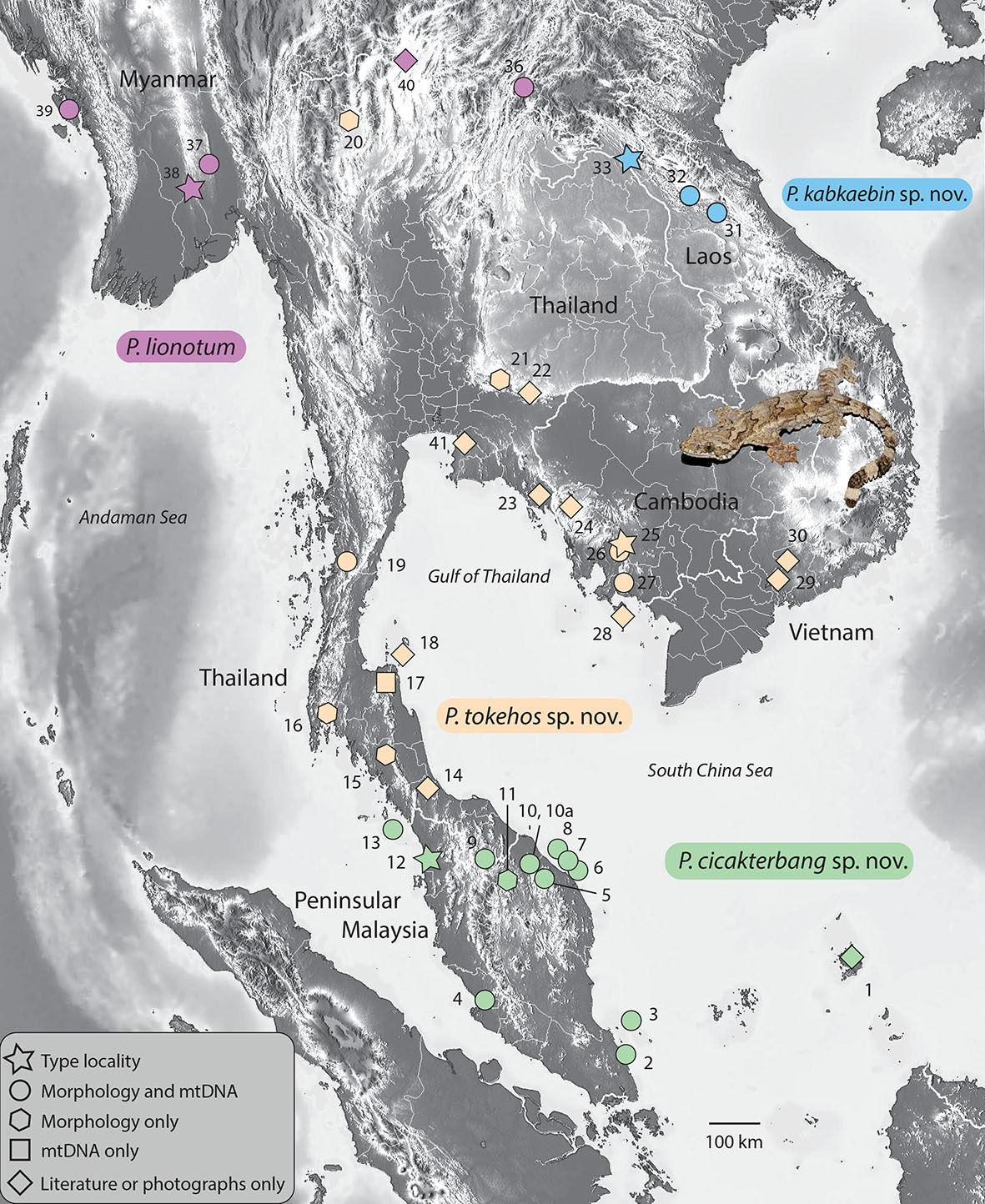
Distribution (Fig. 1). Ptychozoon kabkaebin sp. nov. is endemic to the eastern parts of northern and central Laos although it will likely be found in adjacent areas of central Vietnam.
Grismer, L. Lee, Wood Jr, Perry L., Grismer, Jesse L., Quah, Evan S. H., Thy, Neang, Phimmachak, Somphouthone, Sivongxay, Niane, Seateun, Sengvilay, Stuart, Bryan L., Siler, Cameron B., Mulcahy, Daniel G., Anamza, Tashitso, Brown, Rafe M. (2019): Geographic structure of genetic variation in the Parachute Gecko Ptychozoon lionotum Annandale, 1905 across Indochina and Sundaland with descriptions of three new species. Zootaxa 4638 (2): 151-198, DOI: 10.11646/zootaxa.4638.2.1
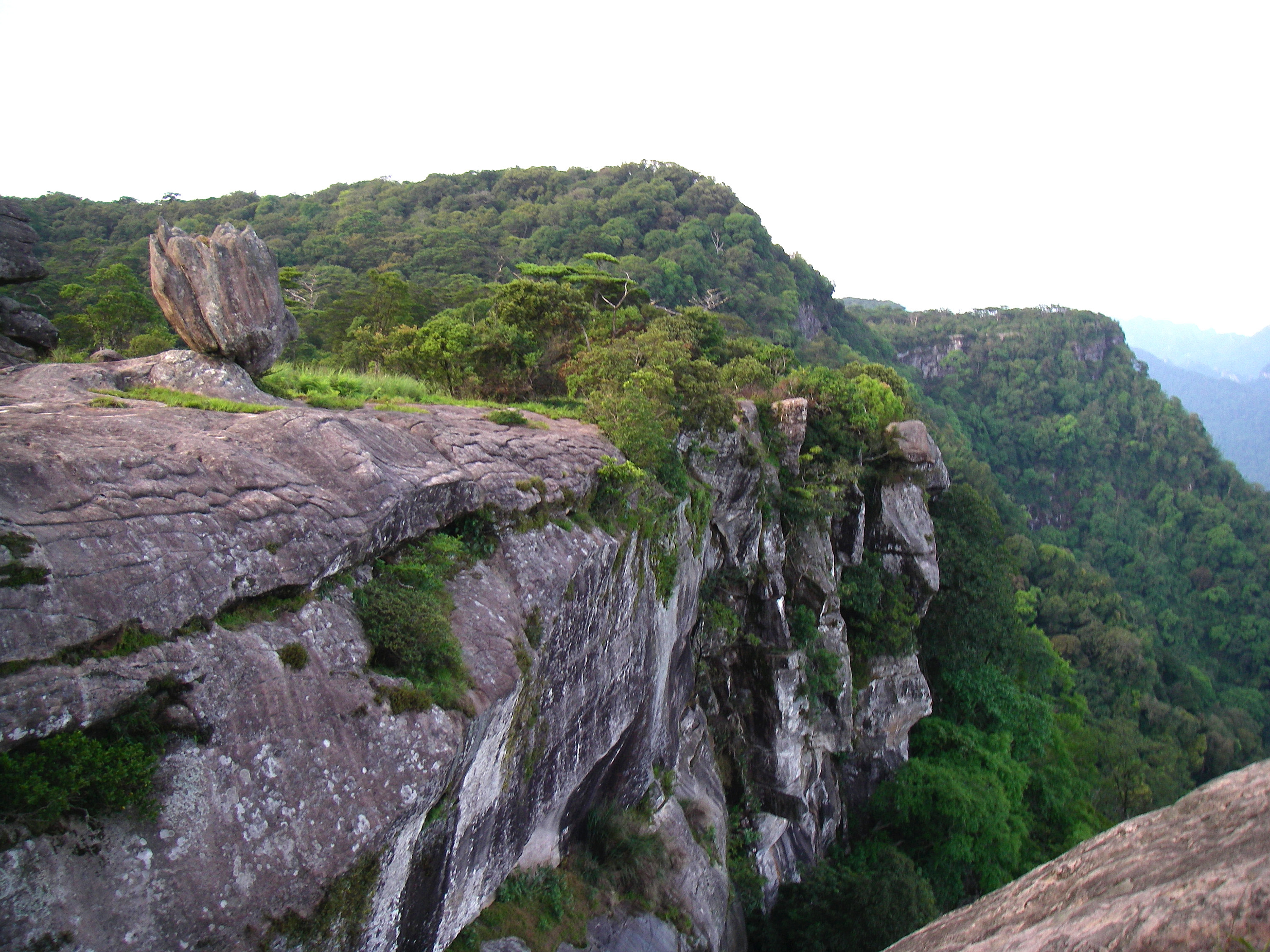
Etymology. The specific epithet kabkaebin is the Lao word used for Ptychozoon. Natural history. NCSM 80585 was collected during the day from beneath a house on stilts that was located along a stream in degraded semi-evergreen forest at 160 m in elevation. FMNH 271140 was collected during the day (1115 h) at 980 m in elevation and NUOL 00036 was collected during the night (2130 h) at 992 m in elevation, both on large boulders in a mosaic of evergreen, deciduous, and pine forest with grassy understory at the edge of a high cliff on a steep escarpment. (Fig. 11).
Grismer, L. Lee, Wood Jr, Perry L., Grismer, Jesse L., Quah, Evan S. H., Thy, Neang, Phimmachak, Somphouthone, Sivongxay, Niane, Seateun, Sengvilay, Stuart, Bryan L., Siler, Cameron B., Mulcahy, Daniel G., Anamza, Tashitso, Brown, Rafe M. (2019): Geographic structure of genetic variation in the Parachute Gecko Ptychozoon lionotum Annandale, 1905 across Indochina and Sundaland with descriptions of three new species. Zootaxa 4638 (2): 151-198, DOI: 10.11646/zootaxa.4638.2.1
Holotype. NCSM 80585 adult female collected by Sengvilay Seateun and Misan Keooudone on 16 June 2012 from Houay Ta Ang Stream, Pakkading District, Bolikhamxay Province, Laos (18.32997 ° N, 103.99140 ° E, 163 m above sea level). Paratypes. FMNH 271140 adult female collected by Bryan L. Stuart, Somphouthone Phimmachak, and Niane Sivongxay on 28 May 2007 from Nakai-Nam Theun National Protected Area, Phou Ack Mountain, Boualapha District, Khammouan Province, Laos (17.64433 ° N, 105.73667 ° E, 980 m above sea level); and NUOL 00036 adult female collected by Bryan L. Stuart, Somphouthone Phimmachak, and Jennifer A. Sheridan on 17 May 2013 from Nakai-Nam Theun National Protected Area, Phou Ack Mountain, Boualapha District, Khammouan Province, Laos (17.64256 ° N, 105.73608 ° E, 992 m above sea level).
Grismer, L. Lee, Wood Jr, Perry L., Grismer, Jesse L., Quah, Evan S. H., Thy, Neang, Phimmachak, Somphouthone, Sivongxay, Niane, Seateun, Sengvilay, Stuart, Bryan L., Siler, Cameron B., Mulcahy, Daniel G., Anamza, Tashitso, Brown, Rafe M. (2019): Geographic structure of genetic variation in the Parachute Gecko Ptychozoon lionotum Annandale, 1905 across Indochina and Sundaland with descriptions of three new species. Zootaxa 4638 (2): 151-198, DOI: 10.11646/zootaxa.4638.2.1

Export occurrence data

Darwin Core Archive (ZIP)

CLASSIFICATION

Taxonomic Classification Tree

MULTIMEDIA

Media Files(6)

FIGURE 1. Distribution of Ptychozoon lionotum, P. cicakterbang sp. nov., P. kabkaebin sp. nov., and P. tokehos sp. nov. Diamond designated localities are non-specimen based and considered tentative. Their sources are: (1) Pulau Natuna Besar, Indonesia (Leong et al. 2003); (14) Hat Yai, Songkla, Thailand (LSUDPC 10946); (18) Ko Samui, Surat Thani, Thailand (LSUDPC 10948); (22) Dong Paya Fei Mounatains, Nakhon Ratchasima, Thailand (Smith 1935); (23) Chantabun, Chanthaburi, Thailand (Smith 1935); (24) Phnom Samkos, Pursat, Cambodia (LSUDPC 10949–53); (28) Phu Quoc Island, Kiem Giang Province, Vietnam (Nguyen et al. 2009); (29) Trang Bom, Dong Nai Province, Vietnam (Nguyen et al. 2009) however this specimen may be P. trinotaterra (see Distribution section for P. tokehos sp. nov.); (30) Cat Tien, Dong Nai Province, Vietnam (Nguyen et al. 2009); and (41) Siracha, Chanthaburi, Thailand (Smith 1935). Numbered locations for the specimen-based localities are listed in Tables 1 and 6–9 and on the tree in Figure 2.

Imageimage/png© Grismer, L. Lee;Wood Jr, Perry L.;Grismer, Jesse L.;Quah, Evan S. H.;Thy, Neang;Phimmachak, Somphouthone;Sivongxay, Niane;Seateun, Sengvilay;Stuart, Bryan L.;Siler, Cameron B.;Mulcahy, Daniel G.;Anamza, Tashitso;Brown, Rafe M.Grismer, L. Lee;Wood Jr, Perry L.;Grismer, Jesse L.;Quah, Evan S. H.;Thy, Neang;Phimmachak, Somphouthone;Sivongxay, Niane;Seateun, Sengvilay;Stuart, Bryan L.;Siler, Cameron B.;Mulcahy, Daniel G.;Anamza, Tashitso;Brown, Rafe M.

FIGURE 3. Uncorrected pairwise sequence divergence between species of rhe Ptychzoon lionotum group (boxplots) and between individuals of the P. lionotum group (matrix). Colored squares represent the 50% quartile. Light-blue circles are means.

Imageimage/png© Grismer, L. Lee;Wood Jr, Perry L.;Grismer, Jesse L.;Quah, Evan S. H.;Thy, Neang;Phimmachak, Somphouthone;Sivongxay, Niane;Seateun, Sengvilay;Stuart, Bryan L.;Siler, Cameron B.;Mulcahy, Daniel G.;Anamza, Tashitso;Brown, Rafe M.Grismer, L. Lee;Wood Jr, Perry L.;Grismer, Jesse L.;Quah, Evan S. H.;Thy, Neang;Phimmachak, Somphouthone;Sivongxay, Niane;Seateun, Sengvilay;Stuart, Bryan L.;Siler, Cameron B.;Mulcahy, Daniel G.;Anamza, Tashitso;Brown, Rafe M.

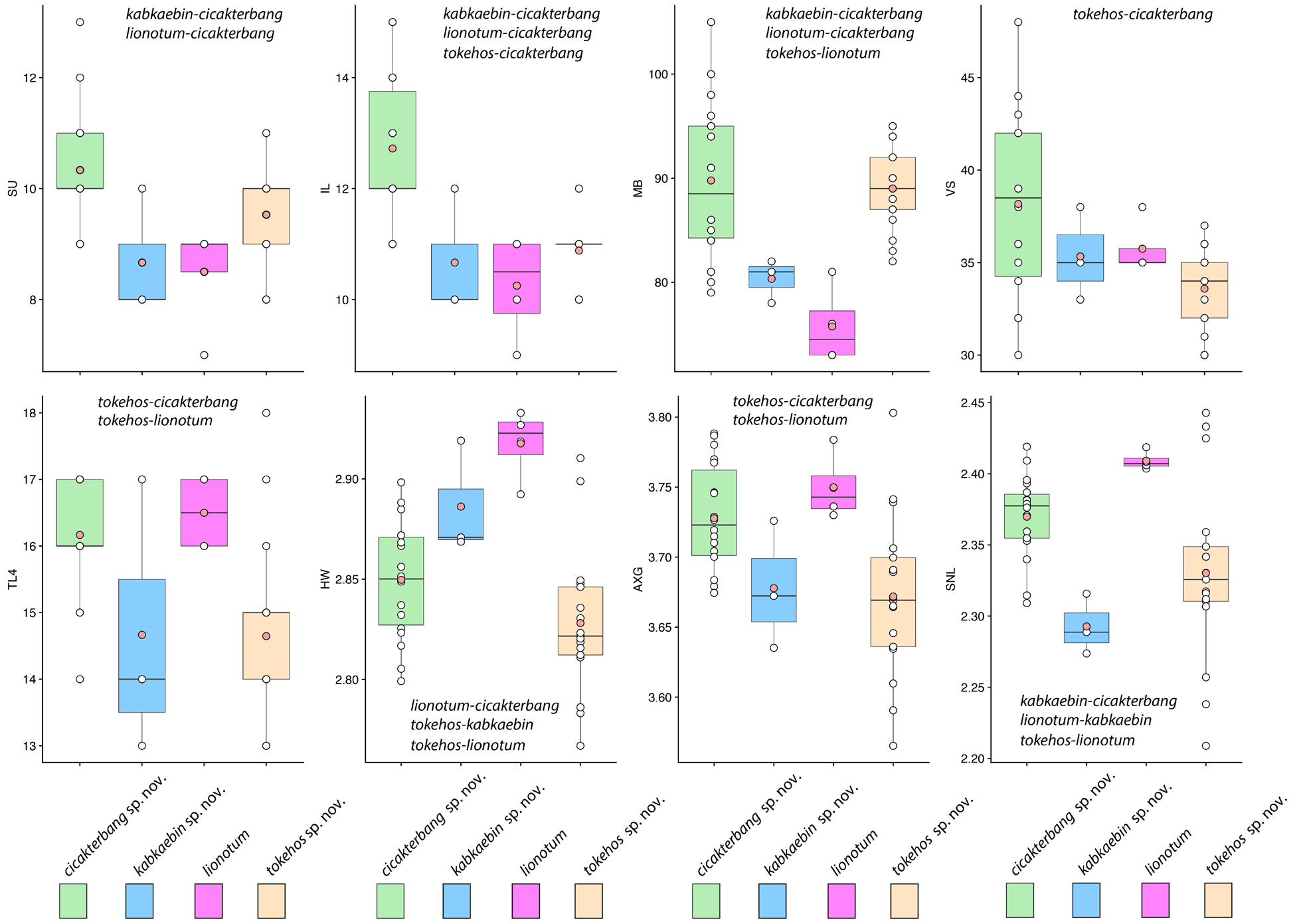
FIGURE 5. Boxplot analyses of the characters bearing statistically significant mean values between various combinations of species pairs. The species pairs are listed on the plot. Colored squares represent the 50% quartile. Orange circles are the means.

Imageimage/png© Grismer, L. Lee;Wood Jr, Perry L.;Grismer, Jesse L.;Quah, Evan S. H.;Thy, Neang;Phimmachak, Somphouthone;Sivongxay, Niane;Seateun, Sengvilay;Stuart, Bryan L.;Siler, Cameron B.;Mulcahy, Daniel G.;Anamza, Tashitso;Brown, Rafe M.Grismer, L. Lee;Wood Jr, Perry L.;Grismer, Jesse L.;Quah, Evan S. H.;Thy, Neang;Phimmachak, Somphouthone;Sivongxay, Niane;Seateun, Sengvilay;Stuart, Bryan L.;Siler, Cameron B.;Mulcahy, Daniel G.;Anamza, Tashitso;Brown, Rafe M.

FIGURE 6. Multivariate analyses of P. lionotum, P. cicakterbang sp. nov., P. kabkaebin sp. nov., and P. tokehos sp. nov. A. PCA ordination along PC 1 and PC2. B. DAPC showing complete separation of the 95% confidence ellipses. C. PCA ordination along PC1, PC2, and PC3.

Imageimage/png© Grismer, L. Lee;Wood Jr, Perry L.;Grismer, Jesse L.;Quah, Evan S. H.;Thy, Neang;Phimmachak, Somphouthone;Sivongxay, Niane;Seateun, Sengvilay;Stuart, Bryan L.;Siler, Cameron B.;Mulcahy, Daniel G.;Anamza, Tashitso;Brown, Rafe M.Grismer, L. Lee;Wood Jr, Perry L.;Grismer, Jesse L.;Quah, Evan S. H.;Thy, Neang;Phimmachak, Somphouthone;Sivongxay, Niane;Seateun, Sengvilay;Stuart, Bryan L.;Siler, Cameron B.;Mulcahy, Daniel G.;Anamza, Tashitso;Brown, Rafe M.

FIGURE 10. Ptychozoon kabkaebin sp. nov. A. Paratype NUOL 00036 from Nakai-Nam Theun National Protected Area, Phou Ack Mountain, Boualapha District, Khammouan Province, Laos. Photograph by B. L. Stuart. B. Paratype FMNH 271140 from Nakai-Nam Theun National Protected Area, Phou Ak Mountain, Boualapha District, Khammouan Province, Laos. Photograph by B. L. Stuart. C. Holotype NCSM 80585 from Houay Ta Ang Stream, Pakkading District, Bolikhamxay Province, Laos. Photograph by L. L. Grismer.

Imageimage/png© Grismer, L. Lee;Wood Jr, Perry L.;Grismer, Jesse L.;Quah, Evan S. H.;Thy, Neang;Phimmachak, Somphouthone;Sivongxay, Niane;Seateun, Sengvilay;Stuart, Bryan L.;Siler, Cameron B.;Mulcahy, Daniel G.;Anamza, Tashitso;Brown, Rafe M.Grismer, L. Lee;Wood Jr, Perry L.;Grismer, Jesse L.;Quah, Evan S. H.;Thy, Neang;Phimmachak, Somphouthone;Sivongxay, Niane;Seateun, Sengvilay;Stuart, Bryan L.;Siler, Cameron B.;Mulcahy, Daniel G.;Anamza, Tashitso;Brown, Rafe M.

FIGURE 11. Habitat of Ptychozoon kabkaebin sp, nov. at Nakai-Nam Theun National Protected Area, Phou Ack Mountain, Boualapha District, Khammouan Province, Laos. Photograph by B. L. Stuart.

Imageimage/png© Grismer, L. Lee;Wood Jr, Perry L.;Grismer, Jesse L.;Quah, Evan S. H.;Thy, Neang;Phimmachak, Somphouthone;Sivongxay, Niane;Seateun, Sengvilay;Stuart, Bryan L.;Siler, Cameron B.;Mulcahy, Daniel G.;Anamza, Tashitso;Brown, Rafe M.Grismer, L. Lee;Wood Jr, Perry L.;Grismer, Jesse L.;Quah, Evan S. H.;Thy, Neang;Phimmachak, Somphouthone;Sivongxay, Niane;Seateun, Sengvilay;Stuart, Bryan L.;Siler, Cameron B.;Mulcahy, Daniel G.;Anamza, Tashitso;Brown, Rafe M.

IMAGES

Gallery(6)

See Gallery

Occurrences with images

Source Information

Geographic structure of genetic variation in the Parachute Gecko Ptychozoon lionotum Annandale, 1905 across Indochina and Sundaland with descriptions of three new species

checklist

This dataset contains the digitized treatments in Plazi based on the original journal article Grismer, L. Lee, Wood Jr, Perry L., Grismer, Jesse L., Quah, Evan S. H., Thy, Neang, Phimmachak, Somphouthone, Sivongxay, Niane, Seateun, Sengvilay, Stuart, Bryan L., Siler, Cameron B., Mulcahy, Daniel G., Anamza, Tashitso, Brown, Rafe M. (2019): Geographic structure of genetic variation in the Parachute Gecko Ptychozoon lionotum Annandale, 1905 across Indochina and Sundaland with descriptions of three new species. Zootaxa 4638 (2): 151-198, DOI: 10.11646/zootaxa.4638.2.1

Abstract

An integrative taxonomic analysis of the Ptychozoon lionotum group across its range in Indochina and Sundaland recovers P. lionotum sensu lato Annandale, 1905 as paraphyletic with respect to P. popaense Grismer, Wood, Thura, Grismer, Brown, & Stuart, 2018a and composed of four allopatric, genetically divergent, ND2 mitochondrial lineages. Multivariate and univariate analyses of continuous and discrete morphological and color pattern characters statistically and discretely diagnose each lineage from one another and together, with maximum likelihood and Bayesian inference analyses, provide the foundation for the recognition of each lineage as a new species—hypotheses corroborated with a Generalized Mixed Yule Coalescent species delimitation analysis. Ptychozoon cicakterbang sp. nov. ranges throughout Peninsular Malaysia to Pulau Natuna Besar, Indonesia; P. kabkaebin sp. nov. is endemic to northern and central Laos; and P. tokehos sp. nov. ranges from southern Thailand south of the Isthmus of Kra northward to Chiang Mai, fringing the Chao Phraya Basin and ranging southward through Cambodia to southern Vietnam. Ptychozoon lionotum sensu stricto ranges from northwestern Laos through southern Myanmar to eastern India. The phylogeographic structure within each species varies considerably with P. lionotum s.s. showing no genetic divergence across its 1,100 km range compared to P. cicakterbang sp. nov. showing upwards of 8.2% sequence divergence between syntopic individuals. Significant phylogeographic structure exists within P. tokehos sp. nov. and increased sampling throughout Thailand may require additional taxonomic changes within this species.

Grismer L L, Wood Jr P L, Grismer J L, Quah E S H, Thy N, Phimmachak S, Sivongxay N, Seateun S, Stuart B L, Siler C B, Mulcahy D G, Anamza T, Brown R M, plazi (2019). Geographic structure of genetic variation in the Parachute Gecko Ptychozoon lionotum Annandale, 1905 across Indochina and Sundaland with descriptions of three new species. Plazi.org taxonomic treatments database. Checklist dataset https://doi.org/10.11646/zootaxa.4638.2.1 accessed via GBIF.org on 2026-06-15.

CC0Published 7/16/2019View dataset
GBIF Usage Key
158690991
Dataset Key
008c2ce6-d9ae-424c-9e2b-0d16d9da40e7
Origin
source
Backbone Key
9968966
Taxon ID
0384597AFFAAFFADFF5EBCAC261BFC90.taxon
Last Crawled
6/10/2026
Last Interpreted
6/10/2026