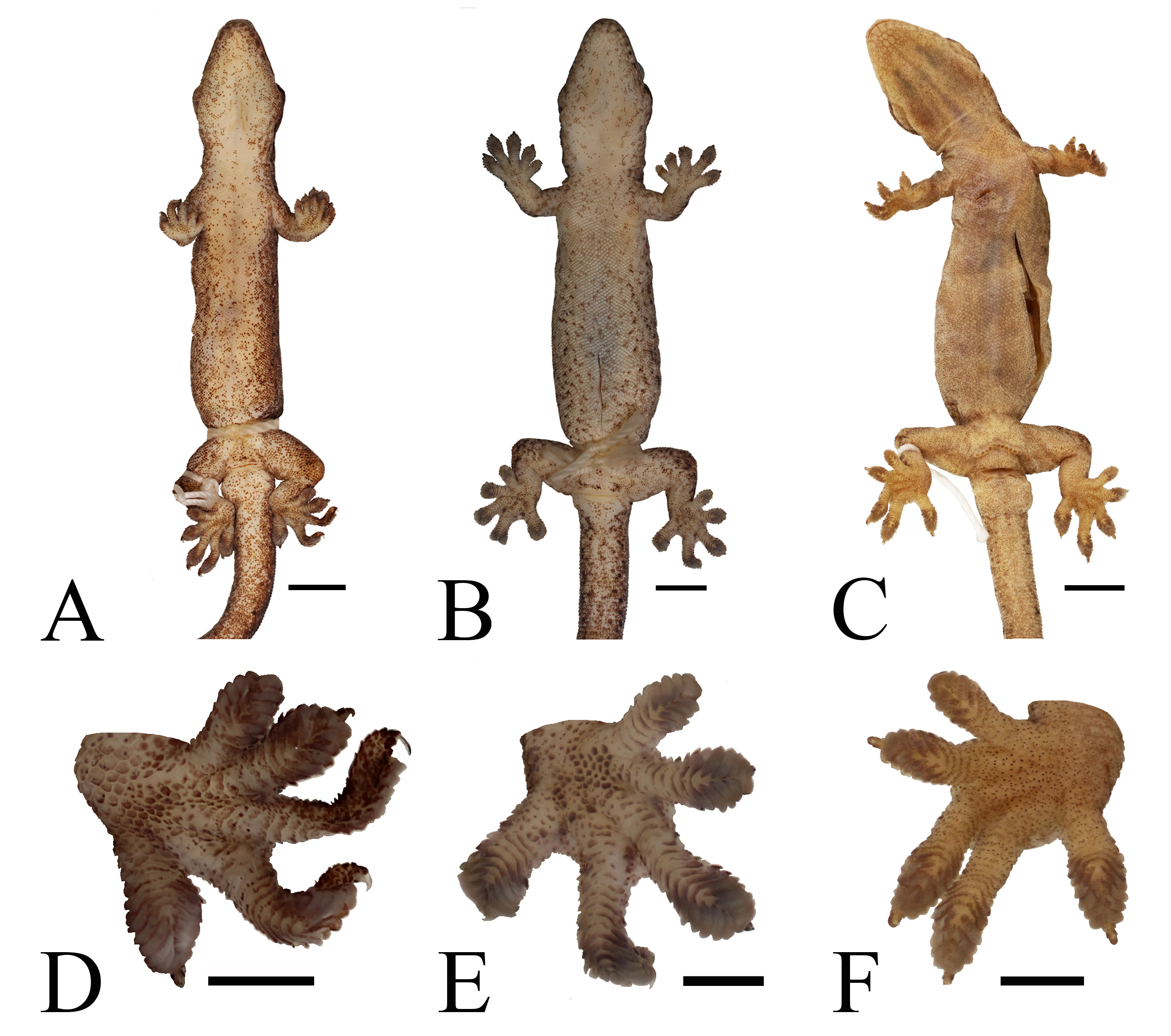
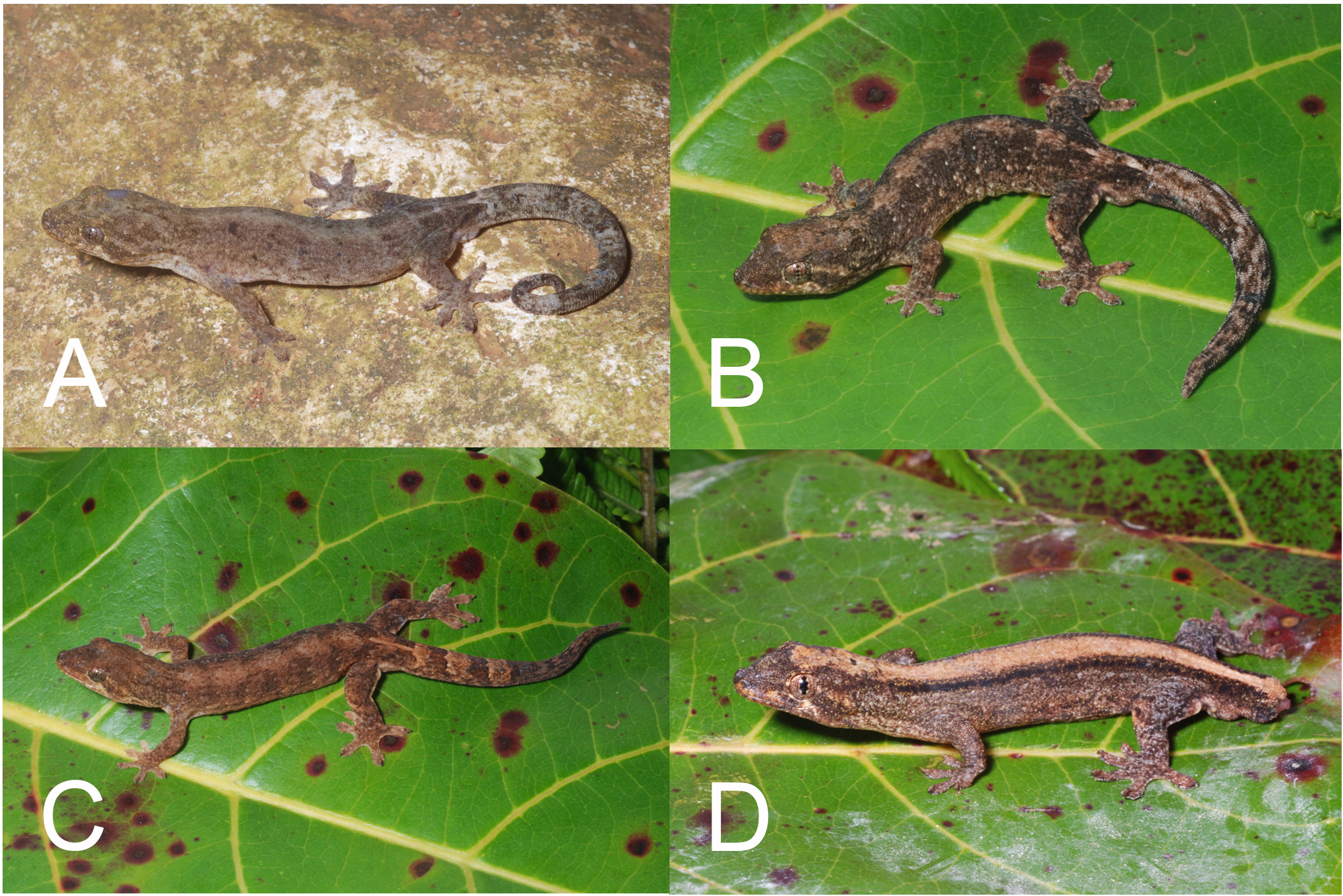
Fig. 3 B, E, 4 B, C, D urn: lsid: zoobank. org: act: 9 D 4 E 2932 - 2478 - 437 E- 8 F 2 E-EF 67 C 78 D 19 EB Holotype. BPBM 39880 (field tag FK 15809), mature male, collected by F. Kraus and local villagers at Gisabwai, 9.0760 ° S, 152.7748 ° E, 110 m, Woodlark Island, Milne Bay Province, Papua New Guinea, 12 October 2011. Paratypes (n = 9). Same data as holotype (BPBM 39879, 39881 – 82) except collected 17 October 2011 (BPBM 39883 – 84); Upper Muniai River, 9.1216 ° S, 152.7486 ° E, 67 m, 17 October 2010 (BPBM 39149); Gisabwai, 9.0745 ° S, 152.77265 ° E, 105 m, 19 October 2010 (BPBM 39150 – 51); Piak Track, 9.1153 ° S, 152.7484 ° E, 60 m, 22 October 2010 (BPBM 39152). Diagnosis. A medium-sized species (adult SVL 41.5 – 49.5 mm) species of Lepidodactylus having a subcylindrical tail without a lateral fringe of enlarged scales; 2 – 3 divided subterminal scansors on T 4; 12 – 15 enlarged scales of pore-bearing series limited to precloacal region, 12 – 14 precloacal pores in males; 12 – 20 T 4 lamellae, 8 – 12 T 1 lamellae; lamellae occupying most of the length of the toes (T 4 lamellaeL / T 4 L = 0.67 – 0.93); toes relatively long (T 4 L / SVL = 0.11 – 0.13) and of moderate width (T 4 W / T 4 L = 0.26 – 0.34); toes approximately one-quarter webbed (T 3 T 4 webL / T 4 L = 0.18 – 0.26); numerous (9 – 10) small precloacal scales between apex of pore-bearing series and the cloaca in adults; no row of tiny scales between the precloacal series and either side of the pubic patch; row of dorsolateral white spots, lacking dark spots in this region; and many posteroventral and plantar scales uniformly brown. Comparisons with other species. The subcylindrical tail without a lateral fringe of enlarged scales and the 2 – 3 divided subterminal scansors under the toes place Lepidodactylus kwasnickae sp. nov. in Brown and Parker’s (1977) Group II. Lepidodactylus kwasnickae sp. nov. differs from other Melanesian members of this group as follows: from L. guppyi, L. pulcher, and L. shebae in having fewer enlarged precloacal scales (12 – 15 versus 39 – 52, 18 – 20, and 34, respectively) and fewer precloacal pores (12 – 14 versus 39 – 52, 16, and 32, respectively); and further differs from L. pulcher in having the lamellae occupy less area on the fourth toe (T 4 lamellaeL / T 4 L = 0.67 – 0.93 versus 1.0 in L. pulcher) and from L. shebae in its larger adult size (SVL 41.5 – 49.5 mm versus ~ 36 mm in L. shebae). It differs from L. novaeguineae in having more T 4 lamellae (12 – 20 versus 9 – 15 in L. novaeguineae, Fig. 3 E versus 3 F), a longer fourth toe (T 4 L / SVL = 0.11 – 0.13 versus 0.10 in L. novaeguineae), dorsum and sides usually rufescent and with dorsolateral series of white spots (versus dorsal pattern with longitudinal dark-brown streaks or dorsolateral series of bold dark-brown spots in L. novaeguineae), and many posteroventral and plantar scales uni- formly brown (versus only with minute black punctations in L. novaeguineae, Fig. 3 E versus 3 F )). It differs from L. mitchelli sp. nov. in its larger adult size (SVL = mean 45.7 mm, range 41.5 – 49.5 mm versus mean 40.3, range = 35 – 45.5 mm in L. mitchelli sp. nov., mass = mean 2.36 g, range 1.85 – 2.95 g versus mean 1.63 g, range 1.15 – 2.15 g in L. mitchelli sp. nov.); longer fourth toe (T 4 L / SVL = 0.11 – 0.13 versus 0.089 – 0.11 in L. mitchelli sp. nov.); more and smaller scales between the enlarged precloacal series and the opening of the cloaca in adults (9 – 10 vs 6 – 8 in L. mitchelli sp. nov.); tiny scales between the precloacal series and either side of the pubic patch absent (present in L. mitchelli sp. nov.); and dorsum and sides more boldly patterned, usually rufescent, and with row of dorsolateral white spots (versus dorsal pattern obscure, brown, and without dorsolateral white spots in L. mitchelli sp. nov., Fig. 4 A versus 4 B, C, D). Description of holotype. A mature male of medium size (SVL = 41.5 mm, TrL = 19.3 mm). Head relatively long (HL / SVL = 0.23) and wide (HW / HL = 0.88), distinct from neck. Loreal region slightly inflated; no distinct canthus rostralis. Top of snout, area between nares, and area posterior to nares concave. Snout tapered and rounded at tip, relatively long (SN / HL = 0.42), longer than eye diameter (SN / EY = 1.6). Eye relatively large (EY / HL = 0.26, EY / EN = 0.71); pupil vertical, constricted into series of four lobes; supraciliaries same size as adjacent granules. Ear opening small (Ear / HL = 0.083), compressed, oriented diagonally from posterodorsal to anteroventral on right, semicircular on left; distance between ear and eye larger than eye diameter (EE / EY = 1.4). Rostral wider (1.9 mm) than high (0.85 mm), highest just medial to nares, lower between these points; length (0.2 mm); barely visible from above. Supranasals separated by three internasals. Rostral in contact with first supralabials, two supranasals, and three internasals. External nares circular; each bordered by rostral, two supranasals, first supralabial, and one postnasal. Mental shallowly triangular, wider (0.90 mm) than long (0.75 mm). Mental bordered posteriorly by two enlarged postmentals, these bordered posteriorly by three rows of enlarged gulars that are followed by smaller, granular chin scales. First three infralabials bordered below by somewhat enlarged scales; remaining scales below infralabials of approximately twice size of central throat scales. Supralabials to mid-orbital position ten on each side; to angle of jaw 12 on each side. Infralabials 12 on right, 13 on left. Body of modest habitus (TrL / SVL = 0.47), slightly depressed. Dorsal scales on head, body, limbs, and throat tiny, juxtaposed granules, larger on sides and snout; tubercles absent. Ventral scales flatter but somewhat beaded, smooth, subimbricate, gradually decreasing in size laterally to become granular. Enlarged precloacal scales in single series of 14, each bearing a pore; no enlarged scales on thighs. Enlarged scales form a pubic patch between the precloacal series and vent; no tiny scales between the precloacal series and either side of the pubic patch; ten scales in a row between apex of enlarged precloacal series and vent. Scales on palms and soles rounded, smooth. Fore- and hindlimbs relatively small but well-developed (FA / SVL = 0.11, CS / SVL = 0.14). Digits well-developed, fairly narrowly dilated throughout their length (T 4 W / T 4 L = 0.30), all but first fingers and toes with recurved claws; clawed phalanges laterally compressed, free above and extending slightly beyond terminal scansors. Subdigital lamellae narrow and smooth, all digits with 2 – 3 divided subterminal scansors; lamellae extend for most of length of each toe (T 4 scansor L / T 4 L = 0.74). Lamellae of manus 7 – 10 – 12 – 14 – 10 on right, 8 – 11 – 13 – 13 – 11 on left; of pes 11 – 14 – 16 – 15 – 9 on right, 9 – 9 – 16 – 14 – 9 on left. Relative lengths of digits on manus and pes I
Kraus, Fred (2019): New species of Lepidodactylus (Squamata: Gekkonidae) from New Guinea and adjacent islands. Zootaxa 4651 (2): 305-329, DOI: 10.11646/zootaxa.4651.2.7