
AnimaliaNot EvaluatedacceptedspeciesAccepted
Metandrocarpa dura
(Ritter, 1896)
GBIF:159167953
0year
ABOUT
Descriptions(1)
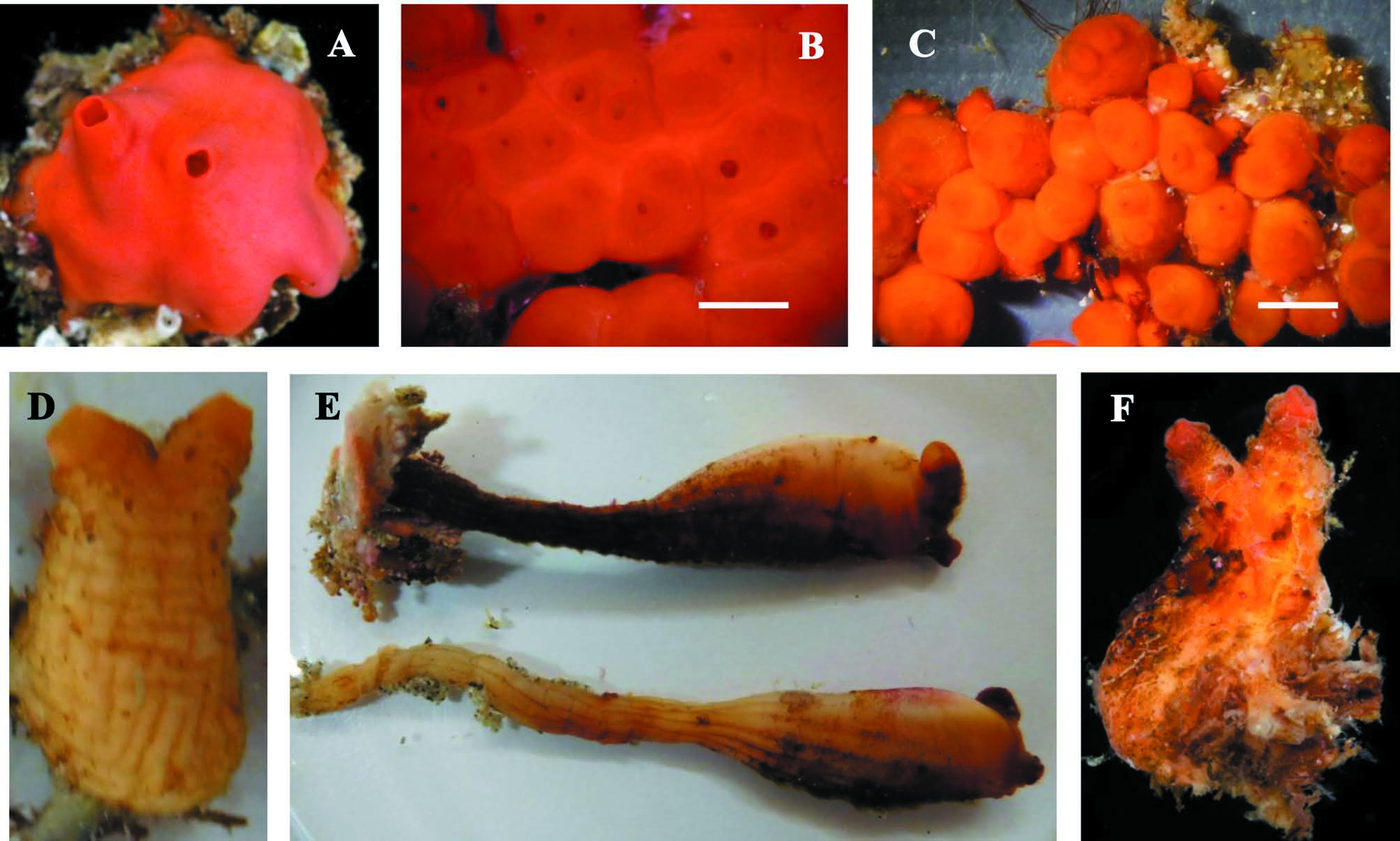
Figure 11 B IHAK 7 BHAK 0373 UF 2453. West Beach, south side, boulder field, low intertidal. One colony, a thick flat mat 7 × 5 × 4 mm thick. IHAK 53 BHAK 1730 UF 2541. Choked Pass, Outer Sandspit, Scuba, 12 m. All zooids are completely embedded in the tough red common tunic, though there is a shallow furrow between each zooid. The colonies are flat, usually no more than 5 – 6 mm in thickness, but may be composed of hundreds of zooids that attain a spread of up to 10 cm or more over hard surfaces. Both siphons of each zooid open independently on the tunic surface. The tunic is always smooth, never covered by epibionts. A detailed morphology is given by Huntsman (1912 b, as M. dermatina) and Van Name (1945). Distribution: British Columbia to southern California (Ritter & Forsyth 1917; Van Name 1945; Lamb & Hanby 2005).
Lambert, Gretchen (2019): The Ascidiacea collected during the 2017 British Columbia Hakai MarineGEO BioBlitz. Zootaxa 4657 (3): 401-436, DOI: 10.11646/zootaxa.4657.3.1
Export occurrence data
Darwin Core Archive (ZIP)
CLASSIFICATION
Taxonomic Classification Tree

MULTIMEDIA
Media Files(1)
FIGURE 11. Styelidae. A: Cnemidocarpa finmarkiensis about 2 cm in width; B: Metandrocarpa dura; C: M. taylori; D: Styela gibbsii 1.7 cm in length; E: S. montereyensis, longest one 8 cm; F: S. truncata 2 cm in length. Scale bars: B, 1 mm; C, 2.5 mm. A and F photos by G. Paulay.
Imageimage/png© Lambert, GretchenLambert, Gretchen
IMAGES