
AnimaliaNot EvaluatedacceptedspeciesAccepted
Styela montereyensis
(Dall, 1872)
GBIF:159167956
0year
ABOUT
Descriptions(1)
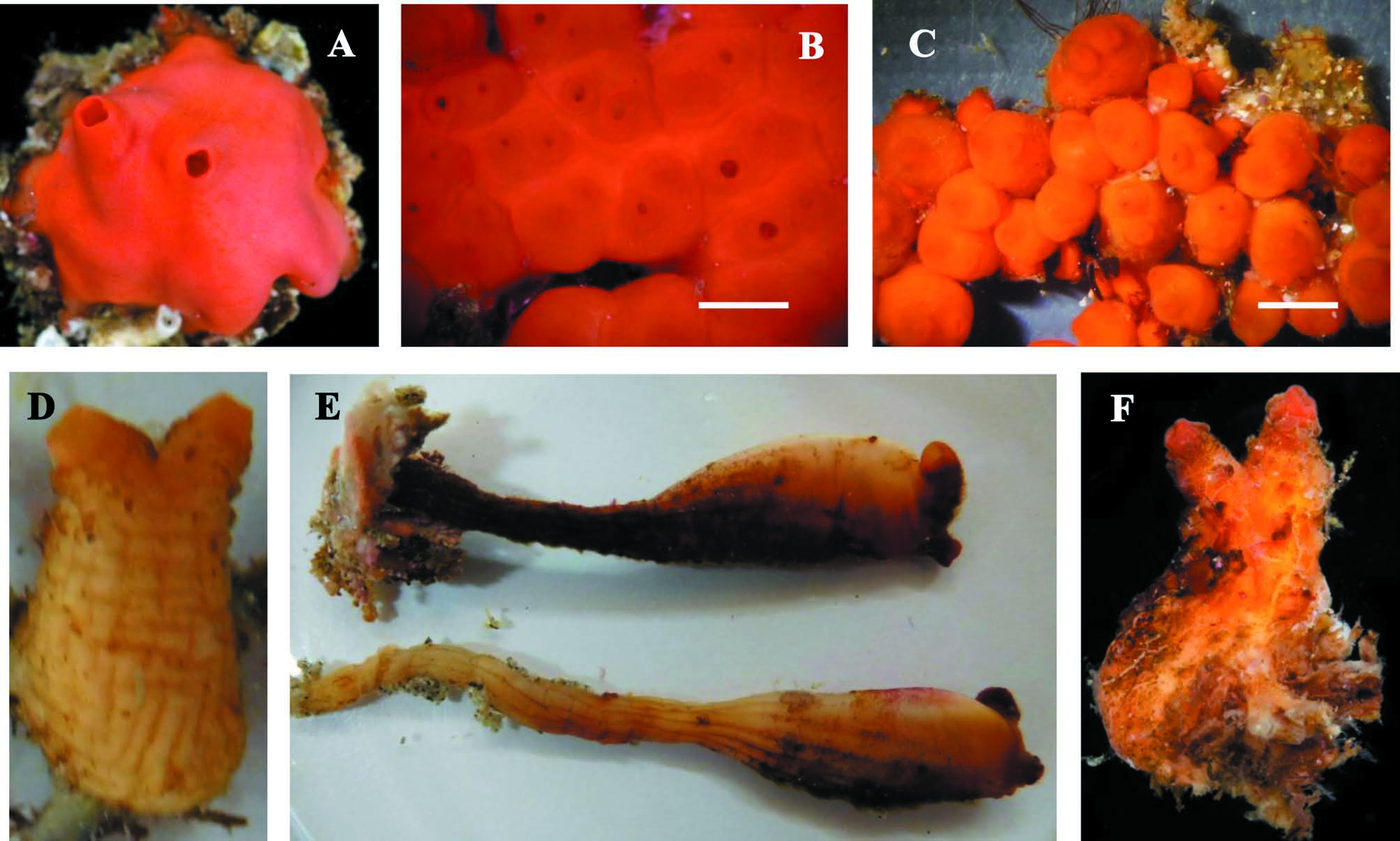
Figure 11 E IHAK 20 BHAK 0658 UF 2507. Meay Channel, Scuba, 18 m. One young specimen, but with gonads. IHAK 28 BHAK 1691 UF 2518. Second Beach, snorkel, 5 m. IHAK 37 Crazy Town surge channel, Scuba, 5 m. IHAK 60 Rattenbury Pinnacle, Scuba, 21 m. One specimen. RHAK 6, BHAK 0626, 0627 UF 2477, 2478. South wall Seventh Beach, low intertidal tidepool. Two young specimens, immature, 7 and 8 cm long. At base of one, coralline algae and tiny colony of Distaplia occidentalis. ZHAK 35 Sasquatch Commode tidepool. This species is very slender, with a long stalk that is usually more than half the total length of the animal. Maximum size may reach 30 cm (Van Name 1945), though most specimens are substantially smaller. The tunic on the body is deeply furrowed longitudinally, the furrows continuing more shallowly on the stalk. Both siphons are at the anterior end of the body, the oral siphon always recurved posteriorly or ventrally, away from the atrial siphon. The long flexible stalk and recurved oral siphon are important in orienting the animal in the high current environments, especially surge channels, that it prefers (Young & Braithwaite 1980). Dorsal tubercle large, as described in Van Name. At least six longitudinal vessels between the four pharyngeal folds on each side, though the number varies with size; there may be more than 10 vessels between each fold in large animals, and only three or four in small specimens. Huntsman (1912 b) catalogued these size – related variables in a study of numerous specimens. There are two long ovaries on each side, with numerous short usually branched testes along the sides of each. A detailed morphological description is given by Huntsman (1912 b), Ritter & Forsyth (1917) and Van Name (1945). Distribution: British Columbia to southern California (Huntsman 1912 b; Ritter & Forsyth 1917; Van Name 1945; Abbott & Newberry 1980). The somewhat similar, introduced, Styela clava Herdman, 1881, native to Japan, is now common from British Columbia to southern California and Mexico but is usually confined to floating docks and pilings; remarkably, none were found during the present study. Its body is broader, rugose, may have longitudinal grooves but they are shallow and do not extend the full length of the body. It has a short stalk less than half the total body length, the siphons are at the anterior end of the body and both are directed forward, and there are more numerous elongate gonads on each side, usually four on the left and six or seven on the right. See Abbott & Johnson (1972) for a detailed description, and comparison with S. montereyensis.
Lambert, Gretchen (2019): The Ascidiacea collected during the 2017 British Columbia Hakai MarineGEO BioBlitz. Zootaxa 4657 (3): 401-436, DOI: 10.11646/zootaxa.4657.3.1
Export occurrence data
Darwin Core Archive (ZIP)
CLASSIFICATION
Taxonomic Classification Tree

MULTIMEDIA
Media Files(1)
FIGURE 11. Styelidae. A: Cnemidocarpa finmarkiensis about 2 cm in width; B: Metandrocarpa dura; C: M. taylori; D: Styela gibbsii 1.7 cm in length; E: S. montereyensis, longest one 8 cm; F: S. truncata 2 cm in length. Scale bars: B, 1 mm; C, 2.5 mm. A and F photos by G. Paulay.
Imageimage/png© Lambert, GretchenLambert, Gretchen
IMAGES