
AnimaliaNot EvaluatedacceptedspeciesAccepted
Styela truncata

Styela truncata

Ritter, 1901

GBIF:159167957

0year

ABOUT

Descriptions(1)

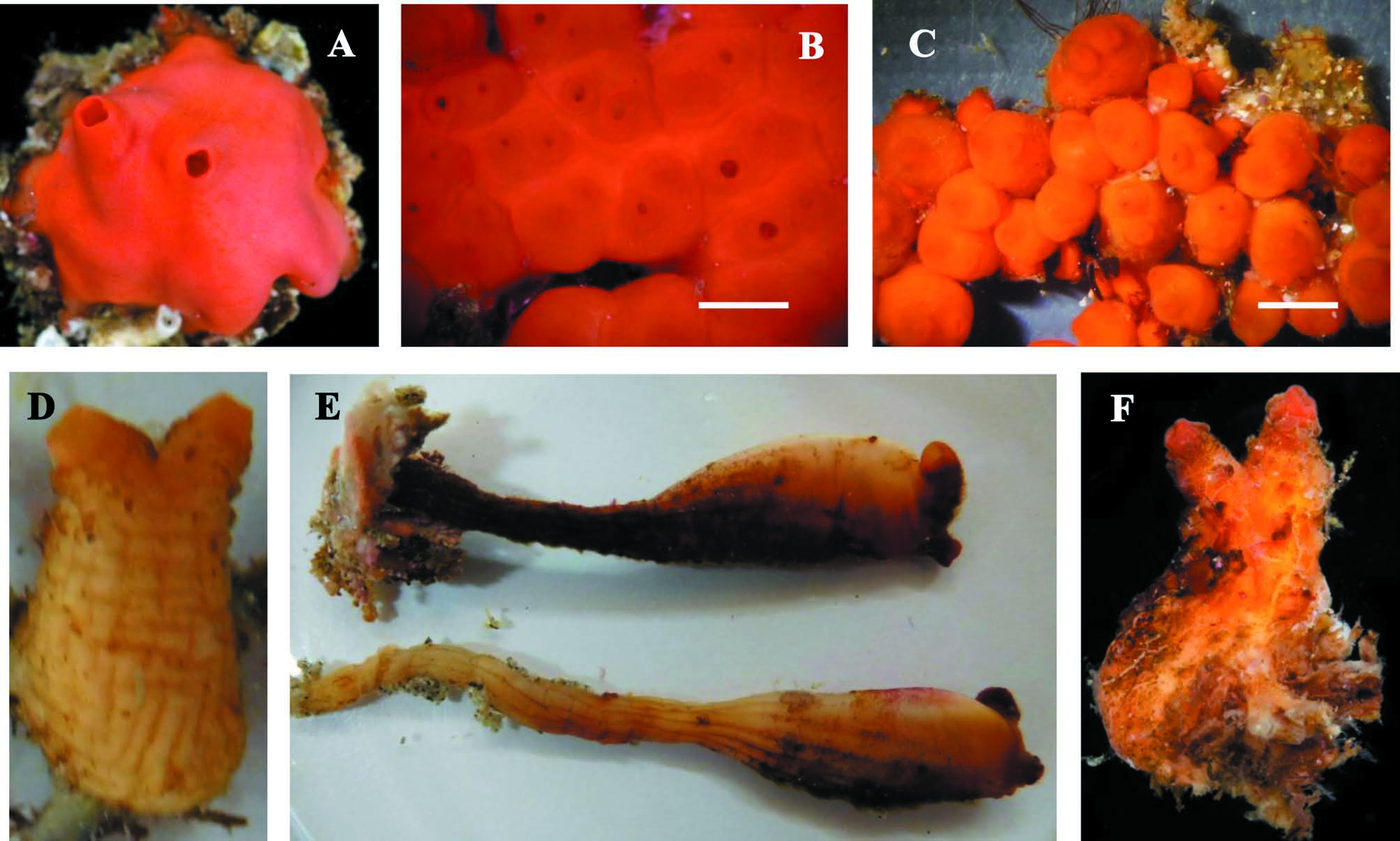
Figure 11 F IHAK 31 BHAK 1695, 1696 UF 2519, 2520. Triquet Island Macro site, Scuba, 8 m. Very small; on Pugettia richii. With D. listerianum. IHAK 37 BHAK 1706 UF 2523. Crazy Town surge channel, Scuba, 5 m. Covered with P. annectens; small but with many brooded uncleaved embryos; on kelp holdfast, wave – exposed. IHAK 44 BHAK 1716 UF 2529. Rattenbury Pinnacle, Scuba, 21 m. No larvae. ZHAK 35 BHAK 3254 UF 2572. Sasquatch Commode tidepool. Small, 7 mm long, but with large brood of embryos. This small species may be difficult to distinguish from S. gibbsii without dissection, though the body is almost always somewhat twisted as in Fig. 11 F and never attains a length of over 3 – 4 cm. Often (though not always) the anterior end is more slender, with the posterior half more bulbous. There are several anatomical differences from S. gibbsii. There is always only one longitudinal vessel between each of the four pharyngeal folds (vs. four to six for S. gibbsii). There are two elongate gonads per side as in S. gibbsii, but in S. truncata the anterior tips of the ovaries curve posteriorly (Abbott & Newberry 1980), resulting in internal oocyte release and fertilization. It is a brooder and brooded embryos can almost always be found in the atrial cavity during the summer breeding season. A detailed morphological description is given by Ritter (1901), Van Name (1945) and Lambert & Sanamyan (2001). Distribution: Alaska to southern California (Ritter 1901; Huntsman 1912 b; Van Name 1945; Lambert & Sanamyan 2001).
Lambert, Gretchen (2019): The Ascidiacea collected during the 2017 British Columbia Hakai MarineGEO BioBlitz. Zootaxa 4657 (3): 401-436, DOI: 10.11646/zootaxa.4657.3.1

Export occurrence data

Darwin Core Archive (ZIP)

CLASSIFICATION

Taxonomic Classification Tree

MULTIMEDIA

Media Files(1)

FIGURE 11. Styelidae. A: Cnemidocarpa finmarkiensis about 2 cm in width; B: Metandrocarpa dura; C: M. taylori; D: Styela gibbsii 1.7 cm in length; E: S. montereyensis, longest one 8 cm; F: S. truncata 2 cm in length. Scale bars: B, 1 mm; C, 2.5 mm. A and F photos by G. Paulay.

Imageimage/png© Lambert, GretchenLambert, Gretchen

IMAGES

Gallery(1)

See Gallery

Occurrences with images

Source Information

The Ascidiacea collected during the 2017 British Columbia Hakai MarineGEO BioBlitz

checklist

This dataset contains the digitized treatments in Plazi based on the original journal article Lambert, Gretchen (2019): The Ascidiacea collected during the 2017 British Columbia Hakai MarineGEO BioBlitz. Zootaxa 4657 (3): 401-436, DOI: 10.11646/zootaxa.4657.3.1

Abstract

A three-week intensive marine biodiversity survey was carried out at a small remote region of the central British Columbia coast at and near the Calvert Island Marine Station (Hakai Institute) July 21–August 11, 2017. The survey included daily sampling by the staff and a number of visiting taxonomists with specialties covering all the major groups of invertebrates. Many marine habitats were sampled: rocky and sand/gravel intertidal and tidepools, eelgrass meadows, shallow and deeper subtidal by snorkel and Scuba, plus artificial surfaces including the sides and bottom of the large floating dock at the Institute and settlement plates set out up to a year previously at various subtidal sites. Many new species were recorded by all the taxonomists. In this very biodiverse remote area 36 ascidian species were identified: 18 Aplousobranchia, 7 Phlebobranchia, and 11 Stolidobranchia, comprising a total of 15 solitary and 21 colonial species including two undescribed colonial species. This represents almost one third of all the known North American species from Alaska to southern California in this limited very remote area. Remarkably, only two are possible non-natives. Diplosoma listerianum (Milne-Edwards, 1841), was collected mostly on natural substrates including deeper areas sampled by Scuba, and one colony occurred on a settlement plate. A few Ciona savignyi Herdman, 1882 were collected, two from natural substrates and four from artificial surfaces. There were no botryllids, Styela clava Herdman, 1881, Didemnum vexillum Kott, 2002, or Molgula manhattensis (De Kay, 1843), though these are all common and sometimes very abundant non-natives in other parts of BC and along much of the U.S. west coast. Most of the species encountered are known in northern California, Washington, and southern BC, but only a small number are represented among the few known Alaska species.

Lambert G, plazi (2019). The Ascidiacea collected during the 2017 British Columbia Hakai MarineGEO BioBlitz. Plazi.org taxonomic treatments database. Checklist dataset https://doi.org/10.11646/zootaxa.4657.3.1 accessed via GBIF.org on 2026-06-14.

CC0Published 8/20/2019View dataset
GBIF Usage Key
159167957
Dataset Key
3414318d-7570-49ac-9013-be4e1f1e6347
Origin
source
Backbone Key
2331969
Taxon ID
6A2E3761A924FFD21390F8E8D9F2FDEE.taxon
Last Crawled
6/10/2026
Last Interpreted
6/10/2026