
AnimaliaacceptedgenusAccepted
Didemnum
Savigny, 1816
GBIF:159167978
0year
ABOUT
Descriptions(1)
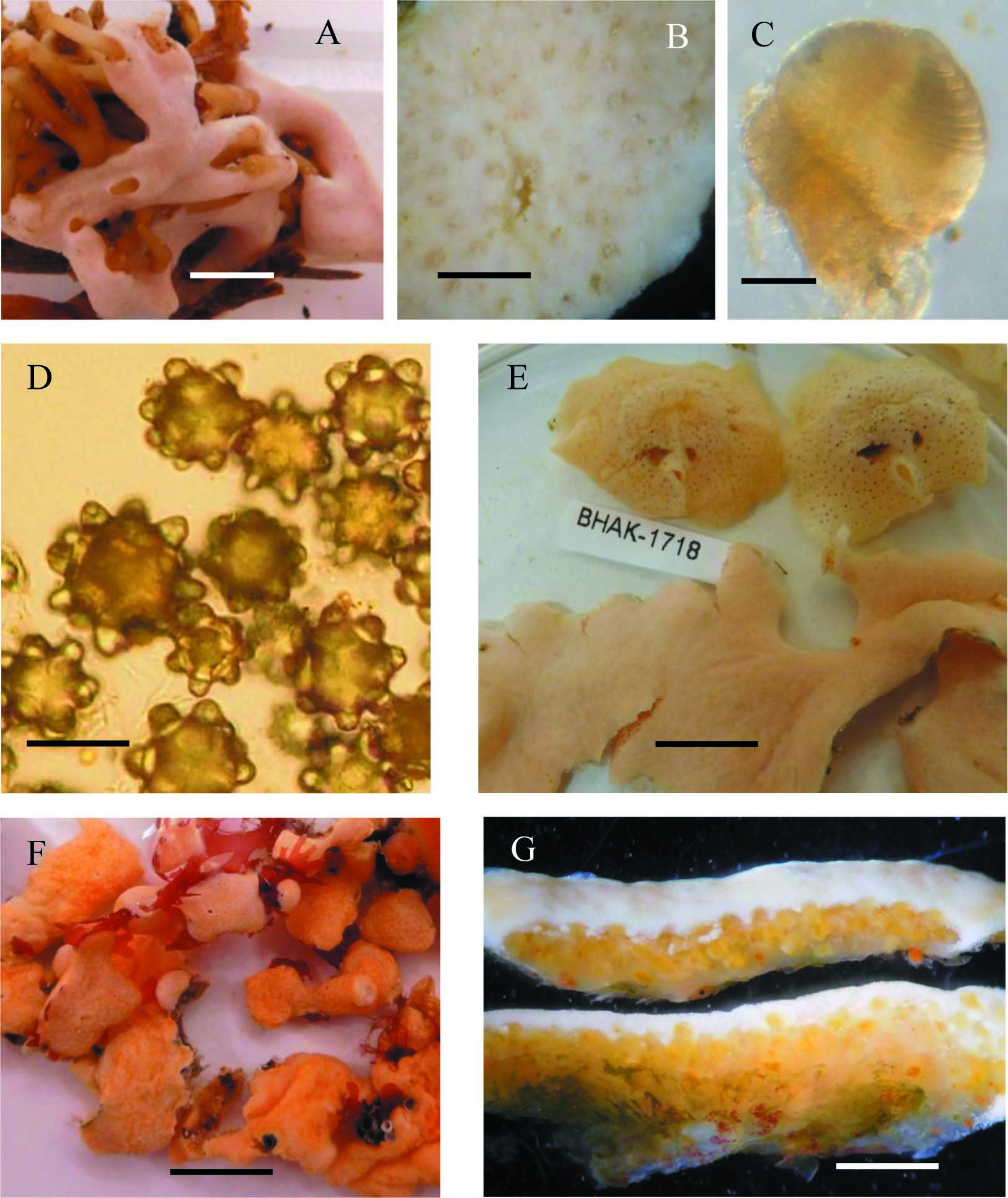
Figure 5 A – E IHAK 31 BHAK 1697 Triquet Island Macro site, 8 m Scuba, on Pugettia richii along with Aplidium californicum. IHAK 31 BHAK 1701. On filamentous and coralline red algae: Plocamium pacificum Kylin, 1925, Calliarthron tuberculosum (Postels & Ruprecht, 1840) E Y. Dawson, 1964, Osmundea spectabilis (Postels & Ruprecht) K. W. Nam, 199 4. IHAK 31 a BHAK 1702. On algal holdfast. IHAK 31 b BHAK 1700. On kelp holdfast. Zooids tiny, thorax contracted. IHAK 36 C BHAK 1713. West Beach Nero Site, Scuba, 5 m. IHAK 37 BHAK 1707. Crazy Town surge channel, Scuba, 5 m, on red alga. IHAK 42 BHAK 1711. Starfish Rocky Reef Site, Scuba, 18 m. Large colony 6 cm across in largest diameter. IHAK 44 BHAK 1718 Rattenbury Pinnacle, Scuba, 21 m. With two lamellariids Marsenina stearnsii (Dall, 1871), UF Mollusca 511662. IHAK 53 BHAK 1728 Choked Pass, Outer Sandspit, Scuba, 12 m. Small colonies on Spiochaetopterus M Sars, 1856 tubes and spider crabs. IHAK 60 Rattenbury Pinnacle, Scuba, 17 – 20 m. Tiny lamellariid on the colony (UF Mollusca 511759, Marsenina stearnsii). This common northeast Pacific species has long been identified as D. albidum (Verrill, 1871), an Atlantic species. Upper tunic heavily impregnated with spicules, less dense in basal layer, few in middle. Atrial opening very wide, almost as wide as the entire length of the thorax in some well-relaxed zooids. Abdomen yellow. Testis doubled, six – eight coils of sperm duct. Tunic spicules blunt-ended and stellate (Fig. 5 D). See Van Name (1945) for Pacific distribution records. Van Name (1945) recorded four – eight coils of the sperm duct but he lumped Atlantic and Pacific specimens. The distinctive double testis and shape of the spicules seem to be identical, but the distinguishing morphological character is the sperm duct: always only three or four loose coils in D. albidum (Van Name 1945 though Marks 1996 reported occasionally more) and at least six but usually seven or eight in this undescribed Didemnum sp. No larvae were observed. Didemnum albidum has never been recorded in the Pacific. Distribution: British Columbia to southern California (unpublished observations). The species will be described in a separate publication.
Lambert, Gretchen (2019): The Ascidiacea collected during the 2017 British Columbia Hakai MarineGEO BioBlitz. Zootaxa 4657 (3): 401-436, DOI: 10.11646/zootaxa.4657.3.1
Export occurrence data
Darwin Core Archive (ZIP)
CLASSIFICATION
Taxonomic Classification Tree

MULTIMEDIA
Media Files(1)
FIGURE 5. Didemnidae. A–E: Didemnum sp. 1, undescribed species. A: whole colony on kelp holdfast. B: detail of tunic surface showing one cloacal opening. C: bifurcated testis from a zooid showing numerous coils of the sperm duct; D: tunic spicules. E: two cryptically colored lamellarid nudibranchs above a colony piece from which they were collected. F, G: Didemnum sp. 2. F: numerous small colonies or pieces of same colony; G: two cross sections of a different colony showing distribution of spicules. Scale bars: A, 1 cm; B, 1.5 mm; C, 0.1 mm; D, 20 µm; E, 1 cm.; F, 9 mm; G, 4 mm.
Imageimage/png© Lambert, GretchenLambert, Gretchen
IMAGES