
AnimaliaNot EvaluatedacceptedspeciesAccepted
Corella inflata
(Huntsman, 1912)
GBIF:159168012
0year
ABOUT
Descriptions(1)
Figure 10 F IHAK 18 BHAK 0640, 0641, 0649, 0650, 0654 UF 2491, 2492, 2499, 2500, 2503. Under lab dock, common. IHAK 40 Pruth Dock two specimens with several Halocynthia igaboja Oka, 1906. XHAK 1 Maey Channel ARMS 7.3 m. On plates with C. willmeriana Herdman, 1898 and Chelyosoma productum. XHAK 9 Kelpie Point ARMS 5 m. Several large specimens on plates. With C. willmeriana, small Chelyosoma productum, one Ascidia columbiana and small flat colonies of Distaplia occidentalis. This common NE Pacific native species is often an abundant settler on newly cleared or otherwise unfouled surfaces and thus may be incredibly numerous on new marina floating docks or on long sabellid polychaete tubes. The intestine, rectum and gonoducts are on the right side, are short (less than half the body length), and end at the base of a very expanded atrial chamber that serves as a brood pouch. Oocytes are spawned into this large atrial cavity where they are fertilized and float until the tadpoles hatch and swim down and out of the atrial siphon. After settlement, the juveniles always develop with an alignment that assures that the atrial chamber will be uppermost, assuring that the brooded embryos will be retained until hatching. The species breeds year around in Washington; summer populations have a life span of only about five months, while winter populations live for about eight months (Lambert 1968, as C. willmeriana). Van Name (1945) incorrectly synonymized C. inflata under C. willmeriana; see Lambert et al. (1981) for detailed morphology and distinction from Corella willmeriana. Distribution: Alaska to Oregon (Lambert & Sanamyan 2001; Lamb & Hanby 2005; unpublished observations for recent Oregon records).
Lambert, Gretchen (2019): The Ascidiacea collected during the 2017 British Columbia Hakai MarineGEO BioBlitz. Zootaxa 4657 (3): 401-436, DOI: 10.11646/zootaxa.4657.3.1
Export occurrence data
Darwin Core Archive (ZIP)
CLASSIFICATION
Taxonomic Classification Tree

MULTIMEDIA
Media Files(1)
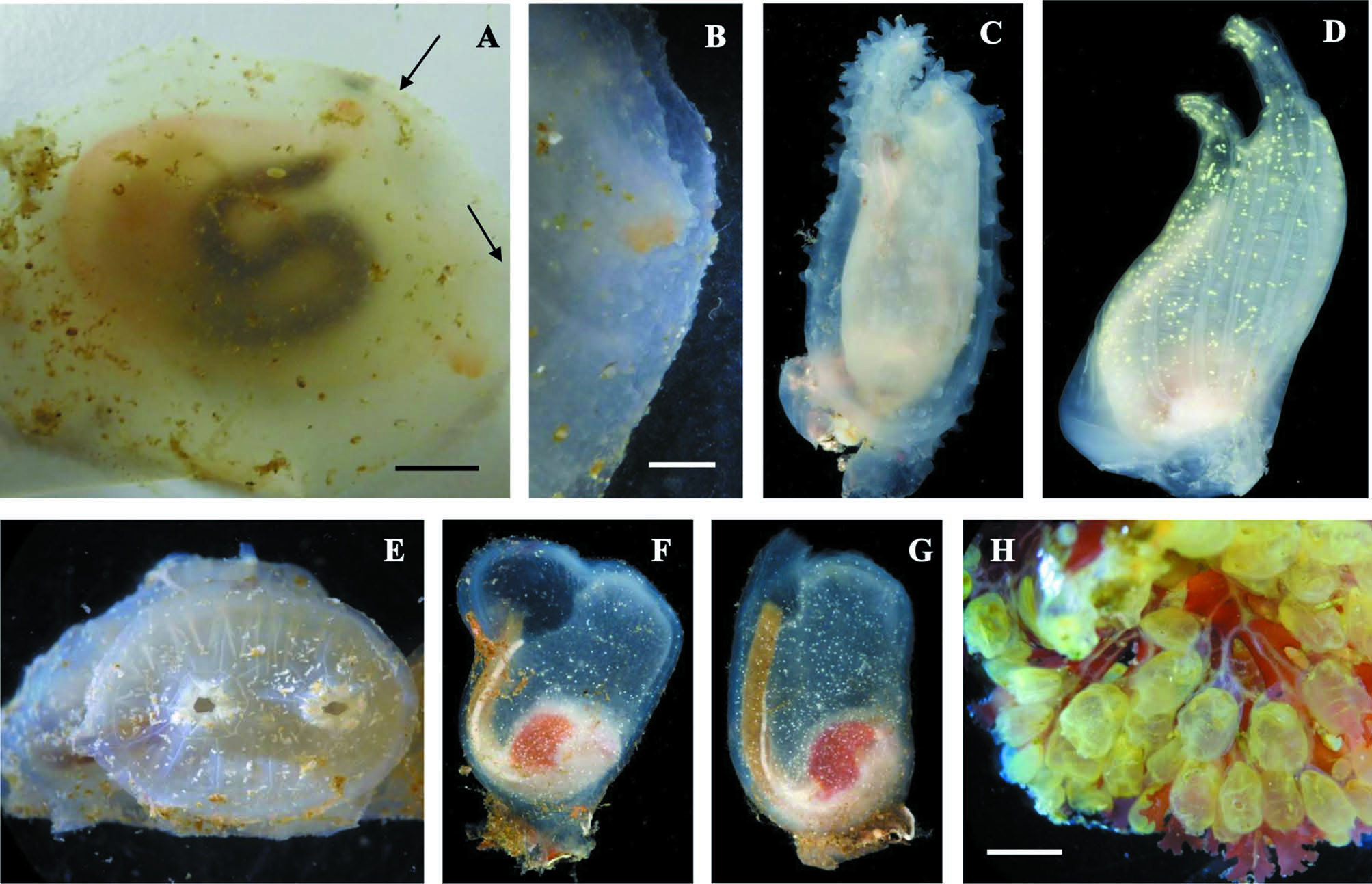
FIGURE 10. Figure 10. Phlebobranchia. A, B: Ascidia columbiana. A: whole animal right side, anterior on the right. Arrows indicate oral siphon opening (on right) and atrial opening above. B: anterior end around oral opening showing tunic papillations. C: Ascidia paratropa 9 cm in length; D: Ciona savignyi 6.2 cm in length; E: Chelyosoma productum 1.5 cm in diameter; F: Corella inflata about 3 cm in length; G: Corella willmeriana about 3 cm in length; H: Perophora annectens. Scale bars: A, 1.5 cm; B, 2 mm; H, 4 mm. C, D, F, G photos by G. Paulay.
Imageimage/png© Lambert, GretchenLambert, Gretchen
IMAGES