
AnimaliaacceptedsuborderAccepted
Sebecosuchia

Sebecosuchia

GBIF:159397220

ABOUT

Descriptions(2)

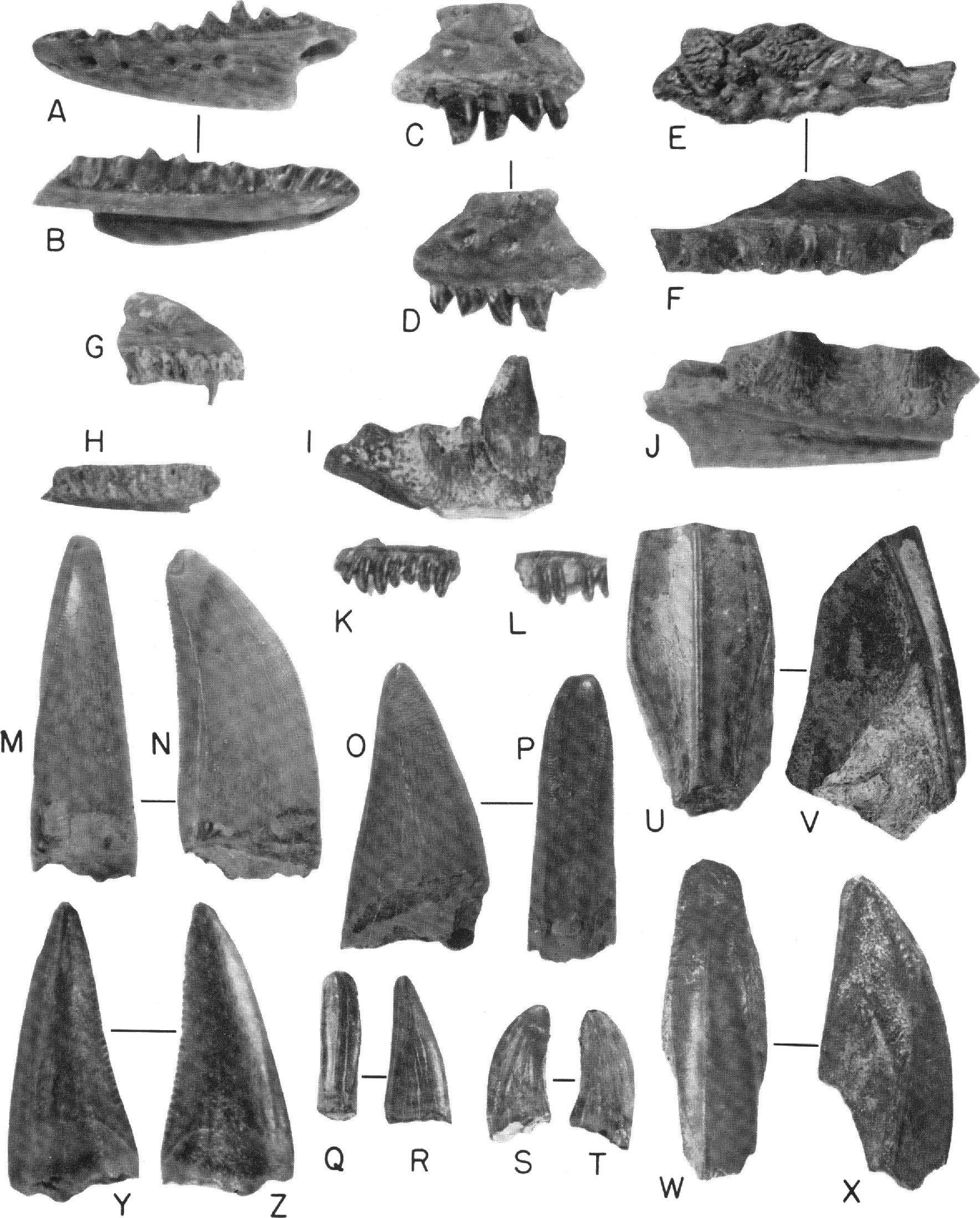
Figure 8 Y, Z
Sahni, Ashok (1972): The vertebrate Fauna of the Judith River formation, Montana. Bulletin of the American Museum of Natural History 147 (6): 319-416, DOI: 10.5281/zenodo.3382461, Hdl: http://hdl.handle.net/2246/1099
AMNH 8549 represents another rare group which is tentatively assigned to the Sebecosuchia (fig. 8 Y, Z). Sebecosuchian teeth resemble theropod teeth as pointed out by Simpson (1937 a, 1937 b) and Colbert (1946), and were consistently confused as such by earlier workers. Such teeth differ from contemporary theropod teeth in that the blade is usually straighter, the serrations on the anterior and the posterior sides are finer, and a more prominent groove is present along the midline of the tooth on the lingual and labial side. Similar teeth have been reported from the Milk River Formation of Alberta (Russell, 1935, p. 123, fig. 9) and from the Lance Formation of Wyoming (Estes, 1964, p. 143). They have yet to be reported, however, from the Judith River Formation or from its equivalent formation in Alberta. Russell (1935) suggested that the teeth may have come from the premaxilla of a deinodont. Considering the known skulls of these large carnivores, this seems unlikely. Estes (1964, p. 143), on the other hand, believed it probable that the teeth represent a juvenile theropod. At present, there is no conclusive evidence that the teeth belong to the theropods, or, for that matter, to the Saurischia. Langston (1956) reviewed criteria useful in distinguishing between sebecid teeth and carnosaur teeth.
Sahni, Ashok (1972): The vertebrate Fauna of the Judith River formation, Montana. Bulletin of the American Museum of Natural History 147 (6): 319-416, DOI: 10.5281/zenodo.3382461, Hdl: http://hdl.handle.net/2246/1099

Export occurrence data

Darwin Core Archive (ZIP)

CLASSIFICATION

Taxonomic Classification Tree

MULTIMEDIA

Media Files(1)

FIG. 8. A. Chamops segnis. AMNH 8486, labial view of left dentary. B. Lingual view. Both x 5. C. AMNH 8488, lingual view of left maxilla. D. Labial view. Both x 5. E. cf. Xenosauridae, AMNH 8498, labial view of left maxilla. F. Lingual view. Both x 5. G. Peltosaurus piger, AMNH 8495, lingual view of left maxilla, x 5. H. AMNH 8494, lingual view of right dentary, x 5. I. Paraderma bogerti, AMNH 8504, lingual view of right maxilla. x 5. J. Parasaniwa wyomingensis, AMNH 8499, lingual view of left dentary, x 5. K. Leptochamops denticulatus, AMNH 8491, lingual view of right maxilla, x 5. L. Exostinus lancensis, AMNH 8497, lingual view of right maxilla, x 5. M. Deinodon horridus, AMNH 8513, posterior view of isolated tooth. N. Lateral view. Both x 13. 0. AMNH 8515, lateral view of anterior dentary tooth. P. Posterior view. Both x 13. Q. AMNH 8514, posterior view of?premaxillary tooth. R. Lateral view. Both x 12. S. Paronychodon lacustris, AMNH 8522, lingual view of isolated tooth. T. Labial view. Both x 12. U. Kritosaurus cf. K. breviceps, AMNH 8525, lateral view of isolated tooth. V. Posterior view. Both x 1 2. W. Procheneosaurus altidens, AMNH 8527, labial view of isolated tooth. X. Anterior or posterior view. Both x 12. Y, Z.?Sebecosuchia, AMNH 8549, views of an solated tooth. Both x 10.

Imageimage/png© Sahni, AshokSahni, Ashok

IMAGES

Gallery(1)

See Gallery

Occurrences with images

Source Information

The vertebrate Fauna of the Judith River formation, Montana

checklist

This dataset contains the digitized treatments in Plazi based on the original journal article Sahni, Ashok (1972): The vertebrate Fauna of the Judith River formation, Montana. Bulletin of the American Museum of Natural History 147 (6): 319-416, DOI: 10.5281/zenodo.3382461, Hdl: http://hdl.handle.net/2246/1099

GEOLOGIC INVESTIGATION of the Late Cretaceous Judith River Formation in the area just north of the Judith River on the Missouri River in north-central Montana has resulted in the discovery of varied vertebrate forms. The beds are mainly freshwater continental deposits consisting of crossbedded channel sandstones, gray siltstones, and carbonaceous shales with occasional seams of lignitic coal. The stratigraphic sequence consists of the Marias River Shale overlain by the Eagle, Claggett, Judith River, and Bearpaw formations. The last four constitute the Montana Group. The Judith River Formation is Campanian in age as determined by its position between the fossiliferous marine Claggett and Bearpaw shales.

The fauna was obtained from the upper 50 feet of the formation. The bone concentration in the productive sandstone is the result of size sorting leading to underrepresentation of the larger dinosaurs. Three orders of mammals are represented, the Eutheria by a single genus, the Allotheria by five, and the Metatheria by at least three genera. Teiid and parasaniwid lizards are frequent. Only a fraction of the large number of described dinosaur genera, however, is represented in the collection by isolated teeth. Fish and amphibians form a sizable portion of the fauna.

Vertebrates from the Judith River Formation are more primitive than, but generally similar to, later Maestrichtian species. The mammals differ from their descendants in the Lance Formation at the species level. The community structure and the paleoecology of the fauna of the Judith River Formation resemble those of the Lance Formation. The greatest difference between the two communities is the greater variety of dinosaurs in the earlier formation.

Sahni A, plazi (1972). The vertebrate Fauna of the Judith River formation, Montana. Plazi.org taxonomic treatments database. Checklist dataset https://doi.org/10.5281/zenodo.3382461 accessed via GBIF.org on 2026-06-15.

CC0Published 12/31/1972View dataset
GBIF Usage Key
159397220
Dataset Key
fd03f669-c046-46cd-861a-6bf56b7fc989
Origin
source
Taxon ID
1A7187CFFFC8177FFEE8FCF5E3215352.taxon
Last Crawled
6/10/2026
Last Interpreted
6/10/2026