
AnimaliaacceptedfamilyAccepted
Pelobatidae

Pelobatidae

GBIF:159397245

ABOUT

Descriptions(2)

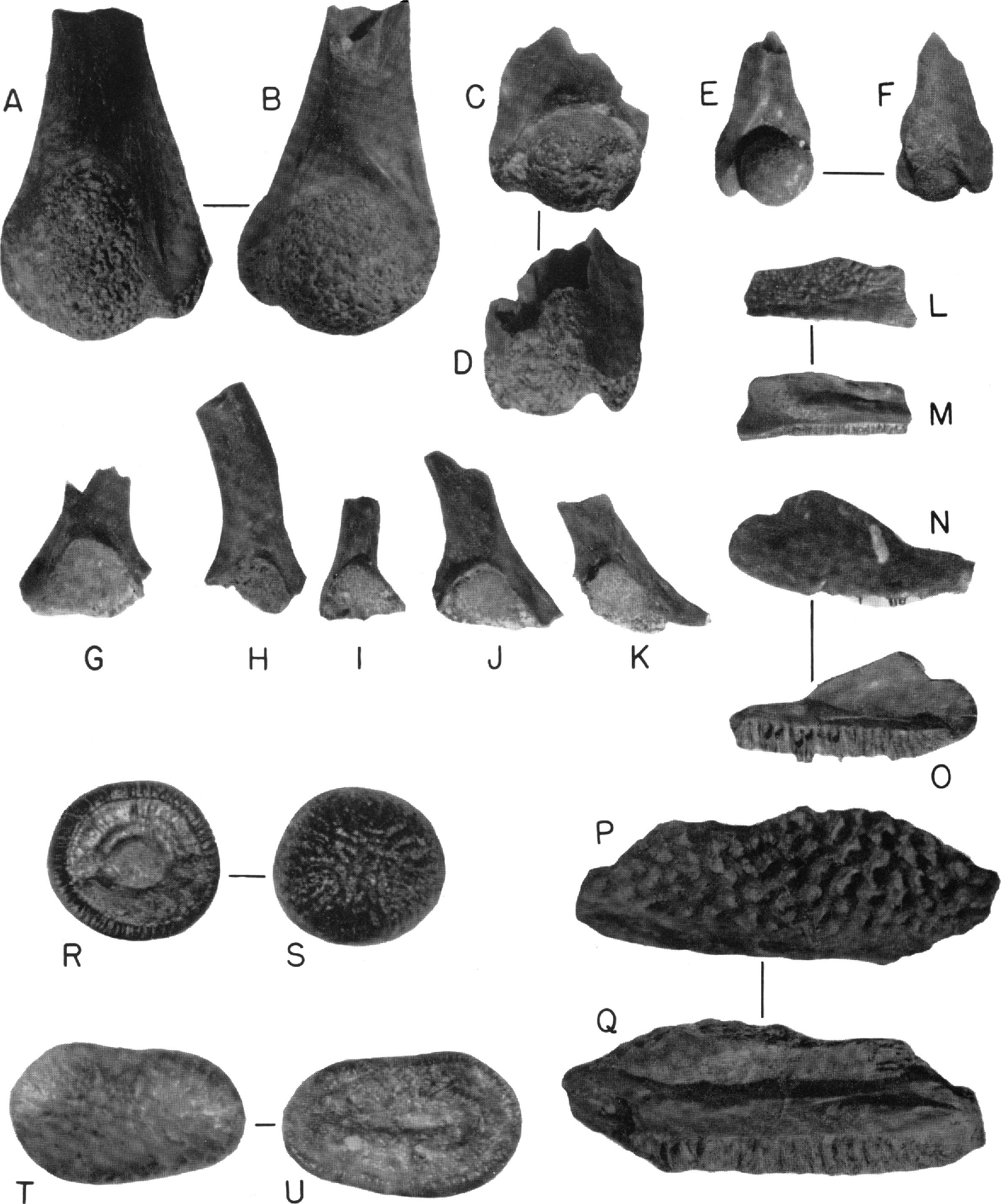
Figure 7 J, K
Sahni, Ashok (1972): The vertebrate Fauna of the Judith River formation, Montana. Bulletin of the American Museum of Natural History 147 (6): 319-416, DOI: 10.5281/zenodo.3382461, Hdl: http://hdl.handle.net/2246/1099
Two ilia, AMNH 8452 and 8453, are tentatively referred to the Pelobatidae (fig. 7 J, K). The identification is uncertain as the specimens are broken and consist only of the acetabular region. AMNH 8452 and 8453 are easily distinguished from other anuran ilia in the collection by the shape of the acetabulum and the relatively greater elongation of the posterior ischial process. In size AMNH 8452 most closely resembles UCMP 49524, a left pelobatid ilium, tentatively identified by Estes (1964, p. 59). The acetabulum of AMNH 8452 is more triangular than semicircular, with a raised and pointed dorsal apex. The posterior part of the acetabulum is at the same level as the ischial process, although anteriorly it develops a prominent rim near the pubic process. This process is broken in both specimens but was probably developed to the same extent as in UCMP 49524 from the Lance Formation. The medial view shows no features of diagnostic value except for an ornamentation consisting of parallel striations along the contact with the ischium and the pubis.
Sahni, Ashok (1972): The vertebrate Fauna of the Judith River formation, Montana. Bulletin of the American Museum of Natural History 147 (6): 319-416, DOI: 10.5281/zenodo.3382461, Hdl: http://hdl.handle.net/2246/1099

Export occurrence data

Darwin Core Archive (ZIP)

CLASSIFICATION

Taxonomic Classification Tree

MULTIMEDIA

Media Files(1)

FIG. 7. A. AMNH 8446, ventral view of left discoglossid (A) humerus. B. Dorsal view. Both x 5. C. AMNH 8449, ventral view of left discoglossid (B) humerus. D. Dorsal view. Both x 5. E. AMNH 8450, ventral view of left discoglossid (C) humerus. F. Dorsal view. Both x 5. G. AMNH 8456, lateral view of distal portion of right discoglossid ilium, x 5. H. AMNH 8457, lateral view of distal portion of left discoglossid ilium, x 5. I. AMNH 8459, lateral view of distal portion of left discoglossid ilium, x 5. J. AMNH 8452, lateral view of distal portion of left pelobatid ilium, x 5. K. AMNH 8453, lateral view of distal portion of pelobatid ilium, x 5. L. AMNH 8460, external view of left discoglossid (C) maxilla. M. Internal view. Both x 5. N. AMNH 8462, external view of right discoglossid (B) maxilla. 0. Internal view. Both x 5. P. AMNH 8461, external view of left discoglossid (A) maxilla. Q. Internal view. Both x 5. R. AMNH 10100, occlusal view of?Paralbula sp. S. Basal view. Both x 10. T. AMNH 10101, occlusal view of?Paralbula sp. U. Basal view. Both x 1.0.

Imageimage/png© Sahni, AshokSahni, Ashok

IMAGES

Gallery(1)

See Gallery

Occurrences with images

Source Information

The vertebrate Fauna of the Judith River formation, Montana

checklist

This dataset contains the digitized treatments in Plazi based on the original journal article Sahni, Ashok (1972): The vertebrate Fauna of the Judith River formation, Montana. Bulletin of the American Museum of Natural History 147 (6): 319-416, DOI: 10.5281/zenodo.3382461, Hdl: http://hdl.handle.net/2246/1099

GEOLOGIC INVESTIGATION of the Late Cretaceous Judith River Formation in the area just north of the Judith River on the Missouri River in north-central Montana has resulted in the discovery of varied vertebrate forms. The beds are mainly freshwater continental deposits consisting of crossbedded channel sandstones, gray siltstones, and carbonaceous shales with occasional seams of lignitic coal. The stratigraphic sequence consists of the Marias River Shale overlain by the Eagle, Claggett, Judith River, and Bearpaw formations. The last four constitute the Montana Group. The Judith River Formation is Campanian in age as determined by its position between the fossiliferous marine Claggett and Bearpaw shales.

The fauna was obtained from the upper 50 feet of the formation. The bone concentration in the productive sandstone is the result of size sorting leading to underrepresentation of the larger dinosaurs. Three orders of mammals are represented, the Eutheria by a single genus, the Allotheria by five, and the Metatheria by at least three genera. Teiid and parasaniwid lizards are frequent. Only a fraction of the large number of described dinosaur genera, however, is represented in the collection by isolated teeth. Fish and amphibians form a sizable portion of the fauna.

Vertebrates from the Judith River Formation are more primitive than, but generally similar to, later Maestrichtian species. The mammals differ from their descendants in the Lance Formation at the species level. The community structure and the paleoecology of the fauna of the Judith River Formation resemble those of the Lance Formation. The greatest difference between the two communities is the greater variety of dinosaurs in the earlier formation.

Sahni A, plazi (1972). The vertebrate Fauna of the Judith River formation, Montana. Plazi.org taxonomic treatments database. Checklist dataset https://doi.org/10.5281/zenodo.3382461 accessed via GBIF.org on 2026-06-15.

CC0Published 12/31/1972View dataset
GBIF Usage Key
159397245
Dataset Key
fd03f669-c046-46cd-861a-6bf56b7fc989
Origin
source
Backbone Key
6743
Taxon ID
1A7187CFFFF51742FD8FF5ACE58A5E82.taxon
Last Crawled
6/10/2026
Last Interpreted
6/10/2026