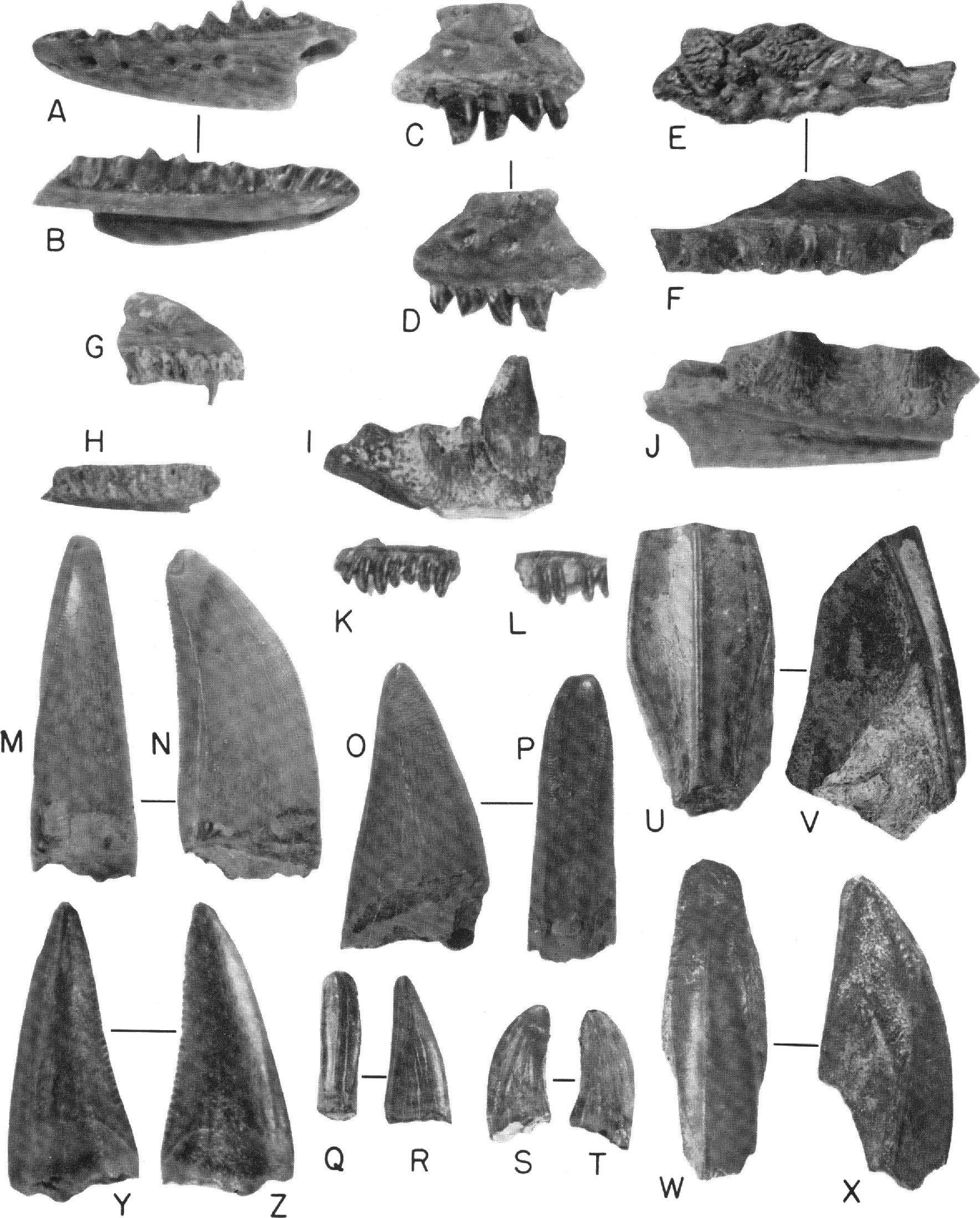
Estes (1 964, p. 11 0) erected a new genus, Leptochamops, for Chamops denticulatus Gilmore (1928) and distinguished the genus from the type of Chamops, Chamops segnis (Marsh, 1 892 b), on the following criteria: " greater number of teeth; higher crowned teeth; teeth with crests running up to the lateral cusps; lateral cusps closely pressed to the main cusp and lacking the welldefined tips present in Chamops segnis; the tooth bases generally not expanded, on the posterior teeth showing this condition weakly; the teeth more compressed and cylindric; the anterior teeth fully pleurodont; and the Meckelian fossa more restricted. " The Judith River material of Leptochamops denticulatus is identical to that from the Lance Formation. AMNH 8490, from Clambank Hollow, is a left dentary assigned to the species. It is more slender than that of Chamops even though the ventral border of the dentary is broken. The dorsal tooth-bearing border of the Meckelian fossa is relatively thinner and not anteriorly expanded as in Chamops. Thus, in occlusal view, the lingual outline of the dentary is straighter and not so concave as it is in Chamops. The mental foramina are small and not well developed. The maxilla fragment, AMNH 8491, shows the extent of heterodonty (fig. 8 K). The anterior four or five teeth are the smallest, which is a condition that prevails in the Recent genera Crocodilurus and Tupinambis. The maxillary teeth are similar to those on the dentary. They are long and slender, and have nonexpanded tooth bases. The anterior accessory cusp on the maxillary teeth is better developed than the posterior, and it is not so well separated from the central cusp as in Chamops. Discussion: Two teiid genera are present in the Judith River Formation. Chamops segnis was first described by Marsh (1892 b, p. 450) in a paper dealing with the reptiles of the " Laramie " Formation. Marsh (1892 b) and Gilmore (1928) misidentified this type specimen as a maxilla, but it is actually a left dentary, as pointed out by Estes (1964, p. 106). The type specimen is peculiar in that it is one of the largest specimens of the genus. Other material referred to Chamops from the Lance and Judith River formations is morphologically similar but much smaller. Chamops denticulatus Gilmore (1928) was used by Estes (1964) for the type of a new genus, Leptochamops. In the Judith River Formation L. denticulatus is nearly as abundant as Chamops and is inseparable from the Maestrichtian form. The two other teiid genera, Meniscognathus and Haptosphenus, described by Estes (1964) from the Lance Formation, have not been identified as yet from the Judith River Formation. Marsh (1892 b) did not assign a familial position to Chamops. Other early workers regarded it as possessing iguanid affinities (Camp, 1923; Gilmore, 1928). Reference of Chamops to the Teiidae was made initially by Boulenger and Nopsca, and has been conclusively demonstrated by Estes (1964, p. 105), who made a detailed comparison with the modern teiids Crocodilurus and Tupinambis. He pointed out that the teiids differ from the iguanids in having an open Meckelian fossa, less pleurodont teeth, straighter roof of the Meckelian fossa, and in the form of the tooth crown and base. The occurrence of Chamops and Leptochamops in the Campanian of North America is the oldest documented record of the Teiidae, and points to the antiquity of the family, which has undergone little change since the Cretaceous. A Chamopslike teiid may be present in the Albian Trinity Sandstone fauna of Texas (Estes, personal commun.) but this has yet to be studied in any detail. Apart from its reported occurrences in the Lance Formation, Wyoming, and Hell Creek Formation, Montana, Sternberg (1951) reported Chamops from the Wapiti Formation of Alberta. Its presence there is significant in three respects: first, it is the northernmost occurrence of the genus; second, the horizon from which the specimen was obtained appears to be older than the Edmonton Formation with which Sternberg (1951) previously correlated it; third, the specimen is larger than average specimens referred to Chamops. The mandible, bearing a few teeth, was collected near Grand Prairie in northwestern Alberta in what Allan and Carr (1946) regard as Member B of the Wapiti Formation. According to Sternberg (1951), 2500 feet of the formation overlies Member B, placing it well down in the stratigraphic section. Recent studies by Williams and Burk (1964) indicated that the Wapiti Formation included not only sediments of the Maestrichtian but also some of the Campanian. They believe that Member A of the Wapiti Formation is equivalent to the Oldman Formation and that Members B, C, and D can in part be correlated with the Bearpaw Shale and the lower and middle members of the Edmonton Formation. Member E corresponds to the Upper Edmonton of Allan and Sanderson (1945), which is generally reported as Lancian or Maestrichtian in age. The Wapiti Chamops consequently may well be in the Campanian and nearly contemporary with the fauna from the Judith River Formation.
Sahni, Ashok (1972): The vertebrate Fauna of the Judith River formation, Montana. Bulletin of the American Museum of Natural History 147 (6): 319-416, DOI: 10.5281/zenodo.3382461, Hdl: http://hdl.handle.net/2246/1099