
AnimaliaacceptedgenusAccepted
Kritosaurus

Kritosaurus

(Marsh, 1889)

GBIF:159397316

0year

ABOUT

Descriptions(3)

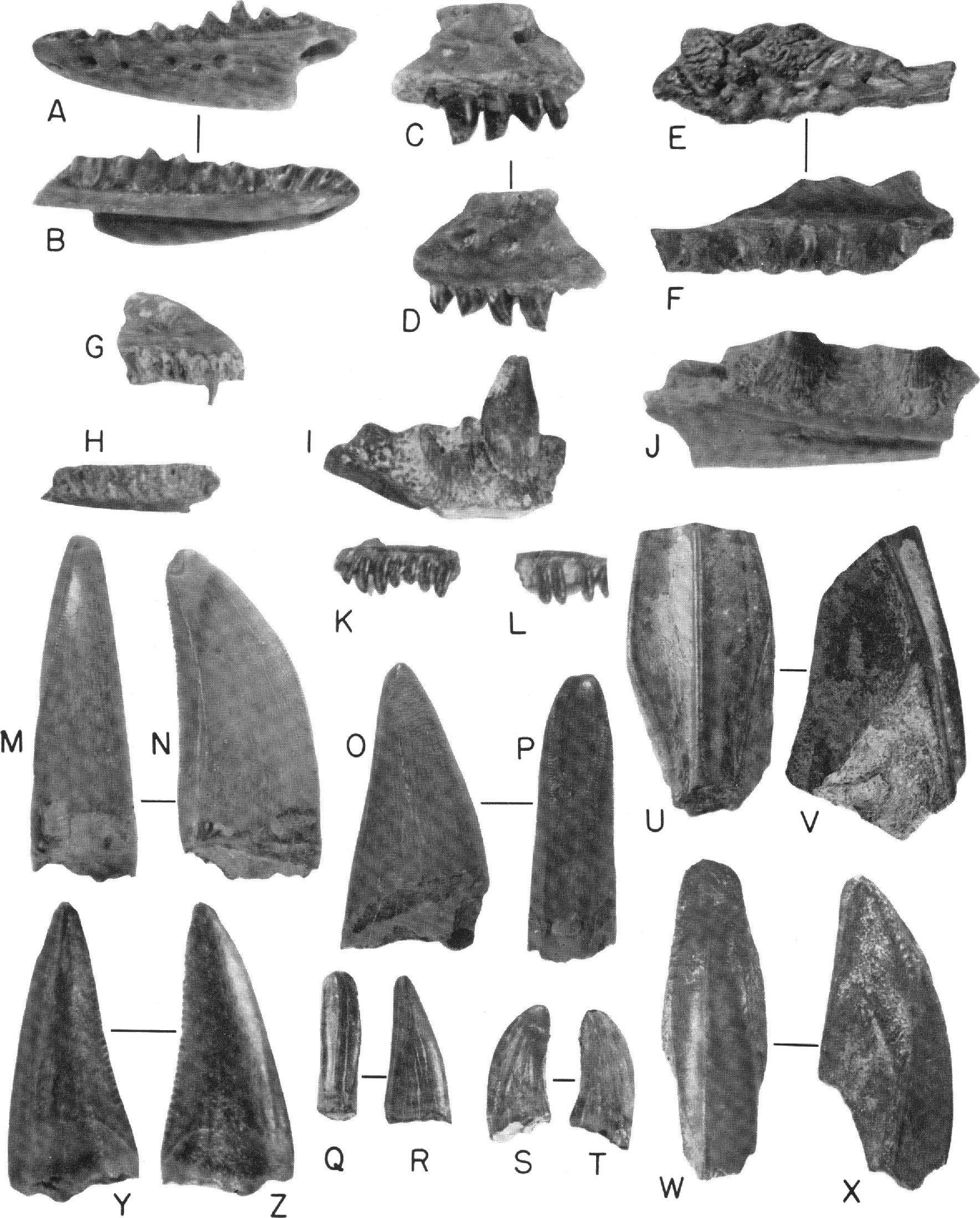
Figure 8 U, V
Sahni, Ashok (1972): The vertebrate Fauna of the Judith River formation, Montana. Bulletin of the American Museum of Natural History 147 (6): 319-416, DOI: 10.5281/zenodo.3382461, Hdl: http://hdl.handle.net/2246/1099
About a dozen teeth of a large flat-headed (hadrosaurine) ornithopod are present in the collections. AMNH 8525 consists of a crown (30 mm. long) making an obtuse angle of about 120 degrees with the fang (fig. 8 U, V). The teeth are similar in size and morphology to each other and appear to belong to a single species. The crown is diamond-shaped with a bluntly rounded apex. A distinct medial keel is present above the slightly concave lateral edges. No ornamentation is found on the sides or keel. These teeth are probably referable to Kritosaurus, the only flat-headed ornithopod to be reported from the Judith River Formation (Lull and Wright, 1942, p. 171). The species was originally described by Marsh (1889 a, p. 335) as Hadrosaurus breviceps, and later (Marsh, 1896 a, p. 224) as Trachodon breviceps. The systematic position of Hadrosaurus and Trachodon has been discussed at length by Sternberg (1936). Trachodon mirabilis seems to be more closely related to the crested lambeosaurines rather than to the flat-headed hadrosaurines. Sternberg (1936) has suggested that use of Trachodon mirabilis be abandoned. Lull and Wright (1942, p. 171) described and figured the dental battery of K. breviceps obtained from the Judith River Formation. The teeth recently collected probably belong to the same species. Comparison of K. breviceps with other species of Kritosaurus from the Oldman Formation is of little use as the Judith River material is still not sufficiently well known.
Sahni, Ashok (1972): The vertebrate Fauna of the Judith River formation, Montana. Bulletin of the American Museum of Natural History 147 (6): 319-416, DOI: 10.5281/zenodo.3382461, Hdl: http://hdl.handle.net/2246/1099
Hadrosaurus breviceps MARSH, 1889 a, p. 335. Trachodon breviceps: MARSH, 1896 a, p. 224.? Kritosaurus breviceps: LULL AND WRIGHT, 1942, p. 170.
Sahni, Ashok (1972): The vertebrate Fauna of the Judith River formation, Montana. Bulletin of the American Museum of Natural History 147 (6): 319-416, DOI: 10.5281/zenodo.3382461, Hdl: http://hdl.handle.net/2246/1099

Export occurrence data

Darwin Core Archive (ZIP)

CLASSIFICATION

Taxonomic Classification Tree

MULTIMEDIA

Media Files(1)

FIG. 8. A. Chamops segnis. AMNH 8486, labial view of left dentary. B. Lingual view. Both x 5. C. AMNH 8488, lingual view of left maxilla. D. Labial view. Both x 5. E. cf. Xenosauridae, AMNH 8498, labial view of left maxilla. F. Lingual view. Both x 5. G. Peltosaurus piger, AMNH 8495, lingual view of left maxilla, x 5. H. AMNH 8494, lingual view of right dentary, x 5. I. Paraderma bogerti, AMNH 8504, lingual view of right maxilla. x 5. J. Parasaniwa wyomingensis, AMNH 8499, lingual view of left dentary, x 5. K. Leptochamops denticulatus, AMNH 8491, lingual view of right maxilla, x 5. L. Exostinus lancensis, AMNH 8497, lingual view of right maxilla, x 5. M. Deinodon horridus, AMNH 8513, posterior view of isolated tooth. N. Lateral view. Both x 13. 0. AMNH 8515, lateral view of anterior dentary tooth. P. Posterior view. Both x 13. Q. AMNH 8514, posterior view of?premaxillary tooth. R. Lateral view. Both x 12. S. Paronychodon lacustris, AMNH 8522, lingual view of isolated tooth. T. Labial view. Both x 12. U. Kritosaurus cf. K. breviceps, AMNH 8525, lateral view of isolated tooth. V. Posterior view. Both x 1 2. W. Procheneosaurus altidens, AMNH 8527, labial view of isolated tooth. X. Anterior or posterior view. Both x 12. Y, Z.?Sebecosuchia, AMNH 8549, views of an solated tooth. Both x 10.

Imageimage/png© Sahni, AshokSahni, Ashok

IMAGES

Gallery(1)

See Gallery

Occurrences with images

Source Information

The vertebrate Fauna of the Judith River formation, Montana

checklist

This dataset contains the digitized treatments in Plazi based on the original journal article Sahni, Ashok (1972): The vertebrate Fauna of the Judith River formation, Montana. Bulletin of the American Museum of Natural History 147 (6): 319-416, DOI: 10.5281/zenodo.3382461, Hdl: http://hdl.handle.net/2246/1099

GEOLOGIC INVESTIGATION of the Late Cretaceous Judith River Formation in the area just north of the Judith River on the Missouri River in north-central Montana has resulted in the discovery of varied vertebrate forms. The beds are mainly freshwater continental deposits consisting of crossbedded channel sandstones, gray siltstones, and carbonaceous shales with occasional seams of lignitic coal. The stratigraphic sequence consists of the Marias River Shale overlain by the Eagle, Claggett, Judith River, and Bearpaw formations. The last four constitute the Montana Group. The Judith River Formation is Campanian in age as determined by its position between the fossiliferous marine Claggett and Bearpaw shales.

The fauna was obtained from the upper 50 feet of the formation. The bone concentration in the productive sandstone is the result of size sorting leading to underrepresentation of the larger dinosaurs. Three orders of mammals are represented, the Eutheria by a single genus, the Allotheria by five, and the Metatheria by at least three genera. Teiid and parasaniwid lizards are frequent. Only a fraction of the large number of described dinosaur genera, however, is represented in the collection by isolated teeth. Fish and amphibians form a sizable portion of the fauna.

Vertebrates from the Judith River Formation are more primitive than, but generally similar to, later Maestrichtian species. The mammals differ from their descendants in the Lance Formation at the species level. The community structure and the paleoecology of the fauna of the Judith River Formation resemble those of the Lance Formation. The greatest difference between the two communities is the greater variety of dinosaurs in the earlier formation.

Sahni A, plazi (1972). The vertebrate Fauna of the Judith River formation, Montana. Plazi.org taxonomic treatments database. Checklist dataset https://doi.org/10.5281/zenodo.3382461 accessed via GBIF.org on 2026-06-16.

CC0Published 12/31/1972View dataset
GBIF Usage Key
159397316
Dataset Key
fd03f669-c046-46cd-861a-6bf56b7fc989
Origin
source
Backbone Key
4823285
Taxon ID
1A7187CFFFC11776FEDFF65CE5535D56.taxon
Last Crawled
6/10/2026
Last Interpreted
6/10/2026