

Psalidothrips
Priesner, 1932
GBIF:159709321
ABOUT
Descriptions(1)
Key to Australian Psalidothrips
1. Pronotal aa well-developed, often twice as long as pronotal discal setae (Fig. 11)................................... 2 -. Pronotal aa minute, about as long as pronotal discal setae, or shorter (Fig. 7)..................................... 11 2. Pronotal am well-developed, longer than pronotal discal setae (Fig. 10).......................................... 3 -. Pronotal am minute or as long as pronotal discal setae (Fig. 7).................................................. 5
3. Vertex anteromedially with weakly or strongly net-like reticulation (Fig. 4); fore tarsal tooth present in male, absent in female...................................................................................... cecryphalus sp.n.
-. Vertex with sculpture only near posterior margin (Fig. 10); fore tarsal tooth absent in both sexes....................... 4
4. Antennal segment III without sense cones (or with one very small sense cone), tergites II–V each with one pair of well-developed median setae (Fig. 41); male sternite VIII with complete pore plate (Fig. 27); both sexes apterous... minantennus sp.n.
-. Antennal segment III usually with 0+1 or 0 1 +1 sense cones, tergites II–V median setae undeveloped, male pore plate on sternite VIII usually divided into two parts (Fig. 29), rarely complete................................ taylori Mound & Walker
5. Pelta eroded to small discrete sclerite separate from anterior margin of tergite II (Figs 41, 45, 46); male without fore tarsal tooth............................................................................................... 6
-. Pelta well developed and confluent with anterior margin of tergite II (Figs 38–40); male with or without fore tarsal tooth... 7
6. Antennal segment VIII broadly joined to VII; male sternite VIII with slender transverse pore plate (Fig. 28).... postlei sp.n.
-. Antennal segment VIII weakly constricted to base; male sternal pore plate comprising two small transverse lateral areas (cf. Fig. 29)............................................................................... greensladeae sp.n.
7. Antennal segment III wider than long, base of VIII not clearly narrower than apex of VII (Fig. 34) [tergite IX setae S1 longer than tube]................................................................................. platetus sp.n.
-. Antennal segment III clearly longer than wide (Figs 35, 37), VIII weakly or strongly narrower at base than VII at apex..... 8
8. Antennal segment III with 2 slender sense cones, VIII weakly narrowed to base.................................... 9
-. Antennal segment III with 1 sense cone, VIII sharply constricted at base........................................ 10
9. Head and pronotum equally light brown to yellow; male without fore tarsal tooth, and no pore plate on sternite VIII.................................................................................................. wellsae sp.n.
-. Head paler than pronotum; male with stout fore tarsal tooth, pore plate broadly transverse across sternite VIII (cf. Fig. 24)........................................................................................... daguilari sp.n.
10. Antennal segment IV sub-globose (Fig. 31) particularly in apterae; compound eyes of apterae with 4–10 (usually 6) facets (Fig. 3).................................................................................. brittoni sp.n. [in part]
-. Antennal segment IV more slender (Fig. 35) [macropterae not known]; compound eyes of apterae with 2 large and 1–2 small facets...................................................................................... trivius sp.n.
11. Antennal segment III with 3 sense cones.................................................................. 12
-. Antennal segment III with 1 or 2 sense cones.............................................................. 13
12. Antennal segments III–V yellow, VII–VIII brown; legs and abdomen yellow; mesopresternum with posterior margin entire........................................................................................... bipictus sp.n.
-. Antennal segments III–VIII almost uniformly brownish yellow; femora and abdomen brown; mesopresternum posterior margin weakly eroded and not confluent with anterior margin of mesoeusternum....................... gloriousi sp.n. [in part]
13. Head dark brown contrasting with yellowish pronotum and pale abdomen (Figs 2, 3, 15)............................ 14
-. Head and pronotum not strongly differing in colour (Fig. 7)................................................... 15
14. Mesopresternum complete, both sexes macropterous; tergites each with 2 pairs of wing-retaining setae (Fig. 39).. verus sp.n.
-. Mesopresternum almost absent, including in macropterae; females macropterous and apterous, males apterous; tergites with one only pair of wing-retaining setae (cf. Fig. 40)............................................ brittoni sp.n. [in part]
15. Mid and hind tibiae yellow in contrast to dark brown femora; fore wing with 4–5 duplicated cilia.... gloriousi sp.n. [in part]
-. Mid and hind tibiae and femora similar in colour, usually yellowish; fore wing either with no more than 4 duplicated cilia or with none at all [macropterae or apterae].................................................................. 16
16. Apterae with compound eyes multifaceted with about 25 facets (Fig. 5), macropterae not known [male with transverse pore plate]....................................................................................... howei sp.n.
-. Apterae with compound eyes reduced to 10 facets or less (Fig. 13)............................................. 17
17. Sternite VIII of male with small oval pore plate medially (Fig. 25); macropterae with 2–4 duplicated cilia on fore wing............................................................................................. driesseni sp.n.
-. Male with pore plate transverse fully across sternite VIII (Fig. 30); macropterae with no duplicated cilia on fore wing.................................................................................................. tritus sp.n.
Export occurrence data
Darwin Core Archive (ZIP)
CLASSIFICATION
Taxonomic Classification Tree

MULTIMEDIA
Media Files(4)
FIGURES 1–9. Psalidothrips species, head & pronotum. (1) bipictus; (2) brittoni macropterous female; (3) brittoni apterous male; (4) cecryphalus holotype; (5) howei; (6) driesseni male; (7) gloriousi; (8) daguilari; (9) greensladeae.

FIGURES 10–18. Psalidothrips species, head & pronotum. (10) minantennus; (11) postlei; (12) trivius; (13) tritus holotype; (14) tritus macropterous female; (15) verus; (16) trivius male; (17) wellsae holotype; (18) wellsae apterous female.
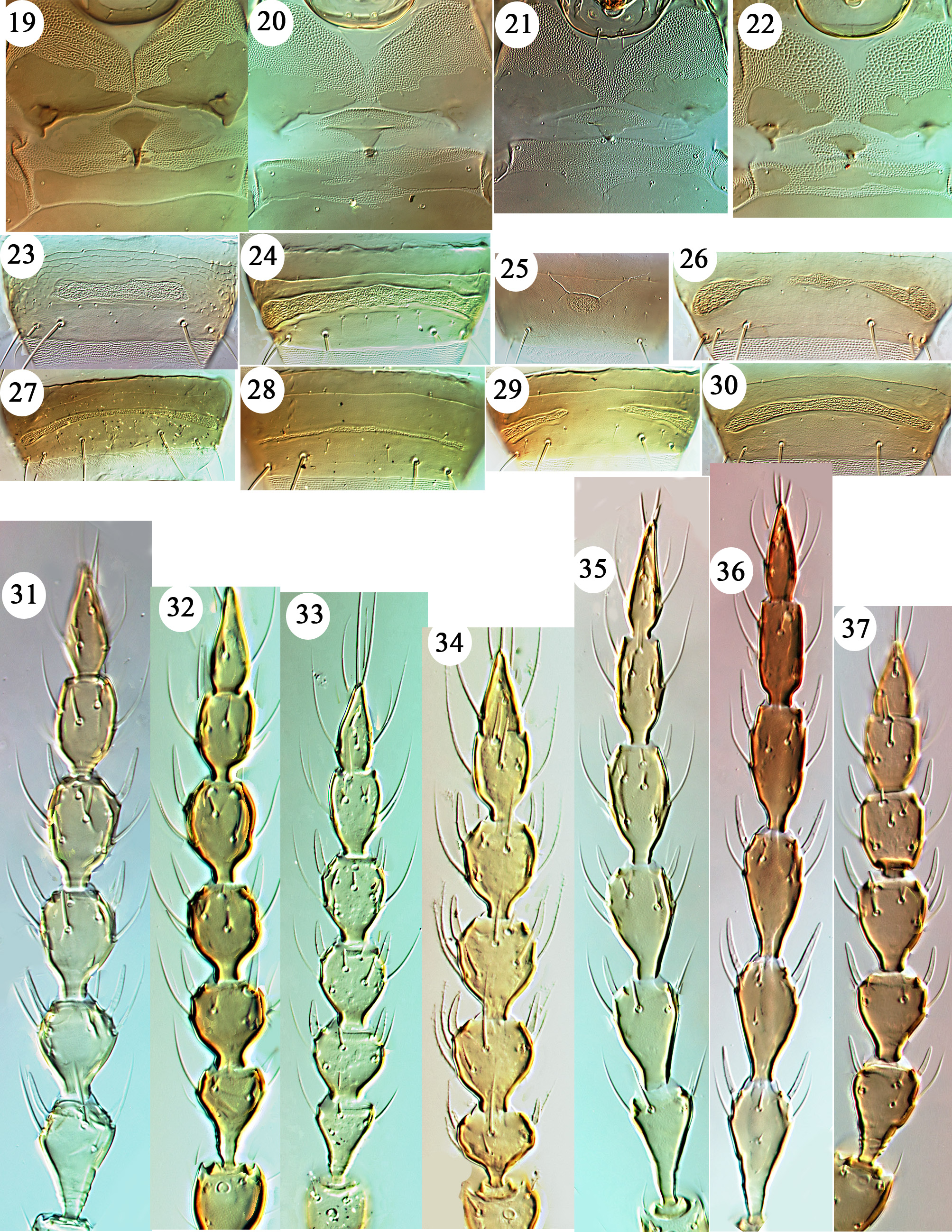
FIGURES 19–37. Psalidothrips species. Mesopresternum 19–22 (19) gloriousi; (20) driesseni macroptera; (21) driesseni aptera; (22) howei. Male pore plate 23–30 (23) brittoni; (24) cecryphalus; (25) driesseni; (26) howei; (27) minantennus; (28) postlei; (29) taylori; (30) tritus. Antennae 31–37 (31) brittoni; (32) cecryphalus; (33) minantennus; (34) platetus; (35) trivius; (36) verus; (37) wellsae.

FIGURES 38–49. Psalidothrips species tergites. Pelta & tergites II–III 38–43 (38) gloriousi macroptera; (39) verus macroptera; (40) tritus macroptera; (41) minantennus aptera;(42) howei aptera; (43) wellsae aptera. Pelta 44–46 (44) brittoni; (45) greensladeae; (46) postlei. Tergites & tube 47–49 (47) bipictus; (48) daguilari; (49) greensladeae.
IMAGES