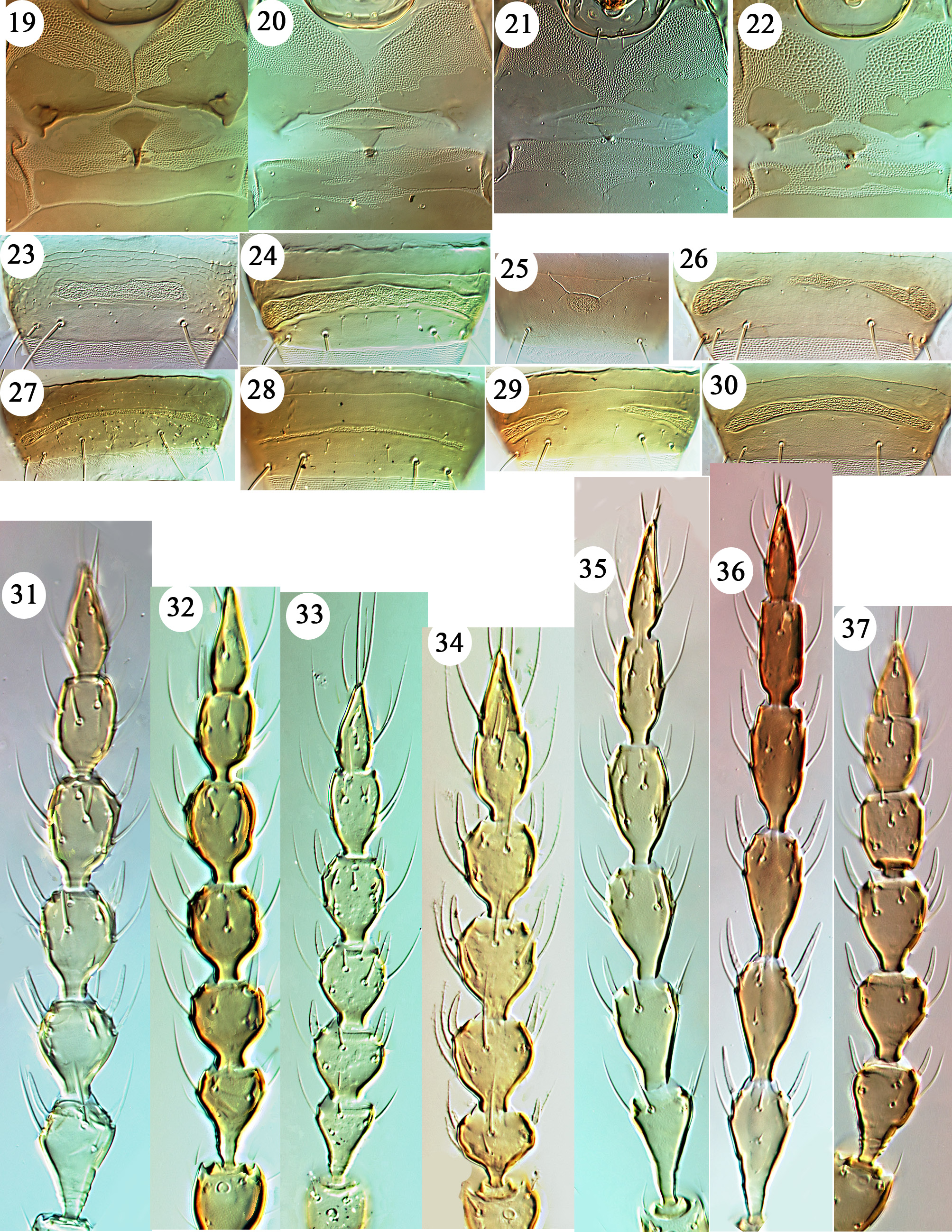
(Figs 2, 3, 23, 31, 44) Female macroptera. Body bicoloured, head brown, pterothorax and tergite II brown laterally, pronotum and abdomen largely yellow, tube pale brown; legs and antennal segments III – VII yellow, I and VIII weakly shaded brown. Head without sculpture, postocellar setae as long as posterior ocelli, compound eyes multifacetted; postocular setae long, weakly capitate; maxillary stylets wide apart, V-shaped in position, retracted about half way to postocular setae (Fig. 2). Antennal segment III with one sense cone, IV with two sense cones, III – VIII each with pedicel; segment III longer than IV, VIII longer than VII. Pronotum without sculpture, with weak median longitudinal line; setae ml, epim and pa well-developed, weakly capitate; aa variable, minute to longer than postocellar setae; am minute. Meso and metanota without sculpture medially. Mesopresternum reduced to pair of lateral irregular sclerites, mesoeusternal anterior margin weakly concave. Fore tarsal tooth absent. Fore wing narrowed medially, with two pairs of minute sub-basal setae, no duplicated cilia. Pelta faintly sculptured at anterior, with small lobes (Fig. 44); tergites almost unsculptured; tergites III – VII with one pair of large sigmoid wing-retaining setae, these setae on II weaker; median setae on II – VIII small; VIII with major setae S 1 capitate; tergite IX setae S 1 longer than tube and acute; anal setae as long as tube. Sternites with 3 to 5 pairs of small discal setae. Measurements (holotype female in microns). Body length 2040. Head, length 173; width 162; postocular setae 60, distance between their bases 136; postocellar setae 16, distance between their bases 43; post ocelli diameter 15. Pronotum, length 133; median width 213; major setae am 5, aa 18, ml 53, epim 68, pa 85. Fore wing sub-basal setae, S 1 17, S 2 10, S 3 9, S 4 9. Tergite IV median marginal setae 102, tergite VIII median setae 68, tergite IX setae S 1 182, S 2 171. Tube length 162; anal setae 162. Antennal segments III – VIII length 53, 44, 46, 51, 43, 51. Female aptera. Similar to macroptera but extensively yellow apart from brown head; compound eyes usually with 6 facets, ocelli absent; postocular setae long; pronotal aa setae usually very small; tergal wing-retaining setae straight to weakly sigmoid. Measurements (in microns). Body length 1979. Head, length 171; width 162; postocular setae 97, postocellar setae 16. Pronotum, length 153; median width 238; major setae am 6, aa 43, ml 75, epim 75, pa 95. Tergite IX setae S 1 195, S 2 179. Tube length 163. Antennal segments III – VIII length 53, 46, 48, 49, 48, 49. Male aptera. Similar to female aptera but head slightly paler (Fig. 3); mesopresternum absent; wing-retaining setae straight; fore tarsus with prominent tooth; sternite VIII pore plate transverse, about half of sternite width (Fig. 23). Measurements (in microns). Body length 1632. Head, length 158; width 139; postocular setae 68, postocellar setae 9. Pronotum, length 122; median width 199; major setae am 6, aa 26, ml 51, epim 54, pa 77. Tergite IX setae S 1 143, S 2 78. Tube length 128. Antennal segments III – VIII length 41, 34, 39, 39, 34, 42. Specimens studied. Holotype female macroptera, Tasmania, Southwest National Park, Olga, moss in rain forest, 18. ii. 1977 (C. Howard), in ANIC. Paratypes: 8 female macropterae, 6 males collected with holotype; 1 female aptera, 1 male from same site and collector, 4. ii. 1976. Tasmania, Trenah Bridge 3 female apterae, 1 male from litter of Eucalyptus delegarensis, 2. vii. 1974; Salmon River, 2 female apterae from litter of Eucalyptus obliqua, 29. xi. 1974; Huon Valley, 1 female aptera, 29. v. 2001, 1 female macroptera, 17. i. 2002. New South Wales, Clyde Mt., 1 female aptera, 1 male, from leaf mould, 4. xii. 1967. Non-paratypes: New South Wales, Dorrigo National Park, 1 female aptera in rainforest litter, 5. ix. 1967. Queensland, Cooloola, 1 male in litter, 23. vi. 1977.
Wang, Jun, Mound, Laurence A., Tree, Desley J. (2019): Leaf-litter thrips of the genus Psalidothrips (Thysanoptera, Phlaeothripidae) from Australia, with fifteen new species. Zootaxa 4686 (1): 53-73, DOI: 10.11646/zootaxa.4686.1.2