AnimaliaNot EvaluatedacceptedspeciesAccepted
Psalidothrips driesseni

Psalidothrips driesseni

Wang, Mound & Tree, 2019

GBIF:159709328

0year

ABOUT

Descriptions(2)

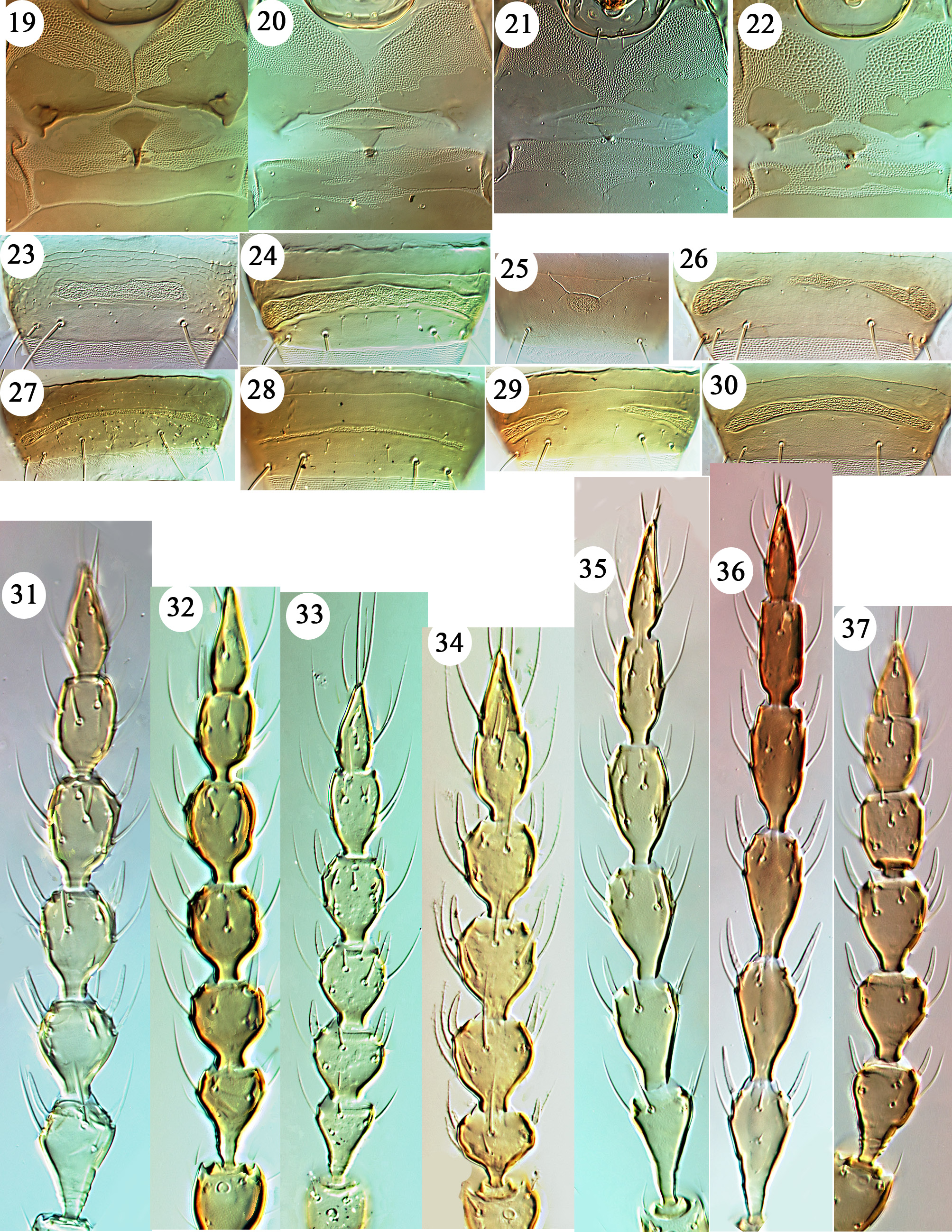
(Figs 6, 20, 21, 25) Female macroptera. Body light brown, head darkest, tube yellow; femora light brown, tibiae and tarsi yellow; antennal segments I – II shaded with brown, III yellow on basal half but III – VIII gradually darkened; fore wing weakly shaded. Head without sculpture, genae constricted behind eyes and narrowed to base; compound eyes multifacetted; postocular setae shorter than dorsal eye length; ocelli present, postocellar setae minute; maxillary stylets two-thirds of head width apart, retracted about half way to postocular setae (Fig. 6). Antennal segment III with 2 sense cones, IV with 2 or 3 sense cones; III – VII each with pedicel, VIII slender and narrowed to base; segment III longer than IV, VIII longer than VII. Pronotum without sculpture; setae ml, epim and pa long and acute, aa and am minute. Mesonotum with weak transverse reticulation; metanotum not sculptured. Mesopresternum transverse with posterior margin eroded (Fig. 20). Fore tarsal tooth absent. Fore wing with sub-basal setae minute, 2 – 4 duplicated cilia present. Pelta with small lobes, recessed into anterior margin of tergite II; tergites II – VII with two pairs of wing-retaining setae but anterior pair on each tergite straight; tergites II – VII median setae minute; tergite IX setae S 1 shorter than tube, anal setae shorter than tube. Measurements (holotype female in microns). Body length 1734. Head, length 211; width 192; postocular setae 63, distance between their bases 158; postocellar setae 22, distance between their bases 77. Pronotum, length 153; median width 247; major setae am 9, aa 6, ml 34, epim 49, pa 65. Fore wing sub-basal setae S 1 9, S 2 9, S 3 14. Tergite IV median marginal setae 71; tergite VIII median setae 60, tergite IX setae S 1 119, S 2 128. Tube length 146; anal setae 153. Antennal segments III – VIII length 66, 53, 56, 57, 46, 51. Male aptera. Compound eyes each with 8 – 10 facets; ocelli almost absent; sense cones on segment III small and thin; pronotum with a median longitudinal line; mesopresternum absent (Fig. 21), mesoeusternal anterior margin eroded; fore tarsal tooth longer than half tarsal width; sternite VIII with small oval pore plate about 35 microns wide (Fig. 25); tergite IX setae S 2 shorter and slightly stouter than S 1. Measurements (in microns). Body length 1734. Head, length 163; width 162; postocular setae 37, postocellar setae 17. Pronotum, length 138; median width 221; major setae am 6, aa 7, ml 17, epim 44, pa 45. Metanotum median setae 19. Tergite VIII median setae 37. Tergite IX setae S 1 90, S 2 56. Tube length 105; anal setae 136. Antennal segments III – VIII length 56, 44, 46, 48, 37, 43. Specimens studied. Holotype femalemacroptera, Tasmania, Lake Pedder, Condominium Creek, in pitfall trap, ii – iii. 2004 (M. Driessen), in ANIC. Paratypes: from pitfall traps on same dates at same locality, White Spur, 1 male; McPartlan Pass, 2 female macropterae, 1 male, 1 female apterae; Huon Valley, 1 male, 1 female aptera from dead wood, 29. v. 2001.
Wang, Jun, Mound, Laurence A., Tree, Desley J. (2019): Leaf-litter thrips of the genus Psalidothrips (Thysanoptera, Phlaeothripidae) from Australia, with fifteen new species. Zootaxa 4686 (1): 53-73, DOI: 10.11646/zootaxa.4686.1.2

Comments. Although probably related to tritus, the size and number of sense cones on antennal segments III – IV are remarkably variable in this species. Two macropterae have three sense cones on segment IV of one antenna, but only two on the other antenna. Similarly, in apterae the sense cones on segment III are very small, and sometimes only the one on the external margin is developed. The fore wing of macropterae bears a few duplicated cilia, but the anterior pair of wing-retaining on each tergite is small and straight. These specimens probably faded in colour before being removed from the pitfall traps with which they were collected.
Wang, Jun, Mound, Laurence A., Tree, Desley J. (2019): Leaf-litter thrips of the genus Psalidothrips (Thysanoptera, Phlaeothripidae) from Australia, with fifteen new species. Zootaxa 4686 (1): 53-73, DOI: 10.11646/zootaxa.4686.1.2

Export occurrence data

Darwin Core Archive (ZIP)

CLASSIFICATION

Taxonomic Classification Tree

MULTIMEDIA

Media Files(2)

FIGURES 1–9. Psalidothrips species, head & pronotum. (1) bipictus; (2) brittoni macropterous female; (3) brittoni apterous male; (4) cecryphalus holotype; (5) howei; (6) driesseni male; (7) gloriousi; (8) daguilari; (9) greensladeae.

Imageimage/png© Wang, Jun;Mound, Laurence A.;Tree, Desley J.Wang, Jun;Mound, Laurence A.;Tree, Desley J.

FIGURES 19–37. Psalidothrips species. Mesopresternum 19–22 (19) gloriousi; (20) driesseni macroptera; (21) driesseni aptera; (22) howei. Male pore plate 23–30 (23) brittoni; (24) cecryphalus; (25) driesseni; (26) howei; (27) minantennus; (28) postlei; (29) taylori; (30) tritus. Antennae 31–37 (31) brittoni; (32) cecryphalus; (33) minantennus; (34) platetus; (35) trivius; (36) verus; (37) wellsae.

Imageimage/png© Wang, Jun;Mound, Laurence A.;Tree, Desley J.Wang, Jun;Mound, Laurence A.;Tree, Desley J.

IMAGES

Gallery(2)

See Gallery

Occurrences with images

Source Information

Leaf-litter thrips of the genus Psalidothrips (Thysanoptera, Phlaeothripidae) from Australia, with fifteen new species

checklist

This dataset contains the digitized treatments in Plazi based on the original journal article Wang, Jun, Mound, Laurence A., Tree, Desley J. (2019): Leaf-litter thrips of the genus Psalidothrips (Thysanoptera, Phlaeothripidae) from Australia, with fifteen new species. Zootaxa 4686 (1): 53-73, DOI: 10.11646/zootaxa.4686.1.2

Abstract

A key is given to 16 Psalidothrips species known from Australia. In contrast to members of this genus from other parts of the world, most of these species show a strong tendency toward wing loss, with associated character states, also remarkable reduction in sclerotisation of the thoracic sclerites. Character state variation is discussed, and 15 new species are described and illustrated: P. bipictus sp.n., P. brittoni sp.n., P. cecryphalus sp.n., P. daguilari sp.n., P. driesseni sp.n., P. gloriousi sp.n., P. greensladeae sp.n., P. howei sp.n., P. minantennus sp.n., P. platetus sp.n., P. postlei sp.n., P. tritus sp.n., P. trivius sp.n., P. verus sp.n. and P. wellsae sp.n.

Wang J, Mound L A, Tree D J, plazi (2019). Leaf-litter thrips of the genus Psalidothrips (Thysanoptera, Phlaeothripidae) from Australia, with fifteen new species. Plazi.org taxonomic treatments database. Checklist dataset https://doi.org/10.11646/zootaxa.4686.1.2 accessed via GBIF.org on 2026-06-15.

CC0Published 10/14/2019View dataset
GBIF Usage Key
159709328
Dataset Key
000a7240-3d12-4025-aa65-16abe083cea0
Origin
source
Backbone Key
10882657
Taxon ID
0394E94CFF8A5C54FF30FEFA1B79F90C.taxon
Last Crawled
6/10/2026
Last Interpreted
6/10/2026