AnimaliaNot EvaluatedacceptedspeciesAccepted
Acherontides serrasapoensis

Acherontides serrasapoensis

Araujo De Lima, Stievano & Zeppelini, 2019

GBIF:159841316

0year

ABOUT

Descriptions(7)

Coordinates Sites Al HP R A HE Date Collectors CN
Araujo De Lima, Estevam C., Stievano, Luis Carlos, Zeppelini, Douglas (2019): A new species of Acherontides (Collembola: Hypogastruridae) from Brazil, with an identification key. Zootaxa 4623 (1): 141-150, DOI: 10.11646/zootaxa.4623.1.9

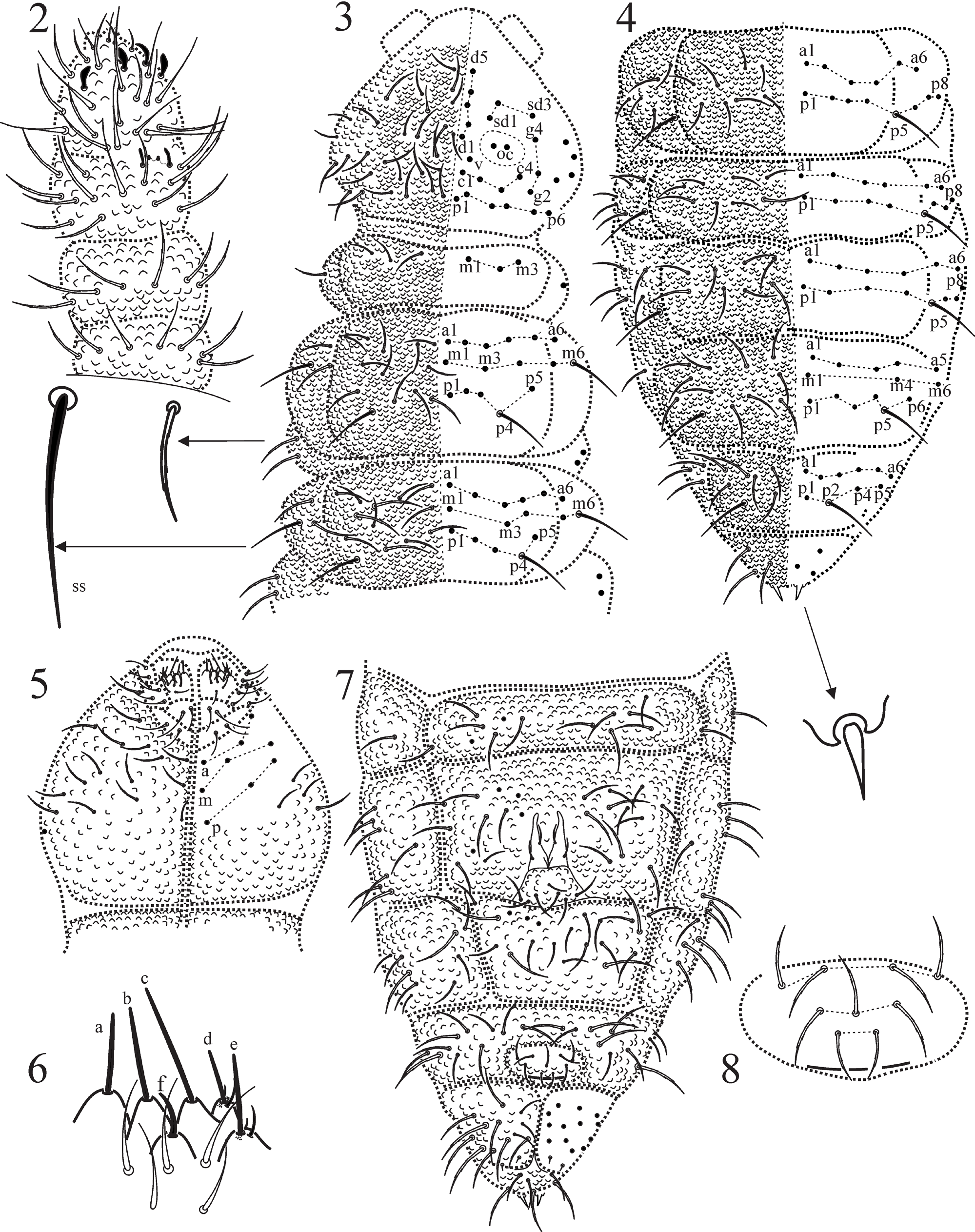
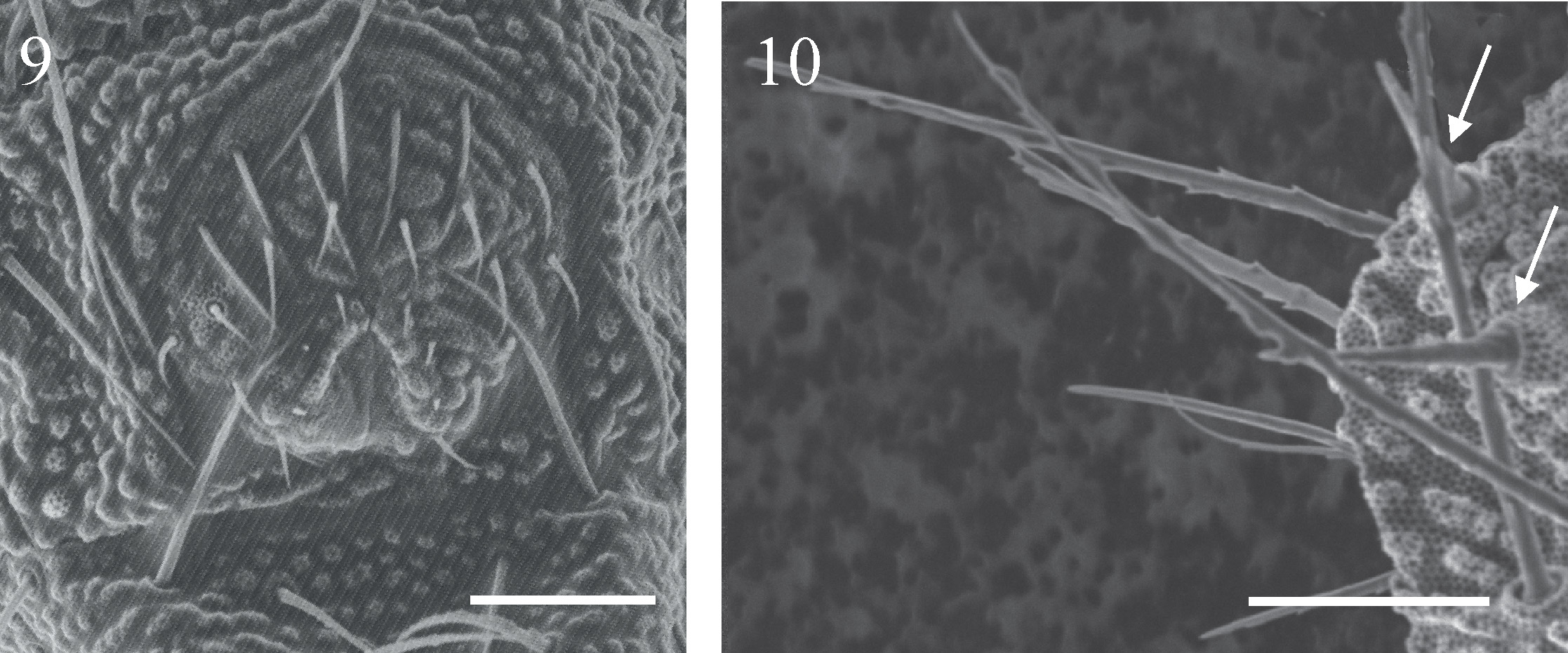
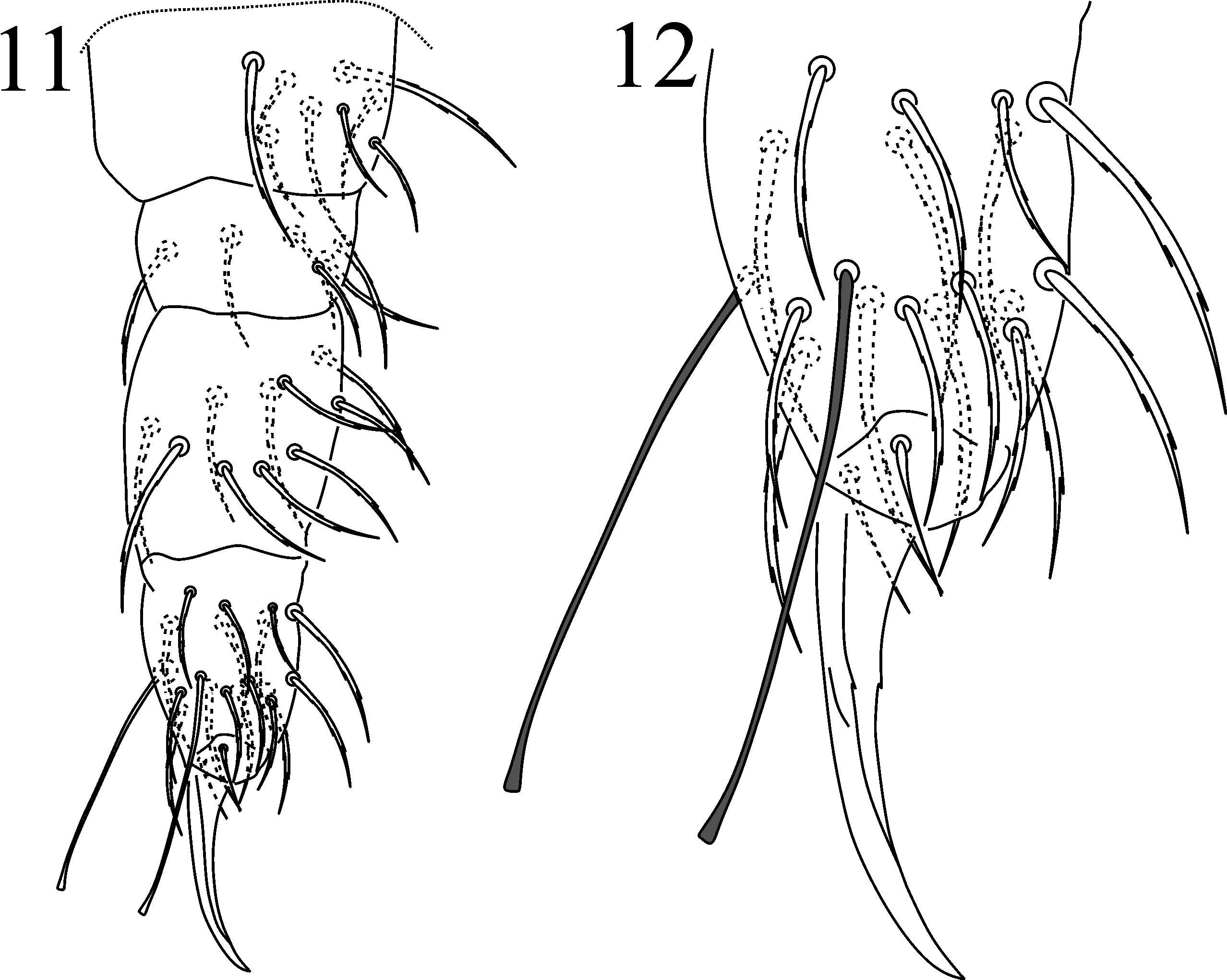
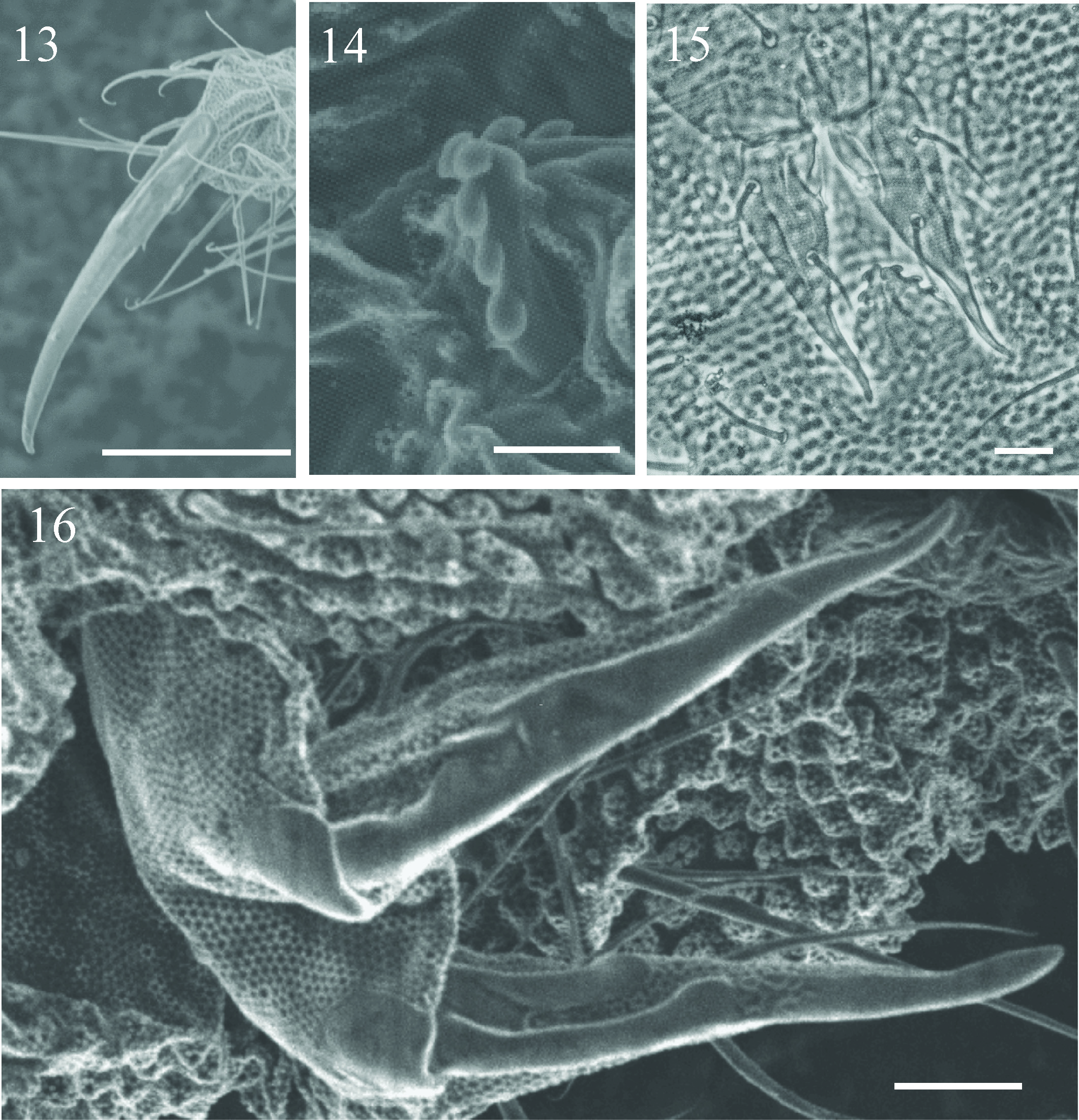
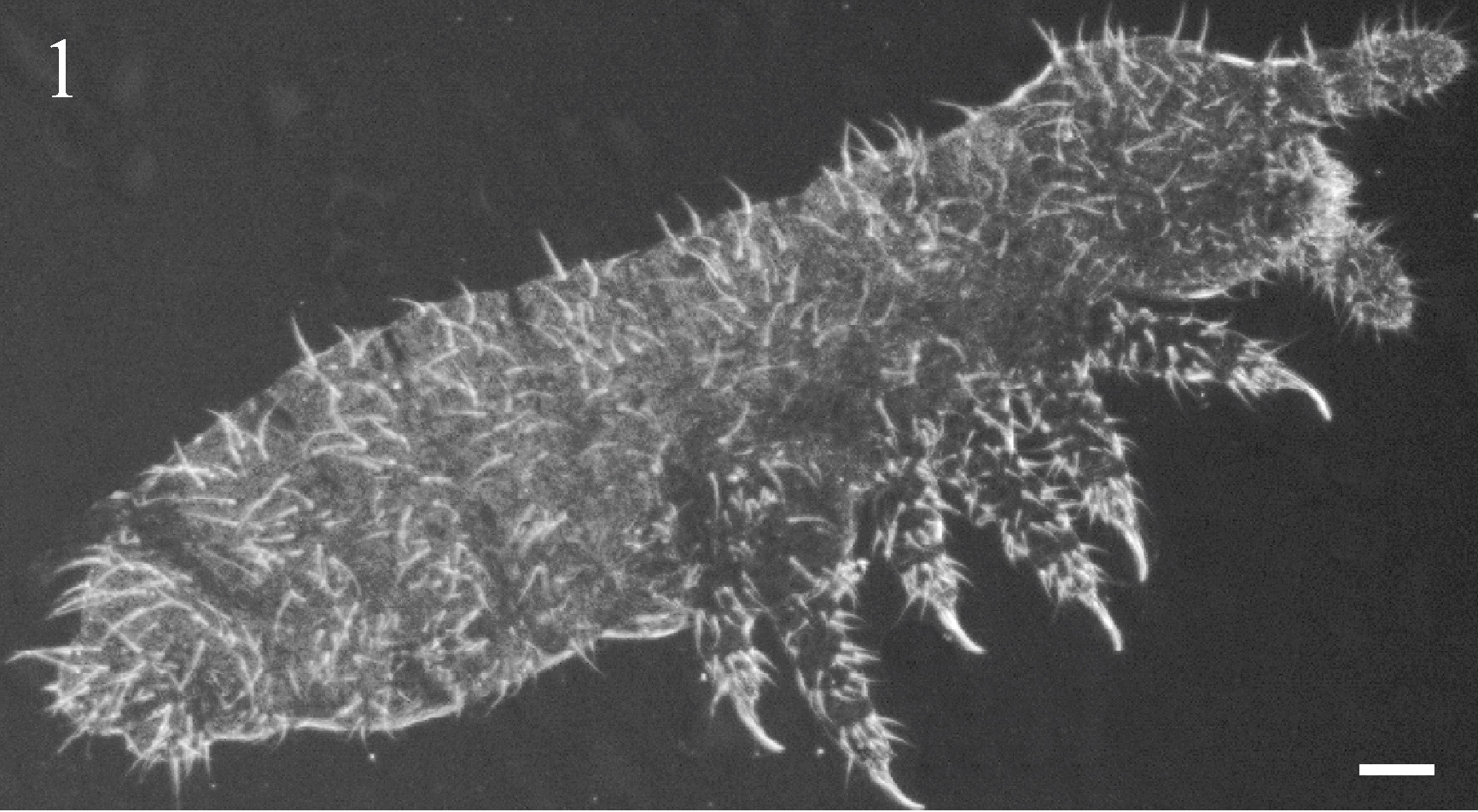
Description. Habitus. Typical to the genus (Fig. 1); body length 1200 µm (n = 10), holotype measurements as in Table 2; integument granulation strong; body with coarsely serrated chaetae and longer and fine sensory chaetae; color white when alive and in alcohol. Antenna. Ant. I with 7 dorsal chaetae; Ant. II with 12; Ant. III with 16 chaetae, sense O. with two free clubshaped microsensilla, not covered by tegumentary fold; two long guard sensilla (sgd and sgv) of same shape and size, and one ventral microsensillum. Ant. IV with 1 dorsal sensillum, 3 dorsolateral sensilla, 1 micro-sensillum, and simple apical vesicle (Fig. 2). Head. Eyes and PAO. absent. Dorsal chaetotaxy of head, Th. and Abd. Head with two chaetae in the ocular area; Th. I with 3 dorsal chaetae per side and 1 lateral; Th. II and III (Fig. 3), and Abd. IV with 3 rows of dorsal chaetae; Abd. I – III and V – VI with 2 rows of chaetae (Fig. 4). Ventral chaetotaxy of head, Th. and Abd. I. Head with 9 chaetae along mid-line (Fig. 5); Th. I without chaetae, Th. II and III with 1 + 1 chaetae; ventral tube with 4 + 4 chaetae; Abd. I without chaetae. Mouthparts. Labial palp presents 3 main papillae (a – c), plus 2 lateral papillae (d – e) with 2 chaeta each, m (f) being smaller than others, base of the palp presents 5 proximal chaetae (Fig. 6). Labrum with 4 anterior, 5 medial and 5 posterior chaetae. Ventral chaetotaxy of Abd. II – VI. Abd. II with 7 + 7 chaetae; Abd. III with 9 + 9 chaetae. Abd. IV and V with about 10 + 10 chaetae; Each anal valve with 13 regular + 2 hr chaetae (Fig. 7). Genital plates and anal spines. Genital plate of female with 2 + 2 pregenital chaetae, 3 circumgenital chaetae and 2 eugenital chaetae (Fig. 8). Genital plate of male with 9 pregenital chaetae, 7 circumgenital chaetae and 2 eugenital chaetae (Fig. 9). Anal spines, about 1 / 3 length of unguis III (Fig. 10). Legs. Chaetotaxy from I to III: coxae 4,9,10; trochanters 5,5,5; femora 12,12,10 – 12; Tita 19,19,18; pre-tarsi 2,2,2; tenent hairs clavate; pre-tarsal chaetae of same length in all legs; unguis thin, slightly bending, with a paired proximal ventral tooth, and unguiculus lacking (Figs. 12 – 14). Ratio Tita / unguis = 1: 0.84. Furca. Manubrium with 3 + 3. Mucro and dens fused, with 2 basal, dorsal chaetae; tenaculum with 3 + 3 teeth, without chaetae on corpus (Figs. 15 – 17).
Araujo De Lima, Estevam C., Stievano, Luis Carlos, Zeppelini, Douglas (2019): A new species of Acherontides (Collembola: Hypogastruridae) from Brazil, with an identification key. Zootaxa 4623 (1): 141-150, DOI: 10.11646/zootaxa.4623.1.9
Figures 1 – 16, Tables 1 – 3 urn: lsid: zoobank. org: act: 736 D 3 A 76 - AE 62 - 40 FA-B 0 C 4 - 760 F 451311 B 2
Araujo De Lima, Estevam C., Stievano, Luis Carlos, Zeppelini, Douglas (2019): A new species of Acherontides (Collembola: Hypogastruridae) from Brazil, with an identification key. Zootaxa 4623 (1): 141-150, DOI: 10.11646/zootaxa.4623.1.9
Diagnosis. The new species has Ant. I with 7 chaetae, 2 chaetae in ocular area, unguis with a paired proximal tooth, tenaculum with 3 + 3, two clavate tenent hairs, anal spines about 1 / 3 length of unguis III.
Araujo De Lima, Estevam C., Stievano, Luis Carlos, Zeppelini, Douglas (2019): A new species of Acherontides (Collembola: Hypogastruridae) from Brazil, with an identification key. Zootaxa 4623 (1): 141-150, DOI: 10.11646/zootaxa.4623.1.9
Discussion. The new species clearly differs from A. atoyacensis, A. juxtlahuacaensis, A. pappogeomysae, A. bullock, A. tanasachie, A. peruensis and A. huetheri because of its furca morphology (developed vs reduced furca). A. serrasapoensis sp. nov. is similar A. potosinus, A. spinus, and A. eleonorae based on the mucro and dens fused in a mucrodens with 2 basal dorsal chaetae. However, it differs from A. potosinus by the number of chaetae in the ocular area, and by tenaculum teeth (2 + 2 vs 3 + 3 chaetae, and 3 + 3 vs 2 + 2 teeth, respectively). A. serrasapoensis sp. nov. can be easily differentiated from A. spinus since it does not have Abd. VI with 10 heavy spine-like chaetae in addition to anal spines. A. serrasapoensis sp. nov. shares many characteristics with A. eleonorae such as 2 + 2 chaetae in the ocular area, and furca morphology, but differs from Ant. I having seven instead of six chaetae; clavate tenent hairs vs acuminate; and anal spines about 1 / 3 length of unguis III vs thin anal spines, about 1 / 5 length of unguis III. For a comparison of the morphological characteristics of all Acherontides species; see Table 3. It was observed same variation on Th. I, exceptionally presenting 4 + 4 or 3 + 4 instead 3 + 3 chaetae, manubrium 3 + 3 plus a medial instead 3 + 3 chaetae, femora III 12 instead 10 chaetae and on tenaculum which may present 3 + 4 instead 3 + 3 teeth.
Araujo De Lima, Estevam C., Stievano, Luis Carlos, Zeppelini, Douglas (2019): A new species of Acherontides (Collembola: Hypogastruridae) from Brazil, with an identification key. Zootaxa 4623 (1): 141-150, DOI: 10.11646/zootaxa.4623.1.9
Etymology. Species name is derived from the type locality, Serra do Sapo, which means “ the frog mountain range ”.
Araujo De Lima, Estevam C., Stievano, Luis Carlos, Zeppelini, Douglas (2019): A new species of Acherontides (Collembola: Hypogastruridae) from Brazil, with an identification key. Zootaxa 4623 (1): 141-150, DOI: 10.11646/zootaxa.4623.1.9
Type material. Holotype female on slide, Brazil, MG, Conceição do Mato Dentro (18 ° 56 ’ 8 ” S; 43 ° 24 ’ 43 ” W), CSS- 09 iron cave, 20 Jul. – 06 Aug. 2015, Carste team leg., deposited at the CRFS-UEPB # 9020. Paratypes: 1 male on slide, (# 9026 CRFS-UEPB), Brazil, MG, Conceição do Mato Dentro (18 ° 55 ’ 1 ” S; 43 ° 25 ’ 40 ” W), CSS- 06 iron cave, 20 Jul. – 06 Agu. 2015 Carste team leg., deposited at MN / UFRJ. 1 female on slide (# 9315 CRFS-UEPB), Brazil, MG, Conceição do Mato Dentro (18 ° 55 ’ 1 ” S; 43 ° 25 ’ 40 ” W), CSS- 06 iron cave, 20 Jul. – 06 Aug. 2015 Carste team leg., deposited at LESM-UNAM. 1 male on slide (# 9025 CRFS-UEPB), Brazil, MG, Conceição do Mato Dentro (18 ° 55 ’ 1 ” S; 43 ° 25 ’ 40 ” W), CSS- 06 iron cave, 20 Jul. – 06 Aug. 2015 Carste team leg., deposited at MZUSP. 1 male and 1 female on slides, 11 – 29 Jan. 2019 other data as holotype, deposited at the CRFS- UEPB # 7334, 7339; Additional material and details of the type material see Table 1.
Araujo De Lima, Estevam C., Stievano, Luis Carlos, Zeppelini, Douglas (2019): A new species of Acherontides (Collembola: Hypogastruridae) from Brazil, with an identification key. Zootaxa 4623 (1): 141-150, DOI: 10.11646/zootaxa.4623.1.9

Export occurrence data

Darwin Core Archive (ZIP)

CLASSIFICATION

Taxonomic Classification Tree

MULTIMEDIA

Media Files(5)

FIGURE 1. Acherontides serrasapoensis sp. nov. Habitus under glass slides in Hoyer’s medium, photograph with optical microscope, scale bar: 40 µm.

Imageimage/png© Araujo De Lima, Estevam C.;Stievano, Luis Carlos;Zeppelini, DouglasAraujo De Lima, Estevam C.;Stievano, Luis Carlos;Zeppelini, Douglas

FIGURES 2–8. Acherontides serrasapoensis sp. nov. 2, dorsal chaetotaxy of left antenna; 3, dorsal chaetotaxy of head and Th. I–III; 4, dorsal chaetotaxy of Abd. I–VI; 5, ventral chaetotaxy of head; 6, labial palp; 7, ventral chaetotaxy of Abd. II–VI; 8, female genital chaetotaxy.

Imageimage/png© Araujo De Lima, Estevam C.;Stievano, Luis Carlos;Zeppelini, DouglasAraujo De Lima, Estevam C.;Stievano, Luis Carlos;Zeppelini, Douglas

FIGURES 9–10. Acherontides serrasapoensis sp. nov. Scanning electronic microscope (photos). 9, male genital; 10, anal spines, and Abd. VI chaetae. Scale bars: 20 µm.

Imageimage/png© Araujo De Lima, Estevam C.;Stievano, Luis Carlos;Zeppelini, DouglasAraujo De Lima, Estevam C.;Stievano, Luis Carlos;Zeppelini, Douglas

FIGURES 11–12. Acherontides serrasapoensis sp. nov. 11, leg III; 12; details of unguis teeth and clavate tenent hairs.

Imageimage/png© Araujo De Lima, Estevam C.;Stievano, Luis Carlos;Zeppelini, DouglasAraujo De Lima, Estevam C.;Stievano, Luis Carlos;Zeppelini, Douglas

FIGURES 13­–16. Acherontides serrasapoensis sp. nov. Scanning electronic microscope (photos 13–14 and 16) and contrast face microscope (photo 15). 13, unguis, details of a pair of median ventral teeth; 14, tenaculum with 4+3 teeth; 15; dorsal furca and tenaculum with 3+3 teeth; 16, lateral view of ventral furca;. Scale bars: 20 µm.

Imageimage/png© Araujo De Lima, Estevam C.;Stievano, Luis Carlos;Zeppelini, DouglasAraujo De Lima, Estevam C.;Stievano, Luis Carlos;Zeppelini, Douglas

IMAGES

Gallery(5)

See Gallery

Occurrences with images

Source Information

A new species of Acherontides (Collembola: Hypogastruridae) from Brazil, with an identification key

checklist

This dataset contains the digitized treatments in Plazi based on the original journal article Araujo De Lima, Estevam C., Stievano, Luis Carlos, Zeppelini, Douglas (2019): A new species of Acherontides (Collembola: Hypogastruridae) from Brazil, with an identification key. Zootaxa 4623 (1): 141-150, DOI: 10.11646/zootaxa.4623.1.9

Abstract

A second species of Acherontides from Brazil is described. Acherontides serrasapoensis sp. nov. has two ocular area chaetae, tenaculum with 3+3, two clavate tenent hairs, and anal spines about 1/3 the length of unguis III. A comparative table is presented and an identification key for the species of Acherontides.

Araujo De Lima E C, Stievano L C, Zeppelini D, plazi (2019). A new species of Acherontides (Collembola: Hypogastruridae) from Brazil, with an identification key. Plazi.org taxonomic treatments database. Checklist dataset https://doi.org/10.11646/zootaxa.4623.1.9 accessed via GBIF.org on 2026-06-15.

CC0Published 6/24/2019View dataset
GBIF Usage Key
159841316
Dataset Key
74c6f5e4-4eff-4085-ad80-c98984ce7c95
Origin
source
Backbone Key
10156787
Taxon ID
F66A473EFFC5FFA6FF7EFAFED41EFD04.taxon
Last Crawled
6/10/2026
Last Interpreted
6/10/2026