
AnimaliaacceptedgenusAccepted
Mecophilus

Mecophilus

GBIF:160406566

ABOUT

Descriptions(1)

Key to Mecophilus species

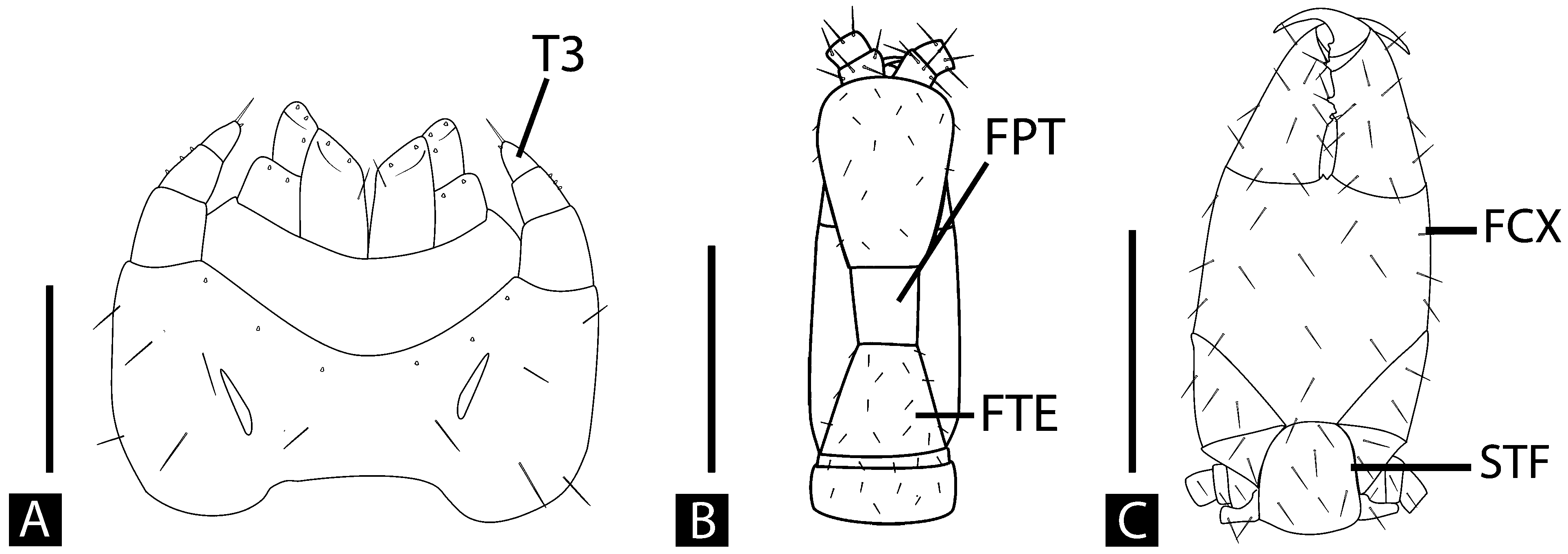
1. Cephalic plate sub-trapezoidal, with posterior part wider than anterior part (Figs 29B, 31B); denticle of tarsungulum small and positioned above base of tarsungulum (Fig. 31D)................................................. M. neotropicus

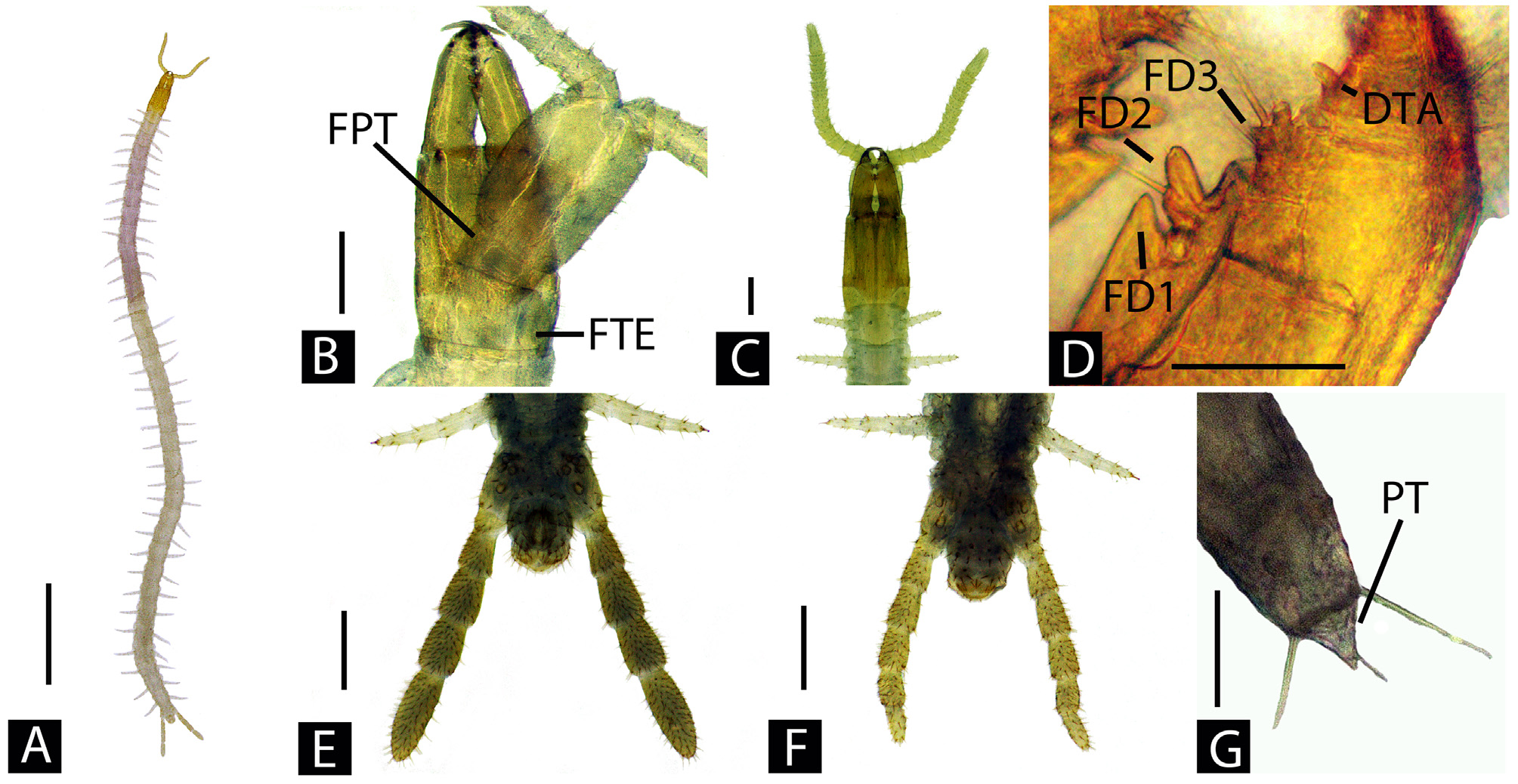
- Cephalic plate sub-rectangular (Fig. 32B); denticle of tarsungulum large and positioned close to base of tarsungulum (Fig. 32D)................................................................................ M. tupiniquim n. sp.

Calvanese, Victor C., Brescovit, Antonio D., Bonato, Lucio (2019): Revision of the Neotropical species of Aphilodontinae (Geophilomorpha, Geophilidae), with eight new species and a first phylogenetic analysis of the subfamily. Zootaxa 4698 (1): 1-72, DOI: 10.11646/zootaxa.4698.1.1MagnoliaPress via PlaziNo known copyright restrictions apply. See Agosti, D., Egloff, W., 2009. Taxonomic information exchange and copyright: the Plazi approach. BMC Research Notes 2009, 2:53 for further explanation.

Export occurrence data

Darwin Core Archive (ZIP)

CLASSIFICATION

Taxonomic Classification Tree

MULTIMEDIA

Media Files(3)

FIGURE 29. A–C, Mecophilus diagnostic characters. Mecophilus neotropicus Silvestri, 1909. Male holotype (MSHG “Vase type”): A, first and second maxillae, ventral; B, anterior part of body, dorsal; C, forcipular segment, ventral. Abbreviations: FCX: forcipular coxosternite; FPT: forcipular pretergite; FTE: forcipular tergite; STF: sternite of first leg-bearing segment; T3: article 3 of telopodite of second maxillae. Scale bars: 0.01 (A), 0.2 (B–C) mm.

Imageimage/png© Calvanese, Victor C.;Brescovit, Antonio D.;Bonato, LucioCalvanese, Victor C.;Brescovit, Antonio D.;Bonato, Lucio

FIGURE 31. A–E, Mecophilus neotropicus Silvestri, 1909. Male holotype (MSNG “Vase type”): A, habitus, ventral; B, anterior part of body, dorsal; C, same, ventral; D, forcipules, ventral; E, terminal part of body, ventral. Abbreviations: BT: basal part of tarsungulum; DTA: denticle of tarsungulum; FPT: forcipular pretergite; FTE: forcipular tergite; PE: penis. Scale bars: 1 (A), 0.1 (B–E) mm.
Imageimage/png© Calvanese, Victor C.;Brescovit, Antonio D.;Bonato, LucioCalvanese, Victor C.;Brescovit, Antonio D.;Bonato, Lucio

FIGURE 32. A–G, Mecophilus tupiniquim n. sp. Male paratype (IBSP 6173): A, habitus, ventral; B, anterior part of body, dorsal; C, same, ventral; D, denticles of left forcipule, ventral; E, terminal part of body, ventral. Female holotype (IBSP 6172): F, terminal part of body, ventral; G, pretarsus of ultimate leg, lateral. Abbreviations: FD1: distal denticle of trochanteroprefemur; FD2: denticle of femur; FD3: denticle of tibia; DTA: denticle of tarsungulum; FPT: forcipular pretergite; FTE: forcipular tergite; PT: pretarsus. Scale bars: 1 (A), 0.1 (B–C, E–F), 0.02 (D, G) mm.

Imageimage/png© Calvanese, Victor C.;Brescovit, Antonio D.;Bonato, LucioCalvanese, Victor C.;Brescovit, Antonio D.;Bonato, Lucio

IMAGES

Gallery(3)

See Gallery

Occurrences with images

Source Information

Revision of the Neotropical species of Aphilodontinae (Geophilomorpha, Geophilidae), with eight new species and a first phylogenetic analysis of the subfamily

checklist

This dataset contains the digitized treatments in Plazi based on the original journal article Calvanese, Victor C., Brescovit, Antonio D., Bonato, Lucio (2019): Revision of the Neotropical species of Aphilodontinae (Geophilomorpha, Geophilidae), with eight new species and a first phylogenetic analysis of the subfamily. Zootaxa 4698 (1): 1-72, DOI: 10.11646/zootaxa.4698.1.1

Abstract

Aphilodontinae are a well distinct but poorly known group of soil centipedes (Chilopoda: Geophilomorpha: Geophilidae) inhabiting two disjunct areas in South America and South Africa respectively. A comprehensive revision of the Neotropical species is presented based on the examination of> 150 specimens, the phylogenetic analysis of the entire subfamily based on 47 morphological characters, and the description of eight new species from Southeastern Brazil. The Aphilodontinae were confirmed a monophyletic clade within Geophilidae and closely related to Geoperingueyia, with which they share synapomorphic characters in the labrum, second maxillae and forcipules. Particular groups of clypeal setae, inconspicuous lateral parts of labrum and coalescent forcipular throchanteroprefemur and femur were recovered as synapomorphies of the Aphilodontinae. Four monophyletic genera are recognized within the subfamily Aphilodontinae Silvestri, 1909 (1908) (= Brasilophilidae Verhoeff, 1908; = Mecistaucheninae Verhoeff, 1925 n. syn.), three exclusively Neotropical and one exclusively South African. The Neotropical genera are: Aphilodon Silvestri, 1898 (= Mecistauchenus Brölemann, 1907 n. syn.; = Brasilophilus Verhoeff, 1908 n. syn.), with ten species (including A. caboclos n. sp., A. indespectus n. sp., A. meganae n. sp., A. pereirai n. sp. and A. silvestrii n. sp.), characterized by a small terminal spine on the ultimate legs, in both males and females; Mecophilus Silvestri, 1909, with two species (including M. tupiniquim n. sp.), characterized by elongated forcipular segment and first leg-bearing segment; Mairata n. gen., with two species (M. butantan n. sp. and M. itatiaiensis n. sp.), characterized by the partial reduction of the distal article of the second maxillary telopodite and a particular shape of ultimate legs, in both males and females. The South African genus, Philacroterium Attems, 1926, comprises eleven known species (including P. weberi (Silvestri, 1909) n. comb., P. caffrarium (Verhoeff, 1937) n. comb., P. porosum (Verhoeff, 1937) n. comb., P. brevipes (Verhoeff, 1938) n. comb., P. bidentatum (Lawrence, 1955) n. comb., P. longipes (Lawrence, 1955) n. comb., P. macronyx (Lawrence, 1955) n. comb., P. maritimum (Lawrence, 1963) n. comb., P. pauciporum (Lawrence, 1963) n. comb. and P. transvaalicum (Lawrence, 1963) n. comb.) and is characterized by vestigial lateral parts of the labrum and the complete suppression of the distal article of the telopodites of the second maxillae. Identification keys are provided for the Aphilodontinae genera and for the species of Aphilodon, Mecophilus and Mairata n. gen. The known occurrence of Aphilodon in Brazil is extended from the states of São Paulo and Mato Grosso to the states of Minas Gerais and Rio de Janeiro, that of Mecophilus from the state of Paraná to the state of São Paulo.

Calvanese V C, Brescovit A D, Bonato L, plazi (2019). Revision of the Neotropical species of Aphilodontinae (Geophilomorpha, Geophilidae), with eight new species and a first phylogenetic analysis of the subfamily. Plazi.org taxonomic treatments database. Checklist dataset https://doi.org/10.11646/zootaxa.4698.1.1 accessed via GBIF.org on 2026-06-15.

CC0Published 11/15/2019View dataset
GBIF Usage Key
160406566
Dataset Key
1c94057f-64de-4f19-b047-2223e4d664e8
Origin
source
Backbone Key
2233976
Taxon ID
06130E72A53CFFDAFF34F8C0FA56ABFB.taxon
Last Crawled
6/10/2026
Last Interpreted
6/10/2026