
Aphilodon
Silvestri, 1898
GBIF:160406567
ABOUT
Descriptions(1)
Key to Aphilodon species
1. Cephalic plate longer than wide, without a distinct transverse suture; coxosternite of second maxillae more or less quadrangular, only slightly shorter in the middle part................................................................. 2
- Cephalic plate wider than long, with a distinct transverse suture (Fig. 17B); coxosternite of second maxillae distinctly shorter in middle part (Fig. 7A)........................................................................ A. micronyx
2. Antenna less than 2.7 times as long as cephalic plate; metasternite of ultimate leg-bearing segment wider than long....... 3
- Antenna more than 3.0 times as long as cephalic plate (Fig. 15B); metasternite of ultimate leg-bearing segment longer than wide (Fig. 14B)............................................................................. A. spegazzinii
3. Forcipular tarsungulum shorter than trochanteroprefemur+femur; metasternite of ultimate leg-bearing segment length/width ratio> 0.6........................................................................................... 4
- Forcipular tarsungulum longer than trochanteroprefemur+femur (Figs 19B, 20C); metasternite of ultimate leg-bearing segment length/width ratio <0.5 (Fig. 19C, 20G)...................................................... A. caboclos n. sp.
4. Pectinate lamella of mandible with straight denticles; ultimate presternite visible in males and females................. 5
- Pectinate lamella of mandible with curved denticles (Figs 25 A–B); ultimate presternite not visible in males and females (Figs 25E, 26E)............…....................................................................... A. pereirai n. sp.
5. Forcipule with distal denticle of trochanteroprefemur and denticle of femur separated at their bases; body in adults less than 25 mm long; up to 59 pairs of legs; up to 15 coxal pores on each coxopleuron in adults................................ 6
- Forcipule with distal denticle of trochanteroprefemur and denticle of femur with coalescent bases (Figs 27B, 28C); body in adults more than 30 mm long; 69 or more pairs of legs; more than 20 coxal pores on each coxopleuron in adults (Fig. 28E)........................................................................................ A. silvestrii n. sp.
6. Forcipule with at least distal denticle of trochanteroprefemur and denticle of femur relatively large.................... 7
- Forcipule with distal denticle of trochanteroprefemur, denticle of femur and denticle of tibia almost absent (Fig. 21A).......................................................................................... A. indespectus n. sp.
7. 45 or more pairs of legs; forcipular pretergite not covered by cephalic plate....................................... 8
- Up to 39 pairs of legs; forcipular pretergite totally covered by cephalic plate (Fig. 24B)................ A. meganae n. sp.
8. Cephalic plate length/width ratio <1.20 (Figs 40 A–D); antenna distinctly tapering to tip; less than 10 coxal pores on each coxopleuron in adults.................................................................................. 9
- Cephalic plate length/width ratio ca. 1.25; antenna not distinctly tapering to tip; more than 15 coxal pores on each coxopleuron in adults (Silvestri, 1909: Fig. X).............................................................. A. intermedius
9. Up to 45 pairs of legs; denticle of trochanteroprefemur and denticle of femur relatively large, denticle of tibia almost absent; approximately 5 coxal pores on each coxopleuron in adults (Silvestri, 1909: Fig. XI)....................... A. modestus
- Around 53–59 pairs of legs; denticle of trochanteroprefemur, denticle of femur and denticle of tibia relatively large; 7–10 coxal pores on each coxopleuron in adults (Fig. 18D).................................................... A. angustatus
Export occurrence data
Darwin Core Archive (ZIP)
CLASSIFICATION
Taxonomic Classification Tree

MULTIMEDIA
Media Files(14)
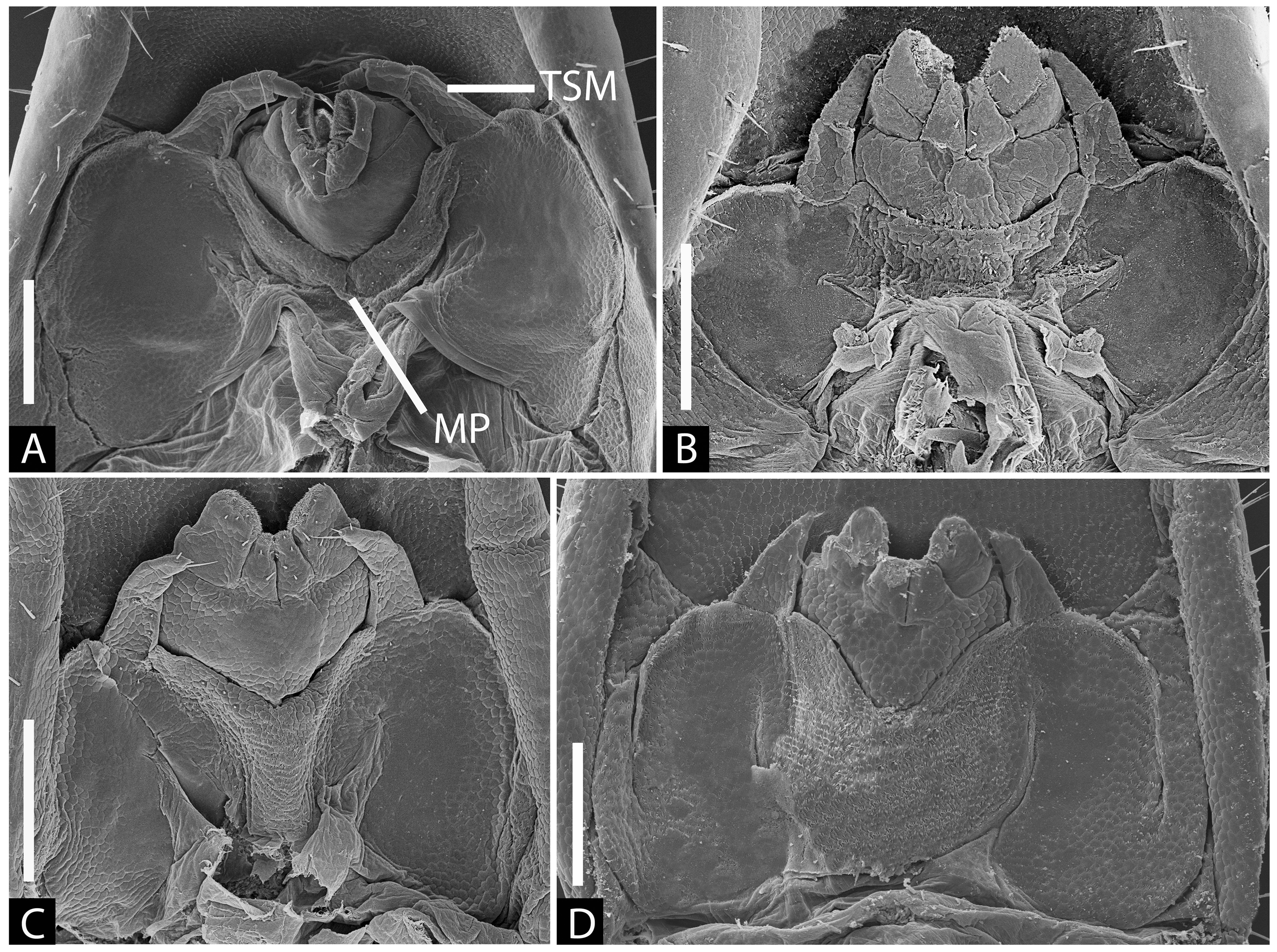
FIGURE 7. A–D, Aphilodontinae second maxillae, ventral: A, Aphilodon micronyx Brölemann, 1902 (IBSP); B, Philacroterium maritimum (Lawrence, 1963) n. comb. (KZN); C, Aphilodon caboclos n. sp. (IBSP); D, Mairata butantan n. sp. (IBSP). Abbreviations: MP: medial part of coxosternite of second maxillae; TSM: telopodite of second maxillae. Scale bars: 0.1 mm (A–D).

FIGURE 14. A–B, Aphilodon spegazzinii Silvestri, 1898 (MSNG “Vase type XXVI”: specimen “b”): A, antennal article III and IV, ventral; B, metasternite of the ultimate leg-bearing segment, ventral. Abbreviations: MTL: metasternite of the ultimate leg-bearing segment; UPS: ultimate presternite. Scale bars: 0.05 mm (A–B).

FIGURE 15. A–E, Aphilodon spegazzinii Silvestri, 1898 (MSNG “Vase type XXVI”: specimen “b”): A, habitus, ventral; B, anterior part of body, dorsal; C, same, ventral; D, terminal part of body, dorsal; E, same, ventral. Scale bars: 0.4 (A), 0.8 (B–C), 0.5 (D–E) mm.
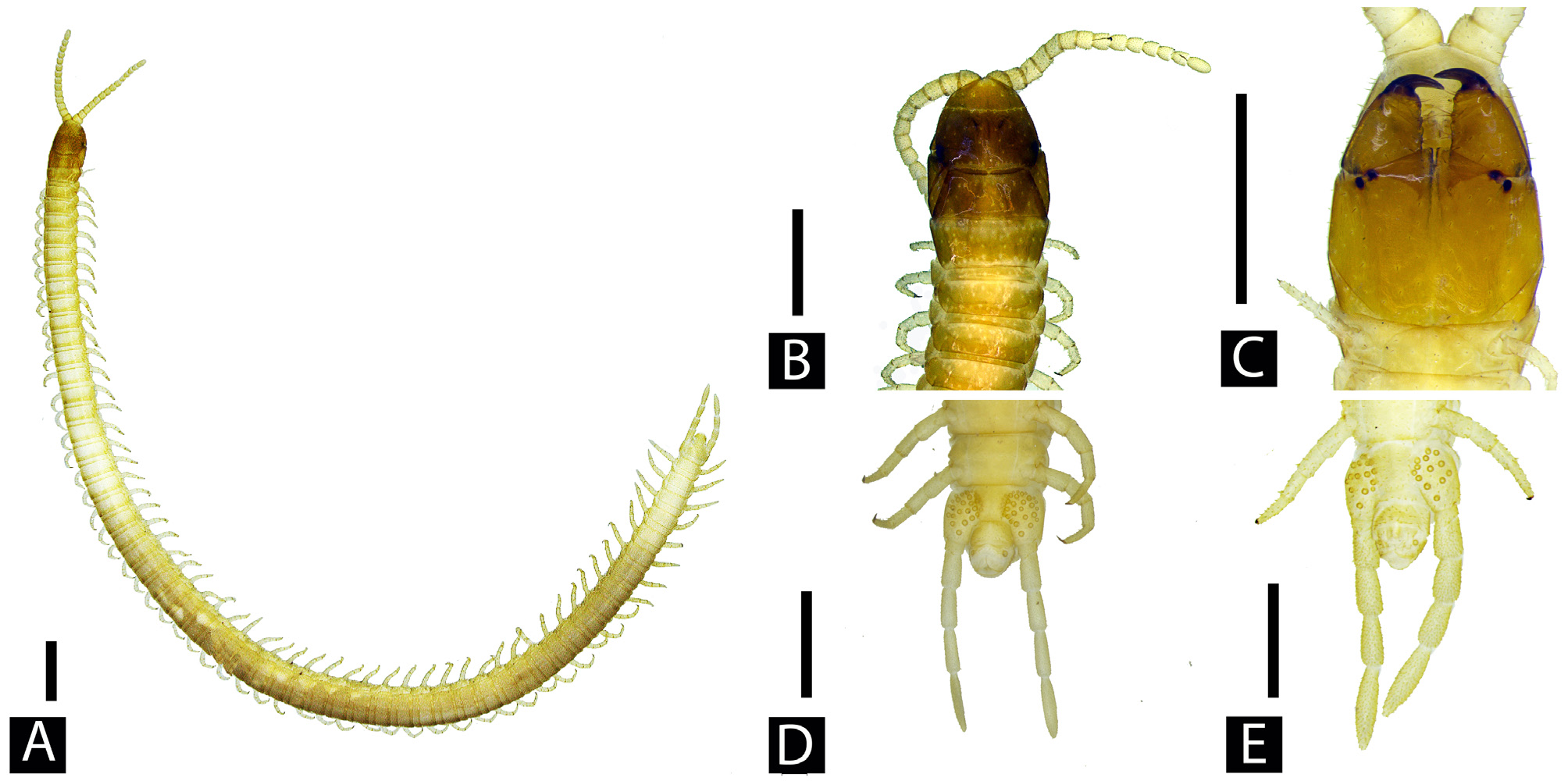
FIGURE 17. A–E, Aphilodon micronyx Brölemann, 1902. Female (IBSP 6175): A, habitus, dorsal; B, anterior part of body, dorsal; C, same, ventral; D, terminal part of body, ventral. Male (IBSP 6175): E, terminal part of body, ventral. Scale bars: 1 (A), 0.5 (B–E) mm.

FIGURE 18. A–D, Aphilodon angustatus Silvestri, 1909. Male (IBSP 3655): A, left telopodite of second maxillae, ventral; B, article 3 of second maxillae telopodite, ventro-lateral; C, forcipular segment, ventral; D, terminal part of body, ventral. Scale bars: 0.01 (A–B), 0.3 (C–D) mm.
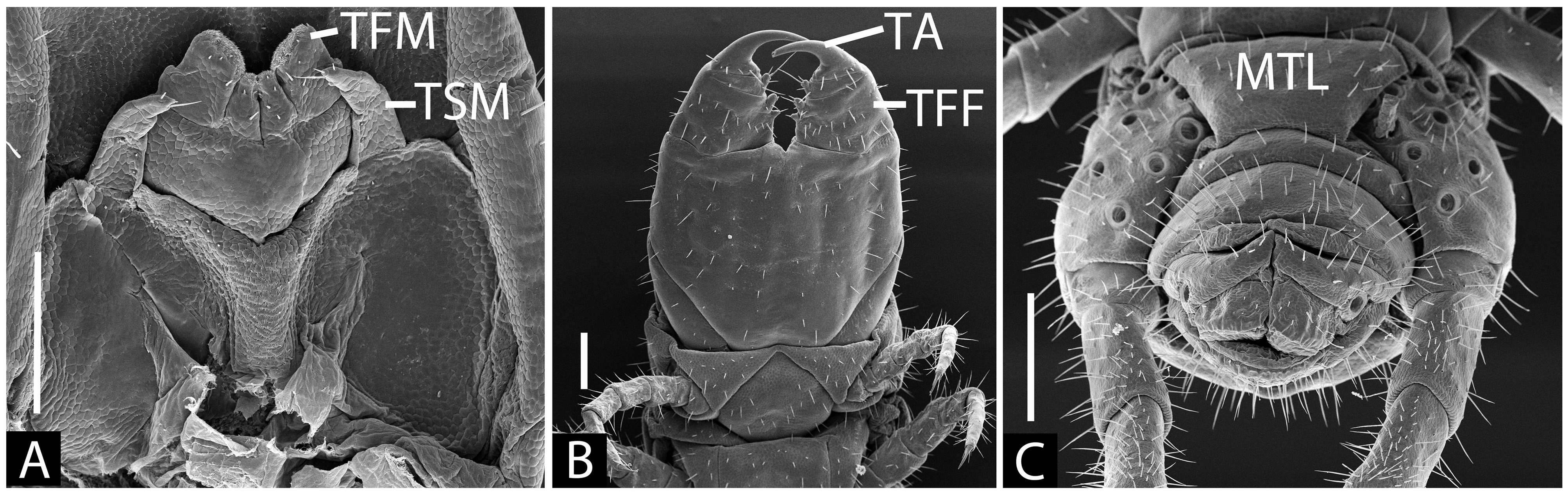
FIGURE 19. A–C, Aphilodon caboclos n. sp. Female paratype (IBSP 4073): A, first and second maxillae, ventral; B, forcipular segment, ventral; C, terminal part of body, ventral. Abbreviations: MTL: metasternite of the ultimate leg-bearing segment; TA: tarsungulum; TFF: trochanteroprefemur+femur; TFM: telopodite of first maxillae; TSM: telopodite of second maxillae. Scale bars: 0.1 mm (A–C).
IMAGES