
AnimaliaNot EvaluatedacceptedspeciesAccepted
Mecophilus neotropicus

Mecophilus neotropicus

Silvestri, 1909

GBIF:160406585

0year

ABOUT

Descriptions(5)

(Figs 3 B, 29, 31, 40 E, 41 H)
Calvanese, Victor C., Brescovit, Antonio D., Bonato, Lucio (2019): Revision of the Neotropical species of Aphilodontinae (Geophilomorpha, Geophilidae), with eight new species and a first phylogenetic analysis of the subfamily. Zootaxa 4698 (1): 1-72, DOI: 10.11646/zootaxa.4698.1.1
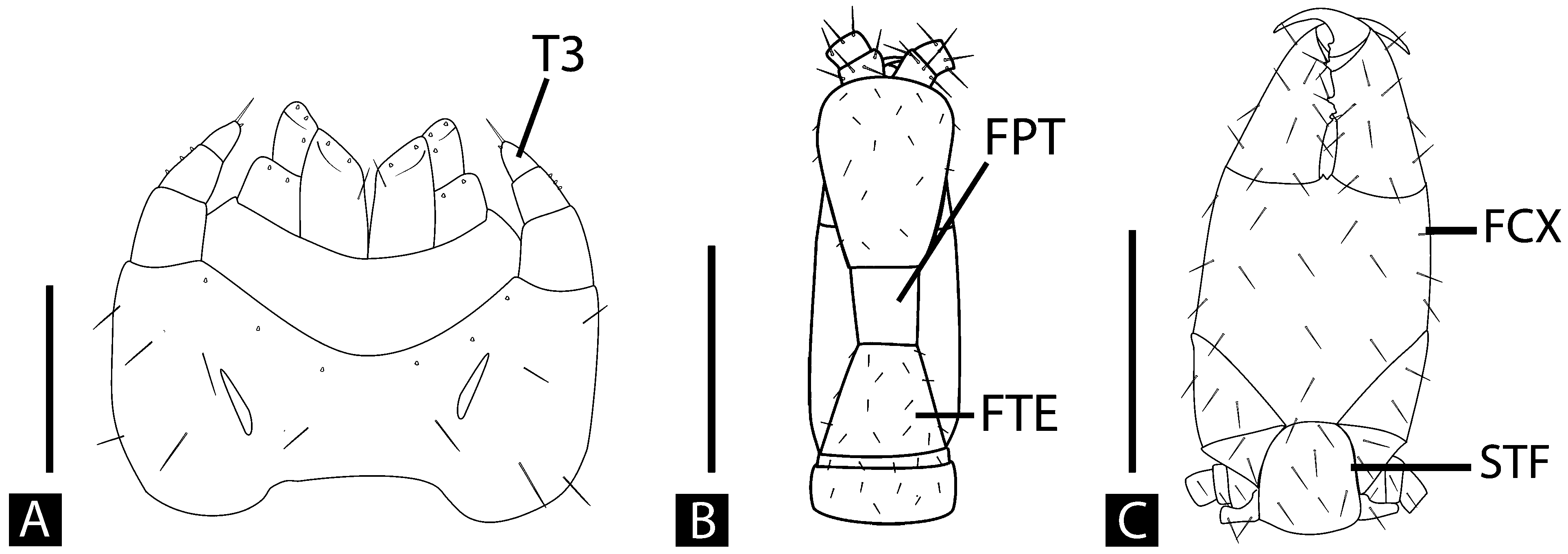
Description of holotype. Male (MCSG “ Vase type ”). Entire body: length 8, maximum width 0.2. Cephalic plate: trapezoidal, with posterior margin 1.5 times as wide as anterior margin; length 0.33 and maximum width (near posterior margin) 0.24 (length / width ratio 1.37). Antenna: length 0.56, 1.7 times as long as cephalic plate; AA II – XIII length / width ratio 0.44 – 0.95; LAA ca. 3.5 times as long as AA XIII. Clypeus: 2 + 2 LS, 1 + 1 PS, 5 + 5 SCS. Mandible: PL with about 20 denticles. First maxillae: TFM length 0.02 and width 0.01. Second maxillae: left TSM length 0.02 (ca. 1.1 times as long as TFM) and maximum width (basal margin) 0.01; T 3 with 1 large apical SE. Forcipular segment: FTE length 0.20 (0.83 times as long as cephalic plate) and width 0.18 (length / width ratio 1.1); FPT length 0.11 (0.55 times as long as cephalic plate) and width 0.10; FCX length 0.30 and width 0.21 (length / width ratio 1.4); FRL length 0.18, surpassing anterior margin of cephalic plate, and maximum width (basal margin) 0.09; FRL with 2 denticles in TFF and 1 in TI; FD 1 relatively large, pointed and with 1 apical SE; FD 2 pointed, with 2 large apical SE; FD 3 bilobate and relatively small, with 1 large apical plus 3 subapical SE; TA 0.61 times as long as TFF; DTA relatively small and positioned in median region of TA. Walking legs: 35 pairs; left FL length 0.17, 0.87 times as long as the second leg; left leg 17 length 0.20. Tergum from the first to penultimate leg-bearing segment: TE 17 length 0.13 and width 0.22 (length / width ratio 0.59), with one anterior row of 7 SE and one posterior row of 7 slightly smaller SE; PT 0.42 times as long as TE and with two parallel rows of 5 SE. Sternum from the first to penultimate leg-bearing segment: STF rectangular, length 0.14 long and width 0.09 (length / width ratio 1.52); ST 17 length 0.16 and width 0.11 (length / width ratio 1.45). Ultimate leg-bearing segment: MTL trapezoidal, length 0.07 and maximum width 0.11 (length / width ratio 0.66); UPS exposed and not divided, length 0.01 and width 0.11. Ultimate legs: with a single tarsal article and without terminal claw; slightly thickened when compared to penultimate leg, length 0.46, ca. 1.7 times as long as penultimate leg; each CXP with 4 little COP which are weakly grouped near MTL and 1 COP further away. Postpedal segments: GM biarticulated; GM 1 with 3 – 4 SE in one row; GM 2 with 4 scattered SE.
Calvanese, Victor C., Brescovit, Antonio D., Bonato, Lucio (2019): Revision of the Neotropical species of Aphilodontinae (Geophilomorpha, Geophilidae), with eight new species and a first phylogenetic analysis of the subfamily. Zootaxa 4698 (1): 1-72, DOI: 10.11646/zootaxa.4698.1.1
Diagnosis. A species of Mecophilus with: known body length in adults more than 8 mm; cephalic plate trapezoidal, with posterior part wider than anterior part (Figs 29 B, 31 B); forcipular tergite elongated, trapezoidal (Figs 29 B, 31 B); denticle of tarsungulum relatively short and positioned close to mid-length of tarsungulum (Figs 29 C, 31 D); distal denticle of trochanteroprefemur and denticle of femur distinctly spaced (Figs 29 C, 31 D). Recorded specimens: a single specimen, ♂.
Calvanese, Victor C., Brescovit, Antonio D., Bonato, Lucio (2019): Revision of the Neotropical species of Aphilodontinae (Geophilomorpha, Geophilidae), with eight new species and a first phylogenetic analysis of the subfamily. Zootaxa 4698 (1): 1-72, DOI: 10.11646/zootaxa.4698.1.1
Distribution. Brazil — Paraná: Foz do Iguaçu (Silvestri 1909 a, 1909 b).
Calvanese, Victor C., Brescovit, Antonio D., Bonato, Lucio (2019): Revision of the Neotropical species of Aphilodontinae (Geophilomorpha, Geophilidae), with eight new species and a first phylogenetic analysis of the subfamily. Zootaxa 4698 (1): 1-72, DOI: 10.11646/zootaxa.4698.1.1
Type specimens. Holotype: ♂, from “ cascata dell’Iguazù (Paranà, Brasile) ” (Silvestri, 1909 a), without collector name and collection date, deposited in MCSG “ Vase type XXVI ”, without specific code. Type locality. Brazil: Paraná: Foz do Iguaçu. Notes on nomenclature. The holotype, which was originally identified as a female by Silvestri (1909 a, 1909 b), was actually found to be a male by direct examination of the specimen by one of us (VCC). Material examined. BRAZIL. Paraná: Foz do Iguaçu, 1 ♂ [holotype] (MCSG “ Vase type XXVI ”).
Calvanese, Victor C., Brescovit, Antonio D., Bonato, Lucio (2019): Revision of the Neotropical species of Aphilodontinae (Geophilomorpha, Geophilidae), with eight new species and a first phylogenetic analysis of the subfamily. Zootaxa 4698 (1): 1-72, DOI: 10.11646/zootaxa.4698.1.1

Export occurrence data

Darwin Core Archive (ZIP)

CLASSIFICATION

Taxonomic Classification Tree

MULTIMEDIA

Media Files(5)

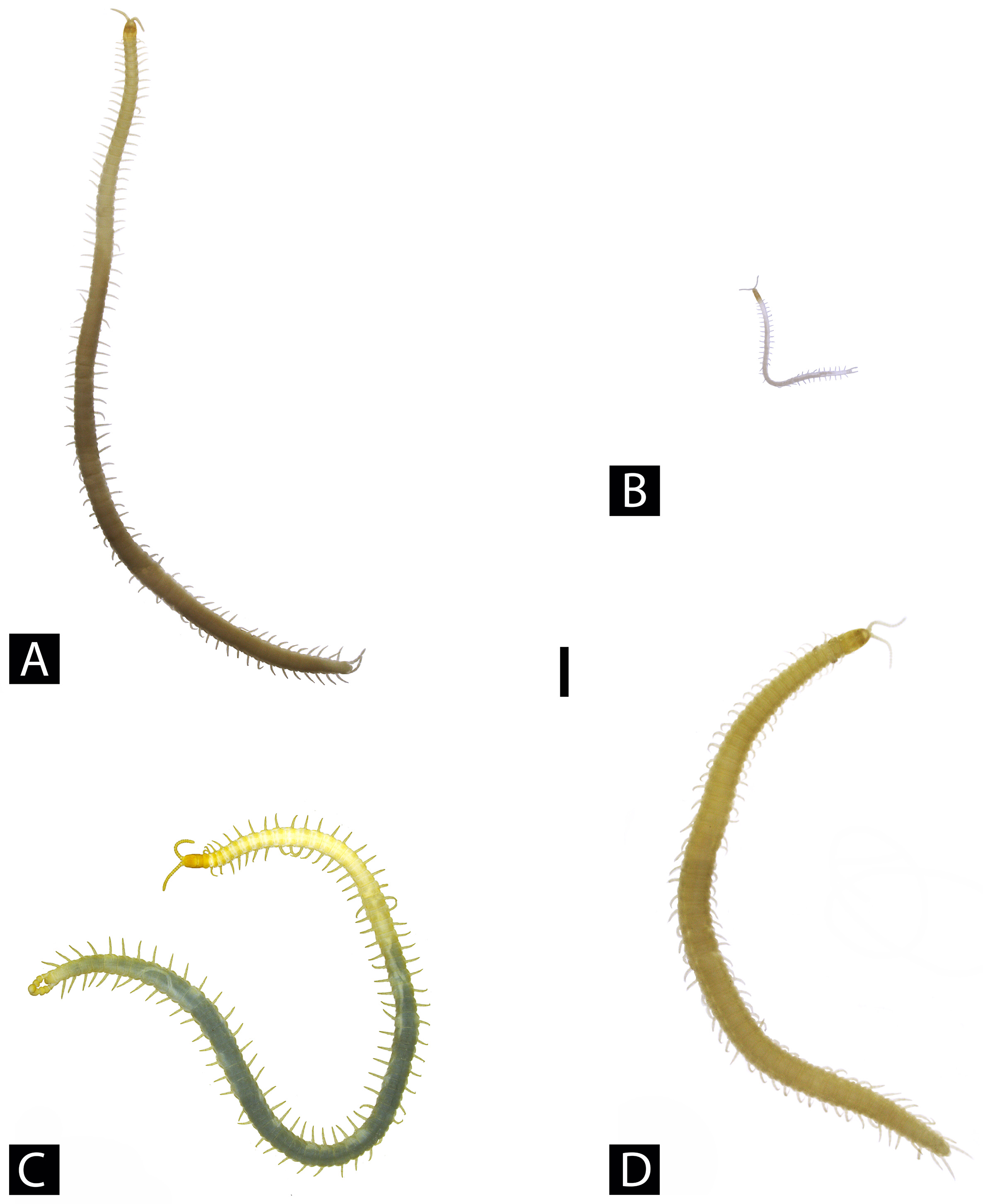
FIGURE 3. A–D, Aphilodontinae habitus, dorsal: A, Aphilodon silvestrii n. sp. (IBSP 3665); B, Mecophilus neotropicus Silvestri, 1909 (MNHG); C, Mairata itatiaiensis n. sp. (IBSP 6178); D, Philacroterium brevipes (Verhoeff, 1938) n. comb. (KZN 5033). Scale bars: 1 mm (A–D).
Imageimage/png© Calvanese, Victor C.;Brescovit, Antonio D.;Bonato, LucioCalvanese, Victor C.;Brescovit, Antonio D.;Bonato, Lucio

FIGURE 29. A–C, Mecophilus diagnostic characters. Mecophilus neotropicus Silvestri, 1909. Male holotype (MSHG “Vase type”): A, first and second maxillae, ventral; B, anterior part of body, dorsal; C, forcipular segment, ventral. Abbreviations: FCX: forcipular coxosternite; FPT: forcipular pretergite; FTE: forcipular tergite; STF: sternite of first leg-bearing segment; T3: article 3 of telopodite of second maxillae. Scale bars: 0.01 (A), 0.2 (B–C) mm.

Imageimage/png© Calvanese, Victor C.;Brescovit, Antonio D.;Bonato, LucioCalvanese, Victor C.;Brescovit, Antonio D.;Bonato, Lucio

FIGURE 31. A–E, Mecophilus neotropicus Silvestri, 1909. Male holotype (MSNG “Vase type”): A, habitus, ventral; B, anterior part of body, dorsal; C, same, ventral; D, forcipules, ventral; E, terminal part of body, ventral. Abbreviations: BT: basal part of tarsungulum; DTA: denticle of tarsungulum; FPT: forcipular pretergite; FTE: forcipular tergite; PE: penis. Scale bars: 1 (A), 0.1 (B–E) mm.
Imageimage/png© Calvanese, Victor C.;Brescovit, Antonio D.;Bonato, LucioCalvanese, Victor C.;Brescovit, Antonio D.;Bonato, Lucio

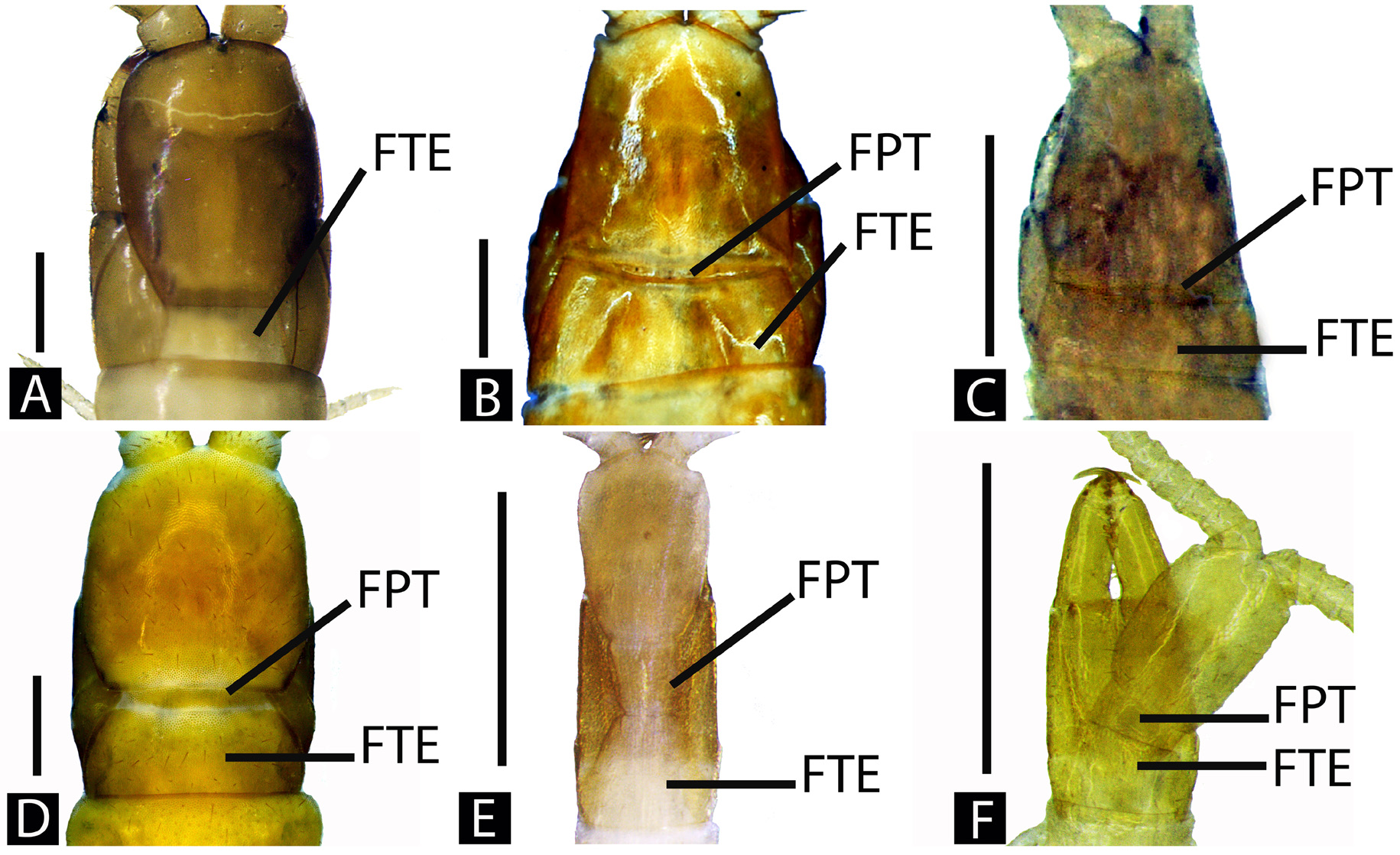
FIGURE 40. A–F, anterior part of body, dorsal: A, Dicellophilus carniolensis (Koch, 1847) (PD); B, Aphilodon pereirai n. sp. (IBSP); C, Philacroterium cribellatum Attems, 1926 (SAM); D, Mairata itatiaiensis n. sp. (IBSP); E, Mecophilus neotropicus (MSNG); F, Mecophilus tupiniquim n. sp. (IBSP). Abbreviations: FPT: forcipular pretergite; FTE: forcipular tergite. Scale bars: 0.5 mm (A–F).

Imageimage/png© Calvanese, Victor C.;Brescovit, Antonio D.;Bonato, LucioCalvanese, Victor C.;Brescovit, Antonio D.;Bonato, Lucio

FIGURE 41. A–L, forcipular segment, ventral: A, Dicellophilus carniolensis (Koch, 1847) (PD); B, Hyphydrophilus adisi Pereira, Minelli & Barbieri, 1994 (PD); C, Macronicophilus abbreviatus Pereira, Foddai & Minelli, 2000 (INPA); D, Strigamia crassipes (Koch, 1835) (PD); E, Henia vesuviana (Newport, 1844) (PD); F, Geoperingueyia dentata Verhoeff, 1938 (MNRJ); G, Mairata itatiaiensis n. sp. (IBSP); H, Mecophilus neotropicus Silvestri, 1909 (MSNG); I, Aphilodon micronyx Brölemann, 1902 (IBSP); J, Aphilodon silvestrii n. sp. (IBSP); K, Philacroterium cribellatum Attems, 1926 (SAM); L, Philacroterium brevipes (Verhoeff, 1938) n. comb. (KZN). Scale bars: 0.2 mm (A–L).

Imageimage/png© Calvanese, Victor C.;Brescovit, Antonio D.;Bonato, LucioCalvanese, Victor C.;Brescovit, Antonio D.;Bonato, Lucio

IMAGES

Gallery(5)

See Gallery

Occurrences with images

Source Information

Revision of the Neotropical species of Aphilodontinae (Geophilomorpha, Geophilidae), with eight new species and a first phylogenetic analysis of the subfamily

checklist

This dataset contains the digitized treatments in Plazi based on the original journal article Calvanese, Victor C., Brescovit, Antonio D., Bonato, Lucio (2019): Revision of the Neotropical species of Aphilodontinae (Geophilomorpha, Geophilidae), with eight new species and a first phylogenetic analysis of the subfamily. Zootaxa 4698 (1): 1-72, DOI: 10.11646/zootaxa.4698.1.1

Abstract

Aphilodontinae are a well distinct but poorly known group of soil centipedes (Chilopoda: Geophilomorpha: Geophilidae) inhabiting two disjunct areas in South America and South Africa respectively. A comprehensive revision of the Neotropical species is presented based on the examination of> 150 specimens, the phylogenetic analysis of the entire subfamily based on 47 morphological characters, and the description of eight new species from Southeastern Brazil. The Aphilodontinae were confirmed a monophyletic clade within Geophilidae and closely related to Geoperingueyia, with which they share synapomorphic characters in the labrum, second maxillae and forcipules. Particular groups of clypeal setae, inconspicuous lateral parts of labrum and coalescent forcipular throchanteroprefemur and femur were recovered as synapomorphies of the Aphilodontinae. Four monophyletic genera are recognized within the subfamily Aphilodontinae Silvestri, 1909 (1908) (= Brasilophilidae Verhoeff, 1908; = Mecistaucheninae Verhoeff, 1925 n. syn.), three exclusively Neotropical and one exclusively South African. The Neotropical genera are: Aphilodon Silvestri, 1898 (= Mecistauchenus Brölemann, 1907 n. syn.; = Brasilophilus Verhoeff, 1908 n. syn.), with ten species (including A. caboclos n. sp., A. indespectus n. sp., A. meganae n. sp., A. pereirai n. sp. and A. silvestrii n. sp.), characterized by a small terminal spine on the ultimate legs, in both males and females; Mecophilus Silvestri, 1909, with two species (including M. tupiniquim n. sp.), characterized by elongated forcipular segment and first leg-bearing segment; Mairata n. gen., with two species (M. butantan n. sp. and M. itatiaiensis n. sp.), characterized by the partial reduction of the distal article of the second maxillary telopodite and a particular shape of ultimate legs, in both males and females. The South African genus, Philacroterium Attems, 1926, comprises eleven known species (including P. weberi (Silvestri, 1909) n. comb., P. caffrarium (Verhoeff, 1937) n. comb., P. porosum (Verhoeff, 1937) n. comb., P. brevipes (Verhoeff, 1938) n. comb., P. bidentatum (Lawrence, 1955) n. comb., P. longipes (Lawrence, 1955) n. comb., P. macronyx (Lawrence, 1955) n. comb., P. maritimum (Lawrence, 1963) n. comb., P. pauciporum (Lawrence, 1963) n. comb. and P. transvaalicum (Lawrence, 1963) n. comb.) and is characterized by vestigial lateral parts of the labrum and the complete suppression of the distal article of the telopodites of the second maxillae. Identification keys are provided for the Aphilodontinae genera and for the species of Aphilodon, Mecophilus and Mairata n. gen. The known occurrence of Aphilodon in Brazil is extended from the states of São Paulo and Mato Grosso to the states of Minas Gerais and Rio de Janeiro, that of Mecophilus from the state of Paraná to the state of São Paulo.

Calvanese V C, Brescovit A D, Bonato L, plazi (2019). Revision of the Neotropical species of Aphilodontinae (Geophilomorpha, Geophilidae), with eight new species and a first phylogenetic analysis of the subfamily. Plazi.org taxonomic treatments database. Checklist dataset https://doi.org/10.11646/zootaxa.4698.1.1 accessed via GBIF.org on 2026-06-14.

CC0Published 11/15/2019View dataset
GBIF Usage Key
160406585
Dataset Key
1c94057f-64de-4f19-b047-2223e4d664e8
Origin
source
Backbone Key
2233977
Taxon ID
06130E72A522FFC4FF34FE01FB93ABFA.taxon
Last Crawled
6/10/2026
Last Interpreted
6/10/2026