
AnimaliaNot EvaluatedacceptedspeciesAccepted

Arrhopalites mendoncae
Brito, Lima & Zeppelini, 2019
GBIF:160598958
0year
ABOUT
Descriptions(7)
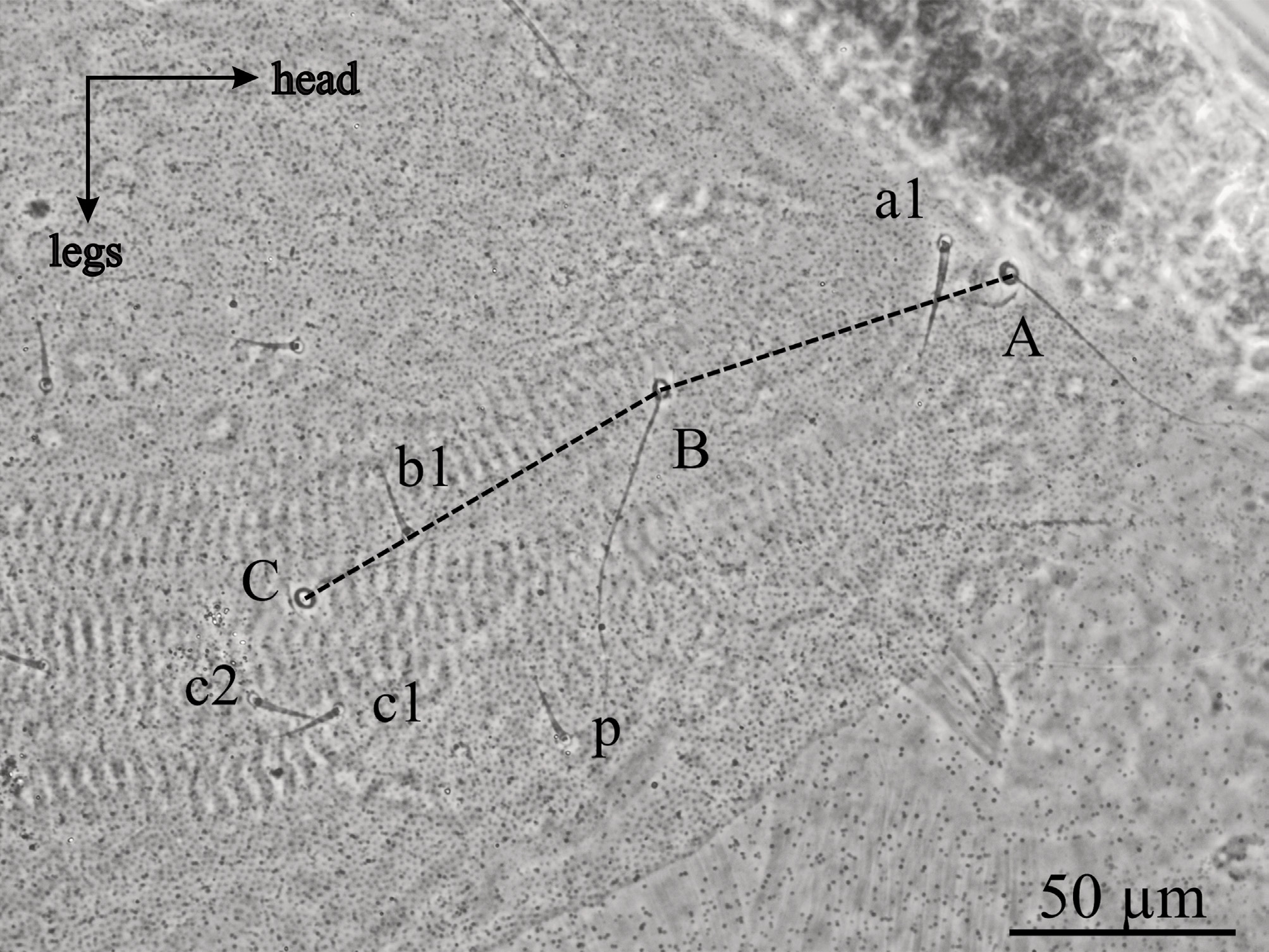
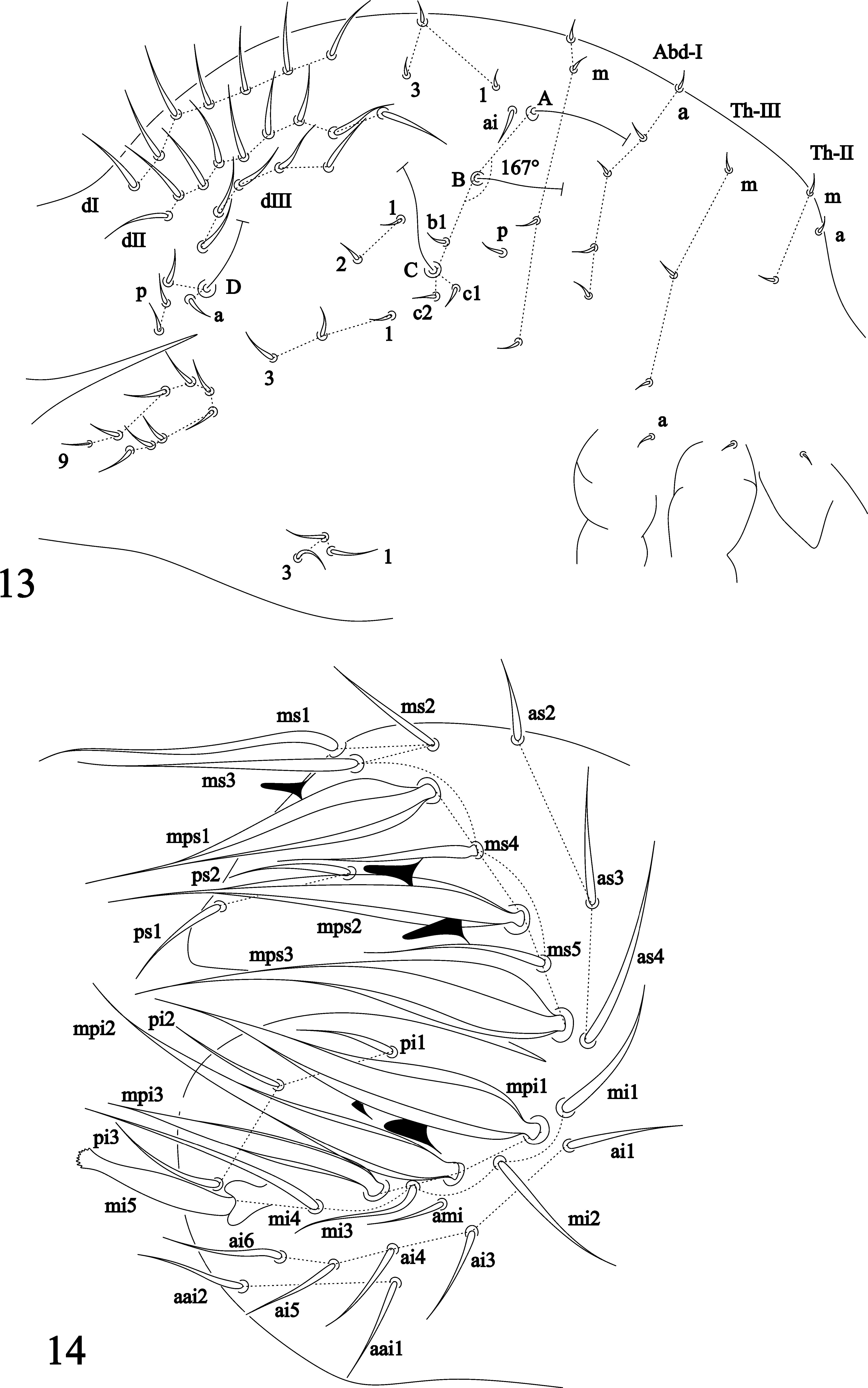
Description. Holotype body about 1.02 mm length. Other measurements presented in Table 1. Coloration in ethanol ranged from white to yellow. Antennae (Figs. 1 – 4). About 1.96 × cephalic length. Mean length ratio of antenna segments I: II, III, IV = 1: 1.6, 3.1, 6.8. Ant. I with six normal chaetae on anterior side, and one small microchaeta in apical part on posterior side (Fig. 1). Ant. II with eight apical chaetae, three medial and three basal, one basal internal much longer (~ 3 ×) than other two (Fig. 2). Ant. III apical organ with two sensilla in separate pits, Ai bigger than Ape, Ape short and bristle-like, Aai minute, rod-like and blunt, other chaetae normal. Ant. III mid-dorsal with two chaetae longer than the other in the segment (Fig. 3). Ant. IV subdivided into five ringed sub-segments. Sub-segment formula as 1 + 3 + 1 = (A + M 1, M 2) + (M 3 – M 5) + (B), A apex with a capitate sense rod. Ant. IV with 13 whorls of chaetae: four on apical sub-segments (A + M 1), five on median sub-segments (M 2 – M 5 + BA) and four on basal sub-segments (BM 1 – BM 3 + BB) (Fig. 4). Head (Figs. 5 – 6). Eyes 1 + 1 unpigmented. Posterior cephalic spines interposed between normal chaetae, posterior dorsal chaetotaxy A, B, C, D as 5,3,4,7, inter-antennal region with four α and three β chaetae; frontal cephalic chaetotaxy a to f as 5,8,8,10,12,12 and with six medial chaetae (Fig. 5). Labral chaetotaxy a, m, p, pl with 4,5,5,6 chaetae respectively (Fig. 6). Leg I (Fig. 7). Precoxae and coxa with one chaetae. Trochanter with three anterior and one posterior chaetae. Femur with 12 chaetae, a 4 turned perpendicularly to the longitudinal axis of the segment. Tibiotarsus with 44 chaetae: whorl I with 9, Ja is slightly curved, whorls II – V with 8, region F with three primary FP chaetae (e, ae, pe), secondary FSa absent. Pretarsus with 1 + 1 chaetae. Unguis 5.25 shorter than tibiotarsus, without tunica, with a small inner medial tooth; lateral or posterior tooth absent. Unguiculus sub-apical filament exceeding unguis tip, with clear corner tooth; 2.66 shorter than unguis. Leg II (Fig. 8). Epicoxae with one and precoxae with two chaetae, pre-coxal process absent; coxa with three primary chaetae, i 2 chaetae absent. Trochanter with trochanteral organ (a 1), three anterior and one posterior chaetae. Femur with 13 chaetae; p 1 and p 3 small and thin. Tibiotarsus with 41 chaetae: whorl I with 8, Ja normal and not curved as in leg I, whorls II, IV with 8, whorls III, V with 7 (Vp absent); region F with three primary FP chaetae (e, ae, pe), FSa absent. Unguis 4.48 × shorter than tibiotarsus, small inner medial tooth present, without tunica. Unguiculus 2.37 × shorter than unguis, with small corner tooth; subapical filament exceeds unguis tip. Leg III (Fig. 9). Epicoxae with two and precoxae with three distal chaetae, coxa with three anterior chaetae, one anterior microsensillum and one posterior chaetae. Trochanter with three anterior chaetae, a metatrochanteral organ, and one posterior chaetae. Femur with 12 anterior chaetae and one short chaetae (p 1) on posterior face. Tibiotarsus with 44 chaetae: whorl I with 9, Ja normal and not curved, whorls II – IV with 8, whorl V with 7 (Vp absent); region F with three primary FP chaetae (e, ae, pe), secondary FSa present. Unguis 5.44 × shorter than tibiotarsus, with a weak tunica and one small inner tooth. Unguiculus 2.31 × shorter than unguis, with a corner tooth, subapical filament short, never reaching the tip of the unguis. Lengths ratio of tibiotarsi I: II, III = 1: 0.97, 1.24. Ratio cephalic: tibiotarsus I = 1.54. Ventral tube 1 + 1 apical anterior chaetae. Rami tenaculum tridentate with a basal finger-like appendix, corpus two apical chaetae. Furca (Figs. 10, 11). Manubrium with 4 + 4 distal chaetae. Dens (23 chaetae): anterior side chaetotaxy I (ae, a, ai): II (ae, a): III (ae, a): V (a): B (a) as 3: 2: 2: 1: 1, all chaetae simple; posterior chaetotaxy Ie, I – IVpe, Ip and IIIp, Ii, II – IVpi heavily spiny (Fig. 10). Mucro gutter-like, both lamellae serrated, constricted at the distal third, with a spoon shaped tip (Fig. 11). Dens 1.54 × as long as mucro. Great abdomen (Figs. 12, 13). All chaetae smooth and acuminated; Th and Abd I chaetae short, dorsal posterior abdominal chaetae long normal. Trichobothrial complex: ABC form an obtuse angle near straight angle (= 167 °), AB smaller than BC (AB = 81.7, BC = 90.5, AC = 171,6, all in m) (Fig. 12). Single p chaetae of p – row on Abd I located below the level of trichobothrium B; chaetae b 1 on same line as BC, closer to C; chaetae c 1 and c 2 below the trichobothrium C. Central dorsal complex with three chaetae arranged in triangular form. Posterior complex lateral with 2 + 3, dorsal with dI = 7, dII = 9 and dIII = 5 chaetae. Furca base complex with nine chaetae. Ventral complex with three chaetae (Fig. 13). Small abdomen of female (Figs 13 – 14). Fifth segment with two chaetae and trichobothrium D in row a, two chaetae in row p. Genital field with 3 + 3 chaetae close to anterior margin of genital opening (Fig. 13). Sixth segment with 2 + 1 + 2 cuticular spines on the upper valve, lower valves with 2 + 2 spines. Chaetae ms 1 slightly curved. Chaetae mps 1 – 3, mpi 1 – 3 broad and winged. Lower valves with aai 1, aai 2 chaetae; sub-anal appendage flattened, gutter-like, and apically serrated.
Brito, Roniere A., Lima, Estevam C. A., Zeppelini, Douglas (2019): Three new species of Collembola (Arthropoda: Hexapoda) from Brazil. Zootaxa 4700 (4): 401-430, DOI: 10.11646/zootaxa.4700.4.1
Figs 1 – 14, Table 1 and 2
Brito, Roniere A., Lima, Estevam C. A., Zeppelini, Douglas (2019): Three new species of Collembola (Arthropoda: Hexapoda) from Brazil. Zootaxa 4700 (4): 401-430, DOI: 10.11646/zootaxa.4700.4.1
Diagnosis. Trichobothria ABC form a very obtuse angle and AB
Brito, Roniere A., Lima, Estevam C. A., Zeppelini, Douglas (2019): Three new species of Collembola (Arthropoda: Hexapoda) from Brazil. Zootaxa 4700 (4): 401-430, DOI: 10.11646/zootaxa.4700.4.1
Remarks. Arrhopalites mendoncae sp. nov. moderately troglomorphic species with reduced eyes and absent pigmentation, relatively long antennae and slender but not elongated claws, even though its distribution suggest this is not a troglobite. Brazilian Arrhopalites are part of harveyi - group with 3: 2: 2: 1: 1 chaetae on anterior surface of dens. The new species differs from A. alambariensis Zeppelini, 2006, A. amorimi Palacios-Vargas & Zeppelini, 1995, A. lawrenci Palacios-Vargas & Zeppelini, 1995, A. heteroculatus Zeppelini, 2006, A. paranaensis Zeppelini, 2006 and A. glabrofasciatus Zeppelini, Brito & Lima, 2018 (in: Zeppelini et al. 2018 b) by the Ant. IV subsegmentation, A. mendoncae sp. nov. with five vs. zero in A. alambariensis and six in the others. The new species shares with A. gnaspinius Palacios-Vargas & Zeppelini, 1995 and A. botuveraensis Zeppelini, 2006 the five subsegmented Ant. IV, and 1 + 1 eyes, however differs from this by absence of tunica in all ungues, present in unguis II and III in the other two species. Arrhopalites mendoncae sp. nov. present ms 1 smooth in small Abd like in A. glabrofasciatus, but differs from the other species that present ms 1 lamellate (A. amorimi, A. gnaspinius, A. lawrenci, A. heteroculatus, A. alambariensis, A. botuveraensis, A. paranaensis) and swollen basally (A. lawrenci, and A. heteroculatus). A comparison of the morphological characters and distribution of the Brazilian Arrhopalites species is given in Table 2.
Brito, Roniere A., Lima, Estevam C. A., Zeppelini, Douglas (2019): Three new species of Collembola (Arthropoda: Hexapoda) from Brazil. Zootaxa 4700 (4): 401-430, DOI: 10.11646/zootaxa.4700.4.1
Distribution and habitat. Good’s Biogeographic zone 27 (Good 1974; Culik & Zeppelini 2003). The climate according to Köppen’s system (Köppen 1936; Shear 1966; Sá Junior et al. 2012) in localities varies from ‘ Cwa’ (Serra do Gandarela, Rio Acima), humid temperate climate with temperature below 18 ° C in dry winter, to ‘ Aw’ (Matozinhos), tropical climate with temperature above 18 ° C in dry winter, both with rainy and hot summer. Populations of new species were found in three caves with distinct lithology, on dry soil in dark zone of hypogean environment, were not collected outside the caves. Cave BM 81 in Matozinhos, Minas Gerais is next to mining degraded areas and suffers from intense direct and indirect environmental pressures related to this activity.
Brito, Roniere A., Lima, Estevam C. A., Zeppelini, Douglas (2019): Three new species of Collembola (Arthropoda: Hexapoda) from Brazil. Zootaxa 4700 (4): 401-430, DOI: 10.11646/zootaxa.4700.4.1
Etymology. The species is named after Maria Cleide Mendonça as recognition to her remarkable contributions to Museu Nacional do Rio de Janeiro and study of Collembola.
Brito, Roniere A., Lima, Estevam C. A., Zeppelini, Douglas (2019): Three new species of Collembola (Arthropoda: Hexapoda) from Brazil. Zootaxa 4700 (4): 401-430, DOI: 10.11646/zootaxa.4700.4.1
Type material. Holotype female on slide, Brazil, Minas Gerais, Rio Acima, Serra do Gandarela (43 ° 40 ’ 07 ” W; 20 ° 04 ’ 02 ” S), Gand 109, limestone cave, 15 – 31. III. 2016, leg. Carste team. Holotype deposited at CRFS-UEPB # 10322. Paratype female, Brazil, Minas Gerais, Rio Acima, Serra do Gandarela (43 ° 40 ’ 07 ” W; 20 ° 04 ’ 02 ” S), Gand 109, limestone cave, 15 – 31. III. 2016, leg. Carste team. Paratype deposited at MZUSP. Additional materials. Female, Brazil, Minas Gerais, Rio Acima, Serra do Gandarela (43 ° 39 ’ 52 ” W; 20 ° 02 ’ 51 ” S), Gand 102, iron rock cave, 15 – 31. III. 2016, leg. Carste team # 10783. Female, Brazil, Minas Gerais, Matozinhos (44 ° 05 ’ 36 ” W; 19 ° 31 ’ 53 ” S), BM 81, limestone cave, 07 – 20. XII. 2016, leg. Spelayon team # 11985. All deposited in CRFS-UEPB.
Brito, Roniere A., Lima, Estevam C. A., Zeppelini, Douglas (2019): Three new species of Collembola (Arthropoda: Hexapoda) from Brazil. Zootaxa 4700 (4): 401-430, DOI: 10.11646/zootaxa.4700.4.1
Export occurrence data
Darwin Core Archive (ZIP)
CLASSIFICATION
Taxonomic Classification Tree

MULTIMEDIA
Media Files(6)
FIGURES 1–4. Arrhopalites mendoncae sp. nov.: 1–4, chaetotaxy of antennal segments, anterior view: 1, Ant. I; 2, Ant. II; 3, Ant. III; 4, Ant. IV.
Imageimage/png© Brito, Roniere A.;Lima, Estevam C. A.;Zeppelini, DouglasBrito, Roniere A.;Lima, Estevam C. A.;Zeppelini, Douglas
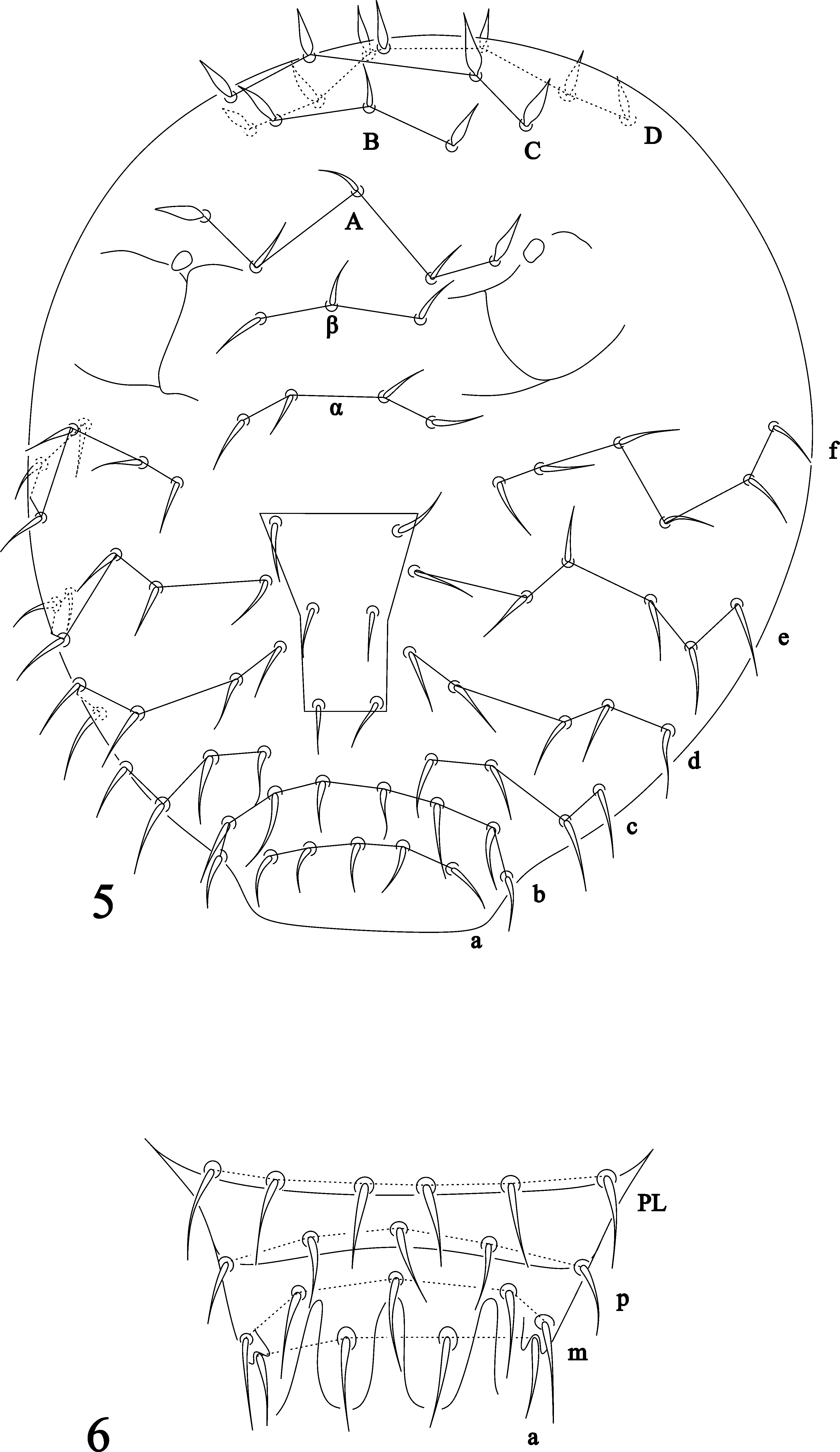
FIGURES 5–6. Arrhopalites mendoncae sp. nov.: 5, cephalic chaetotaxy; 6, clypeo-labral chaetotaxy.
Imageimage/png© Brito, Roniere A.;Lima, Estevam C. A.;Zeppelini, DouglasBrito, Roniere A.;Lima, Estevam C. A.;Zeppelini, Douglas
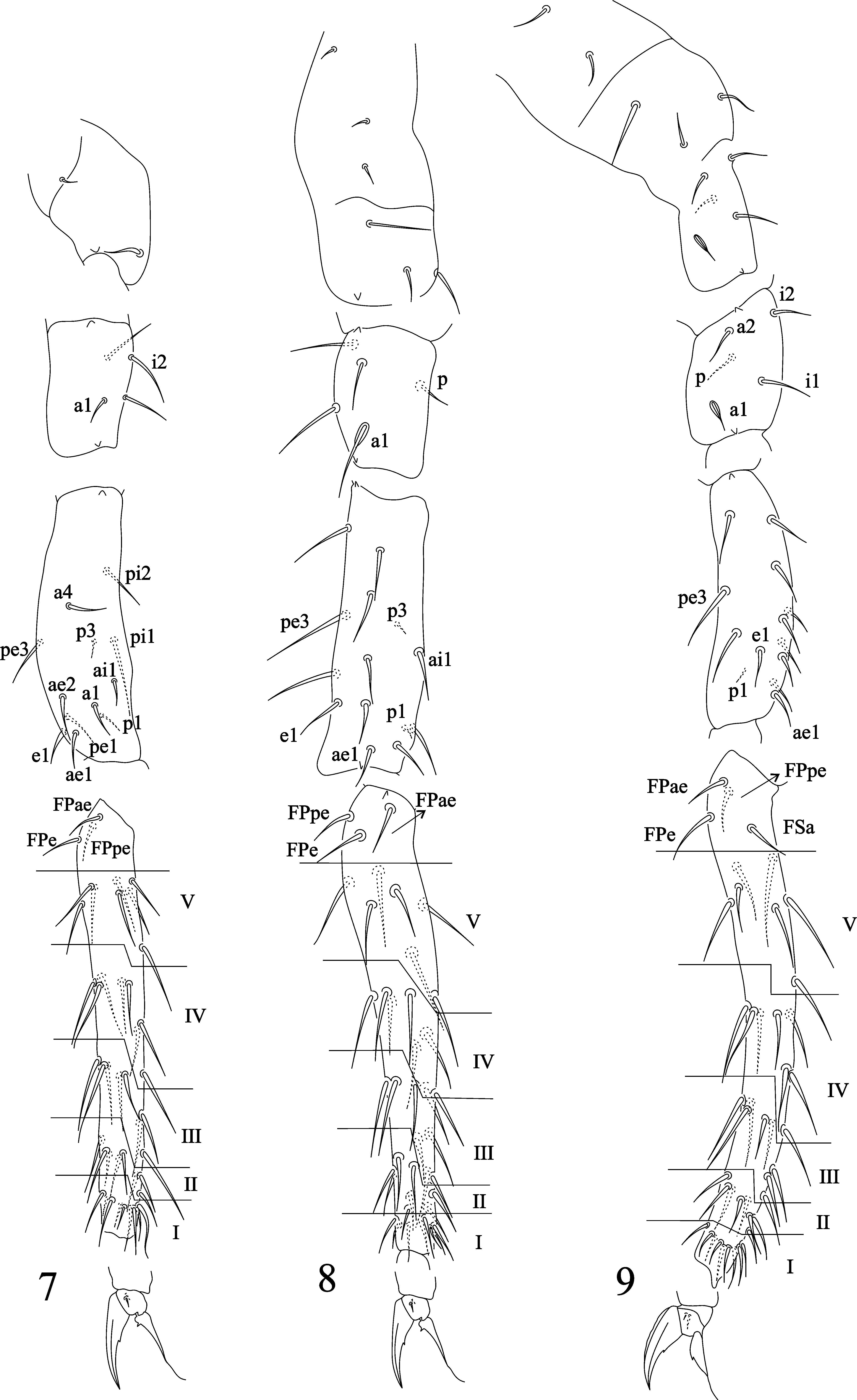
FIGURES 7–9. Arrhopalites mendoncae sp. nov.: 7, chaetotaxy of leg I; 8, chaetotaxy of leg II; 9, chaetotaxy of leg III.
Imageimage/png© Brito, Roniere A.;Lima, Estevam C. A.;Zeppelini, DouglasBrito, Roniere A.;Lima, Estevam C. A.;Zeppelini, Douglas
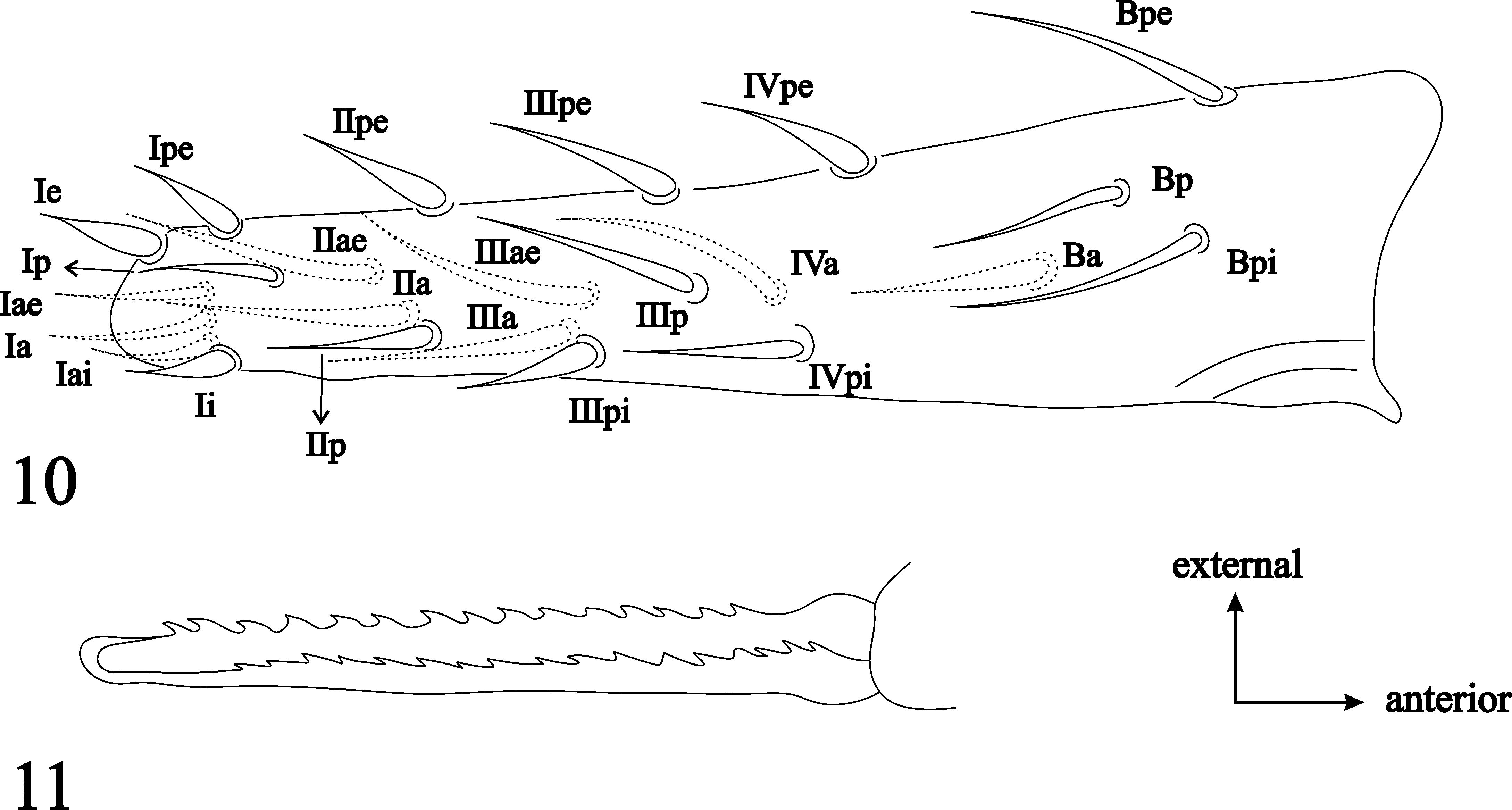
FIGURES 10–11. Arrhopalites mendoncae sp. nov.: 10, chaetotaxy of dens; 11, mucro.
Imageimage/png© Brito, Roniere A.;Lima, Estevam C. A.;Zeppelini, DouglasBrito, Roniere A.;Lima, Estevam C. A.;Zeppelini, Douglas
IMAGES