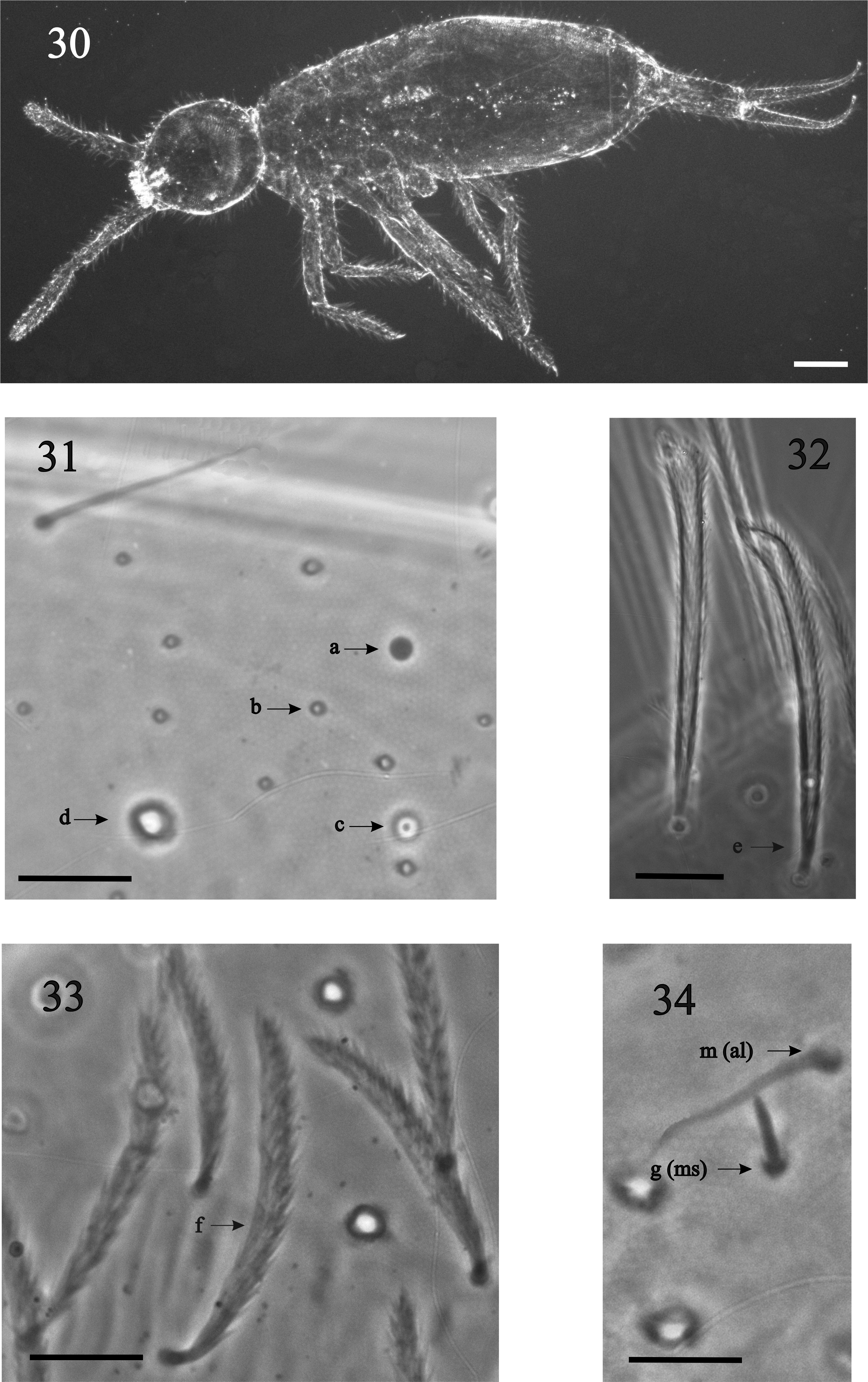
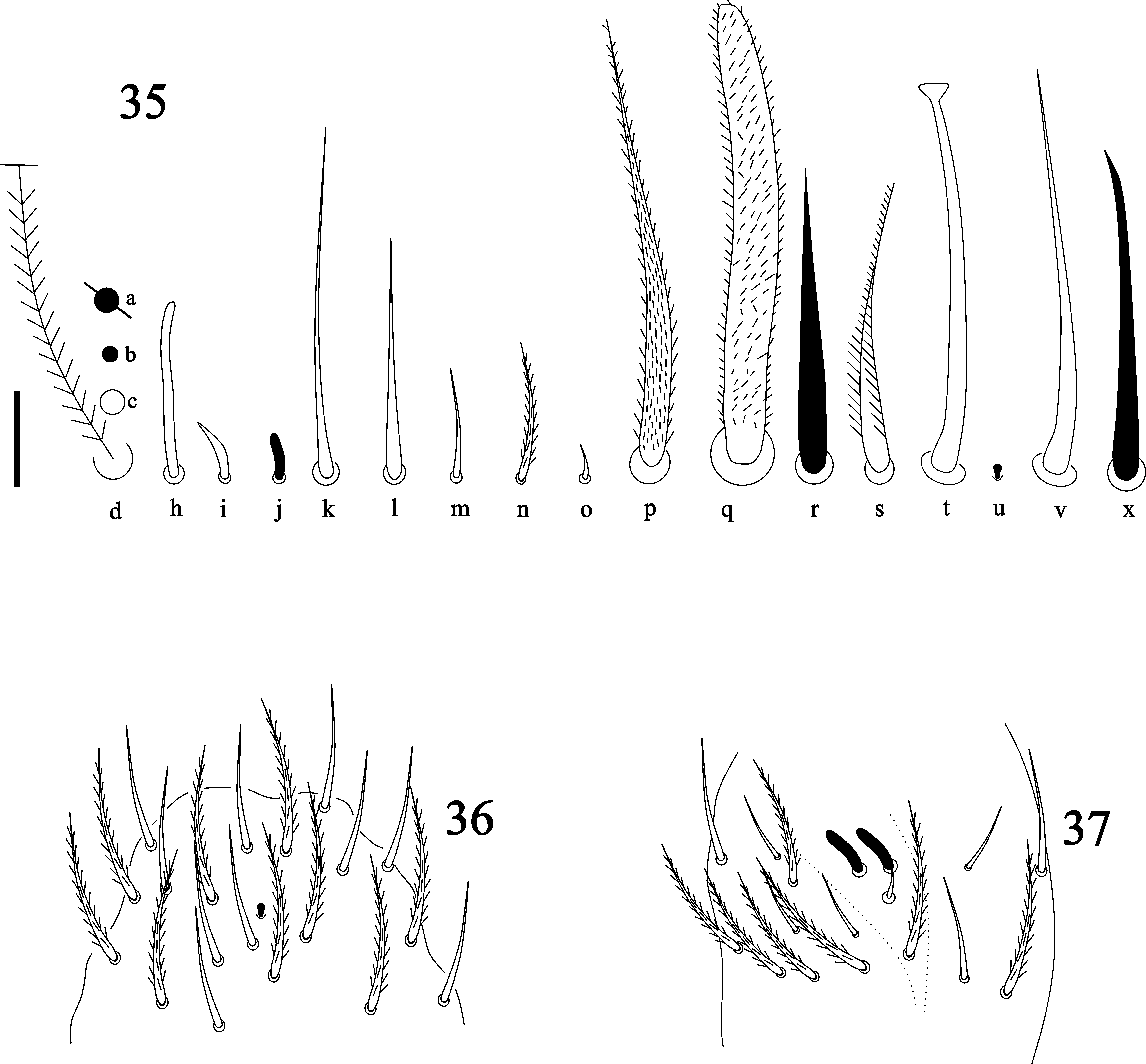
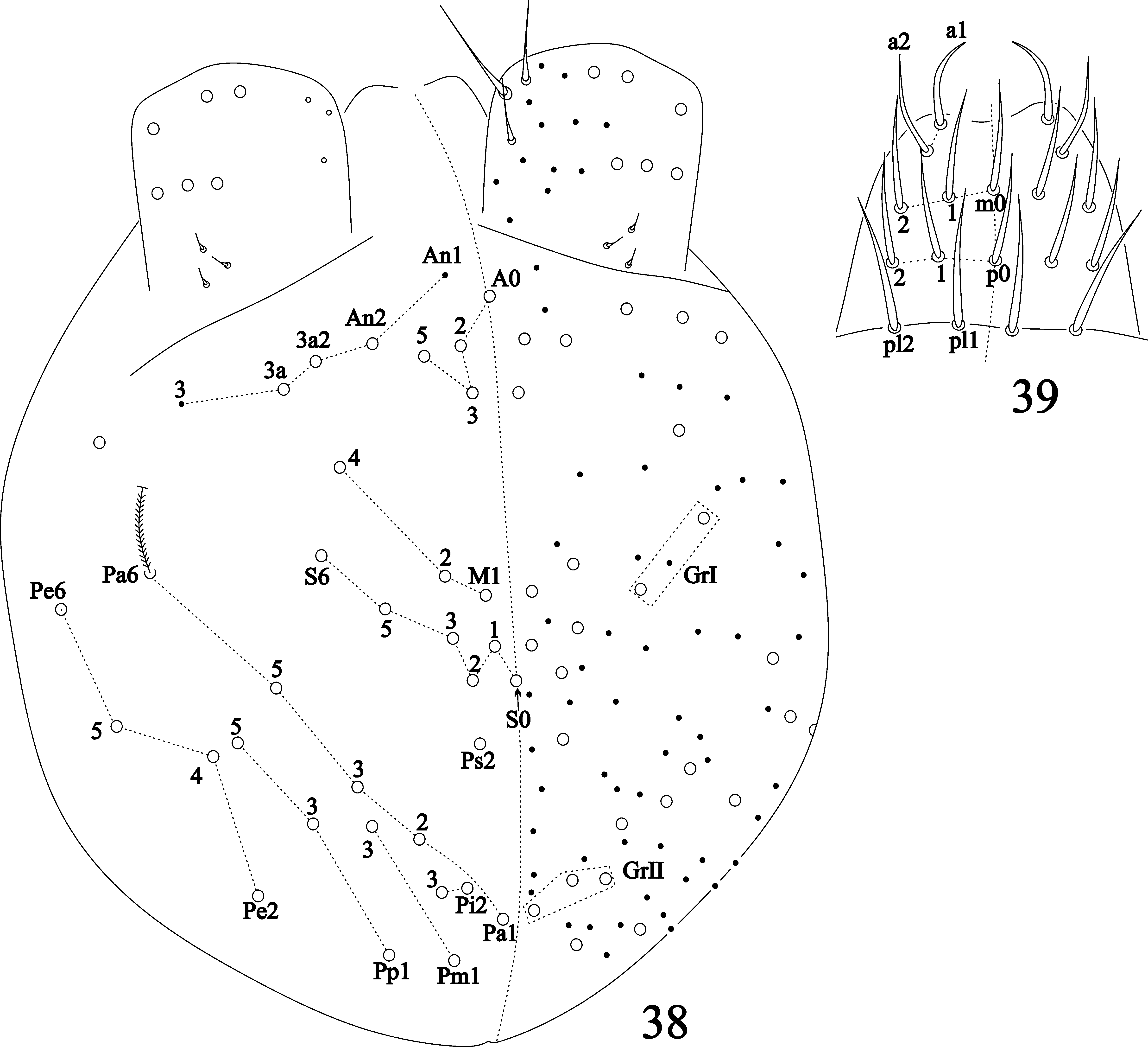
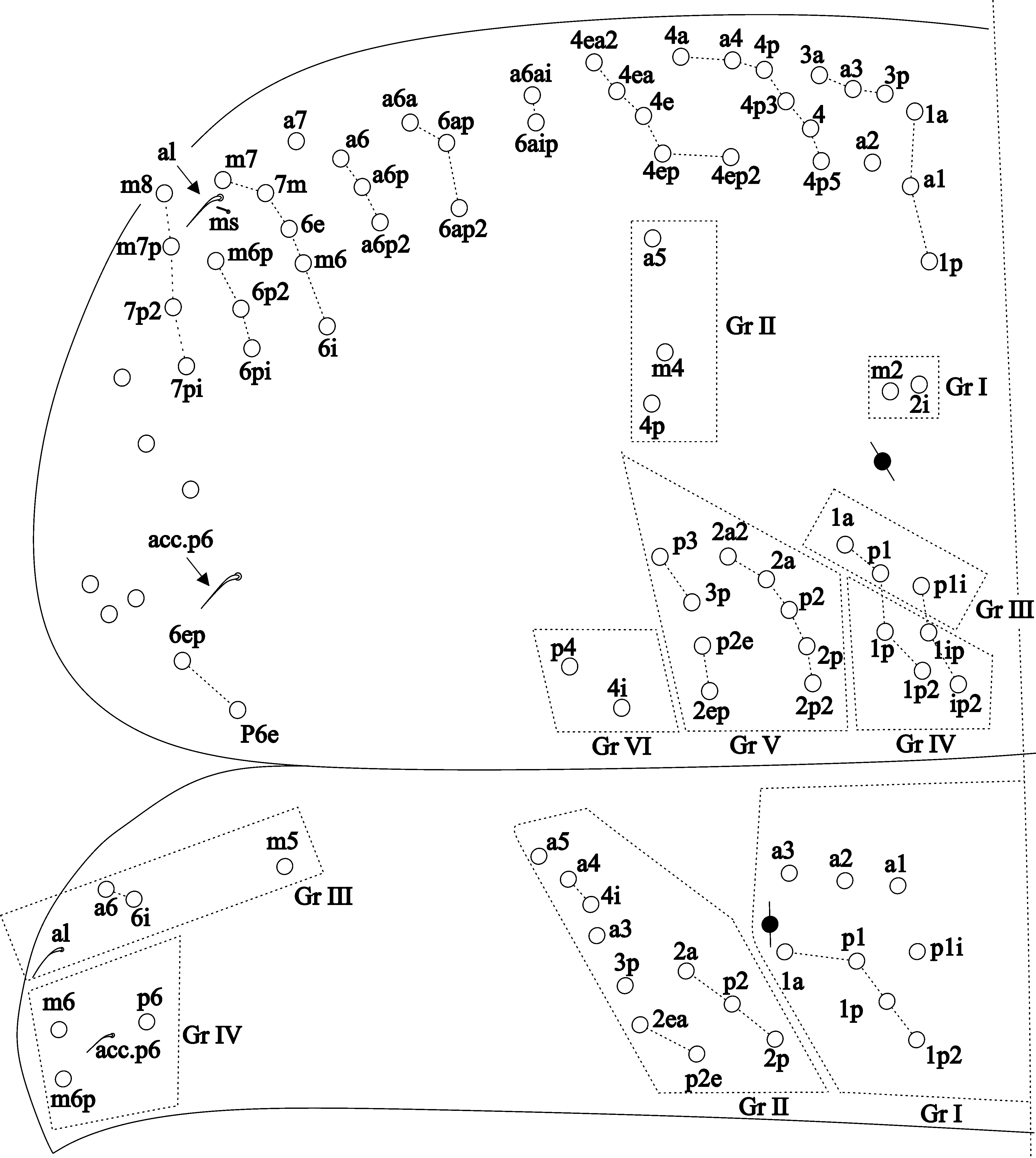
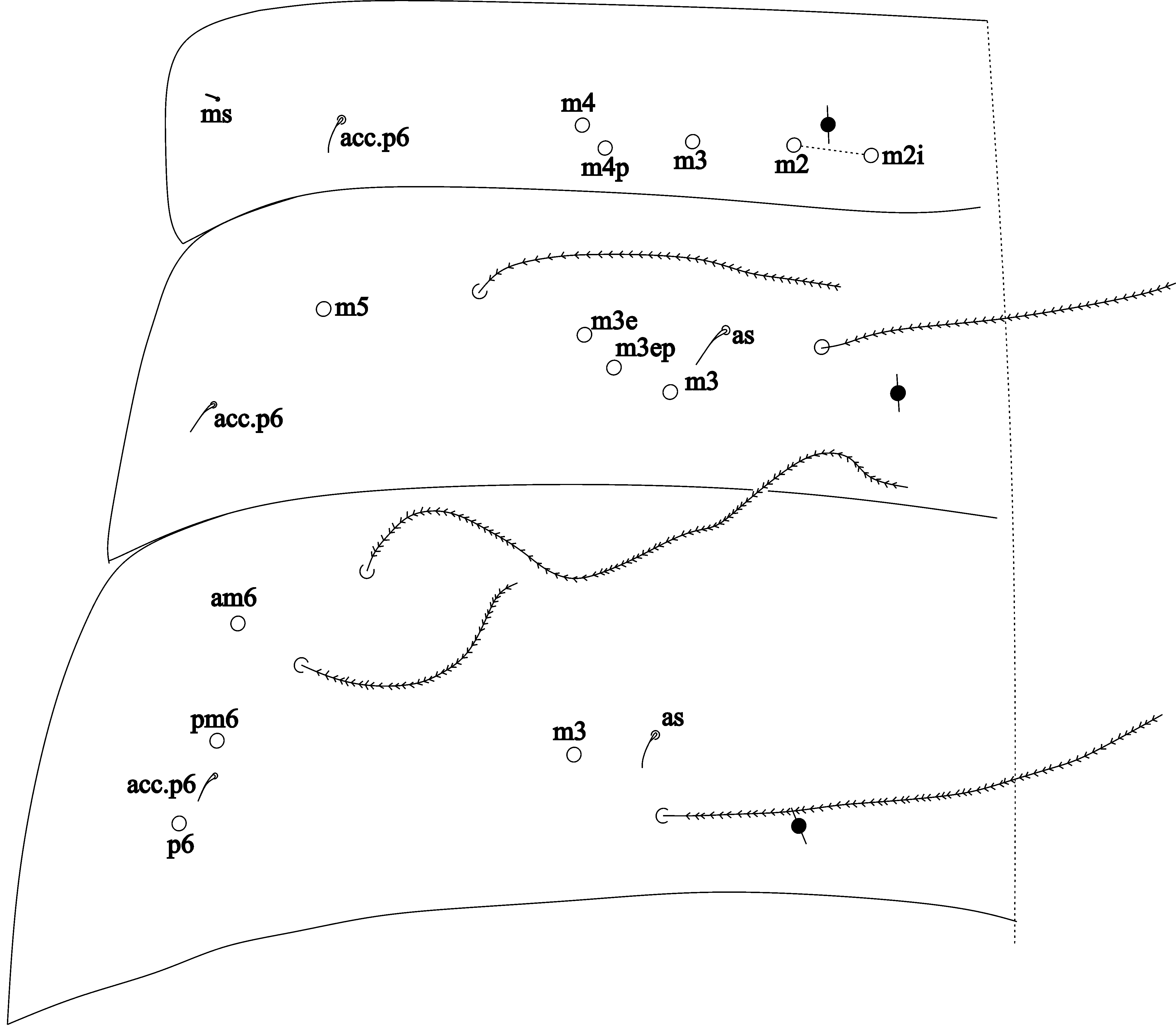
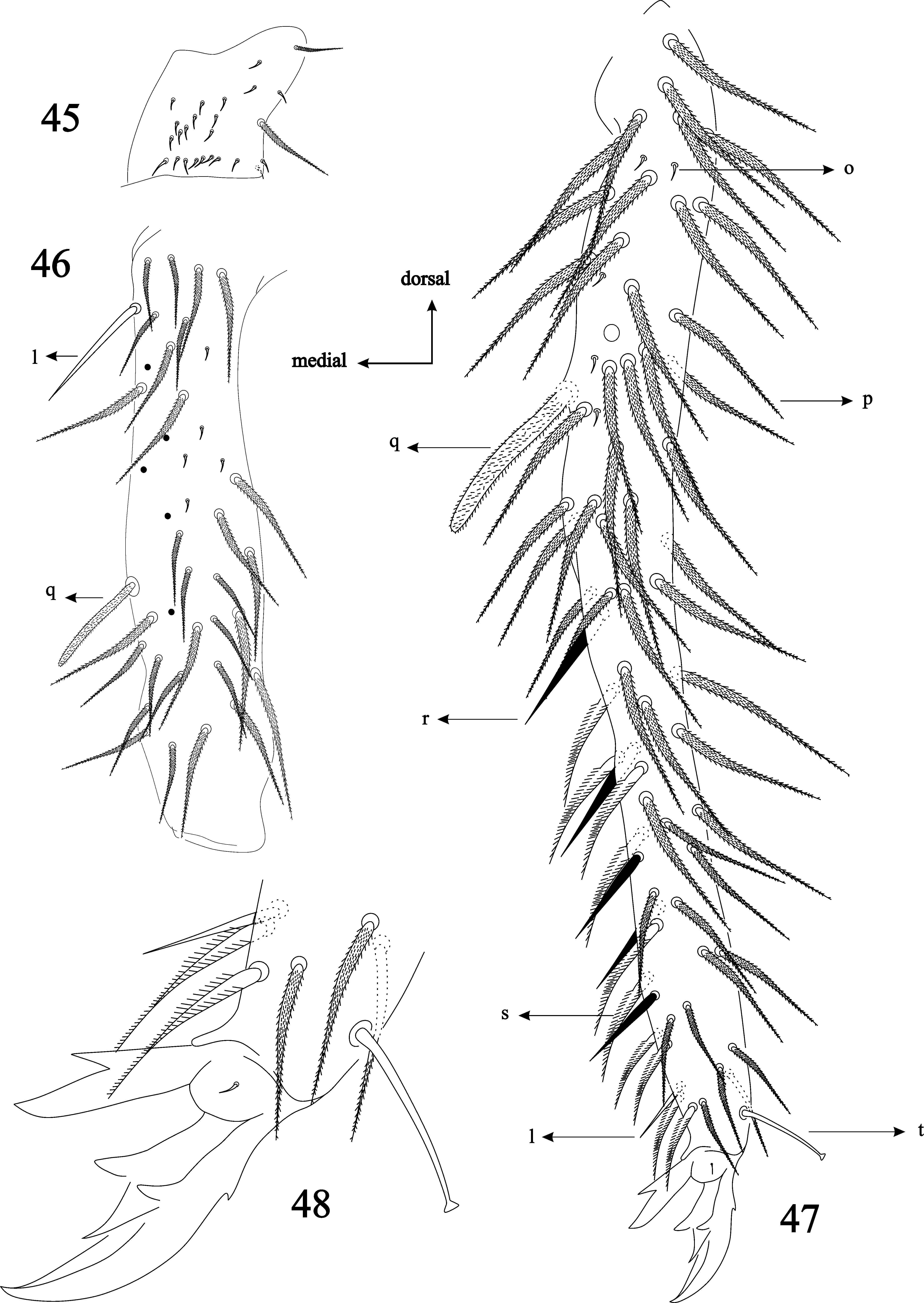
Description. Habitus typical to the genus (Fig. 30). Measurements found in Table 1. Body pale, pigment and scale absent, densely covered by different types of chaetae (Figs. 31 – 35). Antennae (Figs. 36 – 38). Ant. IV not annulated; apical papilla absent, dorsal face on apex with two chaetae types (‘ m’, ‘ n’) plus a subapical organite (type ‘ u’) (Fig. 36); dorsal face on medial and basal parts with three chaetae types (‘ f’, ‘ m’, ‘ n’) and two sensilla types (‘ h’, ‘ i’); ventral face with three types chaetae (‘ f’, ‘ m’, ‘ n’). Ant. III dorsally covered by two chaetae types (‘ f’, ‘ n’), and 8 chaetae type ‘ m’; apical organ with two sensilla (type ‘ j’), and one guard mic (type ‘ o’) (Fig. 37); apical internal face with two sensilla (type ‘ h’) and 1 mes (type ‘ l’); medial internal face with one mic (type ‘ i’); medial external face with two sensilla (type ‘ h’) and two mic (type ‘ i’) almost the same size (~ 10 µm). Ant. II dorsally covered by two chaetae types (‘ f’, ‘ n’) plus one mac (type ‘ e’), one mes (type ‘ l’) and one chaetae (type ‘ m’); medial internal face with three sensilla (type ‘ h’) and one mes (type ‘ l’); medial external face with three sensilla (type ‘ h’) and one mic (type ‘ i’); ventral face with one mic (type ‘ o’) and one chaetae (type ‘ m’) at the base, four mes (type ‘ l’) and one chaetae (type ‘ m’) on the mid-apical portion. Ant. I covered by two chaetae types (‘ f’, ‘ n’); dorsal face with three mic (type ‘ o’) at the base, six mac (type ‘ e’), and three chaetae (type ‘ m’) on the mid-apical portion. Head (Figs. 38, 39). Eyes absent. Dorsal chaetotaxy (Fig. 38) with three antennal mac (An 2, 3 a 2 and 3 a), An 3 as mes; four anterior mac (A 0, A 2 – 3 and A 5); three median mac (M 1, M 2 and M 4); six sutural mac (S 0 – S 4 and S 6), S 5 as mac; one post-sutural mac (Ps 2); two post-occipital internal mac (Pi 2 – 3); four post-occipital anterior mac (Pa 1 – 3 and Pa 5); two post-occipital medial mac (Pm 1 and Pm 3); three post-occipital posterior mac (Pp 1, Pp 3 and Pp 5); four post-occipital external mac (Pe 2, Pe 4, Pe 5 and Pe 6). GrI with two mac (S 5 and S 6) (Fig. 38) and GrII with three (Pa 1, Pi 2 and Pi 3) (Fig. 38). Clypeal formula 2 (l 1), 4 (f 1 – 2), 3 (pf 0 – 1) chaetae, f 2 short and ciliate, others are smooth. Labral chaetotaxy according to formula; a, m, p, pl with 4,5,5,4, respectively, all smooth and acuminate chaetae (type ‘ l’), a 1 and a 2 curved and somewhat spine-like (Fig 39). Outer maxillary lobe with one papillate chaeta, one basal chaetae, and three sublobal hairs. Ventral chaetotaxy with numerous smooth and ciliated chaetae. Labial triangle chaetotaxy as m 1 rel 1 l 2, all smooth chaetae, m 2 (?) absent, r shorther than m 1 and both smaller than the others (Fig. 40). Postlabial area with G 1 – G 4, H 1 – H 4 chaetae (type ‘ l’), X and X 4 (type ‘ o’), X 1 and X 3 absent. Along cephalic groove with 3 – 4 smooth and 4 – 6 ciliate chaetae (Fig. 40). Labial palp with five main papillae (A – E) plus one hypostomal papilla (H), with 0 5 0 4 4, 2 guard appendages, and a lateral process (l. p.) finger-shaped papilla E (Fig. 41), base of the palp with five proximal chaetae (type ‘ l’). Thorax chaetotaxy (Fig. 42). Th II with ms (S-microchaeta type ‘ g’) and al and acc. p 6 sensilla (type ‘ m’); Gr I with two (m 1, m 1 i), Gr II with three (a 5, m 4, 4 p), Gr III with three (p 1 i, p 1, 1 a), Gr IV with four (1 ip, ip 2, 1 p, 1 p 2), Gr V with nine (2 a 2, 2 a, p 2, 2 p, 2 p 2, p 3, 3 p, p 2 e, 2 ep) and Gr VI with two (p 4, 4 i) mac (Fig. 42). Th III with al and acc. p 6 sensilla (type ‘ m’ )); Gr I – IV with 8,10,3,3 mac respectively (Fig. 42). Abdomen chaetotaxy (Figs. 43, 44). Abd I with five medial mac (m 2, m 2 i, m 3, m 4, m 4 p), acc. p 6 (type ‘ m’) and a ms (type ‘ g’). Abd II with three central mac (m 3, m 3 ep, m 3 e) and one (m 5) lateral mac (m 3, m 3 ep, m 3 e, m 5). Abd III with one central mac (m 3) and three lateral mac (am 6, pm 6, p 6). Abd IV about 3.5 × the length of Abd III along dorsal midline, with as and ps sensilla (type ‘ m’), 9 – 11 chaetae (type ‘ k’, nine in holotype); four medial (I, A 6, B 4, M) and six lateral mac (D 1 – 3, E 2 – 4, F 1) each side, nine posterior chaetae (Fig. 44). Abd V with three sensilla (type ‘ m’); one anterior (a 6), three medial (m 1, m 3, m 5), and one posterior mac (p 1) (Fig. 44). Abd VI with one anterior and posterior mac (a 1, p 1) (Fig. 44). S-chaetae formula from Th. II – Abd. V 2 + ms, 2 / 1 + ms, 2, 2, 2 + 9 – 12 (type ‘ k’). Legs (Figs. 45 – 48). External face of coxa I, II and III with two pseudopores. Meta-trochanteral organ with 18 – 23 smooth spine-like chaetae (Fig. 45). Femur I, II and III covered by type ‘ p’ mes, presented one proximal type ‘ l’ mes and 2 type ‘ q’. Femur II and III with 5 type ‘ o’ mic (Fig. 46). Tibiotarsi with types ‘ o’, ‘ p’, ‘ t’, ‘ l’, ‘ s’, a row with 5 ‘ r’, and 2 ‘ q’ chaetae (Fig. 47). Tibiotarsus I without types ‘ o’ and ‘ l’ chaetae. Unguis with one unaired and one basal paired inner tooth, and one unpaired median tooth externally. Unguiculus with a large outer tooth smooth edges (Figs. 47 – 48). Leg I tenent hair acuminate (type ‘ v’), II and III clavate (type ‘ t’). Collophore (Figs. 49 – 51). Posterior side with 3 + 3 chaetae (type ‘ l’) and 2 + 2 mic (type ‘ o’) (Fig. 49); lateral flap with 6 – 9 + 6 – 9 chaetae (type ‘ l’) (Fig. 50); anterior side with 4 + 4 chaetae (type ‘ p’) (Fig. 51). Furca (Figs. 52, 53). Tenaculum with four teeth of decreasing size from the basal to the distal one of each ramus, with a postero-basal chaetae bent distally (type ‘ x’). Manubrium dorsally covered with ciliated (type ‘ p’) and 5 – 7 smooth (type ‘ l’) chaetae, manubrial plate with two chaetae (type ‘ p’) and two pseudopore (Fig. 52), distal part of manubrium ventral with 9 chaetae (type ‘ p’). Dens annulated and covered with chaetae (type ‘ p’) on both sides, basal dens with 1 + 1 chaetae (type ‘ l’), distal smooth part of dens with same length of mucro. Mucro falcate with basal spine almost reaching mucro apex, distal smooth part of dens with same than mucro length (Fig. 53).
Brito, Roniere A., Lima, Estevam C. A., Zeppelini, Douglas (2019): Three new species of Collembola (Arthropoda: Hexapoda) from Brazil. Zootaxa 4700 (4): 401-430, DOI: 10.11646/zootaxa.4700.4.1