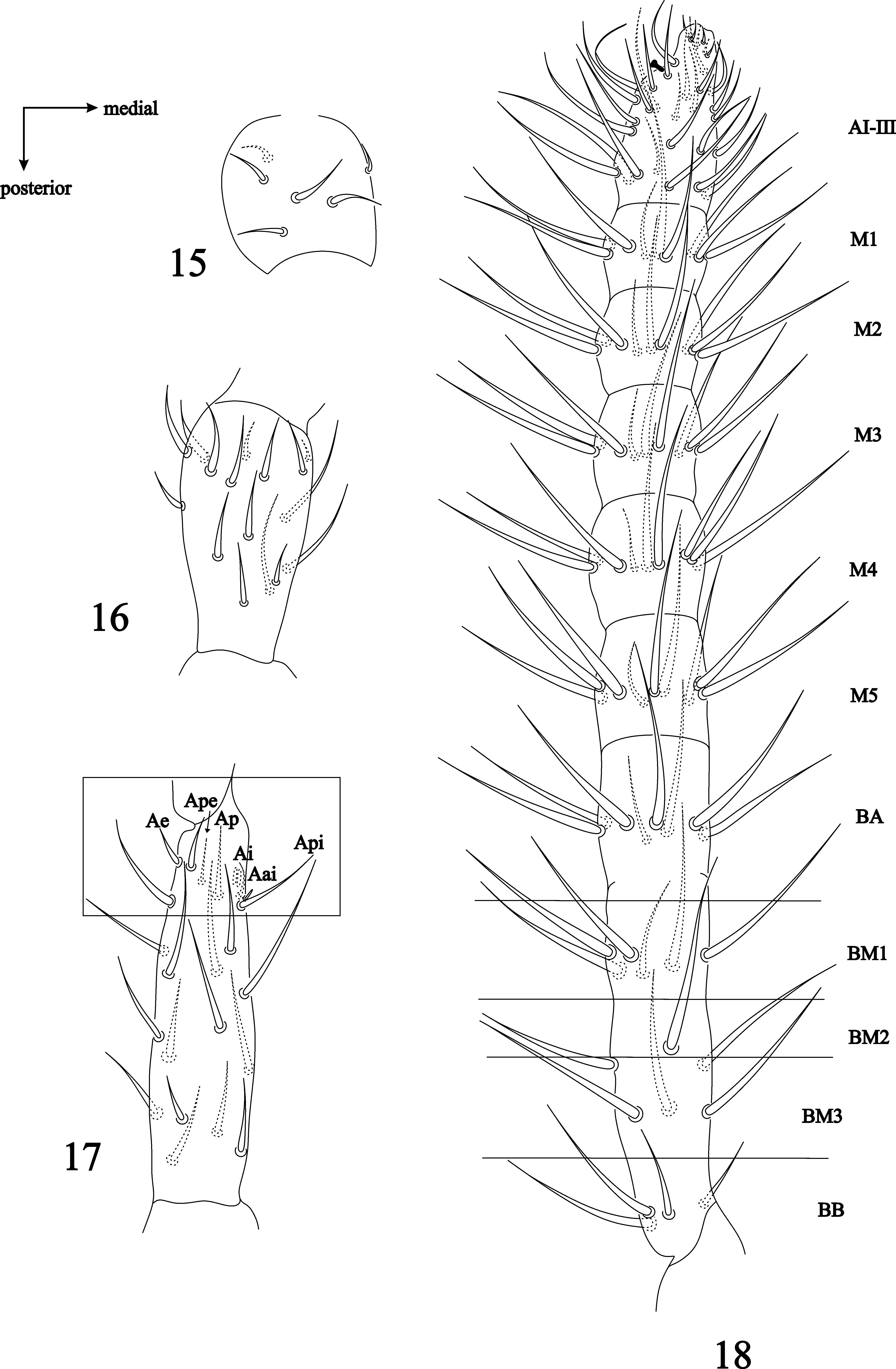
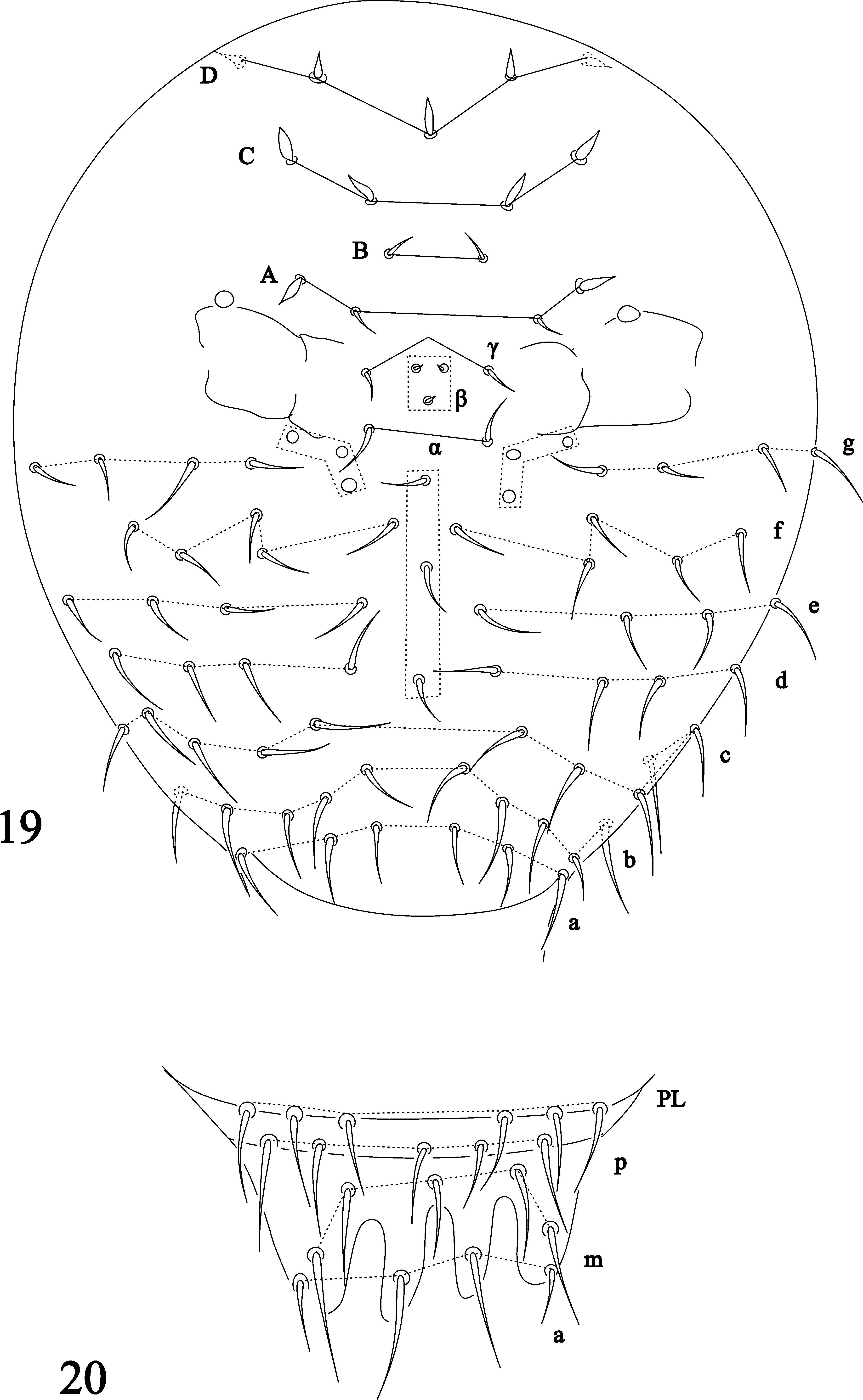
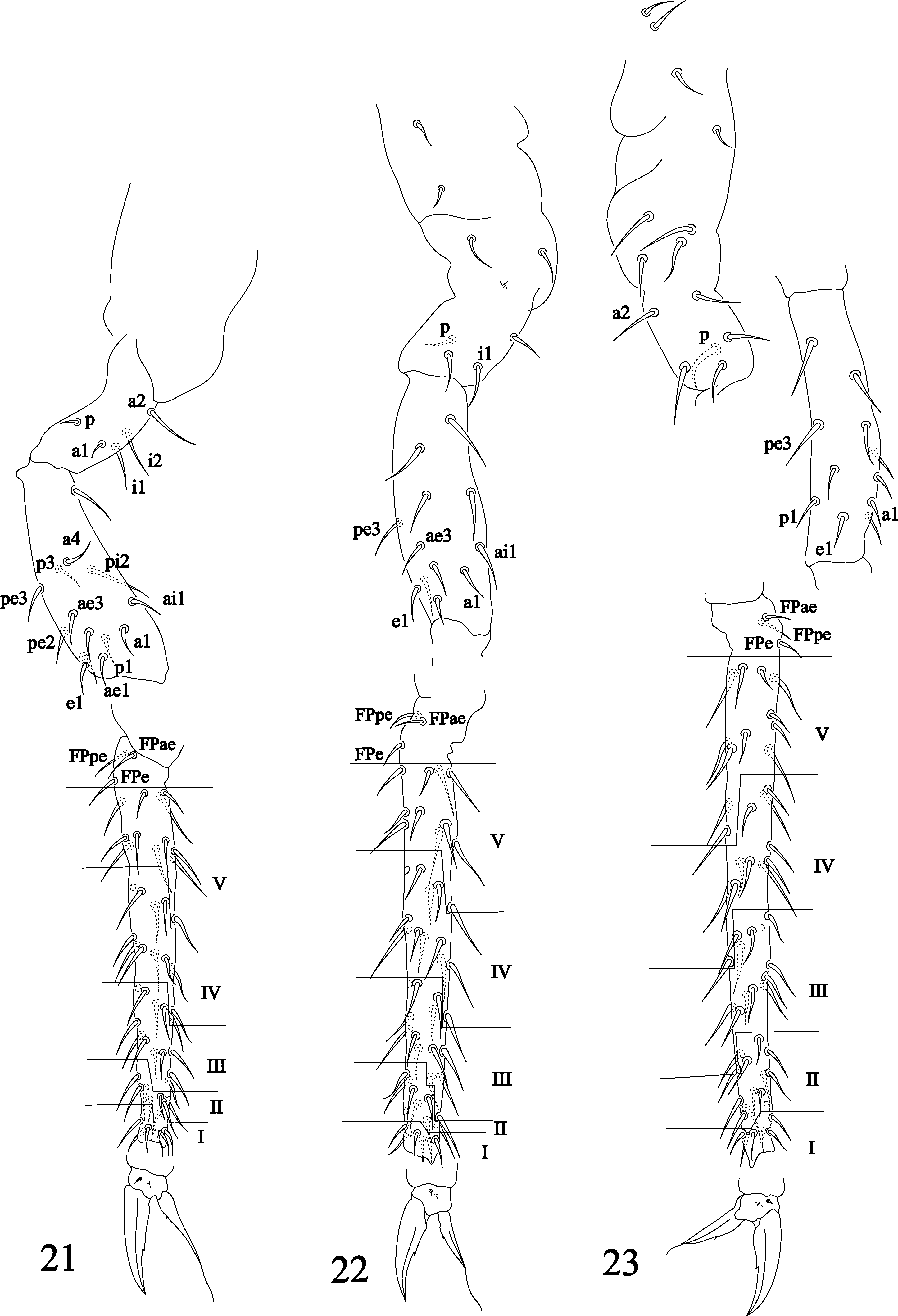
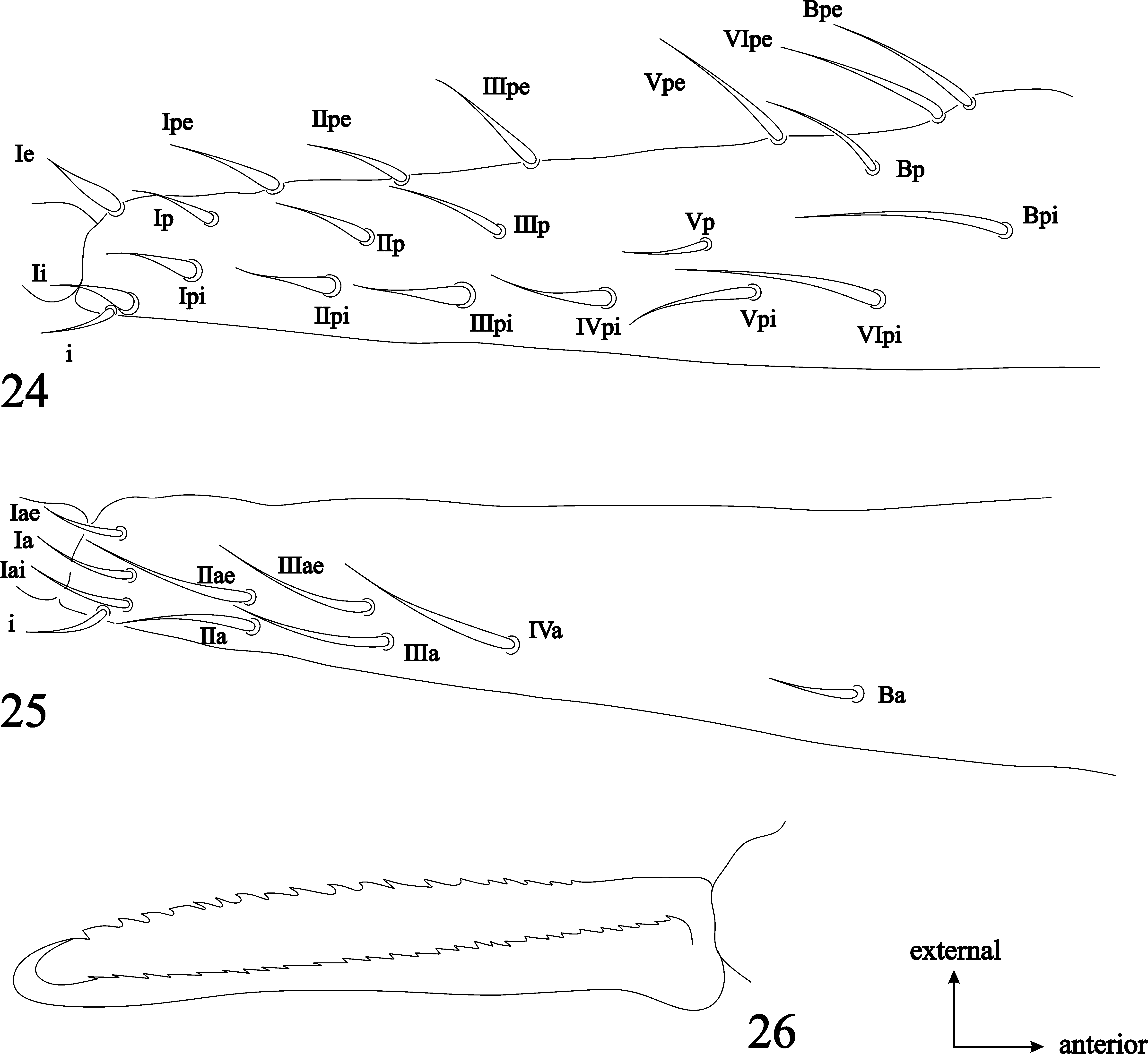
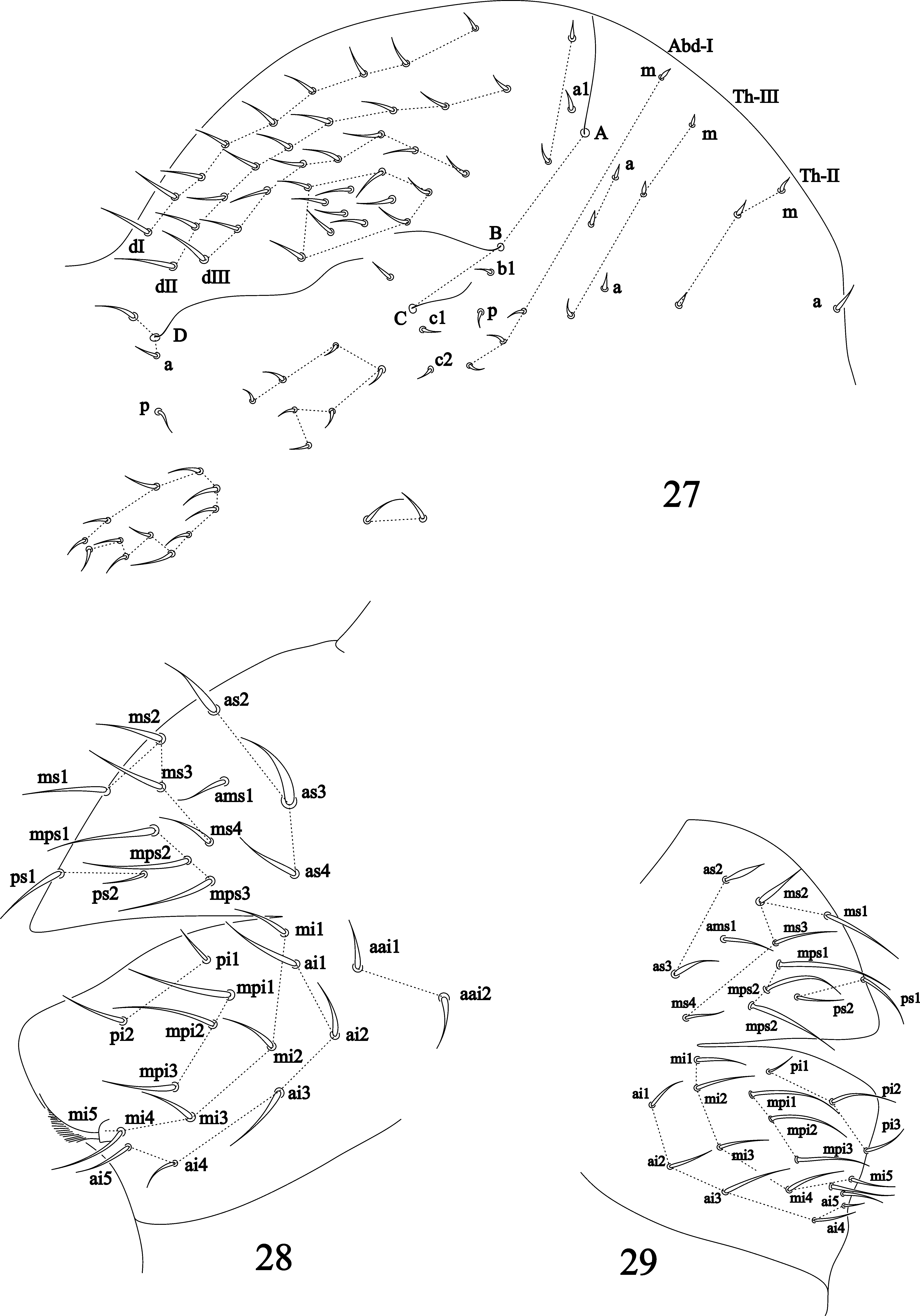
Description. Holotype body about 1.16 mm length. Other measures found in Table 1. Coloration white in ethanol. Antennae (Figs. 15 – 18). About 1.68 × cephalic length. Mean length ratio Ant. I: II, III, IV = 1: 1.8, 3.0, 8.1. Ant. I with four normal chaetae, a bristle-like sensillum on anterior side, one chaetae in apical portion of posterior side (Fig. 15). Ant. II with eight apical chaetae, two small and thin on posterior side, three external apical slightly spiny, and eight mid-basal chaetae (Fig. 16). Ant. III apical organ with two slender elongate sensilla inserted in a single pit; Aai chaetae slender, slightly curved and blunt, Api elongated larger than Ap, Ape bristle-like; Ai acuminated, slightly shorter than Ape and Ae. Ant. III mid-basal part with 14 chaetae (Fig. 17). Ant. IV subdivided into eight, sub-segmentation sometimes incomplete in sub-segment BA. Sub-segment formula 1 + 6 + 1 = (A) + (M 1 – 5 + BA) + (BM + BB), A apex with a capitate sense rod. Ant. IV bears 13 whorls of chaetae: three on apical sub-segments (A), six on median sub-segments (M 1 – M 5 + BA), and four on basal sub-segments (BM 1 – BM 3 + BB) (Fig. 18). Head (Figs. 19, 20). 1 + 1 unpigmented ocelli. Posterior cephalic chaetae slightly spines interposed between normal chaetae, posterior dorsal chaetotaxy A, B, C, D as 4,2,4,5, inter-antennal region with two α chaetae, three β microsensilla arranged in triangular shape and two chaetae; frontal cephalic chaetotaxy a to g respectively 6,10,10,8,8,10,8 chaetae, and three medial axial chaetae; 3 + 3 oval-organs structures (Fig. 19). Labral chaetotaxy according to formula a, m, p, pl with 4,5,5,6 chaetae respectively (Fig. 20). Leg I (Fig. 21). Precoxae and coxa without chaetae. Trochanter with four anterior and one posterior chaetae. Femur with 14 chaetae, a 4 turned perpendicularly towards the longitudinal axis of the segment. Tibiotarsus with 53 chaetae, whorl I with 6 normal chaetae, whorls II – V with 8 chaetae each, whorls III – V with 4 upper inter-whorls chaetae; region F with three primary FP chaetae (e, ae, pe), secondary chaetae FSa absent. Pretarsus with 1 + 1 chaetae. Unguis 5.96 × shorter than tibiotarsus; without tunica and with a small inner mid-distal tooth. Unguiculus 1.83 × shorter than unguis, apical filament exceeding unguis tip, with a clear corner tooth. Leg II (Fig. 22). Epicoxae and precoxae with one chaetae each, coxa with two primary chaetae. Trochanter with four chaetae, three anterior and one posterior; femur with 12 chaetae. Tibiotarsus with 53 chaetae: whorl I with 6, whorls II – V with 8, 9, 8, 7, inter-whorls II – V with 0, 4, 4, 4, whorl V Vp chaetae absent; FSa absent. Unguis 6.49 × shorter than the tibiotarsus, without tunica, with one small inner medial tooth. Unguiculus 2.14 × shorter than unguis, subapical filament exceeds unguis tip, with a small corner tooth. Leg III (Fig. 23). Epicoxae with three and precoxae with one distal chaeta, coxa with four chaetae. Trochanter with five anterior chaetae, a curved metatrochanteral spine. Femur with 11 chaetae. Tibiotarsus with 55 chaetae: whorl I with 6, whorls II – V with 7, 8, 8, 8, inter-whorls II – V with 4, 4, 3, 4, FSa absent. Unguis 7.15 × shorter than the tibiotarsus, without tunica, with a small inner medial tooth. Unguiculus 2.20 × shorter than unguis, subapical filament shorter than unguis tip, with corner tooth. Lengths ratio of tibiotarsi I: II, III = 1: 1.04, 1.25. Ratio cephalic: tibiotarsus I = 1.67. Ventral tube 1 + 1 apical anterior chaetae. Rami tenaculum tridentate, corpus two apical chaetae. Furca (Figs. 24 – 26). Manubrium presents 4 + 4 posterior chaetae. Dens (31 chaetae): posterior Ie, Ii and Ipi heavily spiny, IIpi – IVpi and Ipe chaetae somewhat spiny (Fig. 24); anterior chaetotaxy as 4: 2: 2: 1: 1, i chaetae present, all simple (Fig. 25). Mucro both lamellae serrated (Fig. 26). Dens 2 × as large as mucro. Great abdomen (Fig. 27). Th and Abd I spines short and spearhead-like, dorsal posterior abdominal chaetae normal, smooth and acuminate. Trichobothrial complex: ABC form an obtuse angle (= 156 °), AB greater than BC (AB = 120.5, BC = 93.2, AC = 207.8, all in m) (Fig. 27). Single p chaetae of p - row on Abd I closer to trichobothrium C than to B; a 1 posterior, above of trichobothrium A, b 1 slightly posterior, below and closer to trichobothrium B than to C; c 1 chaetae above c 2, both anterior and below trichobothrium C. Central dorsal complex with two chaetae arranged in vertical line. Posterior lateral complex with 3 + 4 chaetae and posterior dorsal complex with dI = 9, dII = 9 and dIII = 8, next to it a grouping of 11 chaetae. Furca base complex with 12 chaetae. Ventral complex with two chaetae. Small abdomen (Fig. 27 – 29). Female. Fifth segment with three chaetae, trichobothrium D in row a, and one chaetae p (Fig. 27). Genital field with 3 + 3 chaetae close to anterior margin of genital opening. Sixth segment with as 2, as 3 slightly elongated and thick; ms, mi, mps and mpi chaetae normal, smooth and acuminated; sub-anal appendage strongly fringed (unilaterally) (Fig. 28). Male. Chaetotaxy of Abd VI differs from female by the absence of as 4 chaetae, pi 3 present, two additional chaetae between ai 5 and mi 5. Total chaetae number is equal.
Brito, Roniere A., Lima, Estevam C. A., Zeppelini, Douglas (2019): Three new species of Collembola (Arthropoda: Hexapoda) from Brazil. Zootaxa 4700 (4): 401-430, DOI: 10.11646/zootaxa.4700.4.1