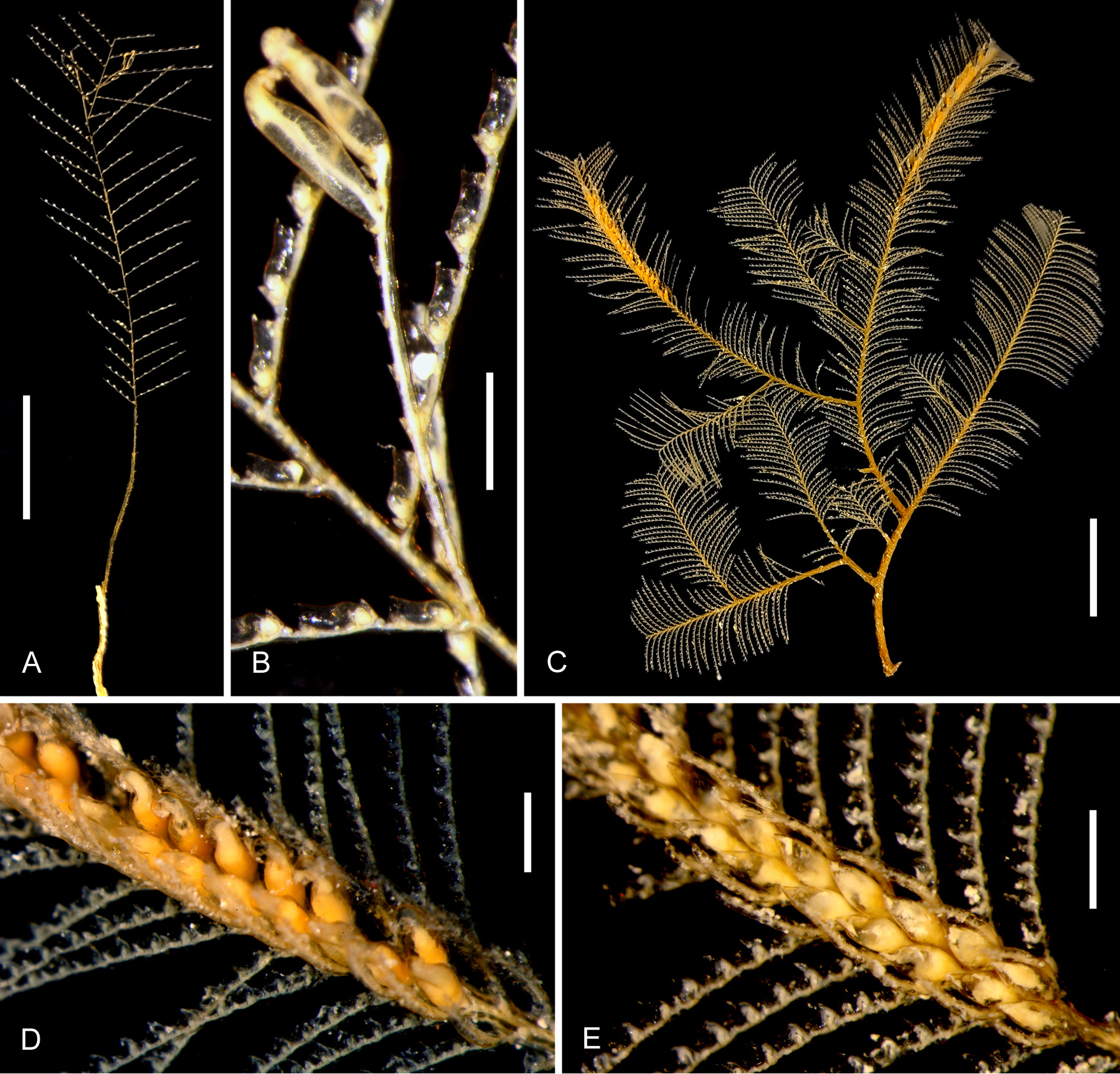
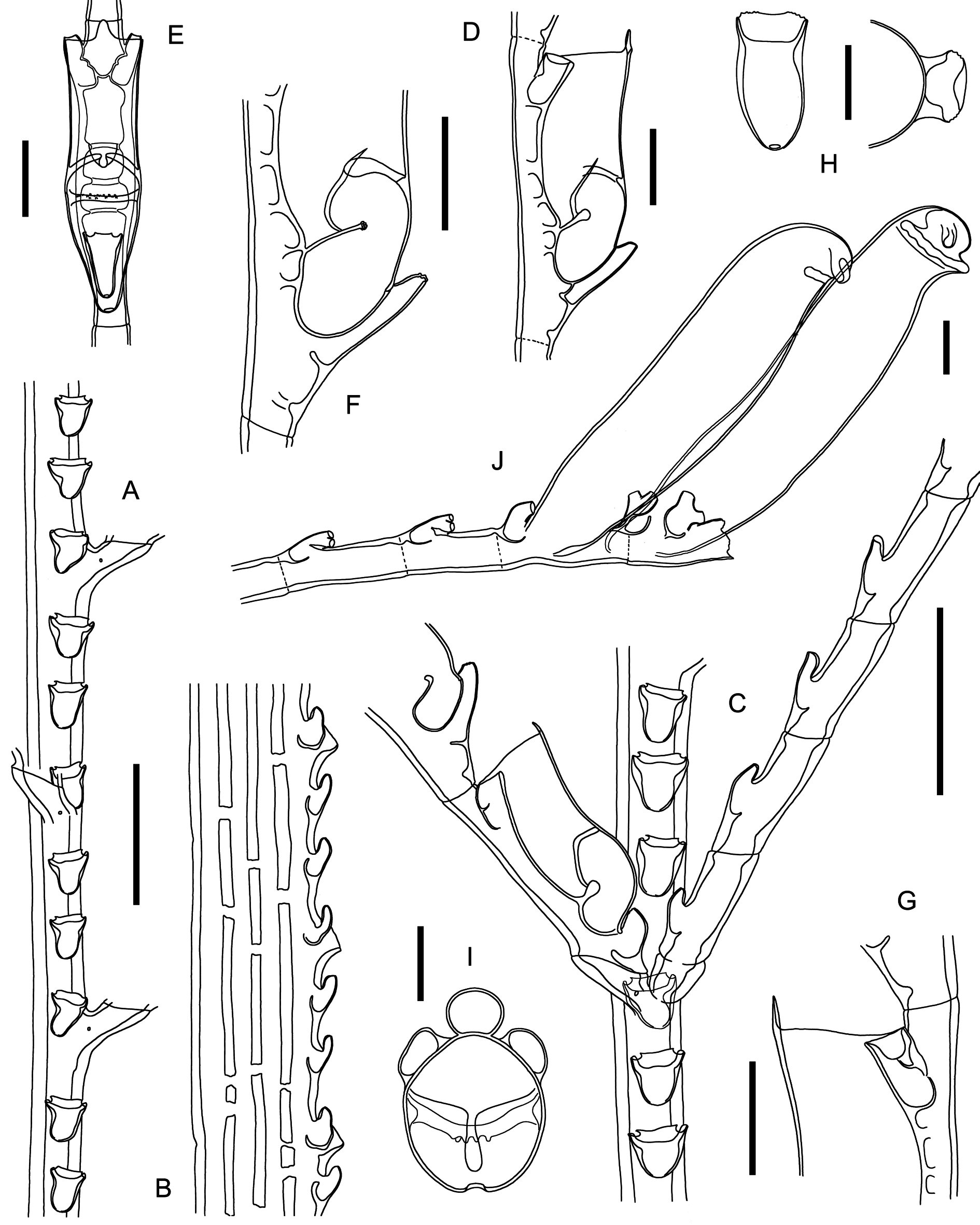
Description Colony erect, feather shaped, delicate, ca 6.5 cm high, hydrorhiza not observed. Stem unbranched although, in the present specimen, the distal part had been partly broken off, but still remained attached, and was consequently displaced laterally by a new, regenerative colony tip that has grown up vertically, giving the impression that the old apex is merely a lateral branch; stem fascicled proximally, grading to monosiphonic distally; every additional auxiliary tube adhering to the dorsal side of the preceding one, not forming a beam around the main tube, but resulting in a laterally-flattened structure (Fig. 7 B); division into internodes indistinct, except for 3 – 4 oblique, deeply-cut nodes towards the proximal part of hydrocaulus, passing through all cauline tubes at a time. Equivalents of internodes 700 – 1050 µm long, 200 – 225 µm wide, composed of 2 – 3 frontal nematothecae in a row, a short lateral cladial apophysis, a reduced nematotheca (with small, rounded aperture) on an inconspicuous mamelon at its base, as well as an axillar, anterior nematotheca rather lateral to it; there is no dorsal axillar nematotheca. Stem nematothecae large, inverted-triangular, with thick perisarc, apertures distal, wide, with inwardly-rolled abaxial wall, giving the impression that two circular apertures are present laterally; apophyses slightly shifted onto the anterior side of the colony, the two rows of hydrocladia forming an obtuse angle. Cladia relatively spaced from one another, up to 1 cm long, unbranched, divided into up to 12 cormidia by means of transverse, though not clearly demarcated nodes (75 – 95 µm wide), each internode 775 – 865 µm long, accommodating a hydrotheca and its 3 associated nematothecae: one mesial and a pair of laterals; up to 8 intranodal projections of the perisarc, of which 2 are given off from the abaxial side below the hydrothecal base, and up to 6 arise from the dorsal wall of the hydrotheca and project for a short distance into the lumen of the internode. Hydrotheca elongated, 600 – 635 µm deep, laterallyflattened, ad- and abaxial walls with slight basal bulges; a septum projecting slightly upwards from the lower portion of the adaxial wall reaches up to the middle of the thecal lumen, and is provided anteriorly with a distal swelling scattered with granular projections; a second, lamellar, two-winged septum is given off upwardly from the lateral sides of the hydrotheca at a rather acute angle, then changes its orientation and slightly plunges downwards, attaching its anterior border to the abaxial wall of the theca, leaving a slit-like, median passage between its two lateral ‘ wings’; hydrothecal aperture 225 – 230 µm wide, rim with a prominent, central, well-developed, abaxial cusp, nearly smooth elsewhere. Mesial nematothecae elongated, rather broad in frontal view, adnate for most of their length, leaving a short (40 – 50 µm) portion free from the base of the corresponding hydrotheca; aperture broad, abaxial wall inwardly-rolled, rim crenelate at corners; mesial nematotheca of first cormidium short, guttershaped and not coalescent with the hydrothecal base. Lateral nematothecae 145 – 155 µm long, broadly cylindrical, reaching the level of the hydrothecal rim; adaxial wall deeply scooped out, abaxial wall crenelate to wavy. Phylactocarp mounted on a short stem apophysis arising laterally, next to a cladial apophysis, on opposite side; divided into several moderately-long (360 – 485 µm) internodes by means of transverse to slightly oblique nodes, each bearing a frontal nematotheca similar to those of stem, with large apical apertures and inwardly-rolled abaxial walls, giving the impression that the nematothecae are bifid; last couple of internodes additionally provided with a basally concrescent gonotheca; the latter long, tubular (ca 1630 × 400 µm), tapering below, distally with a main, broad, subterminal, slit-like aperture with flimsy, wavy rim, above which a second, short, slender, gutter-shaped aperture is to be found. Sex undeterminable.
Galea, Horia R. (2020): Aglaopheniid hydroids (Cnidaria: Hydrozoa: Aglaopheniidae) from off New Caledonia collected during KANACONO and KANADEEP expeditions of the French Tropical Deep-Sea Benthos Program. European Journal of Taxonomy 615: 1-47, DOI: 10.5852/ejt.2020.615