
AnimaliaNot EvaluatedacceptedspeciesAccepted
Lytocarpia fragilis
Galea, 2020
GBIF:162505297
0year
ABOUT
Descriptions(7)
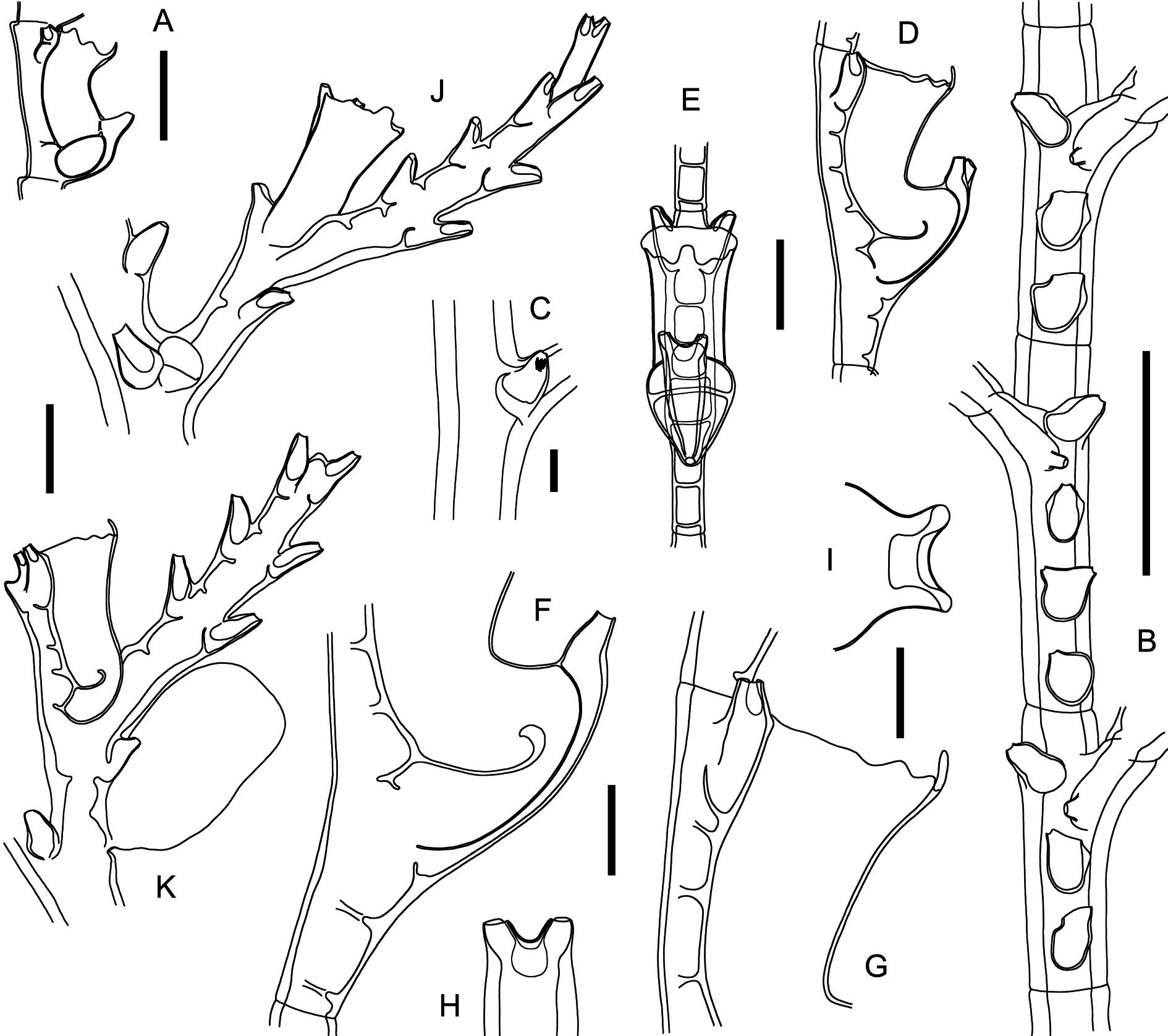
Description Colony erect, of a delicate appearance, comprising a single plume, originally taller than the 7.5 cm-high fragment left after the breakage and subsequent loss of its distal part; arising from a rhizoid stolon firmly attached to hard substrate. Stem unbranched, lightly fascicled, grading to monosiphonic distally; main tube composed of a long (3.5 cm) proximal part devoid of hydrocladia but bearing large, saccate nematothecae in a single, frontal row, and a shorter part bearing cladia; both parts are separated by a short intervening prosegment with one frontal nematotheca, delimited at both ends by very oblique, deeply-cut nodes. Upper part divided, sporadically, into long segments by means of a few oblique nodes; segments further divided into regular, moderately long (680 – 840 µm) internodes delimited by transverse nodes (150 – 170 µm wide), inconspicuous wherever the perisarc is thick, but becoming obvious in youngest parts; each internode with 2 – 3 frontal nematothecae in a single row, a short cladial apophysis with its basal, simple nematotheca mounted on an inconspicuous mamelon, a nematotheca lateral to the apophysis (axillar, in front of stem), as well as an axillar nematotheca on dorsal side of the stem. Frontal nematothecae large, saccate, with wide aperture behind, sometimes giving the impression that one or two lateral apertures are present, due to their inwardly-rolled abaxial walls. Cladia alternate, fairly close to one another on each row, up to 1.3 cm long, composed of up to 18 cormidia. The latter moderately long (705 – 715 µm long, 65 – 70 µm wide at node), accommodating a hydrotheca in their distal ¾, and its 3 associated nematothecae: one mesial and a pair of laterals; 6 intranodal projections of the perisarc: 4 given off from the adaxial wall of the hydrotheca, while the remaining 2 from the abaxial perisarc of the internode. Hydrotheca 475 – 485 µm deep, S-shaped in lateral view, lower half distinctly swollen when seen frontally; mesial nematotheca adnate for most of its length, leaving a short, free, bifid portion reaching the middle of the theca; aperture wide, abaxial wall inwardly-rolled; lateral nematothecae conical, with gutter-shaped apertures in their adaxial wall; hydrothecal aperture 230 – 240 µm wide, rim with a prominent, rounded, abaxial cusp, lateral edges with two pairs of low, triangular cusps, prolonged adaxially by a mere undulation of the margin. Gonosome an open corbula on the modified distal portion of a cladium, after a sequence of 3 – 6 normal cormidia proximally; rachis divided into short internodes by means of transverse nodes; each internode with a costa (there is no distinct apophysis supporting it; costae alternate) and a large, saccate nematotheca (with gutter-shaped aperture) lateral to it; unlike the subsequent ones, the first internode of the corbula possesses an axillar nematotheca at junction between the insertion of costa and the internode; costae composed of a modified hydrotheca that retains its lateral nematothecae at their normal place, while the mesial one (with single, gutter-shaped aperture in this case) is placed a certain distance below the hydrothecal base, so as to allow the formation of a rib composed of about 3 – 4 pairs of nematothecae arranged along its length; except for hydrothecae of the 1 st or 2 nd rib, those placed more distally in the corbula possess an extra, gutter-shaped nematotheca on their dorsal side (compare Fig. 11 J and 11 K). The gonothecae, lenticular in shape, are inserted at the bases of costae, close to the large internodal nematotheca; perisarc flimsy.
Galea, Horia R. (2020): Aglaopheniid hydroids (Cnidaria: Hydrozoa: Aglaopheniidae) from off New Caledonia collected during KANACONO and KANADEEP expeditions of the French Tropical Deep-Sea Benthos Program. European Journal of Taxonomy 615: 1-47, DOI: 10.5852/ejt.2020.615
urn: lsid: zoobank. org: act: 92370 DAB- 142 D- 4322 - 8 CA 0 - DE 8 B 96 EA 9 CD 4 Figs 11 B – K, 12 A – C
Galea, Horia R. (2020): Aglaopheniid hydroids (Cnidaria: Hydrozoa: Aglaopheniidae) from off New Caledonia collected during KANACONO and KANADEEP expeditions of the French Tropical Deep-Sea Benthos Program. European Journal of Taxonomy 615: 1-47, DOI: 10.5852/ejt.2020.615
Diagnosis Lytocarpia with moderately tall, delicate colonies, with lightly fascicled, unbranched stems, divided into rather long internodes, each comprising 2 – 3 frontal nematothecae in a row, a lateral apophysis supporting a cladium with its conical nematotheca, and a couple of axillar nematothecae flanking the apophysis on each side of the stem. Cladia fairly close to one another, cormidia moderately long, with 6 intranodal septa, hydrotheca occupying distal ¾. Hydrotheca distinctly S-shaped, swollen basally, mesial nematotheca adnate for most of its length, free part projecting nearly upwards, and provided with large aperture behind an inwardly-rolled abaxial wall; lateral nematothecae tubular, with adaxially scooped walls, overtopping hydrothecal aperture. Rim with rounded-triangular median cusp, edges with two low, triangular cusps prolonged adaxially by a mere undulation. Gonosome an open corbula, distally on cladia, each internode with a costa and an axillar nematotheca; costae with a basal hydrotheca and a short appendage comprising 3 – 4 pairs of laterally-placed nematothecae; gonothecae lenticular.
Galea, Horia R. (2020): Aglaopheniid hydroids (Cnidaria: Hydrozoa: Aglaopheniidae) from off New Caledonia collected during KANACONO and KANADEEP expeditions of the French Tropical Deep-Sea Benthos Program. European Journal of Taxonomy 615: 1-47, DOI: 10.5852/ejt.2020.615
Remarks The hydrothecae of L. fragilis sp. nov. are mainly characterized by the notable bulging (both abaxially and laterally) of their lower halves, recalling the thecae of L. brevirostris (Busk, 1852) and L. tridentata (Versluys, 1899). The former is equally present in the material dealt with herein (Fig. 11 A) and is readily distinguished from the new species through its hydrothecae occupying the entire length of the cormidium, the lack of lateral swelling in their lower half, a mesial nematotheca provided with a single, gutter-shaped aperture as well as a hydrothecal rim bearing three pairs of large, triangular cusps, in addition to the median, abaxial one. Hydrothecae of L. tridentata share the same distinctive characters as those listed in L. brevirostris, but their rim is set with a pair of low, broad, triangular, lateral cusps, in addition to the median one (Migotto 1996). As noted above in the description, the mesial nematotheca of L. fragilis sp. nov. has a wide apical aperture, partly camouflaged by a backwardly-rolled abaxial wall (Fig. 11 I) that creates laterally two circular passages, giving the impression – upon a frontal view of the hydrotheca – that the nematotheca is bifid (Fig. 11 H). Nematothecae having a similar aperture have been described in L. bathyalis Ryland & Gibbons, 1991 (original account, Ryland & Gibbons 1991: fig. 14 d – e) but, in this species, the nematotheca is adnate to the entire length of the abaxial wall of the hydrotheca, leaving only a short portion free that surpasses the rim. Conversely, a true bifid mesial nematotheca is to be found in L. furcata (Vervoort, 1941) (original account Vervoort 1941).
Galea, Horia R. (2020): Aglaopheniid hydroids (Cnidaria: Hydrozoa: Aglaopheniidae) from off New Caledonia collected during KANACONO and KANADEEP expeditions of the French Tropical Deep-Sea Benthos Program. European Journal of Taxonomy 615: 1-47, DOI: 10.5852/ejt.2020.615
Distribution Known only from its type locality, off New Caledonia (present study).
Galea, Horia R. (2020): Aglaopheniid hydroids (Cnidaria: Hydrozoa: Aglaopheniidae) from off New Caledonia collected during KANACONO and KANADEEP expeditions of the French Tropical Deep-Sea Benthos Program. European Journal of Taxonomy 615: 1-47, DOI: 10.5852/ejt.2020.615
Etymology From the Latin ‘ frăgĭlis ’, meaning ‘ frail’, with reference to the delicate appearance of its colonies.
Galea, Horia R. (2020): Aglaopheniid hydroids (Cnidaria: Hydrozoa: Aglaopheniidae) from off New Caledonia collected during KANACONO and KANADEEP expeditions of the French Tropical Deep-Sea Benthos Program. European Journal of Taxonomy 615: 1-47, DOI: 10.5852/ejt.2020.615
Material examined Holotype PACIFIC OCEAN • 1 colony, devoid of its distal part, ca 7.5 cm high, fertile; off New Caledonia, stn DW 4770; 22 ° 58 ʹ S, 168 ° 21 ʹ E; 455 – 470 m; 28 Aug. 2016; KANACONO leg.; MNHN-IK- 2015 - 523.
Galea, Horia R. (2020): Aglaopheniid hydroids (Cnidaria: Hydrozoa: Aglaopheniidae) from off New Caledonia collected during KANACONO and KANADEEP expeditions of the French Tropical Deep-Sea Benthos Program. European Journal of Taxonomy 615: 1-47, DOI: 10.5852/ejt.2020.615
Export occurrence data
Darwin Core Archive (ZIP)
CLASSIFICATION
Taxonomic Classification Tree

MULTIMEDIA
Media Files(1)
Fig. 11. A. Lytocarpia brevirostris (Busk, 1852), hydrotheca from sample MNHN-IK-2015-514. — B–K. Lytocarpia fragilis sp. nov., from sample MNHN-IK-2015-523. A–B. Portions of stems in frontal (B) and dorsal (C) aspects. D–G. Hydrotheca seen laterally (D) and frontally (E), and details of its basal (F) and distal (G) parts, both in lateral view. H–I. Distal part of mesial nematotheca seen frontally (H) and apically (I). J–K. Two corbulacostae. Scale bars: B = 500 µm; A, D–E, J–K = 200 µm; C, F–I = 100 µm.
Imageimage/png© Galea, Horia R.Galea, Horia R.
IMAGES