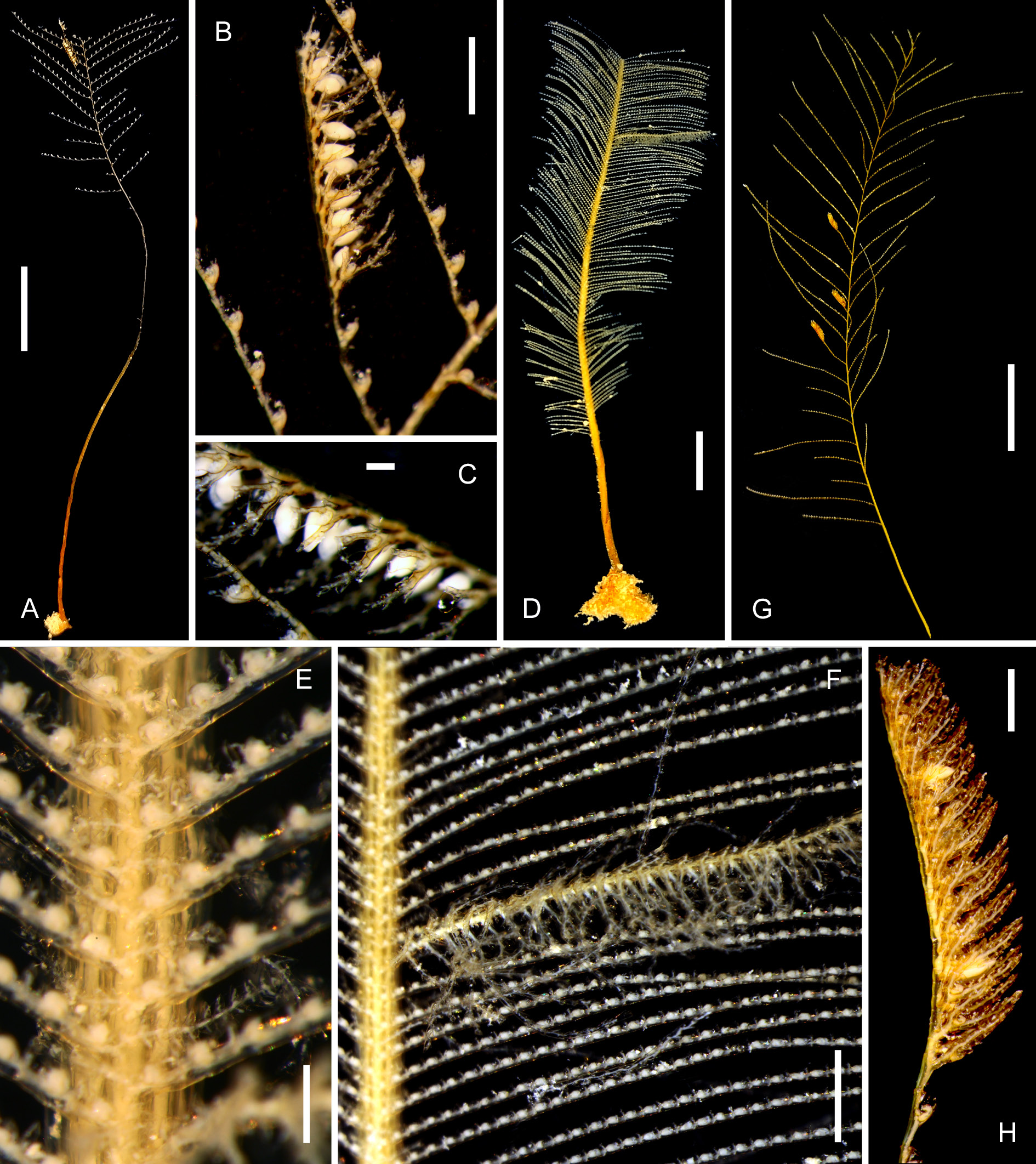
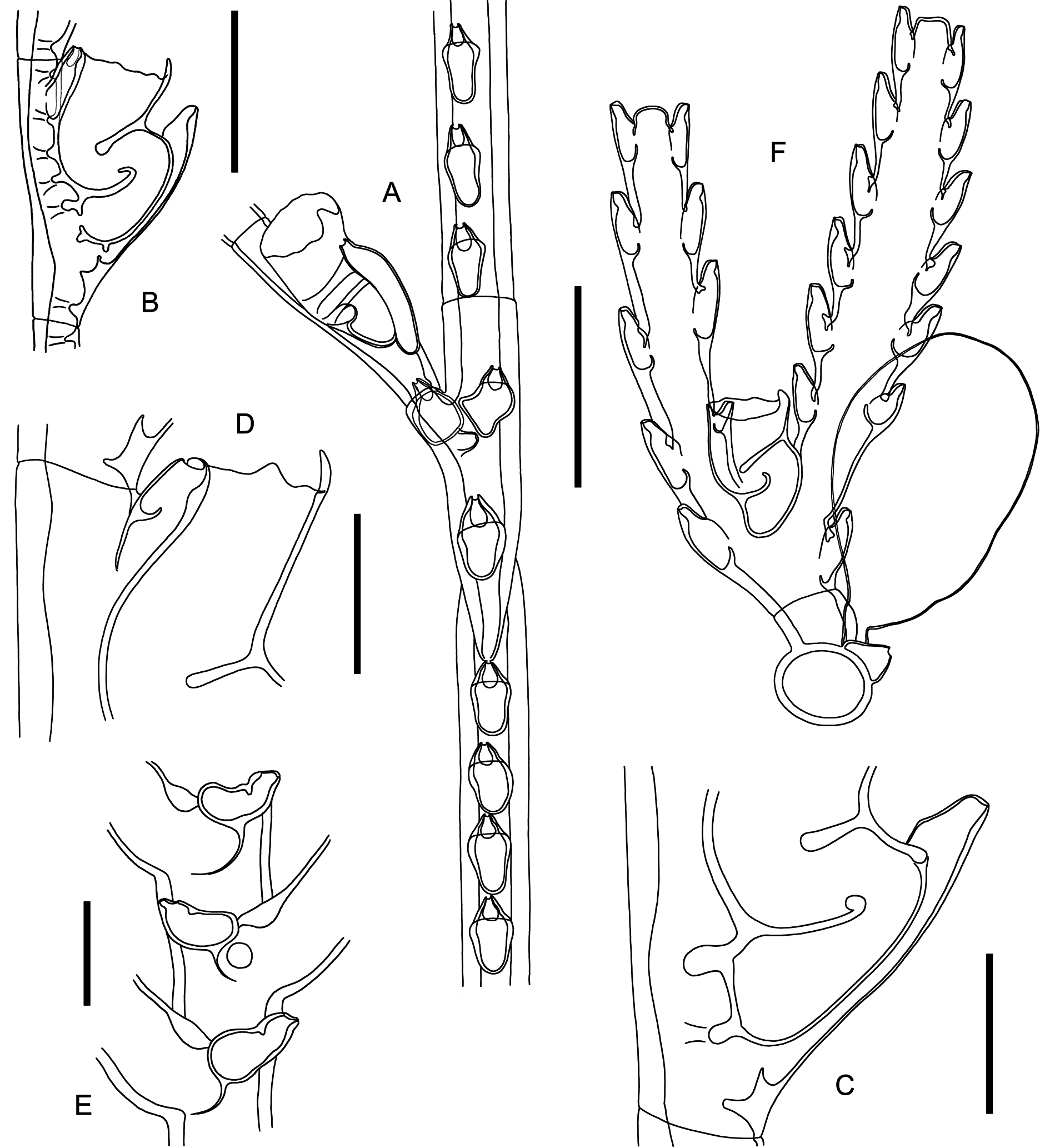
Description Undamaged colonies reaching more than 14 cm high; erect, slender and of delicate appearance, unable to support themselves when out of liquid, though perisarc rather thick throughout the colony; hydrorhiza not seen; stems lightly fascicled, composed of several superimposed auxiliary tubes, each adhering to the dorsal side of the preceding one, not forming a beam around the main tube, but rather resulting in a laterally-flattened structure; a notable deeply-cut, oblique node some distance above the origin from hydrorhiza, passing through all cauline tubes at a time; occasional oblique nodes sporadically along the remainder of stem; division into additional internodes not always distinct, though transverse nodes (170 – 180 µm wide) are more noticeable in the younger parts of the stem, where the perisarc is thinner; each internode 2 – 4 mm long, comprising a frontal row of 4 – 10 saccate nematothecae (with gutter-shaped, adaxial apertures), a short (ca 60 µm) cladial apophysis above carrying basally a conical nematotheca (with small, rounded, apical aperture), as well as an elbow nematotheca (also with guttershaped aperture) lateral to the insertion of apophysis on the internode (fronto-axillar). Basalmost cladia broken off, but arrangement alternate along the longest portion of the stem; up to 3.7 cm long, the two rows shifted on to the anterior side of the colony so as to form an acute angle; cladia fairly distant from one another in each row; divided into rather short (585 – 600 µm) internodes by means of transverse nodes (145 – 150 µm wide), each comprising a hydrotheca and its three associated nematothecae: one mesial and a pair of laterals; hydrotheca 525 – 540 µm deep, strongly S-shaped, with 2 internal septa, one adaxial arising a short distance above the base, and one abaxial given off a certain distance below the aperture from the abaxial wall, both septa protruding at least into the middle of the hydrothecal lumen; internodes with a number of incomplete internal septa: 2 abaxial and up to 5 on their adaxial side; mesial nematotheca long, tubular, adnate for more than ¾ its length, leaving only a short (100 – 115 µm) portion free, provided with a gutter-shaped aperture along its whole free length; lateral nematothecae tubular, 215 – 220 µm long, aperture with rim deeply-scooped adaxially; hydrothecal margin with a prominent, rounded, abaxial cusp, continued on each side by three broad, triangular cusps, the second being the most developed. Gonosome an open corbula borne on a hydrocladium after a sequence of 5 – 18 normal cormidia; rachis slightly geniculate, divided into very short internodes (by means of transverse nodes), each bearing a costal apophysis and an elbow nematotheca lateral to it; costa separated from apophysis by transverse node; costa forked, with a basal hydrotheca (lateral nematothecae lost) in middle; mesial nematotheca situated far below the hydrothecal base, so as to accommodate the insertion of the ‘ anterior’ arm, comprising 5 – 6 pairs of opposite to subopposite nematothecae; a nematotheca on the back of the hydrotheca, above which is inserted the ‘ posterior’ arm, comprising 7 – 8 opposite to subopposite nematothecae; proximalmost costa of a corbula with the mesial nematotheca immediately below the hydrothecal base, not giving rise to the “ anterior ” arm set with nematothecae; all nematothecae elongated, with deeply-scooped adaxial margins. Gonothecae lenticular, with flimsy perisarc, arising from the base of the costal apophyses.
Galea, Horia R. (2020): Aglaopheniid hydroids (Cnidaria: Hydrozoa: Aglaopheniidae) from off New Caledonia collected during KANACONO and KANADEEP expeditions of the French Tropical Deep-Sea Benthos Program. European Journal of Taxonomy 615: 1-47, DOI: 10.5852/ejt.2020.615