
AnimaliaNot EvaluatedacceptedspeciesAccepted
Lytocarpia nigra
(Nutting, 1905)
GBIF:162505299
0year
0
Synonyms
ABOUT
Descriptions(5)
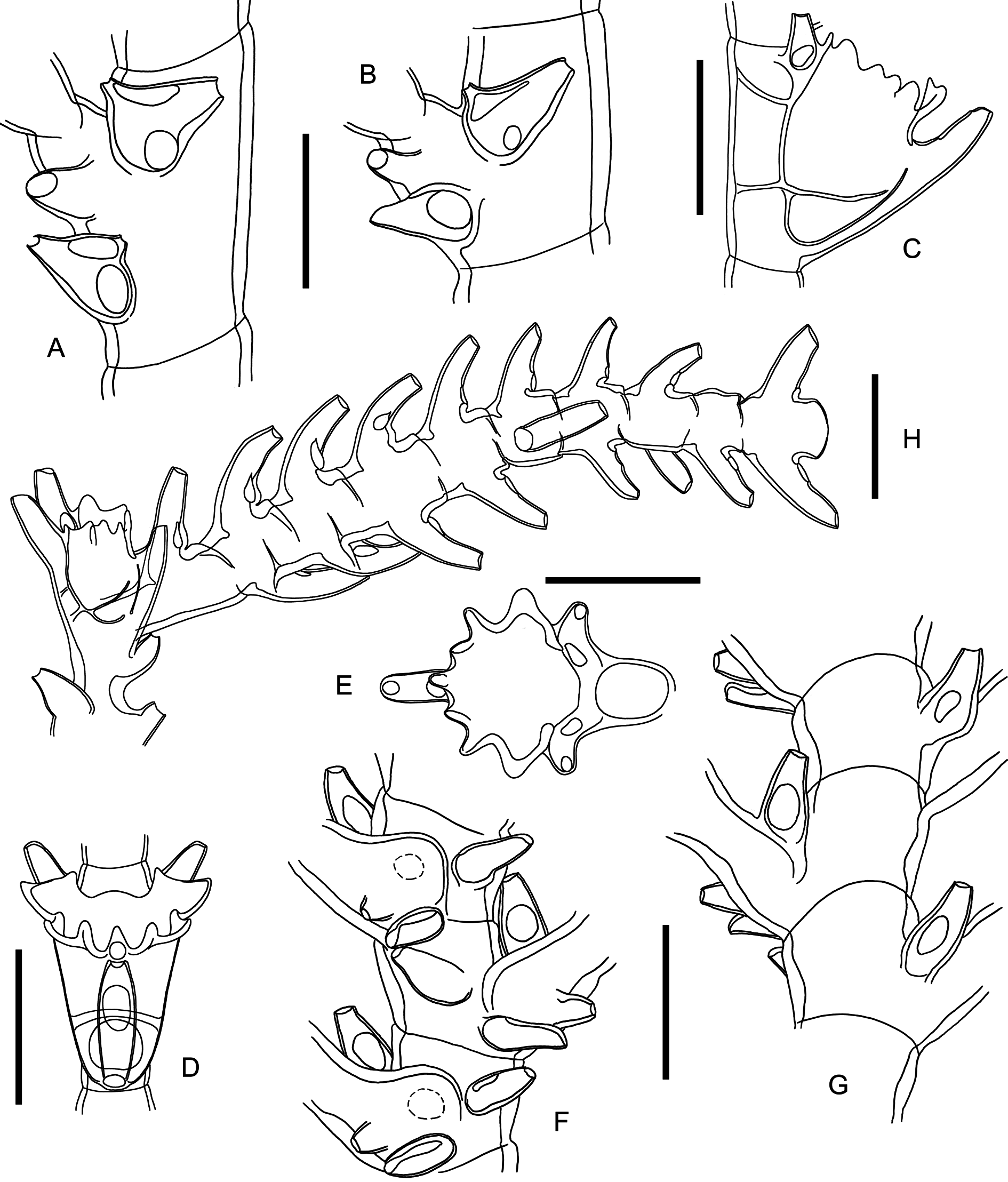
Description Colony erect, with lightly fascicled stem irregularly branched, up to the 4 th order, so as to form an arborescent structure. Stem and branches divided into short internodes by means of transverse nodes. Proximal portion of branches devoid of cladia, but with a frontally-placed nematotheca on each internode. Subsequent internodes bearing alternate cladia, each accommodating a short apophysis and 3 nematothecae: one proximal, below the apophysis, one lateral next to it (axillar), and one conical at the base of the apophysis. Nematothecae on proximal internodes of side branches, as well as the inferior and axillar ones, inverted-triangular in general outline, basally adnate and rounded, distally free and there with a broad aperture with inwardly-curved adaxial wall, giving the impression that two lateral apertures are present. Conical nematotheca fairly developed, with rounded, apical aperture. Cladia close to one another, divided into short cormidia by means of transverse nodes, each cormidium comprising a hydrotheca and its 3 associated nematothecae: one mesial and a pair of laterals. Two intranodal septa are present: one basal, prolonged on opposite side into the hydrothecal lumen as a transverse to slightly upwardly-directed intrathecal septum, and one distal, at base of the lateral nematothecae. Mesial nematotheca arched, long, tubular, adnate for ⅔ of its length, free part almost reaching the hydrothecal rim; a short, spout-like apical aperture, as well as an ovoid one near junction with abaxial hydrothecal wall. Lateral nematothecae rather short, merely surpassing the hydrothecal rim, with circular aperture apically, and large, ovoid foramen adaxially. Hydrothecal rim with 7 cusps: median, abaxial one with thickened perisarc forming a small triangular anterior projection, and 3 pairs of laterals. First cusp narrow and triangular, second (middle) cusp often split in middle, and third (posterior) wide and broadly rectangular. Terminal stolonization often present on tips of branches. Corbula open, up to 9 mm long, replacing normal cladium, composed proximally of a normal cormidium, followed by a short internode bearing a mesial nematotheca, and a succession of up to 70 internodes bearing alternate costae; nodes oblique. Costal internodes short, bearing an arched costa and 4 nematothecae: 3 on ventral (internal) side, and one dorsally (external). Ventral nematothecae: one at base of the costa, another one lateral to it (both elongated and with gutter-shaped apertures), as well as a short, conical nematotheca at the base of the insertion of costa. Dorsal nematotheca conical, with rounded apical aperture and a large, rounded, adaxial foramen. Gonothecae lenticular, with flimsy, transparent perisarc, borne on base of costa by means of short, indistinct pedicel. Gonophores not seen.
Galea, Horia R. (2020): Aglaopheniid hydroids (Cnidaria: Hydrozoa: Aglaopheniidae) from off New Caledonia collected during KANACONO and KANADEEP expeditions of the French Tropical Deep-Sea Benthos Program. European Journal of Taxonomy 615: 1-47, DOI: 10.5852/ejt.2020.615
Fig. 13
Galea, Horia R. (2020): Aglaopheniid hydroids (Cnidaria: Hydrozoa: Aglaopheniidae) from off New Caledonia collected during KANACONO and KANADEEP expeditions of the French Tropical Deep-Sea Benthos Program. European Journal of Taxonomy 615: 1-47, DOI: 10.5852/ejt.2020.615
Remarks As indicated by the specific name, living colonies of this species are characteristically dark colored, due to a black pigment found in the coenosarc. This, however, has been lost in the present alcohol-preserved specimen, but its morphological features match those described earlier (see synonymy).
Galea, Horia R. (2020): Aglaopheniid hydroids (Cnidaria: Hydrozoa: Aglaopheniidae) from off New Caledonia collected during KANACONO and KANADEEP expeditions of the French Tropical Deep-Sea Benthos Program. European Journal of Taxonomy 615: 1-47, DOI: 10.5852/ejt.2020.615
Distribution Hawai’i, Japan, Korea (Schuchert 2015), China (Xu et al. 2014), New Caledonia (present study).
Galea, Horia R. (2020): Aglaopheniid hydroids (Cnidaria: Hydrozoa: Aglaopheniidae) from off New Caledonia collected during KANACONO and KANADEEP expeditions of the French Tropical Deep-Sea Benthos Program. European Journal of Taxonomy 615: 1-47, DOI: 10.5852/ejt.2020.615
Material examined PACIFIC OCEAN • 1 colony, 8.5 cm high, fertile; off New Caledonia, stn CP 4786; 22 ° 46 ʹ S, 167 ° 42 ʹ E; 350 – 469 m; 29 Aug. 2016; KANACONO leg.; MNHN-IK- 2015 - 509.
Galea, Horia R. (2020): Aglaopheniid hydroids (Cnidaria: Hydrozoa: Aglaopheniidae) from off New Caledonia collected during KANACONO and KANADEEP expeditions of the French Tropical Deep-Sea Benthos Program. European Journal of Taxonomy 615: 1-47, DOI: 10.5852/ejt.2020.615
Export occurrence data
Darwin Core Archive (ZIP)
CLASSIFICATION
Taxonomic Classification Tree

MULTIMEDIA
Media Files(1)
Fig. 13. Lytocarpia nigra (Nutting, 1905), from sample MNHN-IK-2015-509. A–B. Two stem internodes, to show variation in the shape of the frontal nematothecae. C–E. Hydrotheca in lateral (C), frontal (D) and apical (E) views. F–H. Rachis of corbula in frontal (F) and dorsal (G) aspects, and costa (H). Scale bars: A–H = 200 µm.
Imageimage/png© Galea, Horia R.Galea, Horia R.
IMAGES